


And don’t miss this weekend’s FREE Deep Dive on Trump Iran blockade and lessons learned from the American Civil War.

This analysis is free, but with Premium Membership you get MORE. Join today.
Our full discussion transcribed after the break:
by Rod D. Martin
August 24, 2026
I appeared on NTD Newsroom with Arleen Richards to discuss how Beijing’s illicit bargain crude unfairly subsidizes its factories to drive American businesses under, all while keeping Tehran alive. Trump’s Economic D-Day targets both advantages at once.
Arleen and I discuss:
Why China is Iran’s primary economic lifeline
How bargain oil gives China an unfair advantage that destroys American jobs
Why China’s demographic cliff makes every subsidy count
How America controls Beijing’s vital energy chokepoints
Why Russia cannot rescue Iran through the Caspian
Why Tehran may be nearing its breaking point
It’s 16 minutes of deep analysis explaining this incredibly complex issue. Watch the interview, and pass it along!
Nothing matters more than educating the next generation with the values we cherish. The Herzog Foundation is making that possible. Learn more here.
Our Full Discussion:
Arleen Richards: President Trump is threatening countries that give the Iranian regime an economic lifeline in a new phase of the Iran War.
Joining us now is Rod D. Martin, geopolitical analyst and founder and CEO of Martin Capital. Rod, good to see you.
Rod D. Martin: Good to see you, ma’am.
Arleen Richards: Let’s start with 2025 data from Kpler Analytics, which tells us that China buys more than 80 percent of Iran’s oil. Is the President’s Economic D-Day threat primarily directed at China?
Rod D. Martin: That’s definitely part of it. Nobody is more affected by this than China, because what we’re talking about is secondary sanctions. I don’t know how you could put many more sanctions on Iran itself.
There are some things we can do to clamp down further on their shadow-banking apparatus and their ability to stash public money in private offshore bank accounts. There are still some levers we have there. But the real lever is eliminating the people who are enabling them in the first place.
And no one does that more than China, which is especially galling in part because Xi Jinping promised the President of the United States, in their May summit in Beijing, that he’d quit it. But he hasn’t. So yes, China is probably the primary recipient of this, ultimately.
And you’re right to point out the oil. Eighty percent, sometimes as high as 90 percent, of all Iran’s oil exports go straight to China. That’s a huge benefit to China. It’s not just that they’re buying some oil from Iran that they could buy somewhere else. Wrong.

What they’re buying from Iran, they’re getting at a steep discount. That’s a huge subsidy to the Chinese economy, which directly translates into their ability to unfairly compete with U.S. and European industry. Every drop of oil that flows from Iran under those conditions to China is a dagger at the heart of American and European workers. The President is going to cut that out.
We have actually allowed a lot of Russian oil to flow during this conflict to keep global oil prices somewhat stabilized, and we’ll probably continue to do that a bit here and there when it makes sense. But the truth is, WTI is about $85 a barrel this morning. That is not dramatically worse than it was in February. The scaremongering about $250 oil simply didn’t come true, and it’s not going to come true.
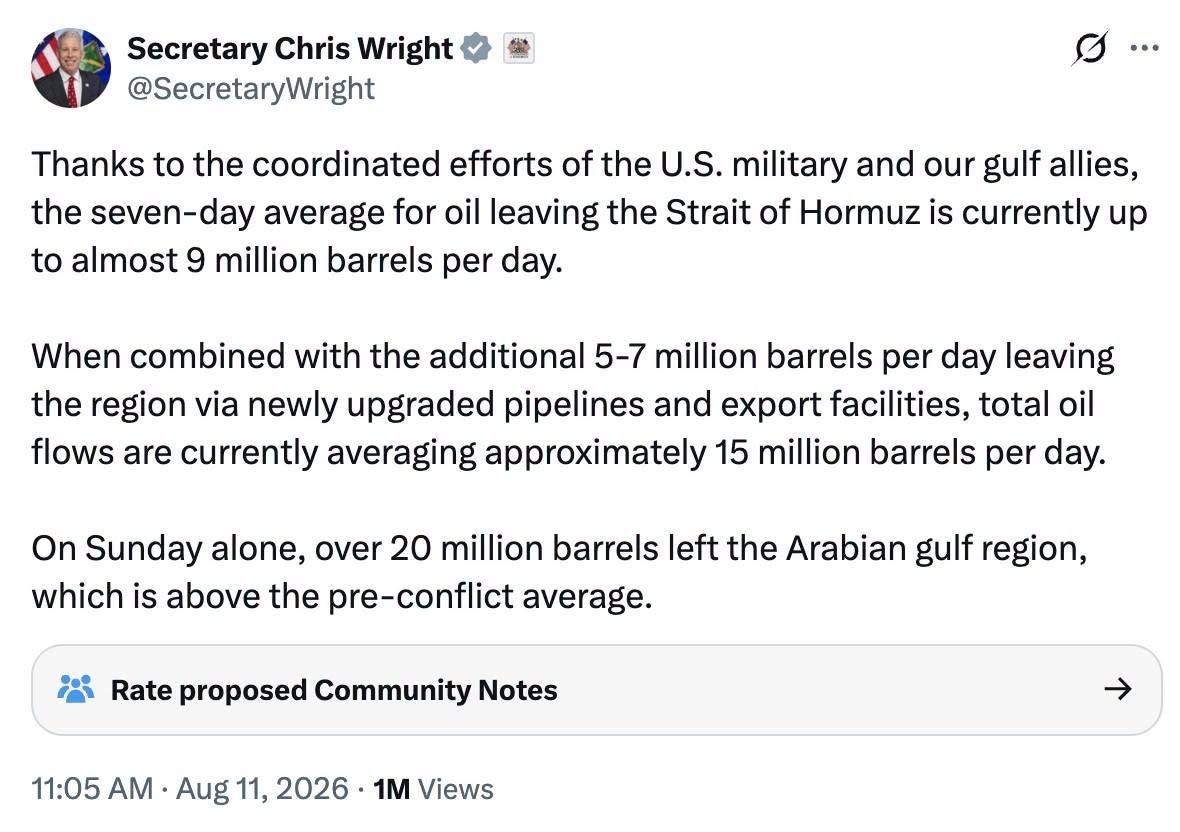
We are now escorting between 10 and 20 million barrels a day through the Strait of Hormuz, and there’s not a thing in the world Iran can do about it. This is definitely the President’s game to lose, and he ain’t losing.
Cheap Oil and China’s Demographic Cliff
Arleen Richards: You talk about the discount China is getting, but we’re seeing a lot of reporting on China’s slowing economy. How important is this Iranian oil to China’s economy?
Rod D. Martin: It’s important precisely because of that. They need to prop up their economy every way they can, and part of that is reducing the cost of inputs, certainly above all else energy, because they are highly dependent on imported energy.

They’re the world’s largest importer of energy, which is a nice change, because that used to be us. Now we’re one of the very top exporters. We outproduce Russia and Saudi Arabia combined now, and we’re going to significantly increase energy production over the next five years.
China is in the boat we were in during the 1970s, and that directly pertains to how able they are to come out of this slump. In my view, they might in the short term, but they’re not in the long term, because, as you and I have discussed before, China faces a demographic cliff.
They have a total fertility rate that’s now about 0.92. You need to be at 2.1 just to replace your current population. They are looking to stabilize in the neighborhood of 0.8, and if that should happen, they lose 75 percent of their population over the next century, with the harm front-loaded starting in the next decade. You’re losing working-age people before you lose the elderly, and that tiny, tiny number of young people has to support that vast sea of old.
The Chinese economy is in bad shape. As you see population declines, you will see increasingly negative pressure on real estate, which is where most Chinese consumers have invested most of their money. So every little bit matters.
This oil situation dramatically harms China’s ability to unfairly compete with U.S. and European manufacturers at a moment when they desperately need to double down on exports to float the economy they have.

Arleen Richards: Speaking of exports, could you see China replacing this Iranian crude with oil from other suppliers, like the United States, or would doing so significantly raise its costs?
Rod D. Martin: Yes and yes. They’re going to have to switch supply to some degree, but they’ve been hesitant about doing that from the source you would expect.
Vladimir Putin went to Beijing a week after Donald Trump did and, hat in hand, begged Xi to authorize this new pipeline from Siberia into China. For the umpteenth time in a row, Xi said no, and at the same time authorized a bunch of LNG purchases from the United States.
I think what you’re seeing is an increasing realization in Beijing that, at least for the time being, they want to get out of this box. They’re talking about building nine aircraft carriers. They’re certainly not going to be less of a threat anytime soon. That’s not my point.

But they do understand that we absolutely control the Strait of Malacca. We presently control the Strait of Hormuz. Eighty percent of their energy flows through those waterways. So if you can’t beat them, join them.
If they actually buy U.S. supply, the net result is that it reduces their trade deficit, or in their case their trade surplus, with the United States. That makes Donald Trump happy, brings down tariff rates, and allows them to export more.
If they get very serious about that, they might be able to partially compensate for the loss of the steep discounts on Iranian and Russian oil. They would certainly have a better trading relationship with the world’s largest consumer market, which they desperately need just to prop up their export-driven economy.
Chokepoints, Taiwan, and the Xi Summit
Arleen Richards: President Trump is expected to meet with Xi Jinping next month. Do you expect the President to use economic pressure on Iran as a leverage point in those talks?
Rod D. Martin: Oh, there’s no question. How that’s phrased will very much depend on how much the President wants to allow Xi to save face. They’re very mindful of the Asian cultural aspects of this. This isn’t their first rodeo.
But the bottom line is that all of these different pressures work together. The Chinese are pressuring us in terms of the arms sales we’re planning for Taiwan. They let it be floated that they’re going to ship MANPADS to Iran. MANPADS is a shoulder-fired surface-to-air missile. That obviously is something we don’t want to happen.
On the other hand, China has denied that that’s happening, and they promised the President that they wouldn’t do that back in the May summit. So they’re jockeying against the Taiwan situation. We’re jockeying on some things as well, and all of these things will come to a head there.

My guess is the September summit will probably go well. I think we’ll be closer to a permanent trade deal at the end of it. In the short term, we’re probably going to have a pretty strong trade deal, which is good for China and good for the United States, so long as they’re not allowed to dump and use other unfair trade practices to undermine American industry.
How Trump Turns Pressure Into a Deal
Arleen Richards: Let’s say the United States sanctions China over Iran or gives it a more direct ultimatum. How might China respond?
Rod D. Martin: That makes it a little dicier, doesn’t it? There is a very real possibility that we see that, and it could potentially blow up the summit. It might not happen in that case. But I don’t think so.
My guess is this will be handled in the typical way we see the President do it. In the Canada segment you ran just before I came on, the President threatened them with a 50 percent tariff on a wide range of Canadian goods. On offer is a reduction of our tariffs on them to the lowest level for any foreign nation, in addition to them eliminating a bunch of unfair tariffs on us, such as their 280 percent dairy tariff that blocks our farmers from selling cheese in Alberta. That’s just crazy. We shouldn’t have to put up with that. The Canadians have agreed to what can only be called a breakthrough. We’ll see if it lasts.
[NOTE: It did not. Since this aired on Friday, Canadian Prime Minister Mark Carney announced that though he agrees with the U.S. position, he doesn’t like America’s attitude. Pride goeth before a great fall. — RDM]
So you get to a fairer setup where everybody has access to each other’s markets. Everybody has an opportunity to compete fairly. The best man wins.

But to get there, you’re actually going to have to solve some of these issues. Again, the Iranian oil situation is not just about Iran. We can clamp down on that oil by blockading their ports, which we’re doing successfully. We can achieve that.
This is jockeying ahead of the summit, in large part because the President wants to make clear: We can do things you can’t deal with if you won’t play ball, and we can do things that make us all rich together. Pick one. That’s his strategy everywhere in the world.
Russia’s Caspian Lifeline Is a Trickle
Arleen Richards: Let’s switch gears a little bit. The United States can’t enforce a naval blockade in the Caspian Sea, where Iran shares a maritime border with Russia. Could Moscow use that route to provide Iran with an economic lifeline, and could Washington stop it?
Rod D. Martin: There’s a limited degree to which they can, but there simply isn’t enough shipping on the Caspian Sea to make up for what’s being lost at Hormuz. The math just doesn’t math, as they say. There aren’t enough ships, and it takes a while to build a ship. You’re not going to do that in a week or a month or even a year.
So no, they can’t, but they can relieve some pressure. And yet, what did we just see? Just a few weeks ago, [Ukrainian President] Zelensky bombed a Russian freighter in the Caspian Sea, preventing an arms delivery to Iran.
We have demonstrated a capability, not just our own but through allies, to interdict that kind of shipping, even to the degree that it can exist. It really can’t possibly replace what they’re losing.

The same thing is true for railroads. There is a rail line from China to Iran. They have been using it. But compared with the flood of the Persian Gulf, it’s a trickle, and you can’t expand it fast enough to make any real difference.
On point after point, no, this won’t solve their problem. Also, all of those things are vulnerable to attack, either by Ukraine or by us. We can blow up the bridges that cross in from Turkmenistan. We can interdict the roads coming in from Pakistan. We can pretty well shut this down to the degree the President chooses to.
Dismantling the Shadow Fleet
Arleen Richards: What should we be watching for to tell whether China and Russia are distancing themselves from Iran or helping Tehran circumvent U.S. pressure?
Rod D. Martin: First and foremost, the President is monitoring that incredibly closely. The Pentagon is all over that. The intelligence community is all over that. We want to know exactly who’s doing what when, and I don’t think anything is slipping by.
What do we need to watch? Those Caspian Sea shipments definitely top the list. China’s willingness to continue using the Shadow Fleet to import oil is worth paying attention to. We don’t wish to interdict anything that is actually Chinese-flagged, if we can help that. But we don’t have to.
The Shadow Fleet, which has carried all of this illicit, sanctioned Russian, Iranian, and Venezuelan oil for years, is kind of going away. Not least because the Ukrainians have now blown up about 140 of those tankers themselves, which is really quite remarkable for a country that doesn’t even have a Navy. We’re kind of impressed with what they’re achieving.
Then we have allied powers all over the world, even tiny Belgium but also giant India, that have been interdicting these tankers, seizing their cargoes, and making it basically uninsurable.

These are things we’re watching, but we’re also clamping down. That is a system that’s just going away. China might as well get with the program.
Iran’s Breaking Point
Arleen Richards: Finally, let’s look at the broader picture. Does Iran’s economy have the resilience to withstand this pressure, or is the regime closer to a breaking point than it’s letting on?
Rod D. Martin: If they were a democracy, they’d have already surrendered. There’s just no question. It is a catastrophe.
The currency is effectively worthless. The banking system has collapsed. They can’t earn revenue. They are, like Russia, a gas station with a country. If we’re clamping down on their shipping, if we are blockading their ports, they’re not getting anything in or out.
Meanwhile, they are having to pay to import gasoline and diesel, which they’ve never had to do, obviously, because they’re one of the world’s biggest producers. All of a sudden, the pressures are getting really, really tremendous.
The only thing saving them, really, is that they have these mullahs at the top who simply do not care about the suffering of the people. They mean to win, and by win they mean outlast Washington’s attention span.
Historically, that hasn’t been a bad gamble. Certainly the Viet Cong succeeded in that. Certainly the Taliban succeeded in that. They’re not going to succeed in that against Donald Trump.
They can’t afford the $500 million a day they’re losing every day the blockade continues. At some point, you reach the point at which you can’t pay the enforcers anymore. And at some point, a bunch of unpaid, hungry IRGC thugs are actually going to have to find a way to get some food on their families’ tables. That’s where the regime comes completely apart.
I don’t know if that’s tomorrow, next Tuesday, or next year. But I think that’s what the President is aiming for.
I don’t think you get to a general peace in the Middle East short of taking the head off this snake. Iran has armed, directed, and funded every armed conflict in the Middle East that is currently ongoing. And Donald Trump means to end it.
Arleen Richards: I think we’re all waiting to see when there is going to be a breaking point in Iran. There are some tough people. But thank you so much, Rod D. Martin, for being here and for your insights.
Rod D. Martin: Thank you.


