



This analysis is free, but with Premium Membership you get MORE. Join today.
Our full discussion transcribed after the break:
by Rod D. Martin and Frank Gaffney
September 29, 2026
My latest interview on Securing America with Frank Gaffney. Sign up NOW for Frank’s Rumble channel and don’t miss a single episode!
Frank and I discuss:
What Trump’s economic record gives Republicans to run on.
Why turnout will decide the midterms, and what to do about it.
Negotiating with China while building allied strength in Asia.
Why perpetual rights in Greenland matter far beyond the Arctic.
What Diego Garcia teaches us about depending on the goodwill of strangers.

It’s 20 minutes of in-depth analysis you won’t want to miss. If you prefer to read, the full transcript is below. Watch, read, like, and share!
Our full discussion:
Frank Gaffney: Welcome to Securing America with me, Frank Gaffney, the program that’s a kind of owner’s manual for protecting the country we love against all enemies, foreign and domestic, to the glory of God and His kingdom.
As you know, if you are a listener to this program of any duration, I consider one of the glories of God being my friend and colleague Rod Martin, who, among other things, is the chairman of our Institute for the American Future. He is also a serial entrepreneur, dating back to some time with the PayPal mafia in its early days, and also as Policy Director to then-governor of Arkansas, Mike Huckabee, now the U.S. ambassador to Israel.
He is also the, well, the prime mover behind a wonderful online resource now of great thought and intellectual heft. It’s called the Rod Martin Report, and you can find it at RodMartin.org. Rod, it’s good to have you back. Welcome, my friend.
Rod D. Martin: Great to be here.

Frank Gaffney: I know you haven’t had a chance to take aboard the president’s address to the U.N., which, as we speak, just occurred. I wanted to give you a little bit of the sort of takeaways from it that I had and ask you to sort of respond, if you would, just viscerally, I guess, as much as anything. He, of course, used the platform as an opportunity to talk about the state of the United States, as well as the world. And he did a bit of a victory lap, I think it’s fair to say, talking about some of the accomplishments of his administration. You have done a wonderful job.
I think you’ve actually got 25 different achievements on a list, a running list that you have at the Rod Martin Report that is really to not only the president’s credit, but also to the great benefit of the country. He obviously isn’t done yet. There’s more to come. But just a quick appreciation, sir, if you would, of where you think we are midway through the president’s term.
Rod D. Martin: Well, our top 25 list doesn’t begin to cover it, although it’s gotten a lot of play. I mean, everybody from Roger Stone to Dan Bongino has been, and Victor Davis Hanson, who’ve been pushing the list. So good for them. We had to do a 25 more list. I’m about to have to release another 25 more list.
For example, we are now at the lowest poverty rate in the history of the United States. The lowest poverty rate in American history. We are now at the highest median income in American history. It is extraordinary and all the more so in comparison to our various allies. 15 years ago, the European Union had a larger economy than the United States.

Today, it’s just two-thirds. Canada, which is playing footsie with the Chinese and pretending they’re going to be an associate member of the EU, something which doesn’t even exist. All Canada has to show for its record is stagnating wages, rising costs. 45% of its population, either foreign-born or the children of foreign-born, and, wait for it, with the same population as California, half of California’s economy, which would be bad enough if it weren’t that California is the most mismanaged state in the United States.
So, no, Trump has a lot to crow about. And this Greenland deal that we’re going to sign today is just extraordinary. We can get to why in a minute.
But the president has every right to not just crow, as the media will put it, but to reprimand those who have taken the socialist path, who have put all their resources into their welfare programs and not into basic defense of their own countries, not into productive research, not into innovation and entrepreneurship, they should all look at what we’ve achieved here and honestly be ashamed. There’s not a single country in Europe that isn’t poorer than our 50th ranked state, Mississippi. That’s ridiculous. And that’s got to change.
Frank Gaffney: Rod, a lot to unpack there. Just, I guess, to put it baldly, this is all taking place, of course, the president’s address, the various responses that will be forthcoming, you can be sure, in the context of an election here in the United States within a little over a month. Talk to me about whether the president is likely to get credit for the record economic performance you’ve just discussed, or whether the narrative, you were mentioning the media, some of them now no longer allowed in the White House, by the way, putting the most negative spin on everything they can.
How is that likely to sort, do you think, if it is, as Carville says, the economy is stupid that governs in elections?
Rod D. Martin: Well, Carville was saying that in a presidential cycle, and this is a midterm. Midterm elections are historically low turnout. In 2022, turnout was down from over 60 percent two years earlier to just over 40 percent. So that’s a pretty big drop-off.
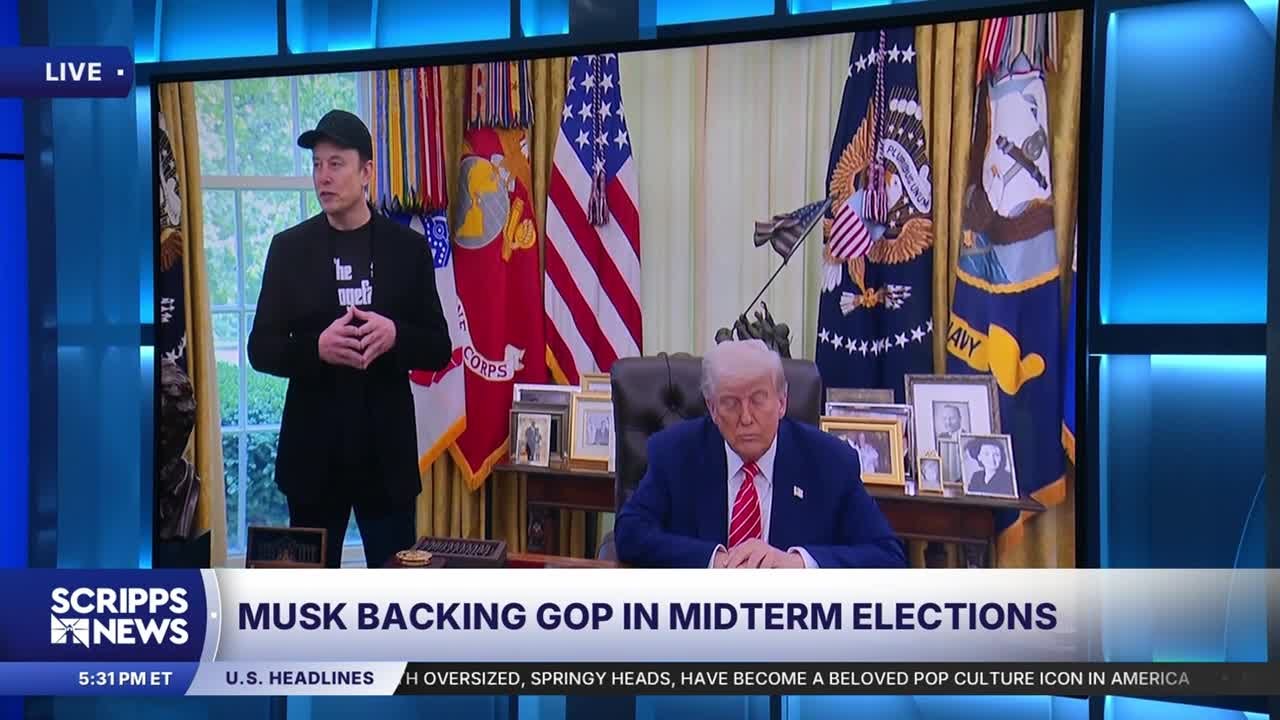
And what it means is the narrative almost doesn’t matter. What matters is turnout. And where we are right now is Donald Trump has $400 million in his super PACs. The RNC is flush with cash. Elon’s saying he’s going to spend hundreds of millions of dollars on this. And the Democrats are trying to figure out how they’re going to pay for a turnout operation at all.
So I don’t think it’s going to be as much about narrative, except in this one respect: if individual conservatives will take responsibility for the direction of the country — which they almost never do — if conservatives will take responsibility and not just wait on some politician somewhere to tell their story, if conservatives will go talk to their friends about, look, here’s what you’re not being told. Here are the amazing things that are actually happening. Here’s why I’m going to pick you up on the first Tuesday in November and drive you with me to the polls. Until conservatives do that, we’re going to lose. If conservatives will do that, we’re going to win.
And the next two years will be better than the last two in every possible respect.
Frank Gaffney: And it goes without saying that if that doesn’t happen, the next two years are going to be messy.
Rod D. Martin: Well, yes, messy, but not a disaster. Because if the Democrats run the House, I don’t see any math by which they’re likely to take the Senate. But if they take the House, they’ll impeach the president five more times. And, you know, they’ll investigate everybody’s pets. They’ll do all the things they’re going to do.
They’re certainly not going to legislate in any way that is helpful. And the president’s just going to veto whatever they do if it survives the Senate. But that’s not the same thing as preventing Donald Trump from doing his thing. And I’ve been saying again and again this year, if you think Donald Trump didn’t plan for a midterm defeat, you’re crazy.

Because the odds are always against the president’s party in the midterms. The president’s party has only won about three of those in the last century that, you know, the odds are against it. So Trump has planned for having a hostile house and he has an agenda that will survive that.
But it would certainly be better if we could do the on-steroids version that actually, actually solves a lot of America’s deep and lasting problems by having a house and a Senate that can actually get work done. And by the way, hats off to Donald Trump on that.
One of the achievements that didn’t make the top 25 list, but probably ought to be number one, is he has cleaned up huge chunks of the Republican Party. A lot of the RINOs are now gone because he took them out in their own primaries earlier this year. So if we elect the guys we nominated, like Ken Paxton, we’re going to have a dramatically improved product in the Senate as a result. And that will be a game changer.
Frank Gaffney: Well, it very much remains to be seen. I have to say, very apprehensive of two years of indictments and investigations and all the rest of it taking the nation’s eye out.
Rod D. Martin: Oh yeah, that’ll be super fun.
Frank Gaffney: That’s not going to be a happy thing. We have to take a short break. Rod Martin is in the house. He’ll be with us on the other side. And we’re going to talk about China or China, as Trump used to say. What’s to come of this summit? And what must we be doing about China? All of that and more straight ahead.
The China Summit
Frank Gaffney: We’re back. And so is the great Rod Martin. We’re going to come back to him in a moment and get his thoughts about the upcoming summit. But I want to give you a little bit of context of my own. It’s ominous that the U.S. Air Force has decided to shut down its small but highly valued team monitoring Mandarin language information about the rapidly growing threat posed by its Chinese counterpart.
Is the closure of the China Aerospace Studies Institute and apparently its Navy and Army counterparts part of a wider effort to appease the Chinese Communist Party during Xi Jinping’s state visit here this week?
Our Committee on the Present Danger of China will be critically examining such prospects in the course of a two-hour special this afternoon on Steve Bannon’s war room program. What’s clear, though, is that the U.S. military needs more and better insights into the evolving Chinese menace. And Xi needs to be disillusioned of any notion that we will unilaterally disarm in his long-running unrestricted warfare against America, which must end now.
Well, those are some of my thoughts about both the summit and sort of the environment. And we’re going to talk with Rod Martin about what he thinks is likely to come of the summit.
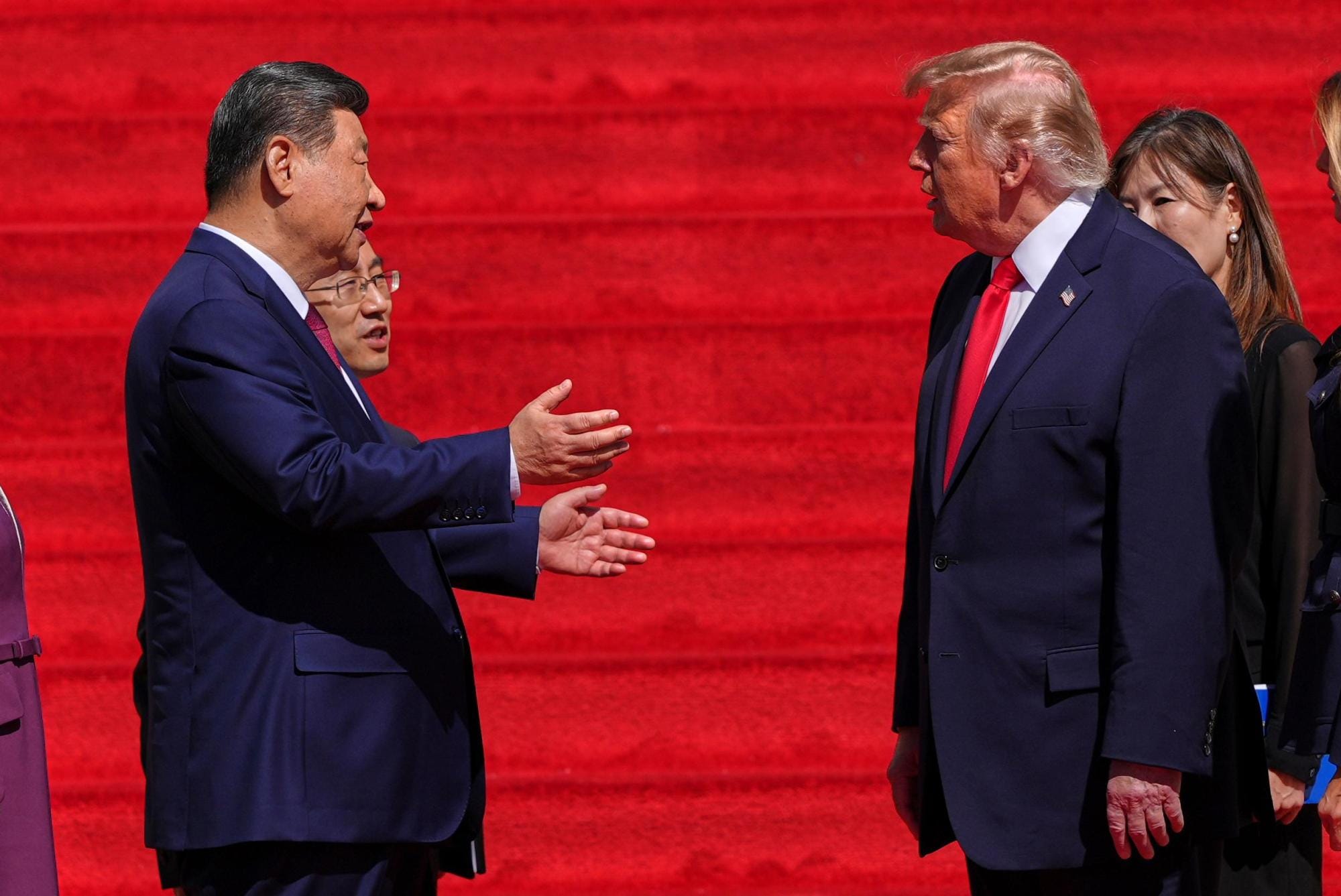
And we’re also going to talk about some steps that the president has recently taken very, very impressively with respect to his interests there in Greenland, not least informed by what the Chinese are up to in the neighborhood as well.
Rod, first of all, thank you again for joining us and for the great work you do at the Rod Martin Report. I’m anxious to get your thoughts on how the president is likely to play this summit meeting with Xi Jinping.
Rod D. Martin: I think we’re going to have a good summit. We’re not going to solve all the world’s problems and we’re not going to get to a permanent trade deal with China, which, by the way, is not because Xi is stalling. It’s honestly mostly Trump. And the reason is very simple. We are making life harder for the Chinese just about everywhere. I don’t know exactly what to make of the Air Force thing. That may just be getting folded into another agency and may just be a show thing leading into [unclear]. Who knows?

I don’t have enough information on that to say, but I know this Xi Jinping has no illusions that we have turned Luzon into a veritable fortress of missiles that they have managed to unite what amounts to an Asian NATO against themselves from India through Indonesia to Australia, to the Philippines and Japan.
And all of this is resulting in meaningful action. The Japanese and the Koreans are now transferring escort vessels to the Philippines, selling a significant number of advanced frigates to Australia, which significantly improves their capabilities. We’re bringing on a nuclear shipyard.
We certainly need two more of those in the United States, but we’re bringing one online in Perth, Australia, where the Australians are going to be building Virginia-class submarines and eventually the new AUKUS-class.
But for now, we’re going to sell them three Virginia-class of the one of the earlier blocks, not not the new ones that are going to be classed SSGNs that dramatically increases the potency of the alliance arrayed against China. And honestly, Xi Jinping has no one to thank for that but himself, his hostility, particularly toward Taiwan and the Philippines is off the chart.
So every day that passes that we have an interim trade deal is a day we get closer to self-sufficiency on rare earths, not just the United States self-sufficient, but our allies collectively. It’s another day that we get closer to reactivating those bases in our former UN trust territories that are now, you know, in compacts of free association with us. All the things that we need to do to be able to contain China behind the first island chain are happening more and more by the day.
And when we get to the point where we are ready to negotiate a full and permanent trade deal, as if any deal is permanent, when that day comes, we’ll be from a position of much greater strength. So Xi Jinping’s only hope here is to beat us in the 2028 election. That is the only way this improves for China. And I’m not saying it’s all roses. I’m saying they’re more dangerous, weak in some respects than they are strong, because if they’re weak, they may feel like they need to break out of the box. I totally get that.

I think the threat is extreme, but at the same time, you don’t deter a threat by not taking the steps necessary to provoke that. Reagan did in the 80s. Trump is now.
Greenland and Long-Term Security
Frank Gaffney: Yeah. We’ll be monitoring this closely, as I know will you, Rod, and we look forward to comparing notes as it goes. But before we leave you today, do tell us a little bit about this deal with Greenland and how it ties into the president’s hemispheric security aspirations and, well, the Arctic and the threat we faced from that quarter by both the Russians, of course, as well as the Chinese.
Rod D. Martin: Well, Greenland is about much more than hemispheric. I mean, first of all, obviously, it’s vital for Golden Dome. Obviously, it’s vital to control the Greenland-Iceland-UK gap. That’s why we occupied Greenland and Iceland during World War II, to prevent U-boats from coming through in greater numbers than they could get away with if we had those positions. You know, and if a Northwest Passage should become available, which I find dubious, but let’s just say it does, we need to control those waterways.
So that’s all good. That’s all important. But that’s not really what happened here.
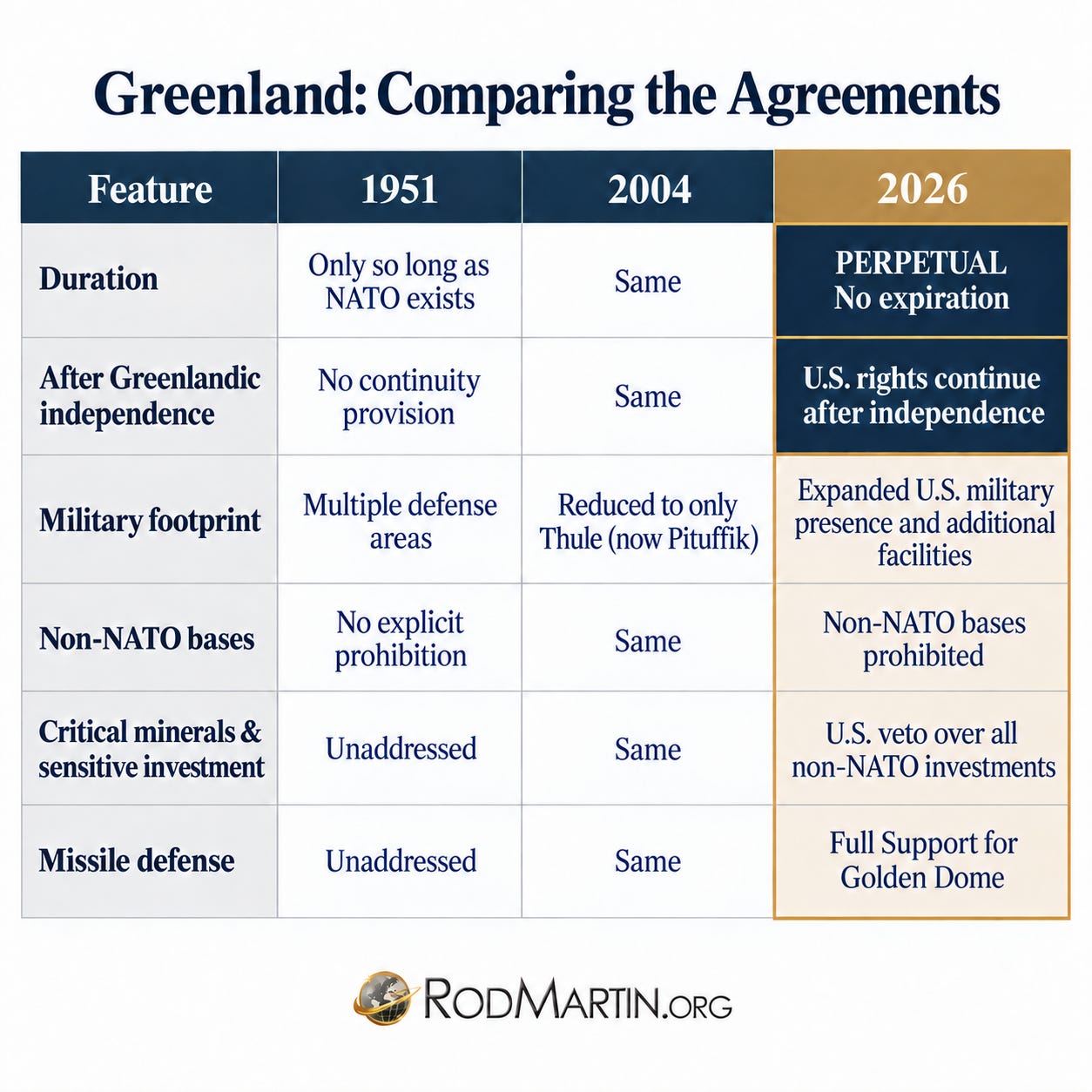
What happened here is a sea change in U.S. foreign policy that is no longer Pollyanna about the stupid idea that alliances are permanent and nations are friends. Nations don’t have friends. They have interests. Sometimes those interests align. If they do, maybe you can be allies for a while, maybe a long while.
But the truth is, the British taught us the lesson with Diego Garcia. By flirting with handing the most important base we have, one we are supposed to have in semi-perpetuity to a Chinese client state. And Trump had to act forcefully to slow that down or stop it. We demonstrated completely that just because Denmark is an ally today doesn’t mean they will be tomorrow.
Their own government has shown that Denmark committed monstrous human rights atrocities in Greenland. And those reports just came out a few weeks ago. So that’s top news in Greenland. And, of course, Greenland may become independent. None of the deals we had prior to today accounted for any of those eventualities, including the possibility of Denmarkistan. None of that is contemplated in the old agreements.

The new one is perpetual in duration, survives the dissolution of NATO, survives the dissolution of the bonds between Denmark and Greenland, survives everything. And that’s essential, not just for Greenland, but for all of our key bases around the world. That’s what we’re signaling. We know you’re our ally today.
You ought to stay our ally, but we’re not going to count on you staying our ally.
Frank Gaffney: Rod, you know, this is all the more extraordinary because months ago, maybe even last week, the conventional wisdom was that Trump was delusional that everyone stood against this idea that the United States would have, well, a fraction of the kind of authority over Greenland that it will now have with the signings today, as we speak, of this deal. Again, a credit to the president and to his willingness, if I could use the expression, to break china in order to get things done.
Rod D. Martin: Absolutely. And look, the bottom line here is Trump is planning for a future that is uncertain. And American presidents for too long have planned on a future where everything stayed the same. This is one of our main criticisms about presidents during the Cold War who just assumed the Soviet Union would last forever and could never be defeated. Reagan refused to take that position with tremendous results for the world. And Trump is following that example.
Frank Gaffney: I pray so. And I hope that will be the case in this summit. We will see. Rod Martin, thank you so much for your insights as always and for sharing some of your time. We appreciate it tremendously. God bless you. We’ll be right back, folks, with Trevor Loudon right after this. Stay tuned. We’ll be right back, folks.


