



NOTE: Europe chose to get in bed with its enemies. It filled its cities with military-aged male Muslims who hate it. It made itself dependent on Russian energy while shutting down countless power plants and oil fields. Since the beginning of the Ukraine war, during which it has ceaselessly saber-rattled and hectored the U.S. to “do more”, it has literally sent twice as much money to Moscow for energy as to Kiev in aid.
And then there’s China.
Donald Trump warned the world that China was a predator, exporting its deflation and overbuilding its industrial plant to drive all legitimate competitors under and thereby dominate the consumer markets it lacks at home. The Beltway refused to hear that message, but the American people heard it loud and clear. Brussels was more obstinate than either.
Now, the awakening. It’s not too late. But it’s awfully late.
One of my all-time favorite writers, Ambrose Evans-Pritchard, explains. — RDM

by Ambrose Evans-Pritchard
June 4, 2026
Europe’s leaders are waking up to the terrifying danger that China could obliterate much of their industrial base within less than a decade, shattering the old political order and the EU project itself.
The Rhodium Group says the Chinese Communist Party is digging in its heels, doubling down on a strategy of systemic over-investment and over-reliance on exports that cannot be absorbed by the rest of the world, and certainly not a Europe already in semi-slump.
The original “Made in China 2025” plan a decade ago targeted a clutch of specific technologies. Beijing is now expanding this into an “industrial policy of everything”: cars, machinery, chemicals, pharma, software, AI, you name it.
China is pursuing this ruthlessly, aiming to capture a larger share of global value added with vertical control of the entire lifecycle.
It is moving towards autarky in its home market while undercutting the West in its own market and in third countries — everywhere and in every product. It devours foreign technology without releasing its own. The Rhodium Group said the foundations of G7 manufacturing are under comprehensive threat.
The “China Shock 2.0” is bigger and more sophisticated than the original China Shock in the 1990s and early 2000s, which flooded the world with cheap goods and wiped out swathes of blue-collar manufacturing in the West.
America bore the brunt of the first shock. The pauperization of the Midwest Rust Belt set the stage for Donald Trump.
As much as China must have access to the giant U.S. consumer market, this time China can’t easily dump its excess capacity on the U.S. because of Trump’s trade barriers. The tsunami is instead being displaced into the softer target of Europe. It is hitting with even greater intensity. China’s trade surplus hit a record 1 percent of global GDP last year. No country has ever reached such an imbalanced position in modern economic history.
“Every day, China posts a €1bn trade surplus with the EU. If we do nothing, by 2027, our trade deficit will reach €500bn. That is not economically sustainable,” said Stéphane Séjourné, vice-president of the European Commission.
“We can’t let Europe be the victim of a predatory strategy that is destroying our industry,” he told Le Monde.
Communist China is pursuing more or less the same policy of autarky and one-way trade as the Qing Dynasty in the 19th century. In that era it sucked up the world’s silver. Today is sucking up the world’s aggregate demand. China seems culturally unable to trade on normal footing of balance and reciprocity.
Note well: the 19th century did not end well for China. But it did a lot of damage first.
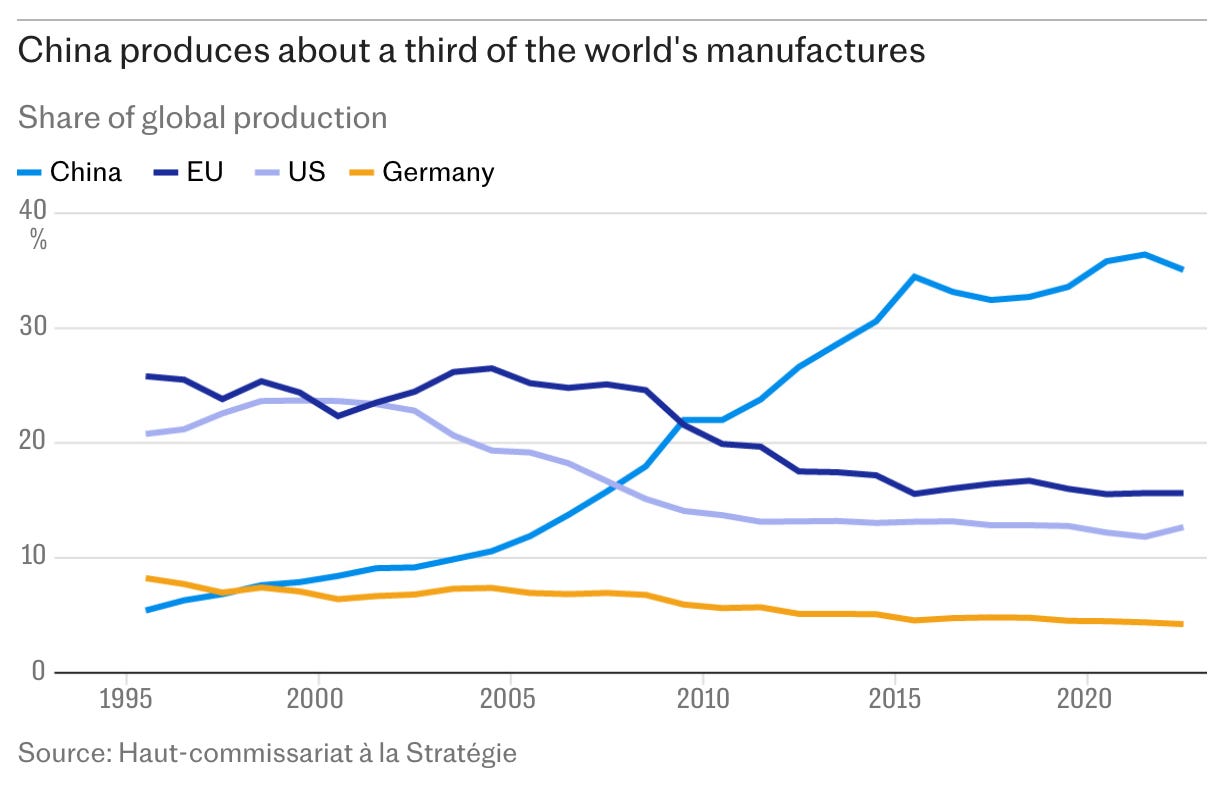
China is a contradiction, wrapped in a paradox, to borrow a Churchillian turn of phrase. The hyper-growth miracle of the past 40 years has hit a dead end, undermined by debt saturation, a burst property bubble, fiscal limits, and the vast wastage of malinvestments.
China’s share of world GDP has fallen for the past four years at market exchange rates and is near lows seen a decade ago. The economy is in structural decline. It has dropped to two-thirds of US levels despite electrotech supremacy.

Semi-bankrupt Chinese companies are trying to export their way out of the internal deflation. The Communist Party is abetting this as a survival strategy for itself, deploying an arsenal of opaque subsidies — 4.4 percent of GDP by the IMF’s estimates — to keep firms afloat and to divert its latent unemployment onto the rest of the world. The export surge is a function of the deep fundamental crisis at home.
But the consequences for Europe could be catastrophic. Here’s why.
