
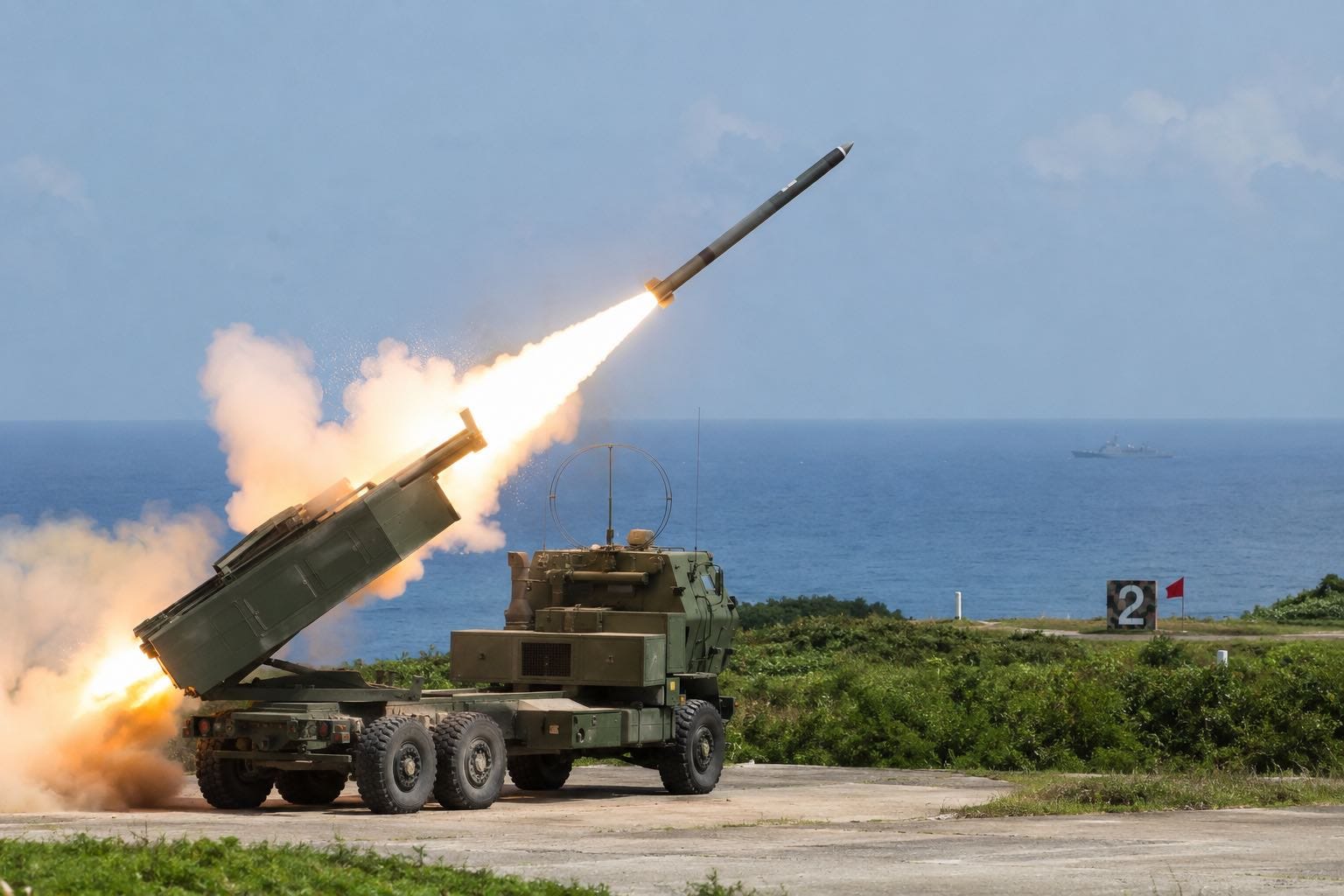
Taiwan Just Rehearsed Killing China’s Invasion Force
Trump is arming Taiwan with HIMARS, ATACMS, howitzers, and the new Precision Strike Missiles, or PrSMs — turning China’s landing fleet into a target set, not a war plan.

This analysis is free, but with Premium Membership you get MORE. Join today.
by Rod D. Martin
June 13, 2026
The key to stopping a war with China — an actual World War III — is demonstrating to the CCP that it cannot succeed. On Wednesday, Taiwan moved a long way toward showing it can kill a Chinese invasion force.
For the first time, Taiwan fired its new American HIMARS rockets from the side of the island China would have to invade: the western coast, near the Dajia River estuary in Taichung, along the shore most likely to face a Chinese amphibious assault. Taiwan used advanced weapons to simulate killing the landing force in the water, on the beaches, and before it can build mass ashore.
Donald Trump is arming Taiwan for exactly that fight.
His December arms package, the largest-ever U.S.-Taiwan defense sale, gives Taiwan 82 additional HIMARS launchers, 420 ATACMS, more than 1,200 GMLRS rocket pods, and the fire-control architecture needed to turn mobile launchers into a lethal anti-invasion network. It also transferred 60 M109A7 self-propelled howitzers, ammunition carriers, precision-guidance kits, and 155mm shells. The deal advances Taiwan’s capabilities by more than 30 or 40 years.
If you want to kill China’s landing craft in the water and then mop up whatever makes it to the beach, this is how. There are no offensive weapons involved, no room for Beijing to claim it’s anything except what it is. It’s designed for one mission: hit the transports, hit the landing craft, and keep moving before China can kill the defenders.
It’s a massive upgrade to Taiwan’s “Porcupine Defense.” It’s also the centerpiece of Trump’s containment strategy: close the map around China, leaving no good options for an offensive war and thus no viable choice other than peace and (fairer) trade. In Morton Blackwell’s words, “make the steal more expensive than it’s worth.”
The howitzers are old school. But HIMARS is an entire mobile launch architecture. It can fire short-range rockets, longer-range ATACMS, plus the new Precision Strike Missiles — PrSMs, or “prisms” — that reach farther, fit two per pod where ATACMS fits one, and are already evolving into ship-killers.
It matters. Taiwan is the keystone of the First Island Chain. Lose it, and China breaks into the wider Pacific, threatens Japan and the Philippines, and turns America’s forward defense line into a rescue mission. And it’s worse than that. The CCP desperately covets Taiwan: any war would be prompted by Beijing’s desire to capture that exact piece of real estate. Taiwan is not some random island. The odds of a major war with China that isn’t centered on an invasion of Taiwan are vanishingly small. (Well, unless you’re Russia.)
The PrSMs are of particular note. The missile is virtually purpose-built to defeat a Chinese invasion fleet: fired from HIMARS or MLRS, harder to find than fixed launchers, able to put two missiles in a pod where ATACMS fits one, and capable of forcing China to hunt mobile batteries that can be gone thirty seconds after they fire.
PrSMs have already gone to war in Iran. In March, U.S. Central Command confirmed that PrSMs had been used in Operation Epic Fury, their first operational deployment. CENTCOM described it as giving American forces an “unrivaled deep strike capability”. The new system is now combat-proven.
Ballistic missiles bring something cruise missiles and drones do not: speed, terminal violence, and the ability to hit time-sensitive targets before the enemy can move, hide, or rebuild the kill chain. That matters against Iranian air defenses, missile launchers, and hardened facilities. It matters even more in the Taiwan Strait, where the opening hours of a Chinese invasion could determine whether Beijing succeeds or suffers the fate of its 13th-century invasions of Japan.
A Chinese assault would depend on mass. Ships, landing craft, and follow-on logistics all have to be concentrated, sequenced, moved, and sustained. There is no Star Trek transporter: China actually has to cross water. That means an enormous army vulnerable at sea. If enough of it drowns in the strait, the rest will die on the beach.
That’s exactly what PrSM threatens.
The baseline PrSM already reaches roughly 500 kilometers. Increment 2 — the Land-Based Anti-Ship Missile version — adds a multimode seeker. Future increments are expected to stretch range and broaden payload options still further. The Army is turning a land-based missile into a ship-killer, and it is doing it on launchers Taiwan, Australia, and other allies already field.
That changes the role of the Army in the Pacific. A truck hidden on an island can now threaten ships at sea. A mobile launcher near a river mouth can help decide whether a Chinese landing force survives the beach. A battery that fires and disappears forces China to waste scarce intelligence and strike assets chasing ghosts.
Ask the Russians how that’s working out.
The Chinese know this. Their own exercises have already singled out HIMARS as a priority target, precisely because mobile launchers threaten their amphibious operations, logistics routes, rocket forces, and coastal targets. And that’s exactly the point, not to fight but to make a fight too risky. The purpose of deterrence is to make Beijing’s imagined conquest look closer to certain suicide.
Ukraine has already taught the world that long-range precision strikes change the map. They erase sanctuary. Once distant refineries, depots, pumping stations, bridges, and ports can be hit, the enemy’s rear becomes indistinguishable from the front. Russia built a war machine on the assumption of protected distance. Trump began tearing that shield away by combining deeper Ukrainian strike capacity with economic war against Russia’s oil lifeline. The geometry changed: Russia can no longer bomb from sanctuary and fund its war from protected infrastructure.
PrSM is the next step in that progression. The relationship between what you can hit and what the enemy can afford to lose is the geometry of war. In Ukraine, that geometry is collapsing around Russia. In the Taiwan Strait, PrSM helps collapse it around China before the first Chinese ship leaves port.
The Army’s FY2027 request would purchase 1,134 PrSMs, up sharply from 108, for roughly $1.9 billion. That’s a beginning, not an end. Last year, Australia fired PrSMs from HIMARS years ahead of schedule. Canberra is now expanding its HIMARS force into a second long-range fires regiment, building a sovereign missile manufacturing industry, and working with the United States on PrSM cooperation that could pave the way for domestic production. Poland and Ukraine are next with Patriot PAC-3, and perhaps the new ERAMs as well.
That is exactly what Trump wants America’s allies to become: not dependents, but force multipliers, partners who can hold their own until and unless the real crisis comes, at which point the U.S. can apply decisive force. The point is not American retreat. It’s to make American power both more flexible and more decisive precisely because our allies are stronger.
In normal times, Europe should be able to defend Europe. Israel and the Gulf should be able to handle their own region. Australia, Japan, South Korea, Taiwan, India, and the rest of the Indo-Pacific coalition should be able to turn their geography into hard military reality. Enemies should be forced to count the cost of attacking them, not just the cost of attacking us.
It’s a radically different model from the neoconservatives’ “imperial overstretch.” It’s also far more potent.
This is not containment by press release, but by outcomes. HIMARS and howitzers put the strait and beaches under threat. ATACMS and PrSMs put China’s coastal staging areas, ports, air defenses, and command nodes at risk. The more of these systems Taiwan fields, the less China has an invasion plan and the more it has a casualty estimate.
Xi Jinping may still gamble. Dictators sometimes do stupid things, especially when surrounded by terrified yesmen and fake numbers. But Trump’s strategy is to make sure Xi has to count the cost: landing craft burning in the Strait, armies drowning, transports sinking before they unload, beachheads turned into kill zones, and mobile launchers and artillery still alive after the first Chinese strike package has already been spent.
That’s the point of Trump’s Taiwan arms package. That’s the point of PrSM. Not to threaten China. To raise the price of China threatening us. Add to that the growing Japanese, Australian, South Korean, and Philippine militaries, the growing U.S. presence in those countries, and the American chokehold on the waterways China depends on for energy, food, and the trade that pays for it.
American planners remain convinced that China means to invade in 2027. Trump says they won’t so long as he’s President, and he may well be right. But to solve the problem in the long run, the CCP needs to know that if it orders a crossing, its invasion force may not survive the water.
This week, armed with Trump’s new weapons, Taiwan rehearsed exactly that.


One minor technical point: ATACMS range is 300 km, not 165 km. The earliest versions, produced in the 1990s (Block I), had the range of 165 km, but that's old news by now. Block I missiles are also at the end of their shelf life at this point in time. Current ATACMS versions are 300 km.
***
On a different note, the idea that China is planning to invade in 2027 is, in my opinion, a psyop. First, I don't believe that something like this would be leaked by China inadvertently - any such "leak" is a deliberate disinformation. If China says 2027, then the real date (to the extent there is a specific real date) is something other than 2027. Since it presumably isn't 2026, it must be after 2027, when everyone breathes a sigh of relief on December 31, 2027, and says "Okey dokey then, we're safe, no invasion."
In my dilettante's view, China is not capable of a SUCCESSFUL seaborne invasion. First, there are only two successful examples of major seaborne invasions in the entire human history: D-day in 1944, and Okinawa in 1945. Both were across essentially uncontested waters, by armies that had years of combat experience, onto landing grounds conducive to such things. China's military has zero combat experience, the Taiwan Strait will be very much contested, and Taiwan's coast has virtually no beaches where an invading force can land.
Could Xi Jinping order it anyway? Anything is possible, but (again, in my dilettante's view) it is doomed to failure AND to a huge loss of face. The risk of the latter is another constraining factor.
One cautionary note: We think of the future invasion of Taiwan as a sort of "D-Day with Chinese characteristics", just using technology of the 2020s. But China's plan will no doubt rely to a much greater extent on pre-positioned special forces teams already on the island striking key targets and causing general chaos, as well as the local Fifth Column (the KMT) loudly calling for immediate capitulation.
Food for thought.
It’s been more than 80 years since a large scale opposed landing has happened. No one knows how precision weapons affect it. No one has the tested doctrine to attack or defend. It’s not just himars. It’s javelin and TOW. Hitting landing craft at 2-3 km. No one knows what happens.