


And don’t miss this week’s Deep Dive on the Navy’s new laser weapons.

This analysis is free, but with Premium Membership you get MORE. Join today.
Our full discussion transcribed after the break:
by Rod D. Martin
September 8, 2026
I appeared on NTD Newsroom with Paul Greaney to discuss how Trump is resurrecting Venezuela’s oil industry, giving its people back their future, filling Gulf Coast refineries, and breaking China’s cut-rate oil racket.
Paul and I discuss:
How socialism crushed Venezuela from four million barrels a day to just 392,000
Why foreign aid doesn’t end poverty: investments and good jobs do
How the Gulf Coast turns Venezuelan crude into American power
Why secure American oil defeats Iran’s Hormuz strategy
How ending China’s illicit oil discount levels the field for American workers
It’s 11 minutes of the analysis you need: watch the interview, and pass it along!
Nothing matters more than educating the next generation with the values we cherish. The Herzog Foundation is making that possible. Learn more here.
Our Full Discussion:
Paul Greaney: Joining us now to discuss this is Rod Martin, geopolitical analyst and founder and CEO of Martin Capital. Good afternoon, Rod. It’s great to see you again.
How significant is it that these oil giants are now willing to invest billions in Venezuela?
Rod D. Martin: Extremely so. There was some hesitation at first, but truly, you can understand why. The socialist dictatorship that has been running that kleptocracy down there since the ‘90s stole all of their concessions in the country.
You have to understand, it was American interests that went down there and developed these fields. The critics here in the United States who act like we’re somehow stealing somebody’s oil seem to think that oil fields just pump themselves. That isn’t true. It requires advanced technology. It requires skilled workers who actually know how to drill for oil. And it even requires people who know how to maintain it, which the Venezuelans didn’t.

They took over these fields, and they went in short order from about four million barrels a day in production to about 392,000 barrels a day. It’s just pathetic. And of course, the country goes broke in the process.
So these American majors going in are getting access back to things they developed in the first place. And they had great deals before. Not great for them: great for Venezuela.
If you were to go and drill for oil in Midland, Texas, the property owner would get 20 percent of the take. In Venezuela, our companies were sharing 50-50 with the Venezuelans.
And now they’re going to get to go back because we’ve created enough legal protection for them to make that realistic. The result is going to be a staggering number of new, high-paying jobs in a country that has been so impoverished, people have actually been eating out of garbage dumps. This is a huge boon to both countries.
Property Rights, Profit, and Prosperity
Paul Greaney: And as you say, Rod, even on top of what you’ve characterized as a bad deal for the American majors in the past, they were also badly burned when the socialist regime took over all of their equipment and forced them out.
What kind of guarantees do you think the Trump administration has given them long-term? As you said, some of them seemed reluctant to go back into Venezuela because of how badly they were burned.

Rod D. Martin: I think the Trump administration has demonstrated a willingness to defend American property around the world. And we actually care about things like American property around the world now.
For decades, I have watched presidents of both parties act just utterly embarrassed by the idea that an American business would make money anywhere.
Well, I’m sorry. You can’t actually have jobs in these countries if somebody doesn’t invest money in them. And they aren’t going to invest money if they can’t make a profit. This is actually really, really simple, and everybody understands it when it comes to their own money.
Here we actually have a President who realizes that poverty doesn’t end because you send foreign aid. Poverty ends because you get people a good job. And the more you develop this infrastructure, the better their country, their living standards, and their children’s futures get.

So this is a huge opportunity for Venezuela to get out from under the socialist death clutch that it has lived under, and also the predatory embrace of China and Russia.
The Russians weren’t paying for any oil down there. They were taking it in debt repayment for predatory loans that they gave Venezuela years ago. The Chinese were buying the oil at an incredibly steep discount to market, and Maduro was happy to take it because his oil was sanctioned and he couldn’t sell it other places.
Here, they’re going to get market price. They’re actually going to be able to sell their oil on the open market.
A Hemispheric Energy Market to Displace OPEC
Rod D. Martin: And there’s another angle to it that a lot of people are missing. Most of the refineries in the world that can actually process the heavy, sour crude that comes out of Venezuela are on the American Gulf Coast, because these same majors built those refineries decades ago for the Venezuelan and, by the way, Canadian crude oil that they were pumping.
So we have the ability to process that into refined product, which will help the American consumer. But it will also help Venezuela sell their stuff to the world. It’s an incredibly symbiotic relationship.
It absolutely bolsters American energy security. That’s incredibly important.
Increasingly, we’re in a position to be able to think of a relatively unified, I’m going to call it North American, although I know technically Venezuela is in South America, but it’s in the Caribbean Basin, a unified North American energy market that increasingly dominates the world in a way not dissimilar to what OPEC had in the ‘70s.
Paul Greaney: Well, that’s an interesting point, as we see OPEC continually fracturing, it seems, at least on the surface. It’s an interesting time for the United States to step this up.
You touched on how Russia and China were actually running oil fields in Venezuela, which will now be taken over and overseen by the United States. It’s an incredible turn of events.
Rod, you touched on a symbiotic relationship and advantages to the American consumer and, you could say, the Western Hemisphere as a whole. How long before we start seeing these benefits?
Rod D. Martin: It starts immediately.
You’ve seen this in every crisis where oil is taken offline for some reason, or there’s a blockade, metaphorical or actual or whatever, and immediately the price of oil spikes.
Well, there’s a reason we don’t have the $250-a-barrel oil that all the naysayers were predicting back in March. Oil is not that much higher than it was before the war. And the reason is that we’re bringing on an awful lot of new supply, and by the way, more secure supply.

So when Europe buys $750 billion in American energy in Trump’s trade deal with them, that oil is worth more to them precisely because they don’t have to pay as much for it, precisely because it didn’t come from the Middle East or Russia.
Why? Because it’s riskier supply. It’s harder to get there, and it is absolutely at risk to any political wind. American oil is secure, and the U.S. Navy protects its transport.
So all of our allies are better off if they’re buying from the Gulf of America and now Venezuela, as we bring it back into the world community.
And the Chinese also lose something pretty big, because they have been buying this illegal, illicit, steeply discounted oil from Russia, Iran, and Venezuela for years.
It is a huge, huge subsidy to their manufacturing economy, nearly all of which is for export. And those exports get that subsidy and undercut the product of American and European workers.
So rectifying that, putting China in the same global market for oil as the rest of us, means that American workers get fairer competition and can compete more fairly in global markets as well as domestic. This is great for everybody.

Paul Greaney: Well, Rod, you’ve taken a very high-level geopolitical view of this. I’m going to follow up on that.
It seems like an interesting hedge for President Trump to secure and utilize the oil in Venezuela, considering Iran’s strategy, or apparent strategy, to counter what the United States is doing there and to disrupt the Strait of Hormuz, disrupt the oil flow out of Iran, in order to force up prices and put pressure on President Trump in the middle of an election year.
The more the United States controls global oil supplies and becomes an even more major player in the supply of oil globally, the less of a card it is for other nations to play to actually raise prices. It only benefits the United States in the end through higher revenue.
Rod D. Martin: Yes. The President learned the lessons of the ‘70s. He was actually an adult in the ‘70s. I was a little kid.
In 1973, when we had the first oil shock and oil prices jumped fourfold in a matter of weeks, you just couldn’t get gas. You had to go buy gas on even- or odd-numbered days, depending on the last number of your license plate. All this crazy stuff, and everything was thrown into recession.
Donald Trump lived through that. He understands it in a way that prior American leaders don’t seem to have grasped, and he’s seeking to reverse it.
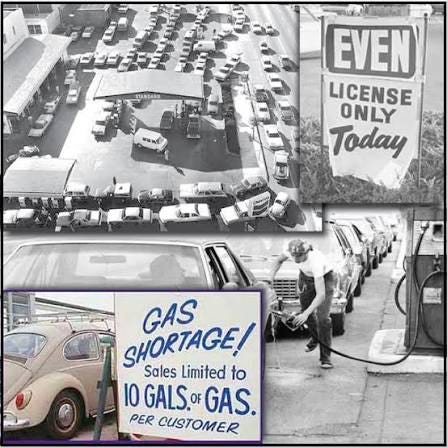
America should be in control of its energy future, and in the process, it can extend that to its allies. That is, again, a huge security measure.
We were really, really threatened by the energy shocks of the ‘70s, when a bunch of countries that control your oil just cut you off. I mean, what happens if the Soviets had invaded in the middle of that? What happens if some other terrible thing is going on?
Donald Trump doesn’t mean to ever allow that situation to rear its head again. And ditto for all the things we outsource to China.
This is why we’re bringing rare-earth refining back to the United States, because the Chinese refined 92 percent of the world’s rare-earth elements. Not just that, they dominated our pharmaceutical industry back during COVID. That was a disaster. We’re never going to let any of that happen again.
Paul Greaney: It’s just incredible to hear reports, or rumors, or comments from the President about perhaps taking over or utilizing Iran’s oil supply. It’s a fascinating game to watch play out.
That’s Rod Martin, CEO of Martin Capital. Rod, thank you.
Rod D. Martin: Thank you.


