


This analysis is free, but with Premium Membership you get MORE. Join today.
by Rod D. Martin
September 4, 2026
On Wednesday, Chief of Naval Operations Adm. Daryl Caudle publicly described one of the most important changes in naval history, one I’ve been telling you about for some time now: “a ship’s electrical power will increasingly become a measure of its combat power.”
Sounds like science fiction, doesn’t it? Combat power is measured in guns, torpedoes, aircraft, missiles, VLS cells, right? Every shot consumes something physical. Every magazine runs dry.
But that world is ending. Fast.
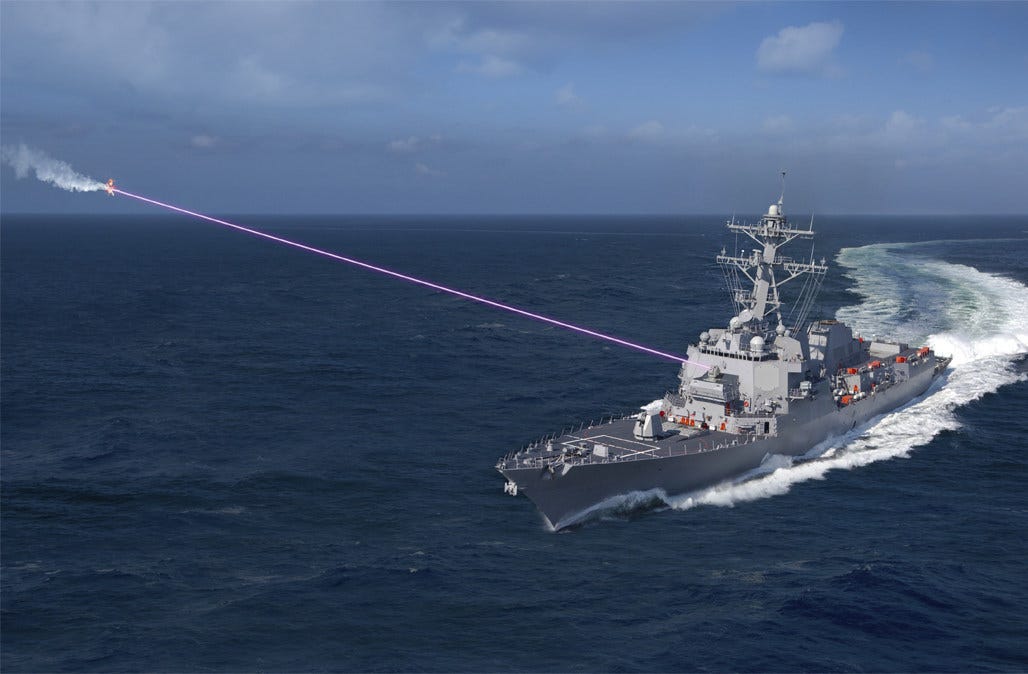
High-energy lasers and high-power microwave weapons are beginning to turn a warship’s electrical generation into defensive firepower. Instead of answering every incoming drone, rocket, or missile with another, more expensive, physical projectile, the Navy is increasingly taking a page out of Israel’s Iron Beam playbook — using electrons and photons to fire again and again as long as the ship can generate the power and dump the heat.
That’s not just some marginal improvement. Indeed, it’s straight out of Star Trek. It’s the beginning of an entirely new kind of magazine, and thereby a new era.
Cheap drones helped force the issue. Shooting down a $30,000 drone with a multimillion-dollar missile is a terrible nightmare for the defender, even when the interceptor works flawlessly. The attacker is highly incentivized to throw whole drone swarms at the target, and at some point, the defense can’t help but be overwhelmed, not by better tech but by simple economics.
Insoluble, right? It’s one of the reasons certain commentators keep telling us the age of the aircraft carrier is over, that the greatest warships of our time are vastly expensive sitting ducks. But that prognosis has consistently ignored the characteristically American innovation that always solves such problems. Why accept the enemy’s cost curve when you can change it?
A single SM-6 interceptor costs about $6 million; the SM-3 anywhere from $11-$35 million. But Israel’s newly operational Iron Beam laser, jointly developed with the United States, costs just $2 per shot. Epirus’s Leonidas can kill entire drone swarms with high-power microwaves. Lockheed Martin CEO Jim Taiclet says his company is already using a 300-kilowatt laser in live-fire testing against drones and actual cruise missiles, and moving toward 500 kilowatts. The Navy has already put lasers to sea.

Under President Trump, this is moving fast into deployment, production, and a broad-based defense architecture — alongside expanded missile production, AI-enabled battle management, and a national nuclear-power renaissance. Golden Dome and the Golden Fleet are already being designed around directed energy systems, making the fleet — and ultimately the American people — increasingly invulnerable to attack from above.
The drone age was supposed to make the surface fleet obsolete. Instead, it provoked a revolution.
Reports of the Carriers’ Death Were Greatly Exaggerated
No platform benefits more from this revolution than the one the “experts” have been burying for most of the last century: the aircraft carrier.
The technology changes; the obituary stays the same. First carriers were supposedly too vulnerable to submarines. Then Soviet bombers and long-range cruise missiles. Then satellites and precision-guided weapons. China developed the DF-21D and DF-26 “carrier killer” ballistic missiles. Hypersonics were going to finish the job. Now it’s drone swarms.
Yet somehow the carrier keeps getting harder to kill. There’s a reason.

The entire “carriers are obsolete” argument makes the same dumb mistake over and over again: it extrapolates the attacker’s technology while freezing the defender’s technology in place.
That is not how anything works. Ever.
China did not spend decades developing anti-carrier missiles because carriers don’t matter. It built them because carriers matter enormously. As I’ve written previously, a carrier isn’t just a runway. It’s sovereign American territory that moves: a floating airbase, command node, intelligence center, and overwhelming concentration of air power that requires no foreign government’s permission to appear off an enemy coast.
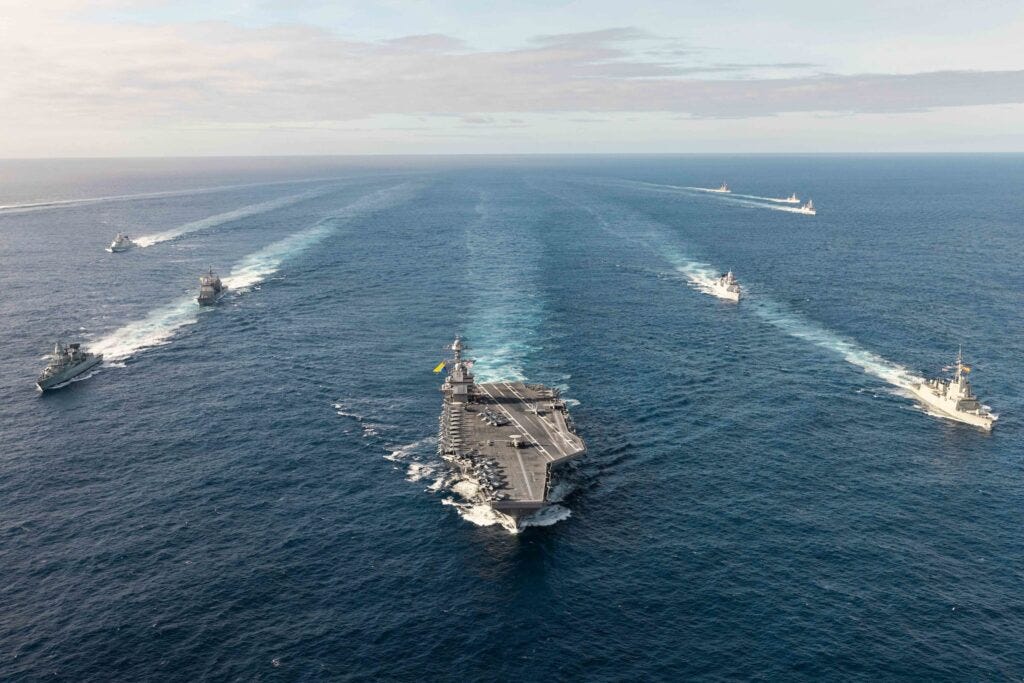
Moreover, an aircraft carrier doesn’t sail around by itself, just waiting for somebody to shoot it. It‘s the center of an enormous moving defensive system extending hundreds of miles beyond the hull. A carrier strike group can detect threats, confuse them, destroy the incoming weapon — or send an air wing more powerful than most countries’ entire air forces to destroy the launch sites before a shot can be fired.
All of that costs a lot. The world’s dominant economy can afford it. But what if it didn’t have to?
Last October, AeroVironment demonstrated its LOCUST laser aboard the USS George H.W. Bush, CVN-77. It effortlessly destroyed its targets, with a kill rate of 100 percent. But even more impressive was how easily the capability was added. LOCUST was not designed into the carrier during construction, or installed during a years-long overhaul.
No. The palletized LOCUST system was forklifted onto Bush’s flight deck, plugged into the ship’s nuclear-generated power, and put straight to work. Navy Decoded reports that Bush subsequently carried LOCUST into combat operations against Iran.
Iran thought it could blow up a carrier. It couldn’t lay a glove on it.
Carriers possess an abundance of everything directed-energy weapons need: tremendous electrical generation, enormous physical volume, sophisticated sensors, powerful cooling systems, advanced command-and-control, and a crew capable of maintaining complex machinery at sea for months at a time.
And suddenly, their nuclear reactors matter in an entirely new way.
For seventy years, the great operational advantage of nuclear propulsion was endurance: a carrier did not need to stop every few days for fuel. In the laser age, the reactors increasingly become part of the weapons system. They don’t just push the ship through the water. They generate the ammunition on demand and at the speed of light.
The Ford class already produces vastly greater electrical power than the Nimitz class specifically to support electromagnetic catapults, advanced sensors, and assorted “future systems.” The ships that follow can be designed with even more. The new nuclear-powered Trump class battleships can take the idea further still, with the electrical and thermal margins needed for larger lasers, railguns, ever more powerful sensors, and weapons we have not yet invented.
Those BBGNs can make a carrier strike group nearly invulnerable from above. They can also be nearly invulnerable by themselves.

Clearly, non-nuclear surface combatants — which make up most of today’s Navy — will have less power to spare. This just makes the carriers even more essential to fleet air defense until the Trump class comes online. And if the carriers are bristling with high-powered lasers, they’re even less vulnerable still.
Indeed, all of this turns the standard argument on its head. The bigger the ship, the more room it has for power generation, cooling, sensors, redundant systems, weapons, and defensive layers. The enormous nuclear-powered warship that looked like an inviting target in an age of finite missile magazines may become the ideal host for the weapons that make saturation attacks futile.
The carrier isn’t dying. It’s becoming a fortress.
The Revolution Doesn’t Have to Wait
Nor is there any need to wait for newly designed ships to deploy this technology.
Caudle is explicitly calling for modular, containerized laser systems like the one tested on the Bush that can be put quickly aboard ships already in service. It’s the right call: the Navy mustn’t let the perfect become the enemy of the good. Field the system, iterate it, scale it: a process of continuous improvement. It’s this philosophy that allowed a startup, SpaceX, to eclipse every long-established launch provider. It’s a lesson Caudle wants the Navy to learn.
And the revolution is already bigger than lasers.
Epirus’s Leonidas system has demonstrated something no missile battery can imitate: one electromagnetic pulse defeating a 49-drone swarm (and that number will grow). Lockheed’s MORFIUS takes high-power microwave energy airborne, flying into a swarm, frying electronics, and returning to recharge. Lasers offer precision; microwaves offer mass effects. Both draw from the same underlying advantage: the ship can keep generating power indefinitely, long after any number of missiles are gone.

That’s where AI-enabled battle management matters too. These systems don’t fight separately. Just as they share the same reactor, they increasingly share the same picture of the battle, allowing the ship to decide in milliseconds which weapon should kill which target.
The beam alone is not the weapon. The integrated kill chain is the weapon.
And because that kill chain is modular, the Navy can keep making it better without waiting years or even decades for new ships. Every improvement can be folded into the fleet already at sea.
Better still, every defensive job electricity takes over frees up something far scarcer: the missiles.
Defend With Lasers, Attack With Missiles
That may be the biggest payoff of all.
Former Pacific Fleet intelligence chief Jim Fanell points to a change that began after the Cold War. Under Reagan, the Maritime Strategy had a brutally straightforward purpose: if war came, take the fight to the Soviet Navy and destroy it.
But as the Soviet threat disappeared, the Navy’s finite missile magazine was increasingly devoted to other missions — first striking targets ashore, then increasingly defending the fleet itself. Ballistic missile defense accelerated the trend. The drone revolution threatened to take it to an absurd extreme, with some of the most sophisticated weapons ever built consumed merely keeping cheap flying bombs from exhausting the fleet.
Directed energy reverses that trend.
Every defensive engagement transferred from a missile to electricity leaves another missile in its cell. That is more than a savings. It restores offensive power. The physical magazine can increasingly return to what it ought to be: the arsenal with which the Navy destroys the enemy.
In a period in which far more VLS cells are being retired than can be replaced, this matters a lot. Every remaining cell needs to be on mission: killing enemy bases and ships, not messing around with incoming drones.
A Navy does not exist merely to survive the enemy’s attack. It exists to take command of the sea. So defend with electricity. Save the missiles for the attack.
And if Beijing starts the war, use those missiles to sink its fleet.
It turns out Star Trek gets a little more real every day.


A fascinating article, Dr. Martin! I didn’t know the Navy had technology like this! It sounds like something out of Science Fiction but yet is true. We need such weapons now more than ever to protect our sailors and our citizens and respond to imminent threats.
Hello Dr. Martin, you have two comments and two book lists awaiting you. One comment and list on your recent conservation on Securing America about Iran, the other on your segment on NTD News on Venezuela and Canada.