
Quick Thoughts: Summit Wins, Xi’s Thucydides Trap, and China's Great Reversal
The Enemedia heard a threat. But in fact, Xi may be realizing China’s best hope is détente: the map is closing in, America is awake, and the old bluff no longer works.
This analysis is free, but with Premium Membership you get MORE. Join today.
by Rod D. Martin
May 16, 2026
Donald Trump had an exceptionally good China summit this week. Xi Jinping did too. He might even realize it.
The Enemedia, of course, is filled with talk of Xi’s “Thucydides Trap” reference, and sees it as a threat. From my point of view, it appears they didn’t actually read Graham Allison’s book (but do reporters actually read books? Little evidence suggests they do). More on that in a minute.
Trump came away with important commitments: Chinese purchases of American farm goods, energy — it’s hard to attack your oil supplier — and a whopping 200 Boeing jets, with a possibility that number could rise to 750; continued progress in trade discussions; a framework for managing non-sensitive commerce; and explicit agreement that Tehran must not obtain nuclear weapons. Rest assured, the mullahs feel betrayed today. But China was never really their ally to begin with.
Likewise on Taiwan, Trump didn’t give an inch. Xi brought it up to be sure: how couldn’t he? Taiwan is an enormous pride point for China; it’s also the centerpiece of America’s First Island Chain containing CCP access to the Pacific. If Xi didn’t raise the point, he wouldn’t just look weak: he would be weak. And in a regime increasingly characterized by purges of top leaders, that is one thing Xi cannot afford.
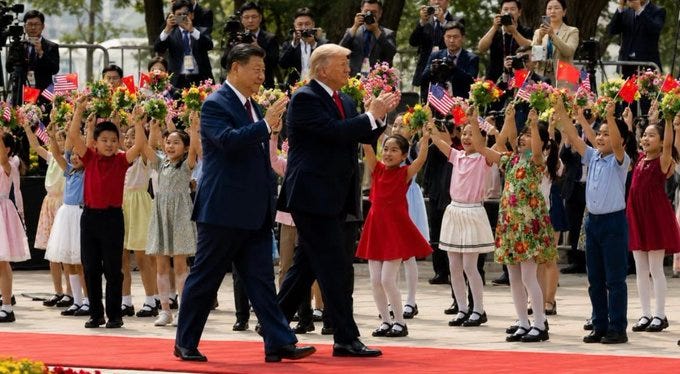
The President understands the Chinese concept of “face” all too well. He hugged Xi. He bragged on his great leadership. He made clear the two men are “old friends”. In every way he showed respect, but not Obama-like bowing and scraping. One story in the New York Post quoted a body language expert as saying that Trump carried himself “like a lion” despite showing Xi “genuine affection”. That’s exactly the correct stance, and it was reciprocated, with a red carpet welcome and even a band playing “YMCA”.
Contrast that with Barack Obama’s 2016 arrival in Hangzhou for the G20 summit, when China forced him to exit Air Force One through the back door because no rolling staircase was provided for the main upper door. In Don Surber’s words, “Xi treated the leader of the best military in the world like a bus boy because on the world stage, Obama acted like one ... Everybody else got stairs except the leader of the free world.”
Times they have a’changed.
None of that fits the black pill/TDS arguments, which are increasingly one and the same. To our pessimistic friends, everything Trump does must necessarily be stupid, blundering, or treasonous, which is odd coming as it so often does from the most anti-American among us.
Which brings us to the Thucydides Trap.
The term comes from Thucydides’ account of the Peloponnesian War: “It was the rise of Athens and the fear that this instilled in Sparta that made war inevitable.” Graham Allison popularized the term in his book Destined for War, based on a Harvard Belfer Center study of 16 major power transitions over the centuries, where a rising power threatened to displace an established one.
In 2015, before an audience that included Henry Kissinger, Xi opined that “There is no such thing as the so-called Thucydides Trap in the world.” But this week, he told his guests that "The world has reached a new crossroads: can China and the United States overcome the Thucydides Trap and create a new model of relations? Can we face global challenges together and provide greater stability to the world?"
Many in the west, whether of the black pill or TDS varieties, or even some perfectly sound analysts, saw this as Xi threatening Trump: the rising power would surely defeat the older, established one.
My question is, did they actually read the book?
In the book, Allison cites 16 examples of rising vs. established power competitions, from Athens and Sparta to the UK and Germany. But does the rising power always win the contest? Far from it.
Four of the duets made peace, leaving 12 that fought. Among those 12, the established power beat the rising power seven times to five.
Hmmm. That’s not sounding so good from Beijing’s perspective. But maybe Xi didn’t read the book either.
As it happens, I doubt that, just like I doubt Xi is unaware of the Malacca Dilemma, a term invented in Beijing. Xi is painfully aware of the facts I describe in my “The Map is Closing Around China” this week, with the added factor that Xi must think from his own fears in the same way our analysts do. To our side, the Soviets looked ten feet tall (turned out they were closer to seven), the Russians today do also (in reality, they’re maybe three), and every new crisis is going to be WORLD WAR THREE!!!!!!!!
Honestly, it’s a bit tiresome. Sun Tzu taught us never to underestimate our enemies; but he also taught us to realistically assess our own strengths, and that if you know your enemy and know yourself, “you will not lose in a thousand battles”. Or as Morton Blackwell puts it, “Remember: the other side has problems too.”
Xi is very aware of his own problems. Two years ago, he was on the verge of controlling the approaches to North America. Today America has flipped that script. So isn’t it at least possible that Xi is recognizing how we've kicked his butt out of the Caribbean, humiliated his armaments industry in Venezuela and Iran, and locked down Malacca, Sunda, and Lombok with our new Indonesian defense pact(s)?
And that’s not even mentioning Japan's reassertion as both a major power and arsenal to our allies, South Korea’s and Australia’s nuclear submarine deals with the U.S., the defensive implications of the Taiwan arms deals, the growing forest of missiles in Luzon, and the recently announced $1.5 trillion Trump defense budget, up from under $1 trillion. If we obsess about China’s strengths, do we really think they don’t obsess about ours? Especially when their map looks like this:
Or from their own perspective, like this:
I think China is at an extreme disadvantage. Its economy requires exports to the U.S., its oil (and far too much of its food) flows through narrow straits the U.S. Navy controls, its demographic implosion has about another ten years before becoming catastrophic, its unending leadership purges show the regime is shockingly brittle, and though it very much wants to invade Taiwan, in 77 years it has not, and it is perhaps dawning upon it that its real best case scenario might be to be among the four great power pairs who made peace rather than the 12 who did not.
I think that’s what Xi was saying in Beijing. Not that China is no danger. Not that China won’t fight if given an opening (and God help us had we elected Kamala!). But that if Trump’s way is America’s new and permanent course, then détente represents China’s best hope for survival.
That was Mikhail Gorbachev’s conclusion in 1985. And Reagan duly made nice, treating the Soviet premier with respect and deference — face — but never giving an inch on any American interest. Then too we were told that the result would be WORLD WAR THREE!!!!!!!! Instead, America won the Cold War and a better world was born.
Could Gorbachev have saved the USSR? Perhaps. And perhaps Xi will save the CCP.
But I think Xi was saying what the weak always say: “back off or I’ll hurt ya!” And often the weak truly can. But that doesn’t mean they want a fight: it means they think they can’t win one.
In 2024, perhaps he could have. But he didn’t risk it. In 2026 he cannot. And that’s the difference.


