
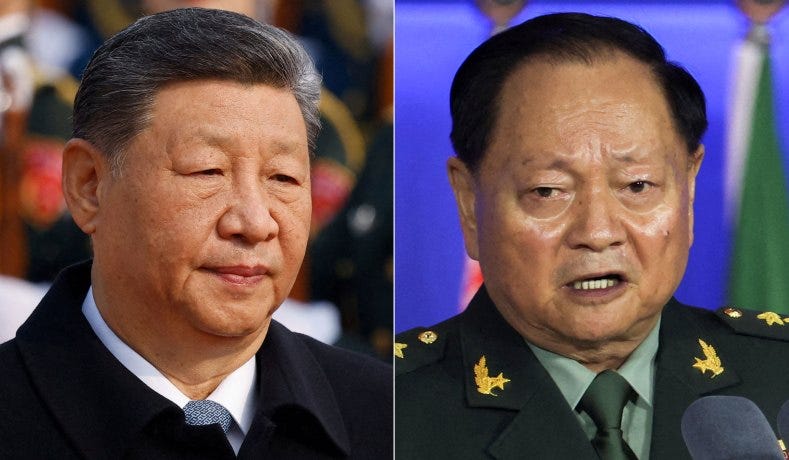
Xi’s Purge Isn’t “Anti-Corruption.” It’s a Power Struggle — and It Could Be a Prelude to War.
China’s top general may have been the last man standing between Xi Jinping and an invasion of Taiwan. Now he’s gone.
This analysis is free, but with Premium Membership you get MORE. Join today.
by Rod D. Martin
January 28, 2026
I’ve been telling you about the behind-the-scenes power struggle in the top Chinese leadership for months. I just talked to Charles Payne about it on Fox Business.
Most of the Western media thinks Chinese Premier Xi Jinping and top General Zhang Youxia are allies. They’re wrong, as usual. These two men have been at odds for quite some time. And now, after sacking most of the rest of China’s senior leadership — military and otherwise — Xi has purged Zhang himself.
Will he stay purged? Good question. Better question: what happens if he does?
Dictatorships don’t do transparency. They do theater. So when Beijing announces that Zhang — Politburo member, vice chairman of the Central Military Commission, and the highest-ranking uniformed officer in the People’s Liberation Army — is under investigation for “serious violations of discipline and law,” you’re not watching a compliance audit.
You’re watching Xi Jinping move against the center of gravity of the regime: the men who command the gun, and potentially inviting a military coup.
Here’s the tell: the regime didn’t frame this as ordinary corruption.
Within hours, PLA-affiliated propaganda was out declaring a “tough, protracted, and all-out battle,” accusing Zhang and his ally, Liu Zhenli, the CMC’s Chief of Staff, of betrayal, of “trampling” the system of “ultimate responsibility” resting with the CMC chairman (Xi), and of fueling “political” problems that threaten the Party’s “absolute leadership” over the armed forces.
Xi is purging the PLA because it has become a rival power center. And there aren’t many of those left, because Xi has spent the past several years eliminating virtually everyone in the Communist Party and the Chinese government (but I repeat myself) who could possibly threaten or succeed him.
In the process, he’s purged nearly everyone who’s competent, not just in the military but everywhere. And while that might sound like a good thing from an American point of view, idiots with nukes is not a pleasant prospect.
The Purge in the Military Became Undeniable in October
If you’ve been following my China commentary for the last year, you already know: this wasn’t a single “case.” It was the coup de grâce.
Through the spring and into the summer, senior figures started vanishing or getting removed. Xi has dismissed 120 senior officers. In 2022 there were 44 uniformed military officers in the Politburo: 29 of those are now gone. Xi himself went “missing” for a time, suggesting that at one point the military might have gotten the upper hand. What became increasingly clear was an internal struggle over who actually controls the military, and whether the military might well take control of the party.
In October, the purge crossed the line from “senior” to “apex.” It hit men at the top of the Central Military Commission itself, including He Weidong and Miao Hua, both members of the “Fujian clique” closely tied to Xi himself. Did this mean they had betrayed their old comrade? Or did it mean the advantage had passed to Zhang, who was increasingly whispered about as a successor to Xi, either post-retirement or otherwise. As is always the case in totalitarian systems, the answer was not entirely clear.
Either way, Zhang himself is now out, while Xi remains. Whether the field officers, or the remaining party elders, consent to that outcome remains to be seen.
The Hawks Aren’t Who You Think They Are
Zhang Youxia isn’t just China’s highest-ranking general. He’s one of the very few senior PLA figures with combat experience. That experience was earned in a war China was supposed to win but lost.
That’s likely why Zhang’s view of the Taiwan situation has been reticent. He knows China isn’t ready to attempt an invasion. He knows China can lose. And he has a clear-eyed view of what the PLA would face in the Formosa Strait and beyond.
It’s not Zhang Youxia pushing China toward an invasion of Taiwan. It’s Xi Jinping.
That should concern you, and not just because Xi looks to be winning at present. If Vladimir Putin had understood the true state of Russia’s military, he’d have never invaded Ukraine. As anyone who ever watched the beginning of Gone With the Wind can tell you, it’s not the wise Rhett Butlers who tend to start such wars, but the inexperienced nincompoops filled with hubris, bloodlust, and dreams of glory.
Whatever such foolishness Zhang Youxia may have had was likely lost in the mountains of Cao Bang.
Zhang is also well aware of the hubris of a different set of generals whose military “experience” consists in exercises and domestic repression. Argentina’s junta thought it would rally the nation behind it by seizing the islands just off its coast too. The Falklands debacle shattered the junta’s legitimacy, led swiftly to a democratic transition, and ended with the generals in jail.
But Xi doesn’t think like a professional soldier. Xi thinks like a Party boss. The purges prove he’s a gambler. His successes feed his ego. The yes-men with whom he’s replaced everyone competent tell him only what he wants to hear.
And Xi is on the clock. He’s 72. “Reunifying” the Middle Kingdom would immortalize him. It would break the First Island Chain, giving the PLA Navy unfettered access to the Pacific and true Global Power status, all while dealing America and Japan a catastrophic blow.
Another clock is ticking too. Xi knows that China is in its last decade before demographic collapse overtakes his ability to act. The country is on track to lose 75 percent of its population over the next several decades; but first, a dramatically shrinking working class will have to pay an ever-increasing price to care for the country’s ballooning elderly cohort, while its investments — largely in real estate for which there will be ever-fewer buyers or renters — disappear.
Whatever Xi wants to grab, he has to act before he can’t. That was precisely Putin’s calculation in invading Ukraine.
Is War Inevitable?
So is war inevitable? No. But it just got a lot more likely.
And that’s exactly the point of Donald Trump’s foreign policy: containing China in Kennan-esque, Reagan-esque fashion until the regime collapses under its own weight.
The tariffs are essential: they reverse the West’s decades-long policy of subsidizing China’s rise at its own expense. For the first time, they also force China to confront the very real constraints of its export-driven economy. Trump’s trade war has shown Beijing how much it depends not only on the vast American consumer market but also on the benevolence of the U.S. Navy. Trade routes don’t police themselves.
Kicking China out of the Caribbean and keeping them out of Greenland averts their attempt to leapfrog the First Island Chain. Golden Dome renders the threat of a Chinese nuclear or EMP attack negligible, and thus too risky to attempt.
The Taiwan arms deal, and the strengthening of regional allies, is also key. Integrating South Korean, Japanese, and to a lesser degree Australian shipbuilding with America’s amplifies the power-projection of all four, very much at China’s expense. The NATO agreement to spend 5 percent of GDP on defense — up from less than 2 percent — increases Europe’s ability to make a difference east of Suez, while reducing the burden on America of defending countries that ought to be able to defend themselves.
And don’t forget the Shadow Fleet. Disrupting that ripples far beyond just Venezuela and Cuba, depriving Russia of the cash it needs to continue its ill-begotten war, and China’s ability to buy 90 percent of Iran’s oil as well.
How will China replace all that sanctioned energy? Certainly the rest of the Gulf states will want that business, but even now, China has inquired about investing in the new Alaska LNG Pipeline. The President’s trade deals with America’s allies have required them to buy from the U.S. instead of their enemies: this creates more jobs in America, but it also provides a significant upgrade to European and East Asian security. To the degree that China joins them, it will find it increasingly difficult to go to war.
Trump knows this. He knows there’s no silver bullet that will guarantee peace. It takes many bricks to build this Great Wall. He’s on a tight clock too.
Is Xi’s Victory Certain?
Is Xi’s apparent victory the final word on this internal power struggle? Don’t bet on it. It seems unlikely that the PLA’s field officers, loyal to Zhang, are going to be very happy. The party elders certainly aren’t. Xi’s faction is not the only one. His decapitation strike against the military may consolidate his power or massively backfire.
And that’s exactly the danger I’m warning of today. It’s not just the inexperience. It’s not just the hubris. It’s not just the yes-men. Xi could look at the throne of bayonets on which he sits and decide that a “quick” Taiwan adventure is just the ticket to make him unassailable.
Countries generally avoid wars that could result in everyone’s destruction. They have for the past 80 years.
But individuals are not countries. Xi Jinping may agree with Louis XIV that “I am the state”, but the key word there was and remains “I”. His interests will trump China’s.
Let us pray that Trump can trump his.


New Round of Purges Wrack the Chinese People's Liberation Army and Defense Establishment
https://www.therightreasons.net/topic/119140-new-round-of-purges-wrack-the-chinese-peoples-liberation-army-and-defense-establishment/
____________________________________
Death Rumors, Military Silence, and Xi’s Control Crisis
Lei's Real Talk
https://www.youtube.com/watch?v=bqgP6sitJzk
3 Thumbs Up!