


Don’t miss my Greenland analysis. And share widely!

This analysis is free, but with Premium Membership you get MORE. Join today.
Our full discussion transcribed after the break:
by Rod D. Martin
September 23, 2026
I appeared on NTD Newsroom with host Don Ma to discuss Trump’s UN speech, and the UN’s catastrophic failures, yesterday’s signing of the Greenland deal, and the sea change in U.S. foreign policy represented by that agreement.
Don and I discuss:
Trump’s UN address
Why the UN — and other global institutions — need serious reform
How the Greenland agreement strengthens America’s national security
How China’s northern shipping routes sharpen the stakes
The lessons of Diego Garcia, and the sea change in U.S. foreign policy the Greenland deal represents
It’s 20 minutes of the in-depth analysis you need: watch it, and pass it along!
Nothing matters more than educating the next generation with the values we cherish. The Herzog Foundation is making that possible. Learn more here.
Our Full Discussion:
Don Ma: President Trump gave an hour-long speech today at the U.N. General Assembly. He says he inherited the dark age of America, but under his administration, the U.S. is entering the golden age. Meanwhile, a deal concerning a strategic defense agreement with Denmark and Greenland at the U.N. General Assembly being signed.
Joining us now to discuss is Rod Martin, political analyst and founder and CEO of Martin Capital. So, Rod, good afternoon to you. Thank you for being here. President Trump's overarching message, it seems like, was that the U.S. has moved from what he described as a period of decline into an era of American strength. Can we get your overall thoughts on the speech? Do you think that is the case?
Rod D. Martin: It’s absolutely the case. And the numbers that we’re seeing this month in particular are just staggering to me. I mean, I’m a supporter of this administration, and I’m blown away by some of this stuff. For example, the lowest violent crime rate in the United States in 126 years, a one-year drop in the murder rate of more than 18 percent. We just got census data that shows that the U.S. poverty rate is now the lowest in history: the lowest poverty rate in history!
And all of this stuff and the manufacturing boom that you and I frequently talk about are all coming because we slashed taxes, because we made our tax code business-friendly, because we got rid of taxes on tips and overtime and social security benefits, because we’re reshoring industry to the United States.
And that’s a model for the world. The entire world is engaged in some degree of mercantilism, plundering the American consumer market. That’s certainly the case with China. And all of them could be better off if they followed this model.
The truth is that 15 years ago, the European Union had a larger economy than that of the United States. Today, it’s only two-thirds the size of the United States. Canada has the same population as California, but only half of California’s economy. And California is the worst-run state in America!
So, I mean, all of this is just horribly wrong. It doesn’t have to be that way. President Trump is showing a better way to all of our friends and allies. And the Greenland deal is part of that better way in ways that most of the media hasn’t even thought about. So we’ll get to that in a minute, I’m sure. But we’re having a big week this week.

Don Ma: And I think another message from the speech is peace through strength, right? And President Trump mentioned stopping eight wars or preventing eight wars. Now, we know the UN existed for decades. In one term, President Trump stopped eight wars, prevented eight wars. What do you think about that?
Rod D. Martin: Eight wars in eight months. And a couple of those wars had lasted for 40 years or more. Nobody in the world cared about these people. The UN certainly didn’t care. No prior American leader did anything about it. Neither did anybody else. There are actually other countries in the world who could have stepped in and done something useful.
Donald Trump is the peace president, which may sound silly in the middle of this Iran war. I understand that. But the net result of that is not another American forever war. It’s ending a forever war. The Iranian regime has been at war not only with us, but with all of its neighbors for 47 years. The president is ending that forever war.
And when we’re done, I have every confidence and hope that the Iranian people will be in a position to rise up and overthrow their totalitarian overlords and create a free Iran. That will be the biggest single boon to peace in the modern Middle East, full stop. And the president was very clear on that point.

The other point, of course, that he made, I thought, incredibly well, was that Cuba — which has been a source of terrorism and communist insurgencies and every possible bad thing throughout the Western Hemisphere, and even as far away as Africa, where the Cubans maintained an army to prop up a communist regime in Angola for decades — Cuba will be free. And we are nearly there.
That is the next thing on the agenda.
America’s Allies and Greenland
Don Ma: Could you help us contrast the United States under this administration versus previous administrations? How do how do the U.S.’s allies and adversaries view the United States right now?
Rod D. Martin: Well, now we come to the Greenland deal, which illustrates the whole thing. You will recall that not long ago, Keir Starmer, the now deposed socialist prime minister of Great Britain, made a deal to give away the Chagos Islands to a Chinese client state, Mauritius. This is absurd. Mauritius has never ruled the Chagos Islands. They’re 1,250 miles away from the Chagos Islands. This just makes no sense.

But it’s even worse when you consider that America’s most important military base in the entire Indian Ocean sits on Diego Garcia in the Chagos Islands. So here’s an actual ally, handing over one of the most important pieces of real estate in the world to a Chinese satellite. It’s just insane.
Now, that’s what happens when we’re allies. What happens when NATO breaks up someday? Not because I’m calling for that, not because I want that, but just because in this life nothing is permanent.
What happens if the nations of Europe become Islamic caliphates? What if we’re facing Denmarkistan? We don’t know what the future holds. And this is what the president is doing. He is imposing tough love on some of our allies. He is also actually acting like a grown-up, which the American foreign policy establishment has not done for decades. They have just imbibed the religion that NATO is forever, that all of these relationships are permanent.
And when they go awry, as Iran went awry — it was our chief ally in the Middle East, and in 1979 it became our chief enemy — they just adjust and say, well, we’re here to manage the inevitable American decline. Donald Trump has no use for that. And the world is seeing it.
You saw it at the Ankara NATO summit earlier this year when even Friedrich Merz, the chancellor of Germany, stood up and said, Donald Trump is frequently abrasive, but he was right.
You heard that again today out of the prime minister of Denmark and out of the premier of Greenland. Donald Trump was right. The security situation in the North Atlantic has changed a lot since 1951. We understand and welcome what the U.S. is trying to do here.
The difference between the old way and the new is very simple. Donald Trump isn’t thinking about the next five years. He’s thinking about the next 50. And he knows that lots of things all over the world will change in that time. You can’t predict which ones. So we’re going to take care of American security and the American people, regardless of what changes may come. And Greenland, of course, is a key part of that. Diego Garcia is too. The Panama Canal is too.
And everywhere and always, Donald Trump is relentlessly pursuing American security interests to the benefit of the people who elected him, but also, honestly, to the benefit of those allies who grumbled as we went along.
The UN and America First
Don Ma: Okay. And I fully intend to ask you more questions on the Greenland deal. But let me ask you a few more things on the speech itself. So I can’t go out. I’d be remiss if I didn’t ask you about how President Trump criticized the U.N. itself while giving a speech at the U.N. He criticized the United Nations and other international institutions, saying they should facilitate cooperation between countries and not impose authority over those countries. And you mentioned putting Americans and America first before other nations. So what are your comments on Trump’s criticism of the U.N.?
Rod D. Martin: Well, he’s exactly right. The U.N. is a disaster. The U.N. spends huge fortunes of other people’s money to accomplish little or worse than nothing. You know, little you see everywhere. But worse than nothing is the sexual abuses of U.N. peacekeeping forces in Africa and the horrible atrocities committed by U.N. forces in Katanga in the 1960s. And just the general imposition on the world of all of the preferences of the world’s greatest tyrannies as opposed to the needs of the world’s people.
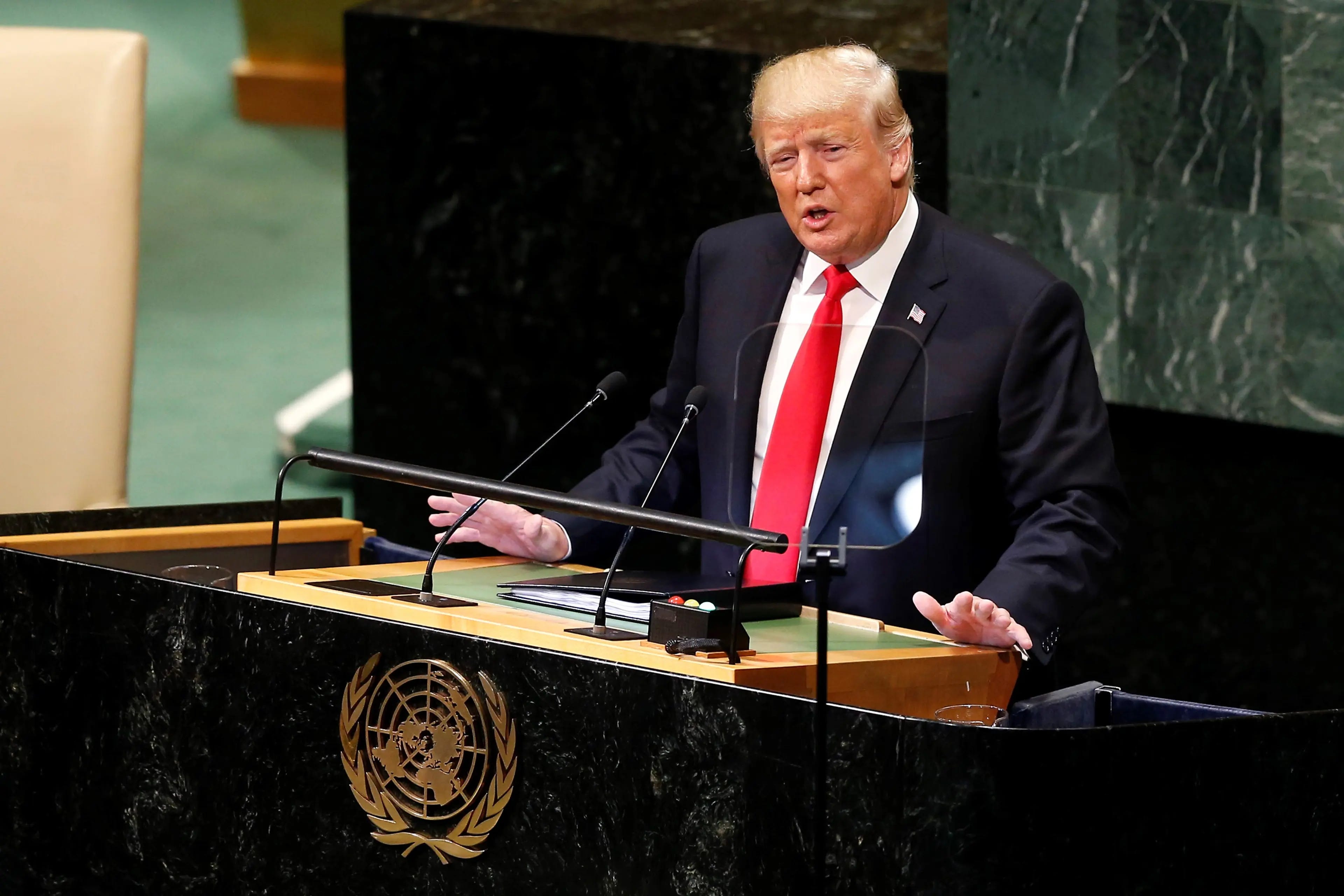
The U.N. has to reform. The U.N. has to spend its money better. The U.N. has to get its budget under control.
And Donald Trump is right to criticize it, as previous presidents have, too, just not as directly and in their face. So he’s spot on there. And truly, this is true of a lot of global institutions. This is part of my earlier point. Whether you’re talking about the IMF or the World Bank or the World Health Organization or any of these other multilateral institutions that we created in the 1940s, they have all become, to some degree, decayed, if not rotten. They all need a revamp. They all need a new look. They all need somebody to come in and do the moral equivalent of Trump building a new ballroom. They need a refresh and a renovation.
And Trump is just the man to do it. As far as putting America first, Donald Trump’s position is not that America should be the only nation, or the only nation that matters. His position is that the world depends on the United States. Certainly, Taiwan does. Certainly, Ukraine does. Certainly, Denmark does. All of these countries rely on us. And therefore, those relationships need to also serve the interests of the American people.
But I would go one further. Donald Trump has routinely articulated the greater position that that should also be true of the elected governments of every nation. French leaders should put French interests first. German leaders should put German interests first. Japanese and Taiwanese leaders should put their people first. Because why do they have the right to tax or rule their people if not to serve them?
Together, when our interests coincide, we can thereby be strong enough and rich enough to deter aggression from the unfree countries of the world. We can be better together. It’s a model of partnership, not dependency. And it’s good for the whole world. But it starts by being good to the people who pay for all this. And that would be the people of the United States.
Don Ma: Okay, just one more comment from me here on the U.N. And then we’ll move on to the Greenland deal. Can I just ask you, how can the United Nations and the Human Rights Council assert any kind of credibility when China and Iran are on the council? Now, these two countries, I mean, I don’t need to tell you, but some of the worst human rights records in history. How can this be the case?
Rod D. Martin: Well, it’s just horrifying. And, of course, it’s a function of the structure of the U.N. General Assembly. When the U.N. was created, if I recall correctly, there were 54 nations. Now there are nearly 200. And many of those have abominable track records on human rights and even just basic freedom. There aren’t just a whole lot of countries in the world, you know — in terms of just the total number of them — that most people would want to live in, because they aren’t free and they are impoverished because their own governments plunder them. And these are not people who should be determining human rights anywhere.

But, of course, the U.N. is a democracy in the General Assembly and only there. We maintain a certain degree of rationality by having a veto at the Security Council. But in the General Assembly, the inmates are running the asylum. It’s just horrible and it has been now for decades. So, again, there needs to be some reform. We should not have a U.N. human rights body that is dominated by countries like Iran and China. It’s just absurd. And it makes a mockery of the whole thing. So we’ve got to get a handle on that.
And honestly, if we can’t get a handle on that, there is absolutely a case to be made for a new organization entirely of free nations that serves the same purpose without all of this absurd baggage. Why should we be allowing the Congo to have a say on human rights anywhere? It’s just crazy and we’ve got to stop it.
What the Greenland Agreement Provides
Don Ma: Okay, well said. Let’s talk about the Greenland deal. I think one thing we have to appreciate, and you spoke a lot of the merits of the deal already, but one thing, let’s just take a moment to appreciate the fact this is not going to put any burden on taxpayers. Because President Trump says there’s not going to be any cost to the United States. What are your comments on this?
Rod D. Martin: Well, we have to separate out what will cost and what won’t. Of course, what the president is saying is that we’re not going to pay Denmark and Greenland for this deal. So that’s good and that’s right, because honestly, Denmark and Greenland are benefiting from this deal more immediately than anybody else.
Denmark can’t afford to defend Greenland. Denmark can’t afford to defend Denmark. In World War II, Denmark, when it had a much bigger military, was overrun by the Germans in six hours flat. These are not places that can possibly shoulder this burden. So America is coming in and defending them. Yeah, we shouldn’t have to pay for the privilege. So that part is good.
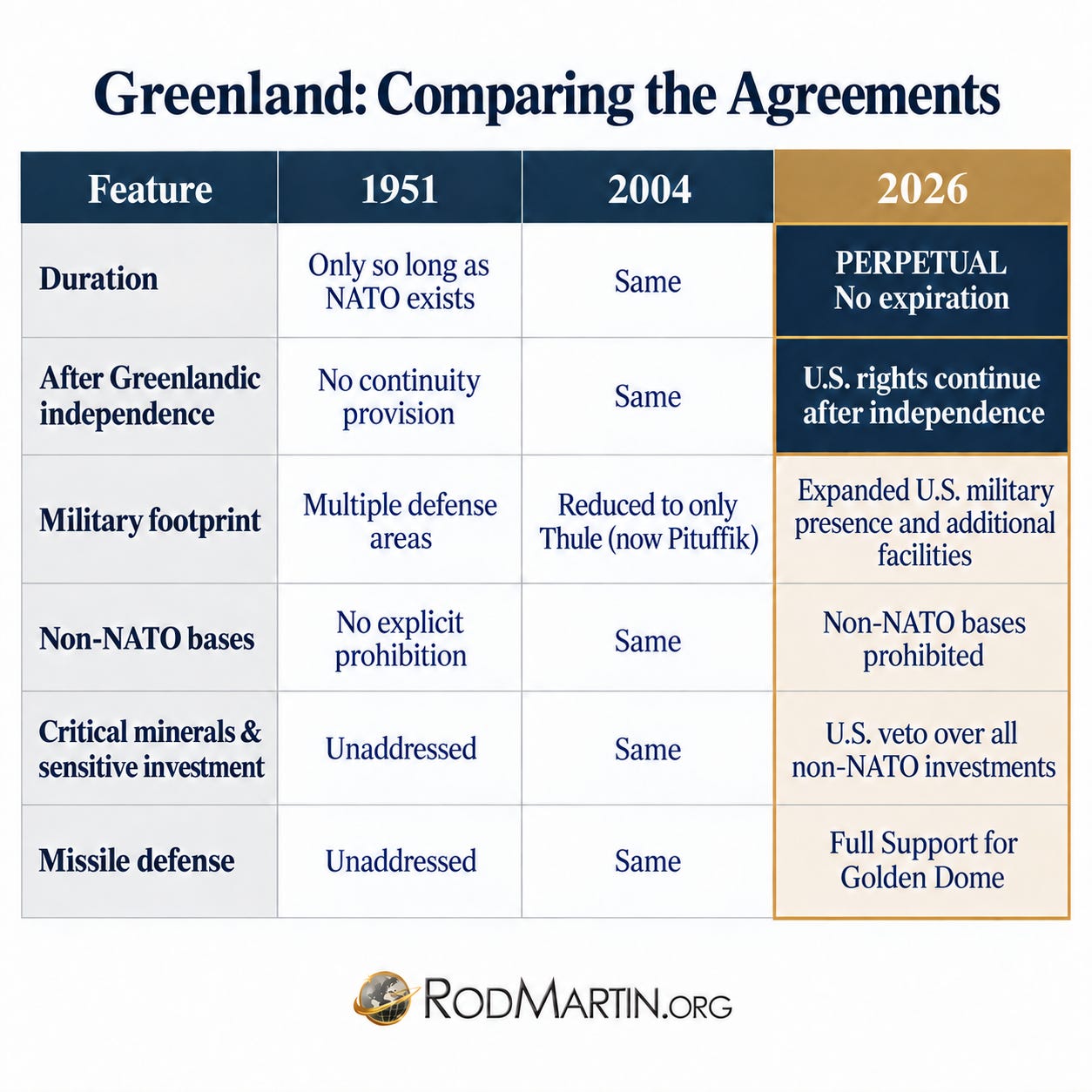
Now, what we will pay for is a significantly expanded military presence on the island. The president announced today construction of two major new bases on the island. That’s long overdue. The Bush administration was foolish, and the Clinton Administration before him, to shut down the bases we did have.

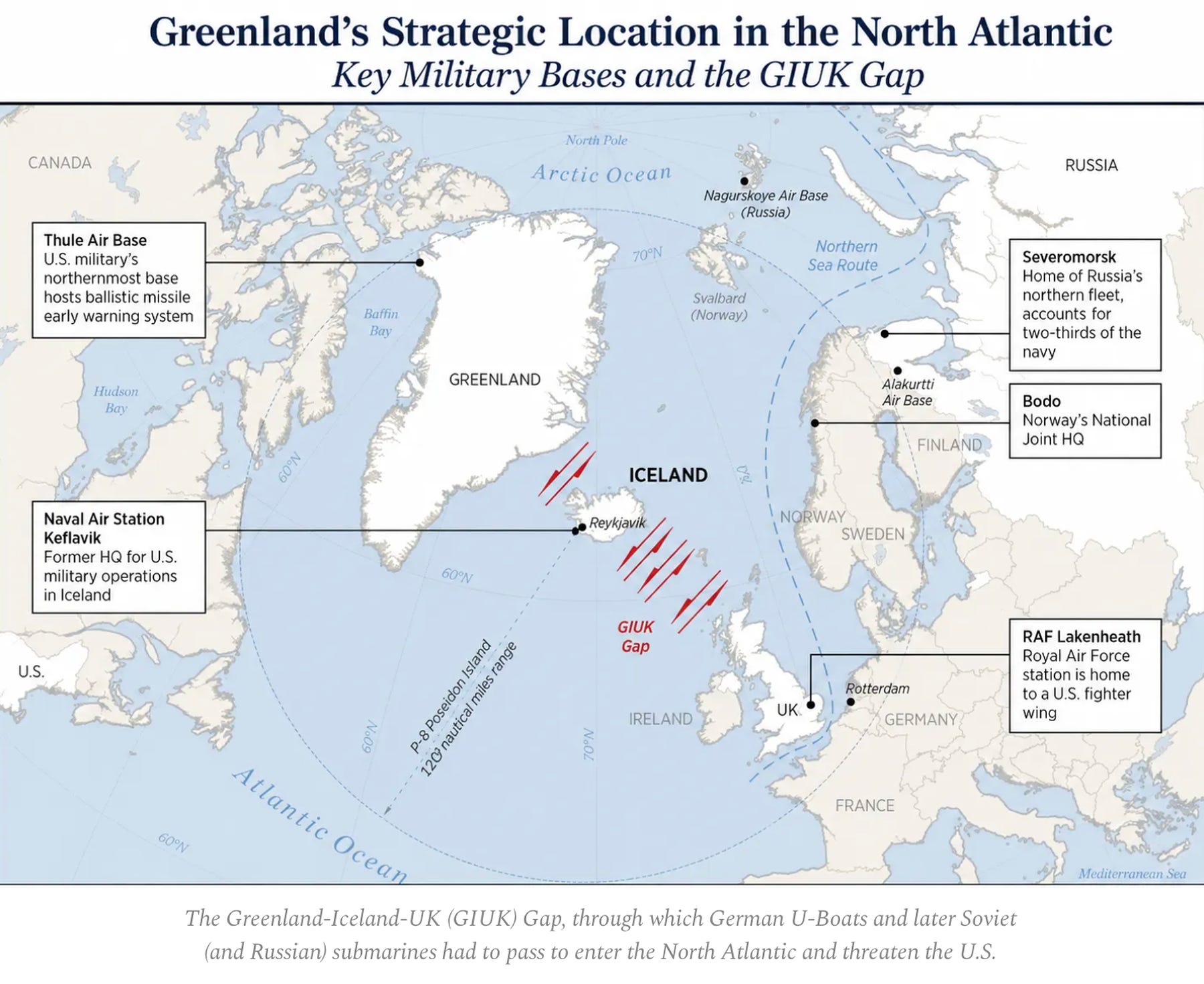
But what we need today looks different than it would have looked 40 years ago anyway. So Pituffik, which is on the screen right now, is a perfect, perfect spot for early warning radar, which is its current primary purpose. It’s also a key spot for our Golden Dome missile defense that will protect the people of North America and Greenland from nuclear attack from whoever might attack.
We don’t know who might attack 30 years from now, or 100. So it’s crucial to the defense of North America. Likewise, we need proper naval facilities on the island to secure the Greenland-Iceland-UK gap. We will now have that.
Why does that matter? It matters for the same reason it mattered during the Cold War and World War II. German U-boats had to transit through that waterway to be able to threaten the North Atlantic. The Russians did the same thing during the Cold War. Their submarines have to pass past Greenland to Iceland and the UK. We have to have the ability to secure those waterways, especially in an age where you’re beginning to have more shipping north of Russia.
As China begins to exploit that route, that becomes a military threat regardless of any commercial boon. And so all of this contributes to that.
But the biggest thing that came out of the deal today, and I can’t stress this enough, the biggest thing is perpetuity. That’s the problem we had in Panama after Jimmy Carter gave up American sovereignty over the canal. We actually have to know that our deal survives Denmark maybe not being in NATO, or NATO maybe not existing, or Greenland becoming independent, which it says it wants to do.
All these different eventualities have to actually be accounted for, and they need to be accounted for when it’s easy, like now, rather than when it becomes harder, because you’ve got a Chinese base on the island. So that’s what the president is doing.
There’s one other thing that I just can’t stress enough, and this is beautiful. The United States now has an absolute veto over any strategic investments by any non-NATO power in Greenland. An absolute veto. If the Chinese want to develop minerals in Greenland, if the Russians want to develop oil off the coast, good luck, because we’re going to tell them no, and we now have the power to make that stick.
That was not true yesterday. And it’s a huge boon to U.S. security.
China and the Arctic
Don Ma: Okay, on that point, let me just ask you one last thing here, and then we’ll wrap up the conversation. Do you think if the United States didn’t come in, China or Russia would have done so eventually, just like how the United States came in with its military and expansion? Because the administration has said this as well. If the U.S. doesn’t do it, China will. What do you think?
Rod D. Martin: Oh, there’s no question. Again, the Chinese are developing shipping lanes north of Russia. That has never existed before in any meaningful way. They’re prototyping that this year with several shipments of goods that normally would have gone either through the Suez Canal or around the Cape of Good Hope. And that makes it an important waterway. It will be a dramatically more important waterway over the next couple of decades.
So what does that mean? Well, it means that the fast-growing Chinese Navy also has access to those waterways and therefore to the North Atlantic. So the Greenland deal is essential to heading that off.
If you’re China, you want a base in Greenland. If you’re China, you want to actually capture the most important mineral resources and oil deposits and so forth to keep them out of American hands. So, yes, we just blocked something today that was unquestionably on the horizon. They just haven’t been able to get it done yet. Now they never will. We are never going to allow it. And we have the power now to prevent it.
Don Ma: All right, Rod, thank you for speaking with us. I hope you didn’t mind the slightly longer conversation. I could just talk to you forever. Rod, thank you very much.
Rod D. Martin: Well, let’s do that sometime.
Don Ma: Yeah, we’ll just talk for the whole show. All right, thanks.
Rod D. Martin: Thank you.


