


by Rod D. Martin
August 27, 2026
Deep in the Xinjiang desert, China is building a nuclear fortress.
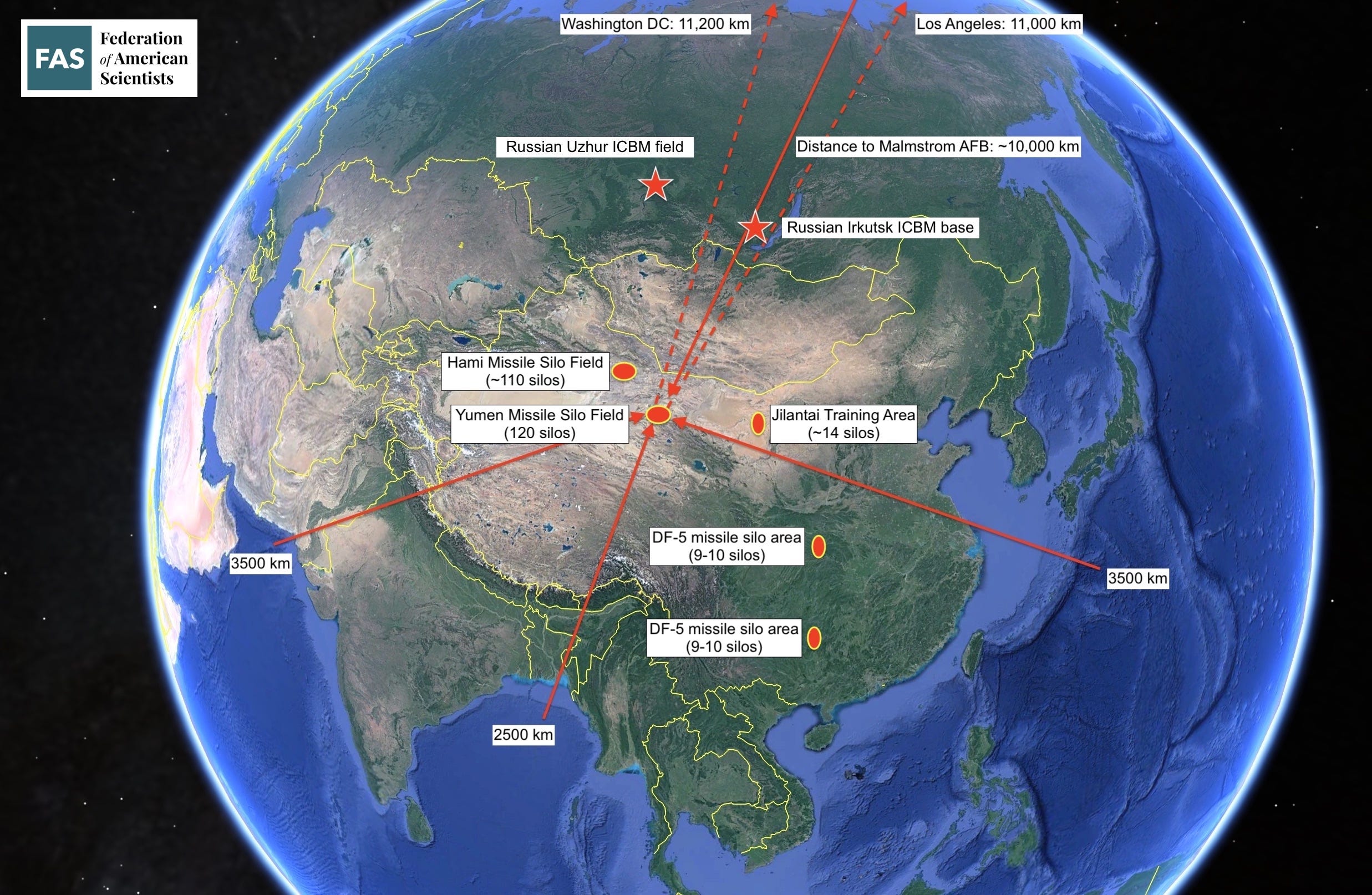
Reuters recently identified more than 80 new pads near China’s Hami missile fields, possible launch positions for mobile missiles and air-defense batteries. They are surrounded by bunkers and facilities analysts believe may support electronic warfare, satellite communications, command and control, maintenance, and storage. Nearby airfields and railheads knit it all together.
No one outside Beijing knows how every pad will be used. But they know exactly what it means. China has tripled its strategic nuclear force — the weapons that would target and destroy American cities — in just four years. Nor are they slowing down: the construction continues, fast.
That would be alarming all by itself. But when combined with Russia’s nuclear forces, it complicates arms control calculus almost impossibly, and threatens to force a costly global arms race of ruinous proportions.
The uncertainty is a big part of the point. The Chinese are dispersing, hardening, concealing, and multiplying the forces around Hami, one of three vast new ICBM silo fields. The Pentagon believes they have likely already loaded more than 100 DF-31-class missiles into silos across those three fields. China’s nuclear stockpile has reached the low 600s and is on track to exceed 1,000 warheads by 2030.
This is not China’s historical “minimum deterrence.” It’s the construction of a survivable, rapidly expanding strategic force designed to complicate every American calculation and give China real first-strike capabilities. It’s also sufficiently concentrated so as to make it readily defensible by antiballistic missiles (ABMs).
Does China want to fight a nuclear war with the United States? Doesn’t matter. It absolutely wants nuclear cover for conventional aggression: a force frightening enough to keep America out of a Taiwan invasion or other adventure while Beijing changes the map.
This is exactly the danger Donald Trump has sought to pre-empt in Iran. But China is a tougher nut to crack. And the danger is not limited to China’s fast-growing arsenal.
For half a century, nuclear strategy has rested on bilateral arithmetic. Washington counted Moscow’s launchers and warheads. Moscow counted ours. Each side knew roughly what the other could destroy, what would survive, and what would come back.
China has turned that equation into a nearly unsolvable triangle, in which any two powers could gang up on the third. Traditional equal arms-control limits become almost meaningless when any two parties can combine twice the firepower permitted to the third.
That makes the world very dangerous very fast. And since China and Russia don’t trust each other either, all three countries have to try to outbuild the others, not individually but combined. That rapidly spirals to numbers of weapons far in excess of the Cold War peak, with staggering economic costs and vastly higher risk of miscalculation and conflict.
This is why President Trump’s Golden Dome is the most important defense project in the world.
Arms control can’t solve this problem. And China has never participated in any arms control agreement anyway. They’re pretty clear on the point that they don’t mean to start.
So if the old ways won’t work, we need a new one. And it just so happens that American technology can solve the problem…if we use it.
Why Arms Control Is No Longer a Solution
I have long asserted the utter uselessness and counterproductivity of arms control. There are really only two significant exceptions.
