


Normally our Deep Dives are for Premium Members only. But this one is so important we’re making it free for everyone. Join today!
by Rod D. Martin
June 11, 2026
Fourteen years ago, almost to the week, Facebook stumbled out of the gate.
It debuted at $38. It briefly touched $45. Then it fell, and the press behaved exactly as the press always behaves when an extraordinary company fails to provide ordinary investors with an instant casino payout.
They called it overvalued. They mocked Mark Zuckerberg (and Peter Thiel). They said Facebook would never monetize. They treated the IPO as a failure because the people who actually built the company did not leave half their money on the table for CNBC’s favored traders.
I called Facebook a Strong Buy. If you listened, you made a LOT of money.
Not because I knew the bottom. I didn’t. I said at the time it might get worse before it got better. It did. I said the noise might continue for months. It did.
But none of that mattered, because the market was asking the wrong question.
The question was not whether Facebook would trade down from its IPO price. The question was whether Facebook already dominated the social graph, and whether that dominance would eventually monetize at a scale the critics refused to imagine.
It did. Spectacularly. Of course.
Now SpaceX is about to go public, and a lot of the same people are making the same type of mistake. Except this time the mistake is bigger. Much, much bigger.
Facebook organized the social graph. SpaceX is organizing the economic graph, of a new terrestrial economy, a new geopolitical reality, and of a multiplanetary human future.

SpaceX is the company that moves mass from Earth into orbit at unmatched scale and about 5 percent of the cost, that is building Starship to make that movement radically cheaper, that connects the planet through Starlink, that is creating AI infrastructure even its competitors need (and pay for), with orbital data centers, lunar industry, Martian cities, and, on the horizon, new technologies and new markets that barely exist today.
That is exactly why Martin Capital is rating it a Strong Buy, at any price that presents itself. Whatever that number is, and whatever volatility it may undergo, there is no price available in the vaguely near future that isn’t a generational bargain.
SpaceX Is a Generational Opportunity
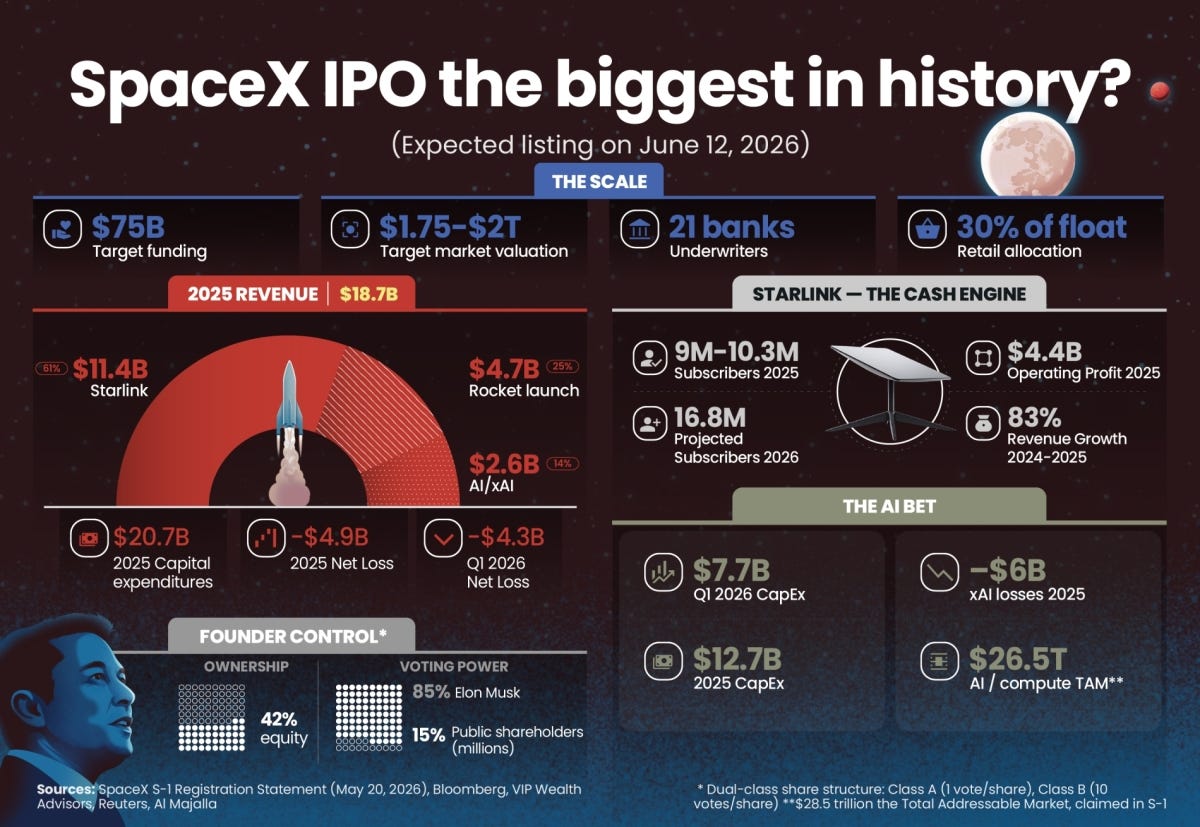
SpaceX is expected to go public on the NASDAQ under the ticker SPCX at $135 per share, raising around $75 billion at roughly a $1.75 trillion valuation. That makes it, by far, the largest IPO in history. It also makes the usual crowd faint.
If you are trying to flip shares on Friday afternoon, and many will, volatility will matter. If the market decides it’s priced to perfection, as Facebook was, it will leave little money on the table in the near term for the kind of lottery win many are looking for. I’m not predicting that. I’m just warning you it could happen.
But if you’re looking to own the most important company of the twenty-first century, short-term volatility matters a great deal less.
The market is going to spend the next few days asking whether SpaceX is worth $1.75 trillion today. That’s the wrong question. The right question is whether any other company on Earth is remotely positioned to own the transportation layer between this planet and the rest of an inhabited, productive, militarily contested Solar System.
SpaceX no longer merely sells rocket launches. Launch is becoming its production line. The old business model was carrying someone else’s payload to orbit for a fee. It still does that: in 2025 it launched at least 85 percent (or more) of the total payload mass to orbit for the entire world.
But SpaceX’s new business model is much bigger: using its own rockets to put its own products into orbit — Starlink first, orbital data centers next, manufacturing, mining, and whole cities after that. The rockets enable a far bigger expansion of human civilization, just as wooden ships and railroads once enabled the creation of America.
Ordinary launch-company multiples miss the point entirely.
SpaceX dominates launch. Starlink dominates satellite broadband. Starship, once fully operational, changes the payload economics of orbit, the Moon, Mars, point-to-point terrestrial transport, even military logistics. And Elon intends to build hundreds if not thousands per year. Thousands of Starships mean ubiquitous, cheap, regular travel between continents in less than an hour. They’ll also enable the deployment of whole armies around the world in that same short time.

The company’s AI infrastructure adds another layer. Its future is not one market but an interlocking sequence of markets that become possible because first it collapsed launch costs.
That is what the skeptics cannot value. They see only today’s revenue and tomorrow’s capex, not the radical expansion of human civilization that is finally upon us, much less the geopolitical (indeed, astropolitical) stakes.
How would you measure that? How would you have measured it in 1492?
Mass, Energy, Process, Value
A useful way to think about the space economy is through four words: mass, energy, process, and value.
To do anything in space, you need mass. You need to put physical stuff where there is almost no physical stuff. Rockets are the answer. Fully reusable rockets are the revolution. Over time, the real breakthrough they enable will be getting more of that mass from space itself — from lunar resources, asteroid mining, mass drivers, and other systems that make Earth the starting point and the consumer market, not the permanent supply depot.

To move mass you need energy. In space, that’s nearly limitless. Solar power, completely unobstructed by weather or night, is limited only by the collection systems deployed. There are still meaningful engineering problems — storage, thermal management, radiation, assembly, repair, transmission — but the basic strategic fact is obvious: the Solar System is powered by the Sun. And Elon’s “other” company Tesla is at the cutting edge of that too.
To coordinate all this you need process: communications, AI, robotics, autonomy, manufacturing, and data centers for a start.
Mass plus energy plus process creates value. Not national vanity projects or pure-cost exploration. An entirely new and vastly larger economy.
SpaceX already owns more of the mass layer than anyone else. Starlink owns the communications layer. Starship gives SpaceX the chance to dominate orbital logistics. AI infrastructure and orbital data centers point toward the next layer.
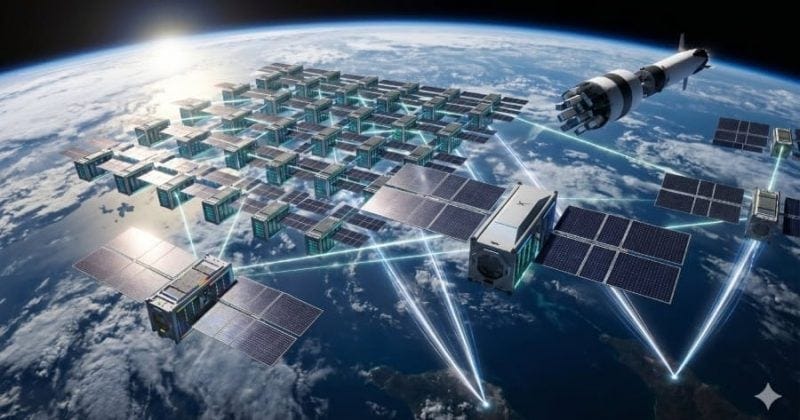
Those data centers also solve an enormous problem on Earth. AI is exploding, but it’s running into a wall of energy, cooling, land, water, permitting, grid interconnection, and local opposition. Everyone wants AI. The power plants, transmission lines, water use, heat, and industrial footprint are turning out to be another matter: America is suddenly in the grips of NIMBY, in part CCP-funded. Space eliminates the problem — and turns it into a staggeringly lucrative opportunity for the one company that can launch, power, connect, and maintain the infrastructure at a price and scale with which no one can compete.
Today, Starlink funds Starship. Starship lowers the cost of Starlink and increases its profits. Fully reusable Starship enables orbital data centers. Orbital data centers create enormous demand for launch, power, communications, and maintenance. Lunar infrastructure supplies mass and materials. In-space manufacturing creates more valuable things in space. Mars settlement becomes just the inevitable next step in a rapidly expanding economy.
That is what Wall Street is trying to value with a price-to-sales ratio.
Good luck.
The 1492 Premium
There is also a geopolitical premium here, and it’s not small.
The Moon, Mars, cislunar space, Lagrange points, orbital data centers, lunar fuel, and in-space manufacturing will not remain abstractions for long. They will be financed, built, occupied, governed, and defended by someone.
In the process, either we will define the human future, or China will. If you want a better future than censorship, genocide, and social credit scores, the CCP must not be allowed to seize the vast domain opening before us.

China has already shown us how it behaves when given an opening. In the South China Sea, it has staked out uninhabited atolls, poured concrete, militarized them, and then used them to claim sovereignty over international waters. Space will be no different.
The lunar South Pole matters because its abundant water ice is not just water, as life-and-death important as that is. It’s oxygen and hydrogen: fuel. The Moon is the first gas station between Earth and Mars. Whoever can deliver the most equipment there, fastest and cheapest, gets to shape and control all that follows.
That is yet another way in which the valuation argument escapes every ordinary spreadsheet. Analysts are trying to price rockets. They should be trying to price the ships to the New World, and the value of the modern equivalents of Spanish forts and cities from the Canary Islands to Cuba.
Imagine being able to invest in 1492, not just in the ships, but in the ports, trade routes, colonies, mines, farms, cities, and the entire opening of a hemisphere.
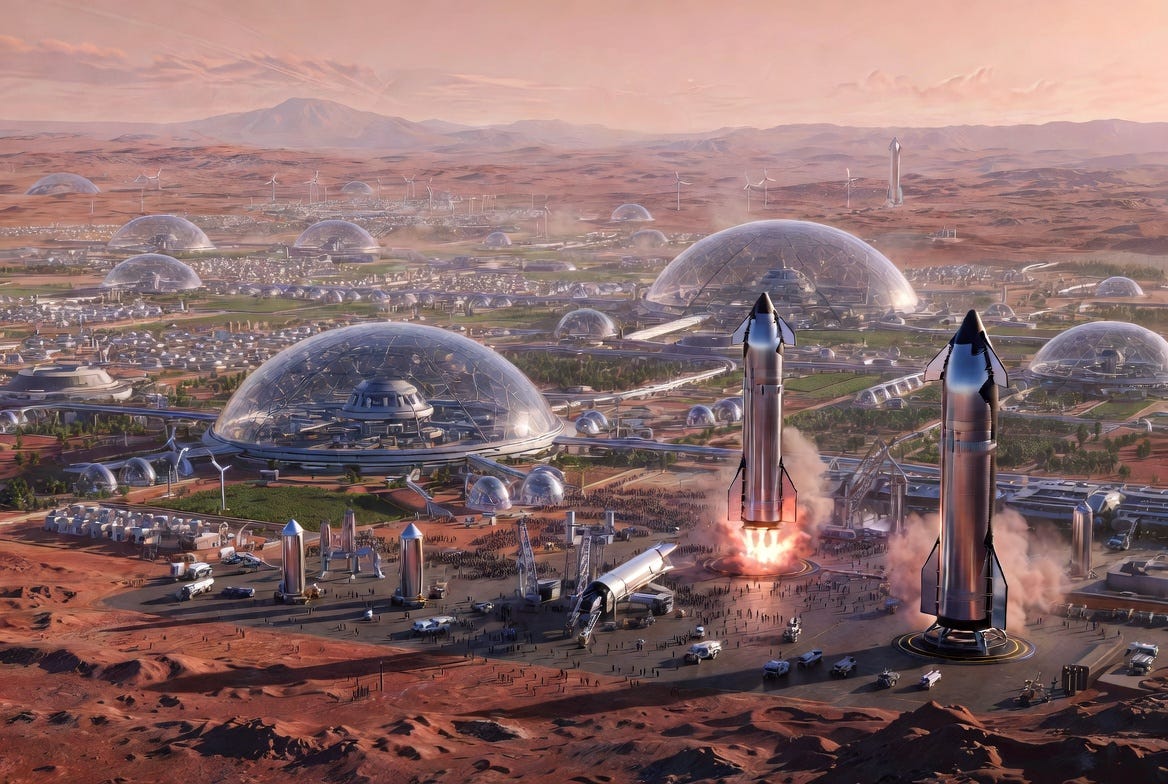
That is the magnitude of the question. The terrestrial applications would be more transformative than the entire aerospace industry till now. The offworld opportunity dwarfs our planet.
Tesla Is the Missing Multiplier
But SpaceX by itself is not the whole story. Tesla is the missing multiplier.
The lazy analyst still thinks of Tesla as an electric car company. But Tesla is batteries, motors, power electronics, manufacturing, autonomy, real-world AI, sensors, energy storage, solar power, charging infrastructure, and robots. Especially robots.
Every one of those things matters more off Earth than on Earth.
The Moon and Mars don’t need “cars” in the Detroit sense. But they do need an ever-increasing number of pressurized rovers, autonomous haulers, mobile power platforms, mining vehicles, robotic construction equipment, distributed batteries, solar fields, factories, repair systems, and machines that can work in a hostile environment both before and after humans arrive.
That is Tesla.
Starship can move civilization. Tesla can build out that civilization once it gets there.

Indeed, Tesla’s defining product may be Optimus. On Earth, Optimus will transform manufacturing, elder care, logistics, construction, agriculture, warehouses, and domestic labor. In space, though, Optimus massively multiplies the off-world workforce, collapsing the time needed for large-scale human expansion.
We rate Tesla as a Strong Buy too. There will be a billion humanoid robots sold in the next ten years, and a very high percentage will be Optimus variants.
The question is, would Tesla be even more valuable as part of SpaceX?
Yes, it would. A combined Tesla-SpaceX-xAI structure would be vastly more cost-efficient and create far more shareholder value. It would also be a lot more to Elon’s liking.
Today, the broader Musk ecosystem has enormous internal logic but separate corporate wrappers. That creates friction. Any movement of capital, technology, data, talent, chips, vehicles, batteries, compute, satellite access, robotics, or brand value between the companies can be treated as a related-party transaction, a governance scandal, or a class action lawsuit.
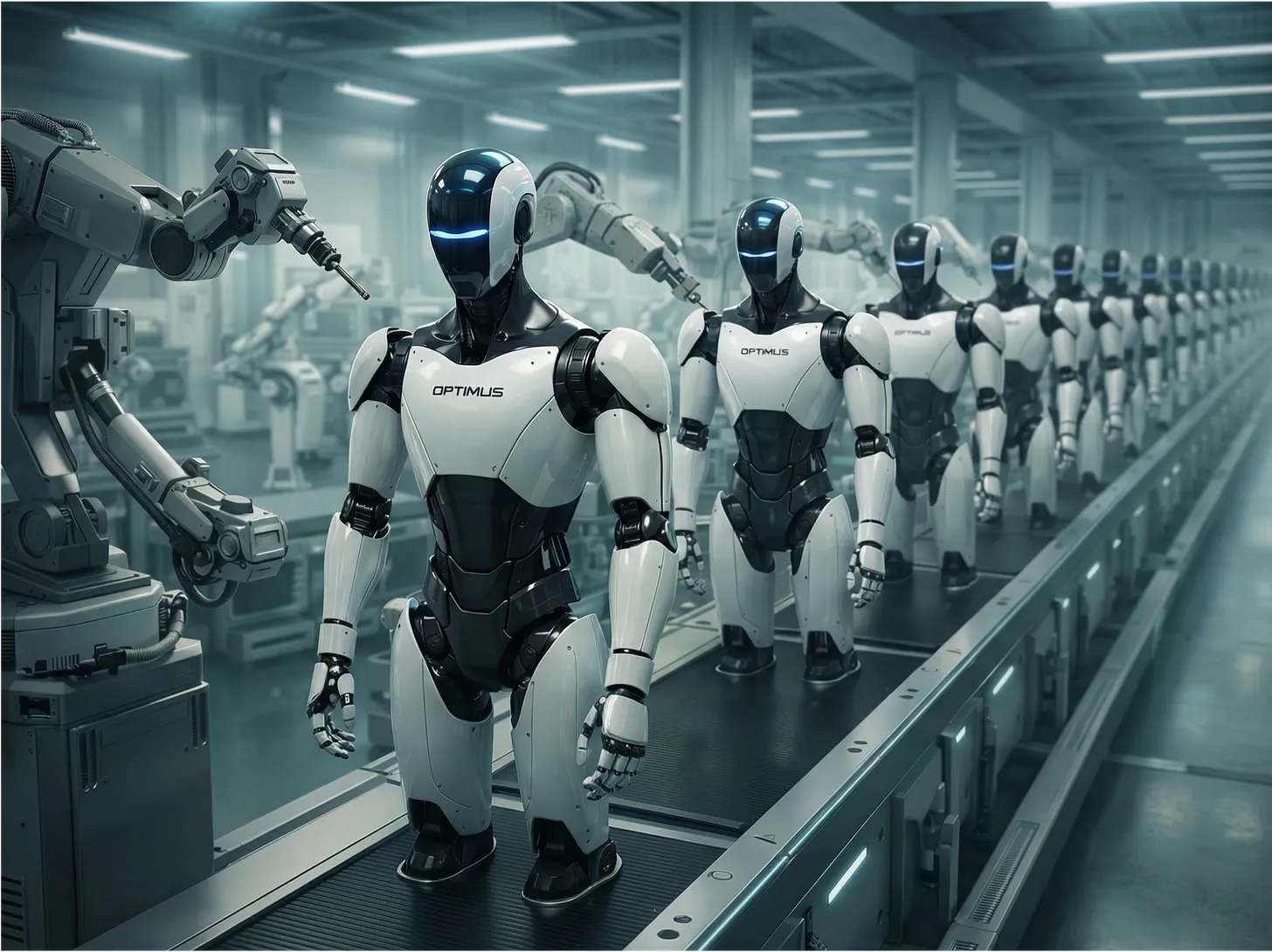
A merger changes all of that. It turns intercompany conflict into efficient internal capital allocation.
That is not a small thing. It is the thing.
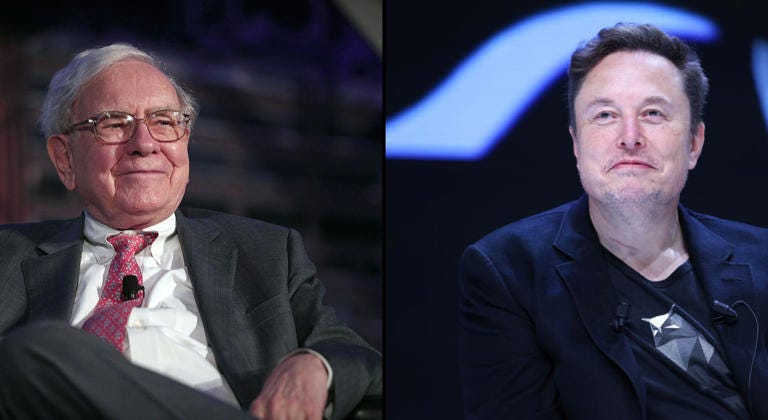
Berkshire Hathaway became one of the greatest companies in history by allowing Warren Buffett to allocate capital across unrelated businesses. Insurance cash flow could buy railroads. Railroads could support energy. Energy could support manufacturing. The whole became far more valuable than the sum of the parts because the capital allocator was better than the market.
Is Elon Musk as smart as Warren Buffett? You tell me.
A combined company would not merely own pieces of the future. It would own the stack: launch, satellites, autonomy, robotics, batteries, solar, AI, communications, vehicles, orbital infrastructure, and eventually the infrastructure of off-world mining, manufacturing, and settlement. That’s not a conglomerate: it’s the operating system for the next era.
It would also give Elon one cap table — unified control — and perhaps even more important, one equity currency.
That matters. The best of the best don’t just work for a salary. The world’s foremost engineers, roboticists, AI researchers, manufacturing leaders, chip designers, launch operators, mission planners, battery experts, and tunneling specialists work for equity: a piece of the fast-growing pie. Again, a unified whole would be worth a lot more than the sum of the parts.
Elon builds what others hold conferences about. He needs a megaphone? He buys one. He needs AI? He builds his own. He needs launch? He reinvents it. He needs energy, robots, vehicles, and manufacturing? He creates those too.
Who doesn’t want to own a piece of that? And who doesn’t want that mind boggling complexity simplied into a unified structure that’s easier to run, more efficient in its operations, and provides multiple revenue streams instead of counting on just one?
In lesser hands, such mergers could and frequently have gone horribly awry. But Elon’s are not lesser hands. The merger is a force multiplier.
It’s also highly likely. Just ask these guys:
“I think Elon will consolidate control and power of his two seminal assets into one cap table.” — Chamath Palihapitiya, venture capitalist.
“That’s in his heart. He wants to make this one big company.” — Walter Isaacson, Elon Musk biographer.
“Musk wants to own and control more of the AI ecosystem and step by step the holy grail could be combining SpaceX and Tesla in some way.” — Dan Ives, Wedbush Securities.
“Good idea.” — Elon Musk, responding to a proposal for an “X” holding company above Tesla, SpaceX, Neuralink, and The Boring Company.
Buying the SpaceX IPO is likely to give you a stake in the entire, far more efficient ecosystem. And that will only increase the value of your investment.
It’s Not FOMO: It’s Just Smart
That doesn’t mean SpaceX won’t trade down. It might. It doesn’t mean Tesla shareholders should accept a bad exchange ratio. They shouldn’t. It doesn’t mean regulators can’t obstruct, China can’t compete, or Elon himself won’t create occasional volatility. All of that’s the price of admission.
But SpaceX will not be valued correctly by treating it like Boeing, Lockheed, AT&T, or any other “normal” company. Even at a $1.75 trillion valuation, SpaceX is a bargain. There is no price at which you can buy it that ten years from now won’t seem cheap.

The critics will say otherwise. So be it. They said Facebook was a disaster. They said Tesla would fail. They said reusable rockets would never work. They said Starlink was impossible. At some point, the people who are always wrong about any longer-term future than the next quarter should stop being treated as experts on it.
Traders will trade the chart. Analysts will argue about multiples. Bankers will count fees. Reporters will hunt for governance scandals. Regulators will circle. Competitors will complain.
Let them.
Elon is not merely launching an IPO.
He is assembling the company that builds the next century or more.
And that future belongs to those who own it before everyone else figures that out.


