


by Rod D. Martin
February 21, 2018
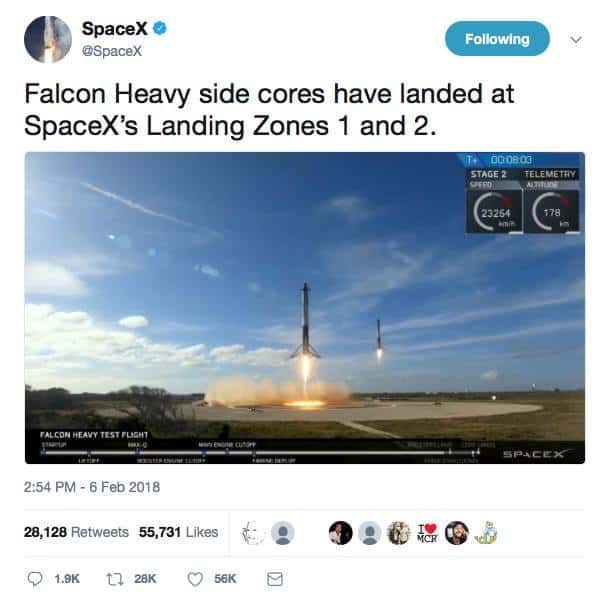
When Elon Musk and Jeff Bezos began testing reusable rockets, few really understood the significance of what they were seeking to achieve. Now that SpaceX is routinely re-launching used Falcon 9 boosters – not to mention this month's launch of the world’s most powerful rocket, the Falcon Heavy, with three times the payload of the Space Shuttle – it is tempting, having never answered the original question, to yawn at what is quickly becoming the new normal.
Indulging that temptation would be a mistake. Reusability is a revolution comparable to the invention of sail, or steam: it changes absolutely everything.
Cost determines use. Supply creates demand.
What’s the big deal about landing a rocket, you might ask? We see airplanes land all the time, after all.
But that’s exactly the point. Airplanes are routine: you don’t have to build a new one every time you fly. If you did, on average (based on list price for a new 737), that would increase the cost of each and every airline ticket by roughly $493,650.79. Each way.
In a world like that, you might go see grandma a bit less. But in the world we actually inhabit, U.S.-serving airlines alone carried almost a billion passengers last year.
Most of the cost of a rocket launch is in its first stage, which until now has been built anew for every flight. It has always been this way; and indeed, the rockets NASA uses – heretofore sold primarily by Boeing and Lockheed Martin, banded together in a joint venture called United Launch Alliance – are based on designs first created in the 1960s. An Atlas V launch costs as much as $150 million. That’s not greatly dissimilar to the cost a decade ago, a quarter century ago, or at the dawn of the Space Age.
SpaceX broke that mold in part by building and flying the first completely new rocket design since the 1960s. Elon started working on it even before we sold PayPal to eBay. Taking his relatively small share of the proceeds of that sale, he was flying cargo to the International Space Station within a decade, at half the cost of that Atlas V.
Elon’s determination to innovate rather than iterate has already transformed the industry. And considering the comparative paucity of resources he had available – one man’s personal wealth vs. the money-printing power of the richest government on Earth – that may already count as a bigger achievement than walking on the Moon.
Even so, the potential of reusability dwarfs that 50 percent cost savings. Even after only a few launches, reusing a Falcon 9 first stage has already cut the company’s cost per launch substantially. But SpaceX believes that, once it has worked out the kinks and once it has a fleet of reusable craft flying, it might be able to provide the equivalent of that $150 million ULA launch – already $62 million or less at SpaceX – for as little as $700,000.
Yes, within a decade, Elon (and presumably Jeff Bezos also) may be able to lift 214 times as much into space for the same money as one launch by NASA and ULA. And yes, that happens to be about the difference in magnitude between a first-class ticket on an actual 737 and the ticket you’d have to buy on an expendable variant.
Put in that perspective, the difference in possibilities is shockingly vast. It’s wagon trains vs. freight trains, clipper ships vs. container ships. And given a little time, it’s the world enabled by those innovations as well.
The Space-Industrial Complex
Of course, as children of what was once quaintly called “the Space Age”, an era in which all the promises of a Jetsons future were thoroughly dashed, the question we can’t help but ask is this: why didn’t aerospace giants like Boeing, Lockheed Martin, and yes, the United States government itself do all of this years, if not decades, ago?
True, the technology is nontrivial. But so is the technology to go to the Moon, or to build the internet, or to fill the world with iPhones. SpaceX has spent just $1 billion to develop and implement reusable technology, roughly 5% of NASA’s budget for a single year. And unlike Elon Musk, who started SpaceX with around $100 million of his own, very finite dollars, the United States literally prints money, and spends billions on space every single year, with companies that have spent billions more of their own.
They had virtually unlimited resources compared to tiny SpaceX, for half a century longer than SpaceX has existed. So why wasn’t making that money go twice as far, much less 214 times as far, a priority? Why have they literally been sending our tax dollars up in smoke?
