



This analysis is free, but with Premium Membership you get MORE. Join today.
NOTE: Daniel Hess’s work on the growing demographic implosion — and what to do about it — is excellent. Be sure to follow him on X. — RDM
by Daniel Hess
May 28, 2026
Demographic collapse is getting real. Fertility numbers have been moving relentlessly downward in the last decade, and the latest figures are shocking: 0.88 births per woman in Chile, 0.73 in South Korea, 1.25 in Canada and 0.92 in China. The United States, once comfortably close to replacement, now has a fertility of just 1.6.
Meanwhile the religious, from traditionalist Catholics to the Amish, from the Laestadian Lutherans in Finland to Orthodox Jews in Israel, from pious Muslims to devout Africans, are the ones still having children in high numbers. For countries and U.S. states, and all the way down to the level of individuals, religiosity is a strong predictor of fertility.
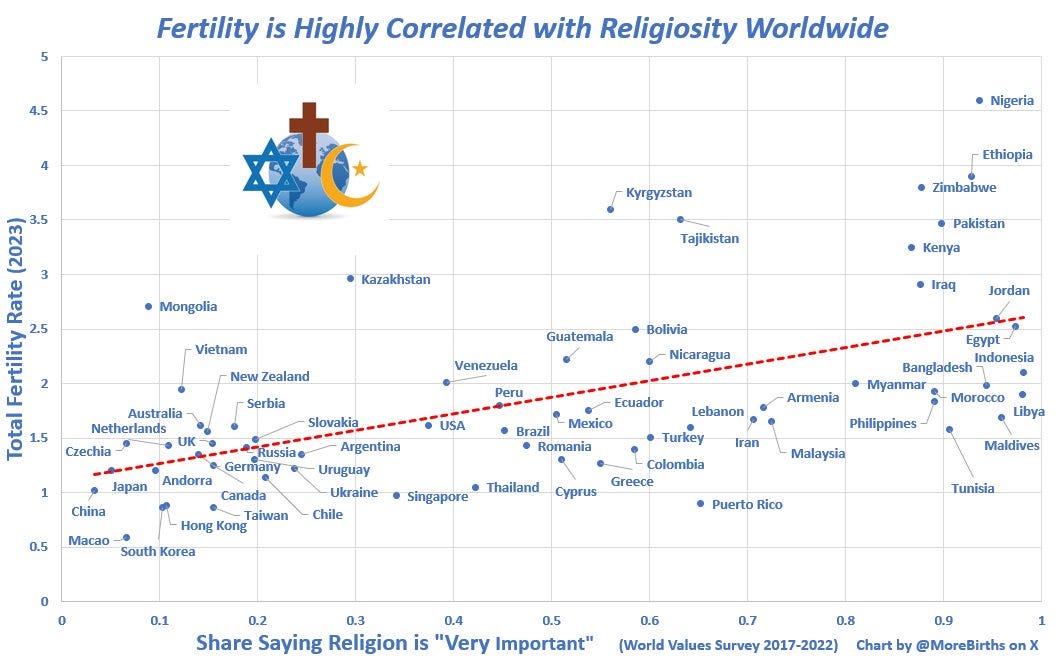
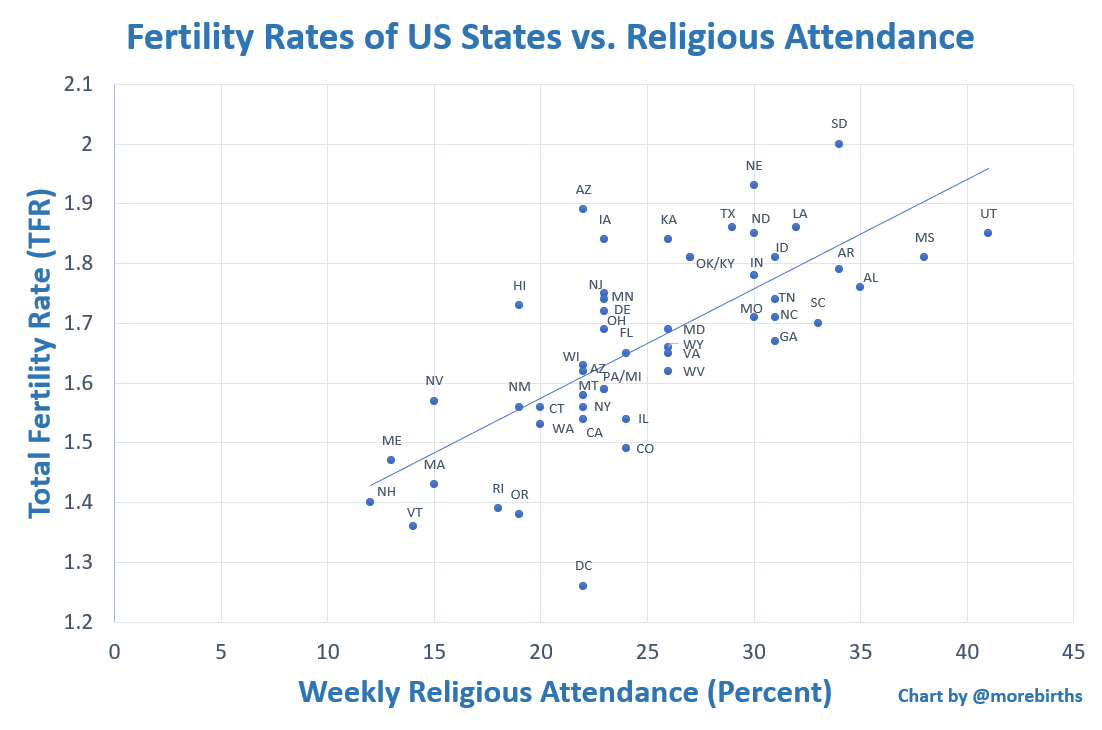
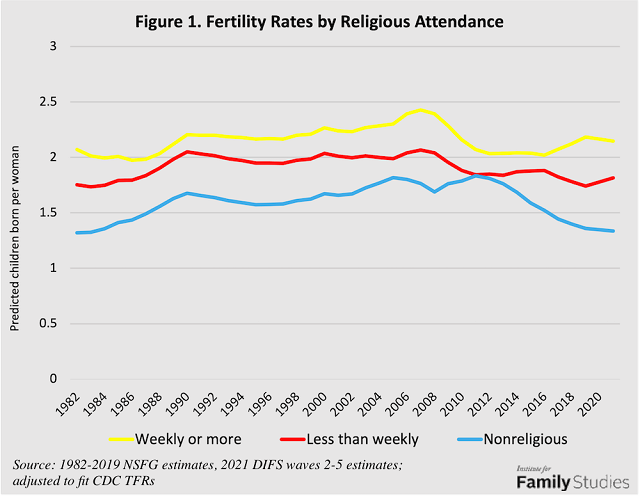
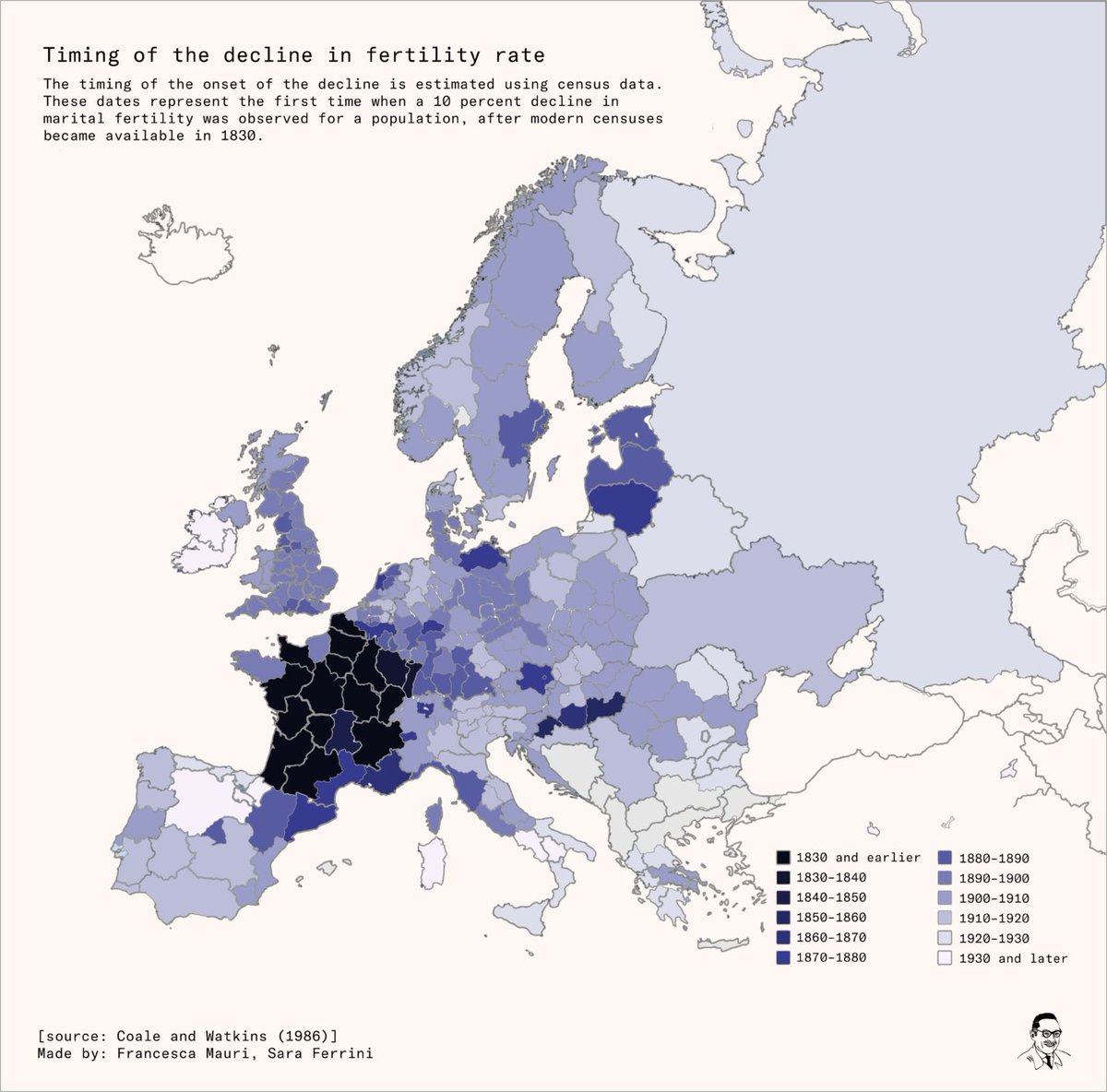
This isn’t a new story either. Secularization as early as the 1700s in France explains why the French population stagnated in the 1800s while Victorian England, which did not secularize until much later, remained fertile and growing.
At the same time, America had extraordinary fertility and grew from 2.5 million people in 1776 to 76 million in 1900, with a backdrop of religious fervor propelled by a series of Great Awakenings.
A lot of very brilliant people, like my friend Robin Hanson (a longtime atheist), have come to appreciate the value of religious belief a whole lot more in a world of collapsing birthrates. That’s not to say he has suddenly come to believe religious doctrines are true. But he has a newfound respect for cultures that have what it takes to endure in a world that seems to be succumbing to fertility collapse.
What is it about religiosity that leads to higher fertility? There are several causes. Let’s explore.
1. Religion as source of transcendent meaning and pronatal belief
As evolutionary psychologist Geoffrey Miller explains, physical attraction and the sex drive were once all that was needed for high fertility. But now with a range of techniques and tools for contraception, people can follow their innate drives without having any children at all. Means for avoiding pregnancy have existed for centuries but have been perfected much more recently.
In this brave new world, children are a choice rather than a byproduct of our biological impulses. Religion, which provides beliefs that lead people to want more children, matters even more than in the past.
Demographer Lyman Stone, conducting a large study of religiosity and fertility in Canada, found enormous differences in family ideals and intentions by religious attendance.
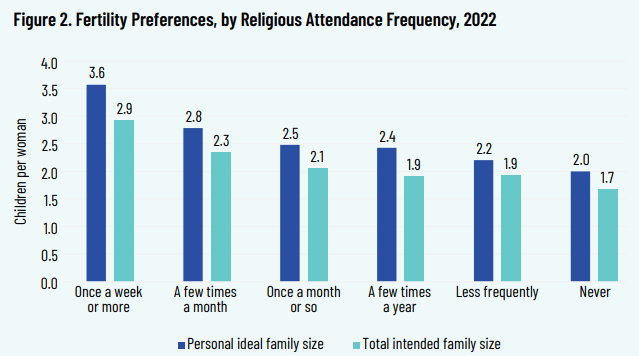
When you take into account the fact that people tend to have fewer children than they want, only the religious in Canada are near replacement.
2. Religion as a cultural bridge between men and women
A little over a year ago, data scientist John Burn-Murdoch published a graph that shocked the world. He showed that a huge ideological gap has opened between men and women in many countries.
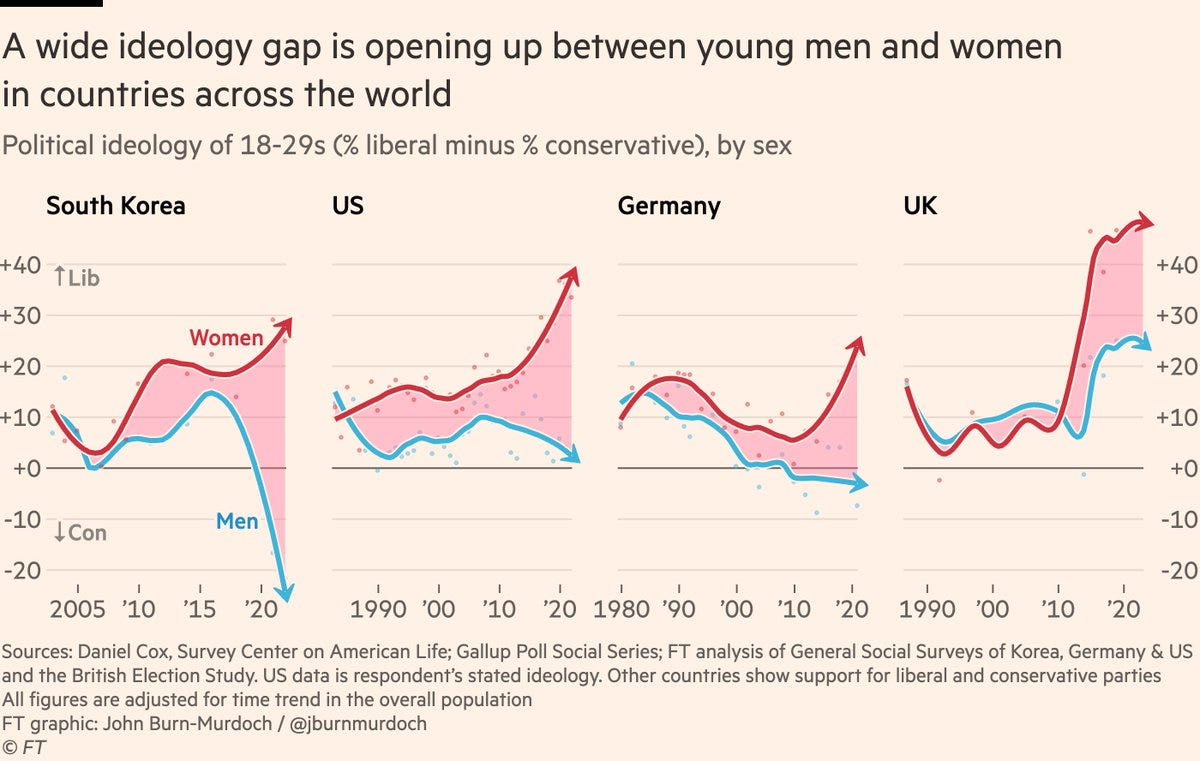
This is a big hindrance to marriage and family formation because most people are very reluctant to partner across an ideological divide. In fact, an analysis by FiveThirtyEight found that only about 4 percent of new marriages in the U.S. are between Democrats and Republicans (versus 20 percent of new marriages that are interracial)!
Meanwhile, the rise of online dating (which would seemingly make it easier to find partners) has actually made things a whole lot harder.
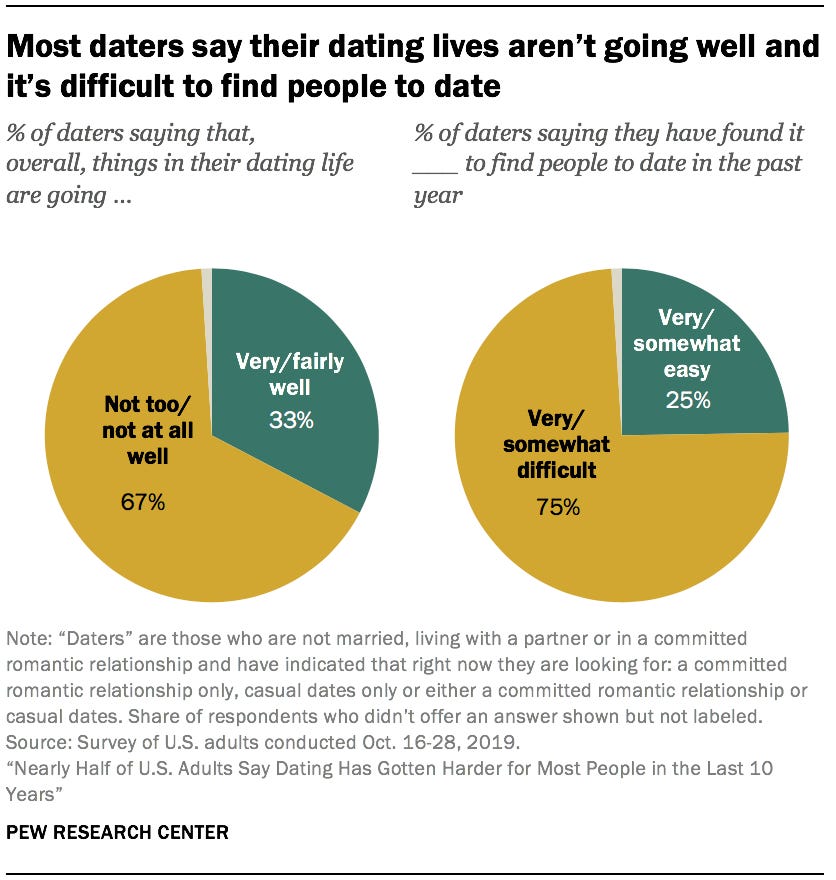
I explained why online matching services are so bad at making couples in this X post. Click for details:


As demographer Stone explains, religious communities offer a dating pool that is already pre-screened for common belief and purpose, making it far easier for young people to find a match.
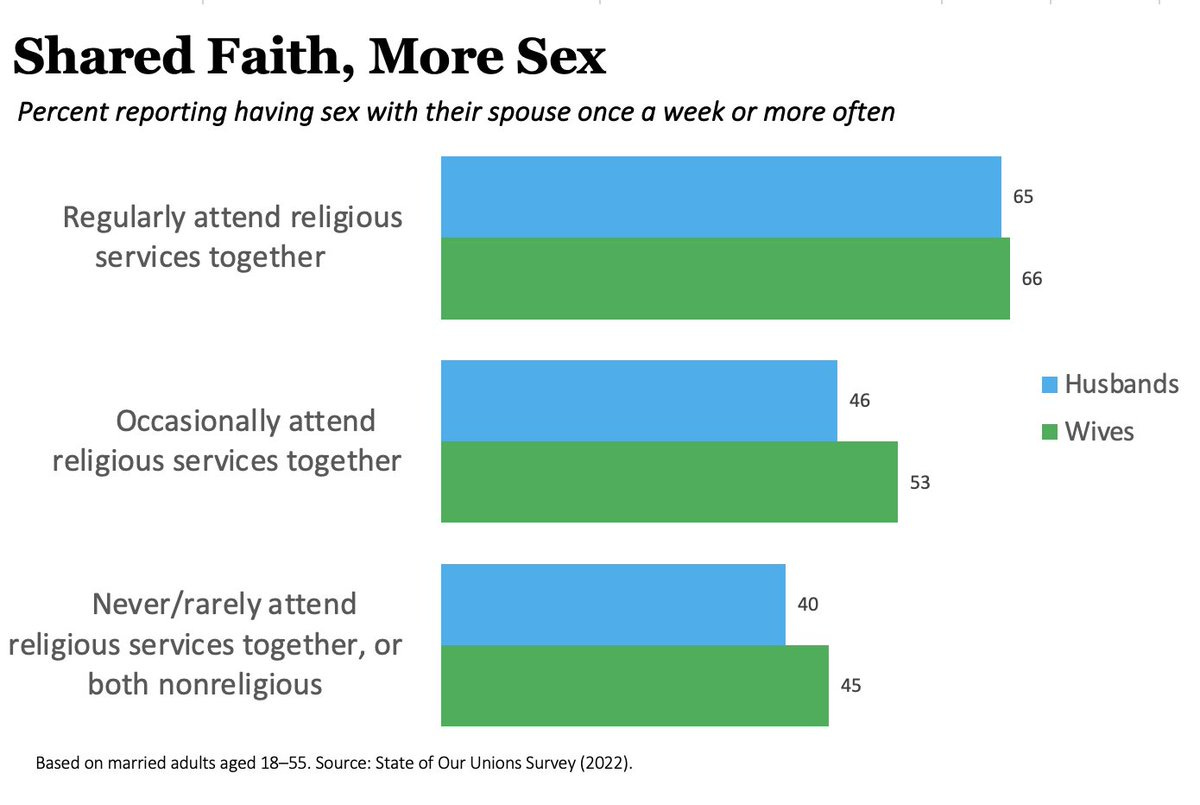
Common belief is apparently a very big deal. Family studies expert Brad Wilcox reports in his 2024 book that religious couples are having a lot more sex, suggesting greater relationship success. It also can’t hurt the business of baby making.
3. Greater happiness and mental health
The Baylor Religion Survey found that those who are religious tend to have far lower rates of depression than those who are not religious.
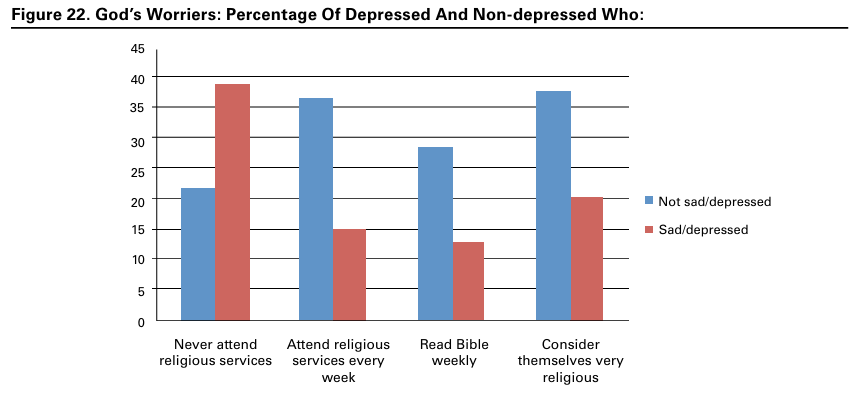
This is a finding that has been confirmed by numerous other studies such as Fruehwirth, Iyer and Zhang (2019).
This matters because as a report by the Institute for Family Studies showed, happier people are much more likely to go for more kids.
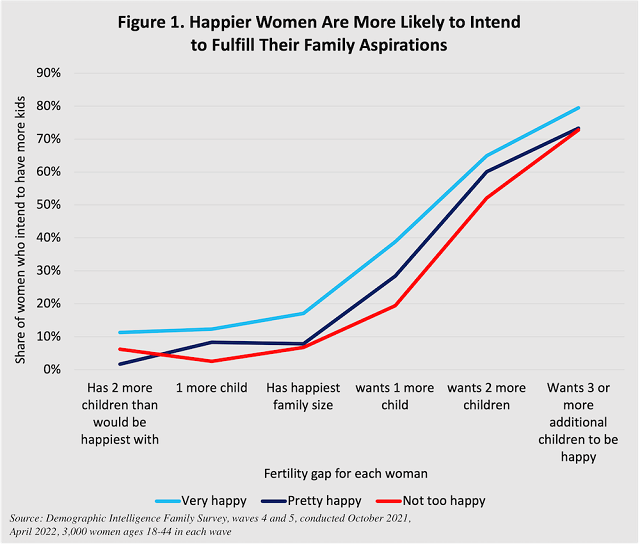
Philosopher and poet Elon Musk recently made this point in verse.

4. Faith communities are a social network that makes it easier to raise kids
Journalist and author Tim Carney emphasized in his 2024 book Family Unfriendly that religious communities make parenting a lot easier. They do this, he says, by creating thick support networks of like-minded families. Demographer Stone explains that alloparenting (childcare help by people other than parents) is a big reason why fertility is a lot higher in faith communities.
Relatedly, studies show that having children is socially contagious. Women are much more likely to get pregnant if their friends and acquaintances are pregnant. And a religious community is a great place to catch the baby bug!
5. Faith groups confer status on mothers and big families that the rest of society does not
In 2024 I wrote a viral thread on Mongolia, showing how women will have a lot of children if motherhood is considered high status.


Motherhood isn’t especially high-status across society these days. But for certain religious groups like the Amish and the Haredi, it is high status to have a lot of kids. And so, their fertility is high.
And that is a big part of what pronatal culture means.
Some caveats:
1. Not every faith is pronatal
The Abrahamic faiths (Judaism, Christianity and Islam) all urge the faithful to have more children. For Christianity and Judaism, this starts at the very beginning of the bible, with the command, “Be fruitful, multiply, fill the Earth and subdue it.” All three of these faiths are associated with higher birthrates.
But Buddhism, the fourth-largest faith, seems to have a low or even negative correlation with fertility (Skirbekk 2015), lacking clear pronatal teaching. Enlightenment in Buddhism is a solitary affair. Hinduism, the third-largest faith, is more complicated. Although less ideologically pronatal than the Abrahamic faiths, traditional Hinduism celebrates marriage strongly, and that is pronatal in effect.
The Amish and the Haredi are notably a lot more pronatal than the ancient traditions they derive from. That suggests that belief systems are movable on a pronatal axis, and can be changed to be much more pronatal!
2. Repressing faith is a bad idea, if you care about birth rates
Below is a map of countries that are already falling in population, meaning that they have had low fertility for a very long time, not merely that their current Total Fertility Rate (TFR) points that way.
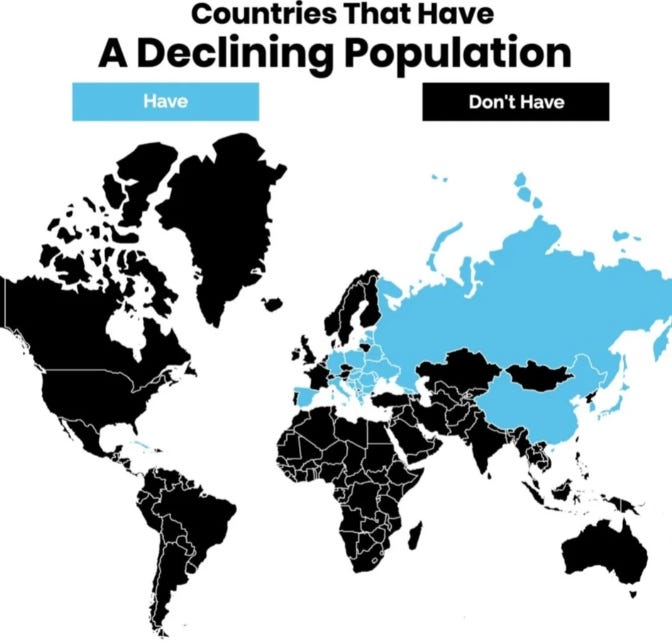
Compare that to a map of the current and former Communist world, where religious practice was intentionally suppressed.
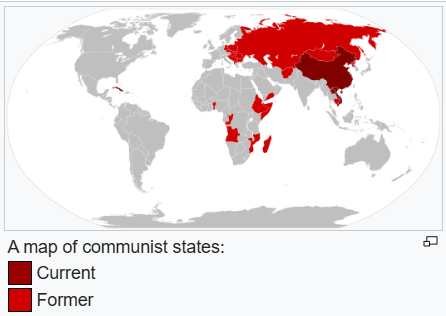
These maps are pretty close! Notice Eastern Europe and also Cuba in the Western Hemisphere. The case of China is especially notable. Demographer Yi Fuxian explains that traditional Confucianism, which is very pronatal, was stamped out over many years by the CCP.
3. A challenge for the rest
Can secularists also create a pronatal culture? There is hope. In Mongolia and Israel, secular people have high fertility, because the national culture positively celebrates having children.
Meanwhile, the lesson of modern fertile sects is that faith groups that are only weakly pronatal can become a lot more so. In a world of crashing fertility, everything helps.
— This essay originally appeared on X. Be sure to follow him there as well as on Substack at More Births.


In an Orthodox Jewish community, kids and baby carriages are everywhere. Double strollers aplenty. Many of the mothers manage households in an organized way you couldn't imagine, while often holding jobs in teaching, social work, etc. Families work as a team, which was especially important during COVID mania.
The first command before the Fall--relational and economic--and never negated: "Then God blessed them, and God said to them, “Be fruitful and multiply; fill the earth and subdue it; have dominion over the fish of the sea, over the birds of the air, and over every living thing that moves on the earth.”--Genesis 1:28