


by Rod D. Martin
May 26, 2026
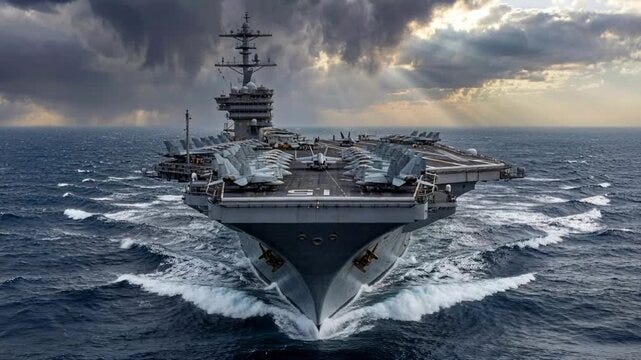
Over the past several months, President Trump has wielded the country’s naval power the way only an American President can: first to pressure Venezuela into submission in the Caribbean, then to smash Iran’s war machine in the Middle East, and now to send the Nimitz Carrier Strike Group to Cuba as the Communist regime staggers.
China has been watching all of it. It can do nothing about any of it.
America’s power is unmatched. But the tempo of operations proves an uncomfortable point: America’s carrier force is magnificent, but despite being nearly four times the size of its nearest competitor, it’s too small for its mission.
Unmatched power is not the same thing as sufficiency. America must be able to quickly establish dominance off the coast of East Asia, the Mediterranean, the Middle East, the Arctic, the Caribbean, the GIUK Gap, the Strait of Malacca, the South China Sea, and every other place where American interests and allies might be threatened.

The Courts have taken liberties with the Constitution for far too long. An Article V convention could close the loopholes. Learn more here.
So America has 11 carriers. Theoretically.
But that’s a fiction.
Federal law requires the Navy to maintain “not less than 11 operational aircraft carriers.” But the same law allows a carrier to count as “operational” even when it is temporarily unavailable for worldwide deployment because of routine or scheduled maintenance or repair. Which sounds reasonable until you realize that “scheduled maintenance” of a nuclear-powered supercarrier can take as much as three to six years.
In other words, Washington can count a carrier that cannot actually fight. And it does. At any given moment, about five of its 11.
That’s why 11 carriers are not enough. That’s the problem Trump’s “Golden Fleet” concept has to solve.
The Real Count Is Not Eleven
The problem is not that America lacks carriers. The problem is that carriers are real things, not congressional abstractions. They age. They deploy. They return exhausted. They require refueling. They require overhauls. They require dry docks, shipyard workers, nuclear specialists, air wings, escorts, crews, and time.
Industrial bottlenecks do not disappear because Congress wrote a number into law.
A nuclear supercarrier is one of the most powerful weapons ever created by man. But it is still made of steel. It is still subject to physics. It cannot be in the Persian Gulf, the Caribbean, the Western Pacific, and Newport News at the same time.
The USS Nimitz is on her final deployment before retirement and reactor defueling. The USS John C. Stennis is still scheduled to complete her mid-life refueling and complex overhaul (RCOH) this October, five years and five months offline. The USS Harry S. Truman will begin its own multi-year RCOH in June. The USS Ronald Reagan will complete a 17-month dry-dock maintenance in August. The USS Gerald R. Ford, after an extraordinary extended deployment, will have a maintenance bill of her own.
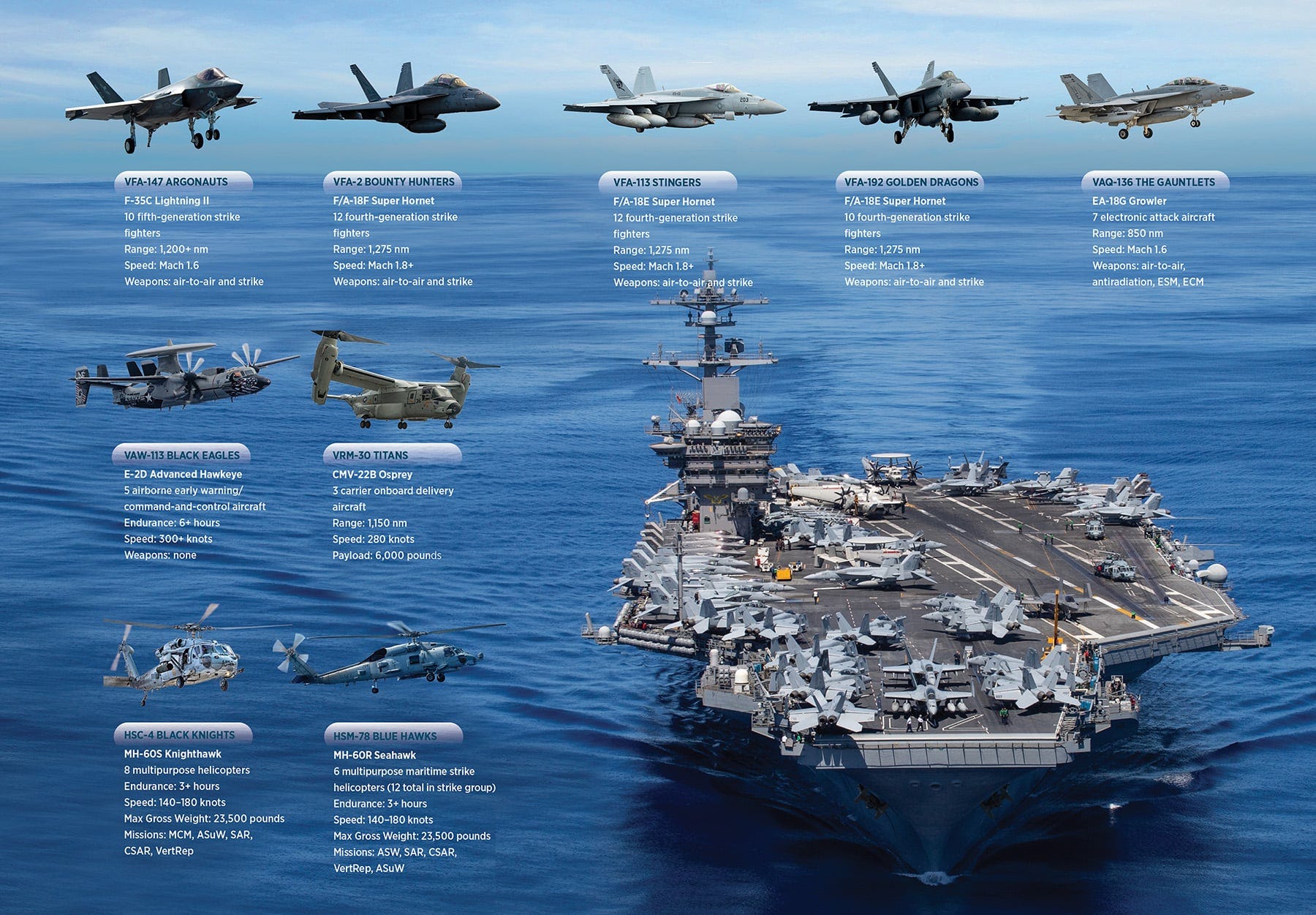
The number that matters isn’t the legal minimum in service. It’s the actual number available for combat.
A carrier fleet is supposed to obey a rough rule of thirds: one-third deployed, one-third training, one-third in maintenance. That is the clean peacetime math. But the clean math collapses under pressure. Deployments stretch. Overhauls slip. Training pipelines compress. Maintenance gets deferred. And then, just when a crisis arrives, the Navy discovers what every serious planner already knew: a fleet sized for ideal conditions is not a crisis-response fleet at all.
This is not a criticism of the Navy. Quite the opposite. The U.S. Navy has been asked to do the impossible and has repeatedly risen to the challenge. It has stretched deployments, compressed training cycles, deferred maintenance, and carried the burden of a global strategy with a force too small for the mission.
But that can’t continue forever. A Navy can surge. It cannot live permanently at surge tempo.
That is what the last several months have shown. Trump used the carrier fleet exactly as a President should: not to “send messages” but to impose outcomes. But each success consumed carrier availability that is a lot more limited than the law suggests. Too limited.

That’s the point. Donald Trump has brilliantly established American control of every global chokepoint that matters. But if America faced sufficiently numerous or intense crises at once, an eleven-carrier Navy would not be able to maintain global command of the seas. It would be reduced to strategic scarcity management.
Trump has established command. Sixteen carriers are how we make that command durable.
China Is Counting Too
The carrier shortage would be bad enough if Iran were the only problem.
It is not.
China is the pacing threat. China is building a navy, missile force, and industrial base expressly intended to break American dominance in the Western Pacific. Beijing is not merely planning to contest Taiwan. It’s planning to make America hesitate, delay, and calculate whether the price of showing up is too high. That’s a bad bet against Donald Trump. It might not be against a Kamala Harris or Gavin Newsom.
Ergo, a too-small carrier fleet helps China. That is the part Washington does not want to say out loud.

America is a maritime superpower. It maintains its safety and the security of its interests because it is protected by oceans, allied to key maritime powers, and capable of controlling the chokepoints through which enemy trade must pass.
This has been the central fact of American power from the Founding to today. The United States does not need to occupy the world to dominate it. It needs to control the seas: the approaches, the straits, the trade routes, and the crisis zones where American presence prevents hostile powers from setting the terms.
That is why the “carriers are obsolete” argument is so unserious. China did not build an anti-carrier missile force because carriers don’t matter. It built those weapons because carriers matter enormously. Beijing wants to push America’s carriers away from the First Island Chain because the carrier strike group is one of the primary ways America turns the map into power.
Nor did Iran leave those carriers unmolested: it used all its Russian, Chinese, and homegrown weapons against them, to no avail. The navies of the world noticed.
A carrier is not merely a runway. It is sovereign American territory that moves. It is a floating airbase, a strike platform, a command node, and a visible act of national will. Land bases require permission. Carriers require oceans.
And America has oceans. All of them.
Twelve Is a Patch. Sixteen Is the Need.
What it does not have is enough carriers to control them all at once. But that’s a problem with a straightforward solution.
