
Hungary and Europe
Brilliant geopolitical mind and refugee from Hungarian Communism George Friedman looks at Orbán's loss, Magyar's victory, and what it means for Europe, NATO, and the future.
This analysis is free, but with Premium Membership you get MORE. Join today.
NOTE: One of the finest geopolitical minds of our time, George Friedman, has a unique connection to Hungary, having fled Communism with his parents at a young age. Here are his thoughts on the meaning of this week’s elections, Hungary’s past, and Europe’s future. — RDM
by George Friedman
April 17, 2026
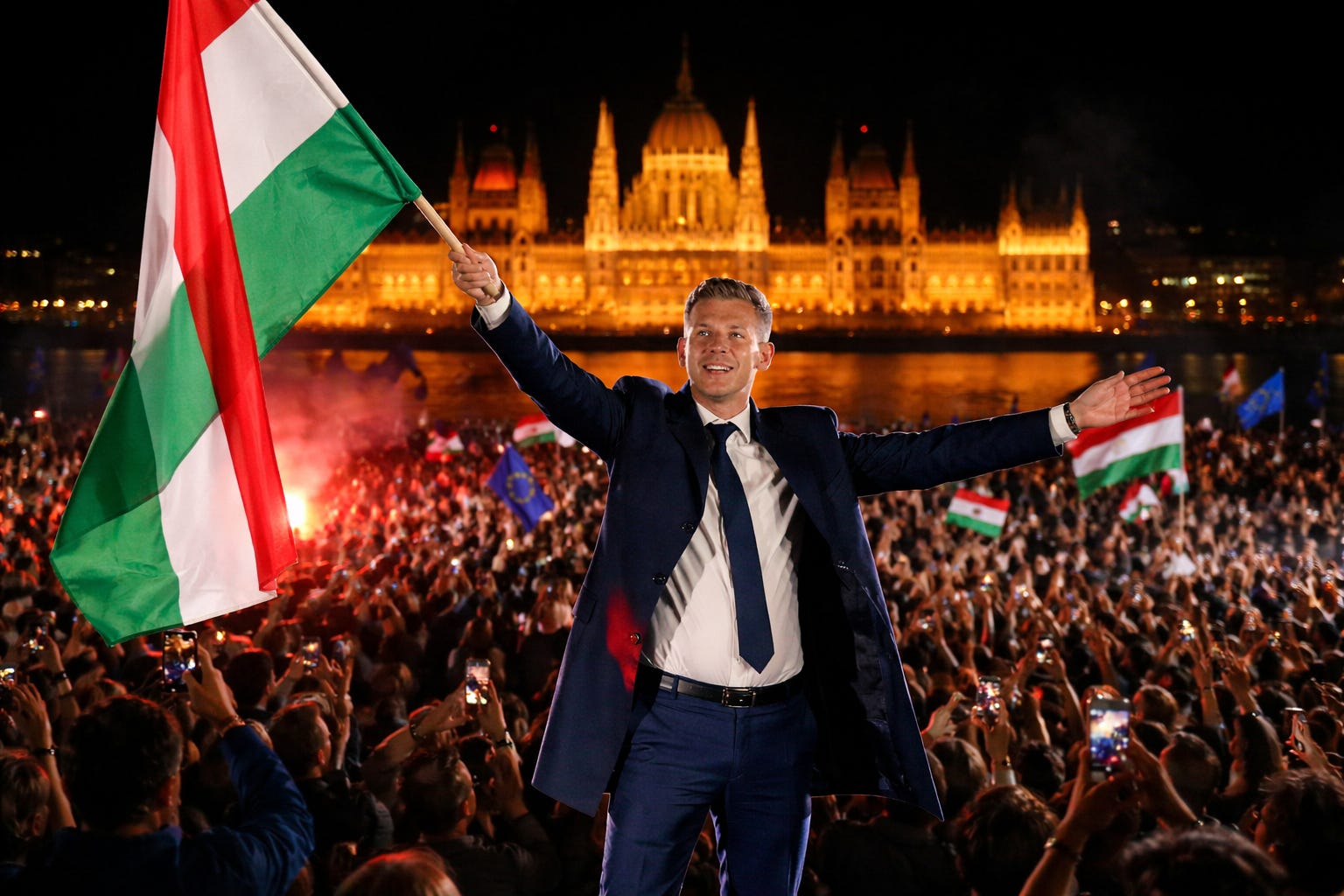
Viktor Orban, after 16 years as prime minister of Hungary, has lost an election and will soon be replaced by Peter Magyar. Orban was a man of the right, opposing large-scale immigration into Hungary, holding negative views on homosexuality and, according to many, suppressing democracy with authoritarian tendencies.
In addition, he maintained friendly relations with Russia and President Vladimir Putin. In this sense, he was an outcast in Europe, or least in the places that many in the U.S. think of as Europe: Britain, France and Germany.
Although Russia, under communism, had occupied and to a large degree controlled Hungary, Orban viewed Moscow in much friendlier ways than most of his European peers, even after its invasion of Ukraine. From Orban’s point of view (and, given that he was elected, the majority Hungarian point of view), Russia was not the Soviet Union, and it was a critical source of oil and gas. In addition, it was an extremely powerful nation, and a friendly relationship was essential to Hungarian security.
Hungary also had tense relations with Ukraine. The western part of Ukraine had been part of Hungary until the end of World War I. Ethnic Hungarians still live in that area, speaking Hungarian. Orban wanted, among other things, greater protections for the Hungarian language in Ukrainian schools. The Ukrainians were unwilling to go as far as Orban wanted, and I suspect that Orban had hoped that if defeated by Russia, the Hungarian part of Ukraine, if not returned to Hungary, would at least ease restrictions on the use of the Hungarian language in education.
Hungary, therefore, had a fundamentally different view of Ukraine than did the rest of Europe. It saw its relationship with Moscow as an asset, despite their bad history, and Ukraine as, if not an enemy, in no way a friend. As a result, it also saw Russia’s invasion of Ukraine in a very different light. Thus, Hungary has repeatedly been a stumbling block for tougher EU sanctions against Russia, and most recently, it has blocked an EU loan (which required unanimity) to support Ukraine’s war effort.
In some ways, this allied Hungary with the interests of the United States under President Donald Trump. Trump likely does not care about Hungarian-language schools, but he regards Russia as too weak to threaten the rest of Europe and prefers a negotiated settlement to the conflict, allowing Russia to keep the parts of Ukraine it has occupied. On this, he and Orban could agree.
And here, too, Orban was an outsider, this time relative to other countries in Eastern Europe once occupied by the Soviet Union. Poland, on the eastern edge of NATO, was profoundly concerned about the invasion of Ukraine, as was Romania, another Eastern European country bordering Hungary. However, from Hungary’s perspective, shielded by greater distances and harsher terrain, Russia did not look so threatening.
Despite many commonalities with Orban, the election of Peter Magyar represents a fundamental shift in Hungary’s stance. He is a Europeanist, which means he is likely to go along with the European consensus. The problem is that the consensus ignores a fundamental difference in European nations and in the nature of Europe. The most important difference is between the nature of Western and Eastern Europe in their recent histories.
Western Europe was occupied by the British and the Americans at the end of World War II. Under the umbrella of NATO and its main power, the United States, the economies of Western Europe developed rapidly. But Eastern Europe emerged from the war occupied by the Soviet Union, under much harsher political conditions and, given the economic weakness of the Soviets after the war, with far less economic development possible.
This difference between Western and Eastern Europe was not really new. From the late 15th century, Western Europe, with maritime access to the Atlantic and the Mediterranean, imposed a colonial system on parts of Africa, Asia and the Western Hemisphere at varying times. It is difficult to comprehend the wealth generated from those empires, but just consider that a small country like the Netherlands owned the vast expanse of Indonesia. Eastern Europe, with far less maritime access, did not have colonialism as the engine of economic development.
In spite of the destruction of World War II, these differences persisted. Given the American interest in reviving the economies of Western Europe to prevent communism’s spread, an entire political and economic system — known today as the European Union — developed alongside the NATO military alliance. In time, the west emerged far wealthier than Soviet-controlled Eastern Europe. When the Soviet Union disintegrated, the newly independent Eastern European countries were incorporated into this Western European system, but after decades living under communism they were effectively at the mercy of their richer relatives in Western Europe.
This was the foundation of Orban’s hostility to the EU, as well as his caution about NATO. We can assume that Magyar will take a different track. At the same time, there is an ingrained difference in the perception of the world for Western and Eastern Europeans, due mostly to the disparity in economic development. This gap is slowly closing, but while it exists, it is difficult for the EU in particular to create policies beneficial to both regions.
This is actually an old story. Jozef Pilsudski, a Polish general, argued after World War I that Eastern Europe was fundamentally different from the west and that the nations between the Baltic and Black seas should join together in recognition of this fact to form what he called the Intermarium. He argued that under the economic domination of Western Europe, the countries of Eastern Europe could not prosper or be secure from predator nations, but that united, they had the cultural and resource capabilities to evolve economically and defend themselves. Nothing came of that proposal, which was followed by a global depression that further weakened the east, World War II and the Cold War.
The reality has changed in one sense: Poland has emerged as one of the 20 largest economies in the world, as well as a significant military power essential to NATO’s powerful eastern frontier. An Eastern European power has for the first time entered the upper ranks of nations.
The other Eastern European countries have also evolved to some extent but are far behind Poland and certainly Western Europe. Given that the center of gravity of the European Union is in the west, the emergence of an economic and military alliance in the east remains a fundamental imperative. However, the nationalism within and mutual mistrust among Eastern European nations have blocked this union, despite their common military and economic realities.
Orban realized that the system created by Western Europe existed for its own benefit and could not serve Hungary, and so he sought a different path for the country. He drew it away from the West, but Hungary is a small country, and there were limits to its economic and military power. This is something it has in common with other Eastern European countries like Romania, Slovakia and the Baltic and Balkan states.
The truth is that Hungary alone cannot evolve as Poland has. It is smaller in size and population than Poland, and even Poland remains far behind Western Europe by economic standards, even if it is to some extent its equal militarily.
Pilsudski understood the fundamental difference between Europe’s east and west but was ignored. Oddly, Orban also understood the profound difference, but he could not overcome his focus on his own nation and had less than cooperative relations with countries like Poland and Romania. The region is intellectually and culturally gifted. Poland and Hungary rank 13th and 14th in the number of Nobel laureates, which is extraordinary given their size. It is not a lack of intellect that limits the region, but size and mistrust.
The election of Magyar, after Orban’s significant efforts to develop Hungary alone, opens the door to an understanding that an alliance structure similar to that of Western Europe, applied to Eastern Europe as a whole, might lead to massive development if it is not hindered by European institutions. Where Orban understood the limits that Western European institutions placed on Hungary, and Poland has demonstrated what is possible in Eastern Europe, Magyar might usher in a new era by recognizing the potential for integration among similarly developed countries (as opposed to the vastly unequal relationships implicit in union with Western Europe).
Hence, the emergence of Eastern Europe as a first-rate power may be possible. It is not Magyar’s persona that is the key, but rather the possibility that he might combine his preference for multinationalism with Orban’s understanding that Hungary is not a Western European nation. Thus, the first item on the table might be mending Hungary’s relationship with Poland.
This is not a forecast, given the nature of the region, but it is an imperative for the region nonetheless.
— George Friedman is an internationally recognized geopolitical forecaster and strategist on international affairs, a many-time New York Times bestselling author, and the founder and chairman of Geopolitical Futures, where this article first appeared.


Great Mr. Rod. Thank you.
Another View
Power Line
DID Hungary move to the left?
April 16, 2026 by Bill Glahn
https://www.powerlineblog.com/archives/2026/04/did-hungary-move-to-the-left.php
I was told that the election in Hungary that saw the ouster of Victor Orban after 16 years in power swung the country to the left. From Newsweek,
Hungary’s New PM Takes Aim at EU with Tough Border Policy.
Newsweek reports,
Hungary’s Prime Minister-elect Péter Magyar has vowed to strengthen his country’s borders, suggesting his defeat of EU‑sceptic Viktor Orbán will not lead to a policy shift toward Brussels on migration.
European leaders welcomed Magyar’s achievement in ending the 16-year rule of Orbán. While Magyar has pledged to reengage with the EU, he said his government’s plans do not include implementing the EU’s new migration and asylum pact.
I know nothing about Hungarian politics. Perhaps Magyar will cave in the end. But I was told that Orban’s defeat would result in Hungary being overrun with millions of non-European “asylum” seekers, in punishment for past defiance of the European Union (EU). Perhaps that will still happen.
But this Magyar isn’t sounding soft, yet.
Mentioning the European Commission, the EU’s executive arm, Magyar said in a speech Wednesday that Hungary had a strict immigration policy and “it will not accept any pact”. It would keep its southern border fence and “patch up the holes that are there now,” he added.
“We really want to protect our country and Europe from illegal immigration,” Magyar said, adding that the conservative Tisza party he leads “will pursue a strict illegal immigration policy.”
(Snip)