
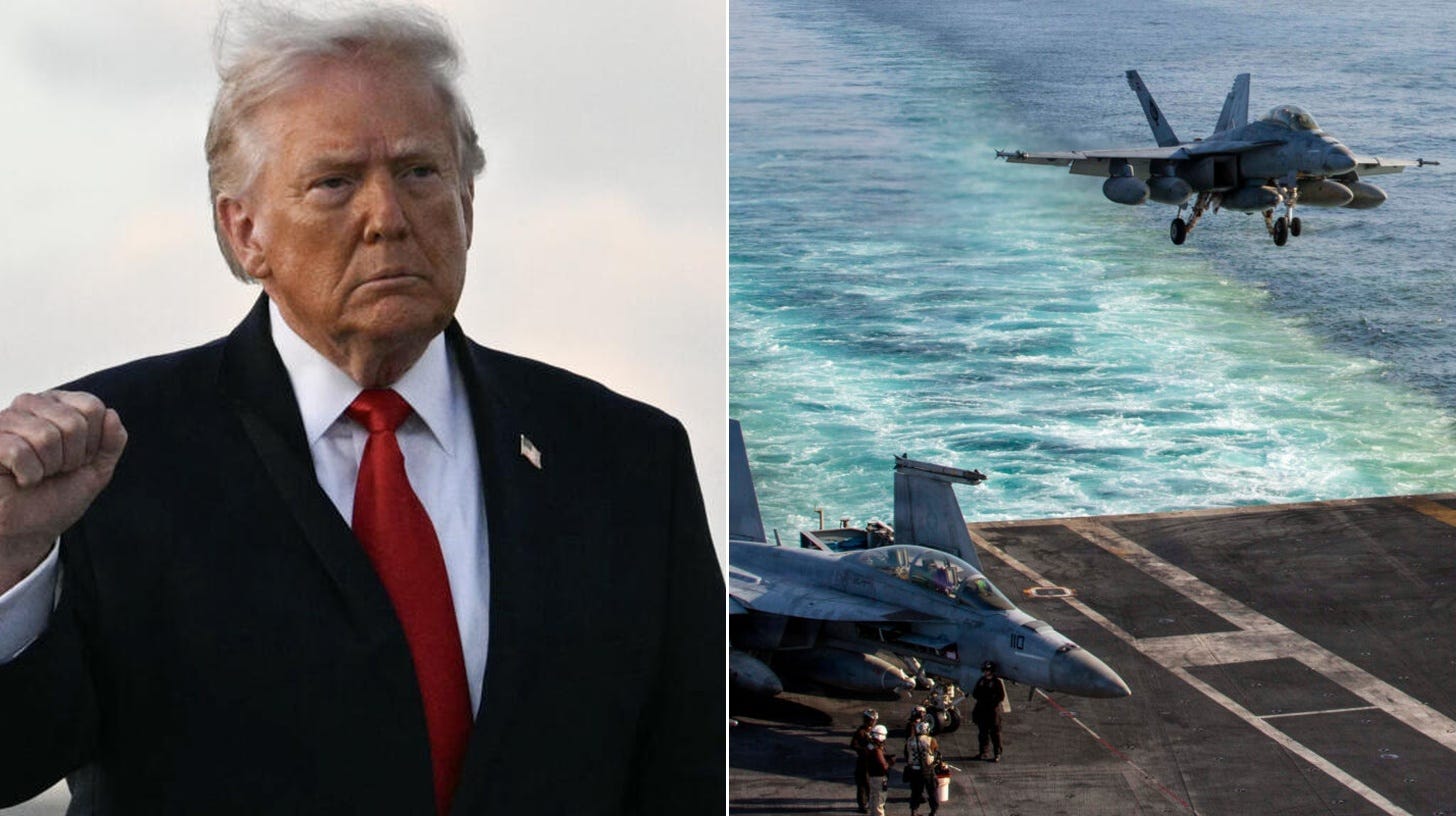
Trump’s Hormuz Trap Snaps Shut
Iran thought it could extort the world. Instead, Trump is turning a closed Strait into leverage, rising U.S. energy exports, and a global reordering.
Our Deep Dives are normally for Premium Members only, but the importance of this weekend’s events is such that we’re making this one FREE for everyone.
by Rod D. Martin
April 13, 2026
Yesterday, President Trump announced that peace talks with Iran have broken down, and that effective immediately, the U.S. Navy will blockade the Strait of Hormuz: no one in, no one out. He described the policy as “all or nothing.”
Three weeks ago, I argued that the pundit class was asking the wrong question. It kept demanding to know when the United States would reopen the Strait of Hormuz, as though America’s only job were to restore the old arrangement as quickly as possible and ask no larger questions.
That was the wrong question then, and I said so. It’s painfully obvious now, to Iran if not to the TDS-afflicted Enemedia. Donald Trump is not trying to restore the status quo. He is replacing it, and in the process, reshaping the global order.
The old arrangement was comfortable for everyone except the country paying for it. America provided the Navy. London priced the risk. Europe consumed the oil while pretending Persian Gulf security (or European security, for that matter) was somehow not its problem. China feasted on steeply discounted sanctioned crude from Iran, Russia, and Venezuela. And whenever the system wobbled, Washington was expected to clean up the mess, calm the markets, get the tankers full of foreign oil moving, and then submit to lectures from allies and adversaries alike.
Trump doesn’t think that way. Trump sees what the pundits do not: every day the Strait remains closed, America sells more oil and gas. That’s cash, jobs, and investment in America. It’s also secure oil supply that doesn’t subsidize America’s enemies.
I told you he was in no hurry to open the Strait. And here we are.
Iran’s Hormuz Gambit Is Backfiring
Most readers hear “Strait of Hormuz” and think in military pictures: mines, missiles, drones, speedboats, destroyers. Those things matter. But they are not the key.
The key is confidence. The key is insurance. The key is whether shipowners, charterers, ports, bankers, and underwriters believe a voyage is commercially viable — insurable. A tanker does not sail because it floats. It sails because somebody will insure it, finance it, charter it, and receive it. Without that, it is not a voyage. It is dead weight.
The Strait did not have to be physically sealed, and indeed, the Iranians were not capable of physically sealing it. Once war-risk coverage is canceled in some zones, narrowed in others, and repriced at panic levels across the rest, the whole chain starts to lock. Banks get cautious. Charterers hesitate. Ports get nervous. Traders rethink routes. Counterparties demand more margin. Voyages that are physically possible become commercially irrational.
That is why so much of the “Iranian toll booth” story was nonsense from the beginning: it simply wasn’t happening. Tehran certainly wanted the world to believe that the regime had succeeded in turning maritime terrorism — piracy — into toll collection. In Pakistan it certainly wanted J.D. Vance to ratify its new claim to be Hormuz’s sovereign regulator.
But in making that attempt it overplayed its hand. Iran has profited mightily for the last half century from its apparent willingness and ability to menace the Strait, through which 20 percent of the world’s oil flows. But making good on the threat showed its limits.
The regime believed Hormuz was a card to be played. In reality, it was a wasting asset. A chokepoint has value only so long as markets organize themselves around it. The moment the chokepoint holder demonstrates that it really is willing to weaponize that position, everyone with money, engineering talent, and strategic sense begins building around it: new routes, new supply chains, new export terminals, new pipeline capacity, new sources of crude.
For decades, the threat gave Iran leverage. The reality destroys it. By trying to prove its power, Iran began liquidating it. And it’s even worse than that. Iran can’t actually close the Strait unless the U.S. Navy stands down. Under Obama and Biden, that would be the most likely outcome. With Trump, that will never, ever happen.
So of course, Trump has called the bluff. Iran imagined it could close Hormuz to all traffic but its own. Trump has now closed it to all traffic whatsoever. And in due time, it will be he, not Tehran, dictating who does and does not pass.
That cuts Iran’s financial jugular. It has no backup plan.
Every Day Hormuz Stays Closed, the U.S. Sells More Oil
This is the part the Enemedia still doesn’t understand, and it’s the heart of Trump’s trap.
Since Putin’s 2022 invasion of Ukraine, Europe has sent twice as much money to Moscow for energy as to Kiev in aid. Thanks to Trump’s trade deals last year, they’re now buying more from the United States. But they’re still buying from Russia, and they’re making up the difference from the Persian Gulf.
This is no small part of Trump’s annoyance at their unwillingness to support the U.S., not even with combat forces but with minesweepers, escorts for tankers carrying their oil, access to bases America paid for, even simple overflight rights for U.S. planes. Why are we paying to defend Europe’s oil, oil it could have bought from us, if Europe actively obstructs while lecturing and contributing nothing?
Trump is bringing the ongoing redefinition of that relationship to a head in Hormuz.
And Asia is far more dependent on the Gulf than Europe. The more unstable Persian Gulf supply is, the more valuable secure American supply becomes. That means more demand for U.S. crude, more demand for U.S. LNG, more demand for the infrastructure that moves it, insures it, finances it, and exports it. It means cash, jobs, and investment in America. It means more business for American producers, American ports, American pipelines, American refiners, American shipping interests, and American workers.
Trump made that point explicit when he posted on Saturday that “massive numbers of completely empty oil tankers” were heading to the United States to load up with the best and “sweetest” oil and gas in the world.


The U.S. Navy is the foundation of global maritime insurance, and therefore of global trade. But America is not just the Navy beneath the system. It’s increasingly the replacement supplier within the system.
That is a profound change, and one too few people seem to appreciate. For decades, foreign-policy mandarins have talked as though the United States were merely the world’s policeman, standing outside the commercial order and guarding everyone else’s prosperity. But that is not where we are now. We are not merely securing trade. We are supplying it. We are not merely suppressing risk. We are monetizing the reduction of risk and the displacement of risky supply.
That is why that supertanker map matters. Market actors are repositioning toward the United States because U.S. supply is secure. They aren’t moving ships to the Gulf of America for the scenery.
As they do, the rest of the system begins adjusting around that expectation. If the war results in a free Iran, risk drops dramatically in the Strait. If not, Gulf producers will push bypass routes. Saudi Arabia will lean harder on east-west pipelines to the Red Sea. The UAE will push more crude toward Fujairah outside the Strait. And in either case, the United States will entrench itself as the flexible supplier with scale, liquidity, and quality.
As risk drops, prices will drop, ultimately quite a lot lower than before the war. Consumers will find relief while U.S. market share soars. More American supply means more secure allied supply. It means fewer petrodollars flowing to regimes that hate us. It means a world less vulnerable to blackmail by enemies and less distorted by the risk premium the Strait has imposed for half a century. Everyone wins, except our enemies.
Every day the Strait is closed, America sells more oil and gas. Trump is upending the global energy order that’s defined my entire lifetime, making America vastly richer and more secure in the process. That’s a legacy that will long outlive him.
The Pressure Is the Strategy
Trump’s foreign policy is not isolationism. But neither is it some neocon fantasy in which America attempts to impose its will through twenty-year deployments, while wealthy allies sit on their wallets and hostile powers exploit the order we underwrite. It is something much harder, much more coherent, much more realpolitik: America will protect the system from which America and its partners benefit. But not for free, not forever, and not on everyone else’s terms.
In Trump’s view, the status quo is what got us here. The status quo enabled China’s rise, rewarded Europe’s dependency, preserved London’s privileged position profiting from maritime risk, and let Iran imagine that threatening the world’s trade arteries was a source of leverage rather than a death wish.
Trump is in no hurry to relieve the pressure. The pressure is the strategy. And nowhere is that clearer than in the President’s increasingly strained relationship with Keir Starmer.
The British Empire may be gone, the Royal Navy may not rule the waves, but the City of London still sits astride one of the world’s quiet choke points: specialty risk, especially marine and war-risk insurance. The City assesses risk and sets prices, and hardly anything sails without their say-so. Iran couldn’t close the Strait: Lloyd’s of London did.
Trump’s response was extraordinary.
On March 3, he announced that the U.S. Development Finance Corporation would mobilize political-risk insurance and guaranty products to support private-sector operations in the Gulf, including shipping. Three days later, Reuters reported that the United States would provide reinsurance for maritime losses up to about $20 billion. Later, Reuters reported that Chubb would serve as the lead insurer for the DFC-backed plan.
Read that carefully. This was not merely the United States saying, “The Navy may escort some ships.” This was the United States moving against the City of London’s semi-monopoly, one of the last vestiges of imperial power. The default risk desk suddenly has a rival with a bigger balance sheet, a bigger navy, and a bigger reason to care.
And that points to the deeper truth beneath the whole episode. The real insurer of global trade is not Lloyd’s of London. It is not Chubb. It is not even the DFC.
It is the United States Navy. It has been for 80 years.
Now, with that Navy blockading the Strait directly, no one will pass without U.S. permission. That buys time for the new insurance reality to ramp up. It also gives Starmer time to repent before it can.
What will happen? As the President might say, we’ll just have to find out.
The pressure exposes who is willing to be a partner and who is freeloading as a functional dependent. It also makes plain that America is no longer willing to subsidize a global order in which others consume the benefits, obstruct the guarantor, and then sneer at the one country that keeps the whole system alive.
Trump is not merely using pressure to punish Iran. He is using it to reorder America’s relationships across the board. Europe is being told to act like a partner. The City is being told that prestige without power is not enough. Asian allies are being told to erase their U.S. trade surpluses by buying American energy.
And America’s enemies are being told that it’s a lot safer to be America’s friend. The carrot is very real. So is the stick.
Ending the Islamic Regime
What remains of the Iranian regime is not a functioning unitary state in the way Western commentators lazily assume. It is a shattered center trying to hold together a swarm of competing factions. As I said Friday on NTD, Iran’s much-praised “Mosaic defense” decentralized not merely resilience but command. The senior leadership in Tehran having been gutted, what remains is a struggle for power and survival among men who don’t trust each another, and shouldn’t.
That is what the talks were really about. Not trust-building. Not a new handshake with Tehran. Not some grand diplomatic reset. They were a means of intensifying suspicion, forcing choices, and making every faction wonder which of the others was preparing to cut a deal and save its own skin. When Trump spoke publicly about Iranian negotiators being more “reasonable” in private, he was not making small talk. He was painting targets on their heads.
The President trapped the Iranians in another way. After years of denying they were building nuclear weapons, Iran blew up the negotiations on the one point that proved they always were: uranium enrichment far beyond anything needed for commercial power. And they did it just weeks after showing their hand on IRBMs they long denied possessing: missiles that can hit Paris and London and, with relatively minor upgrades, Washington and Dallas.
The ceasefire’s “two weeks” weren’t accidental either. The USS Bush, USS Ford, and USS Boxer all converge on the region in exactly that window. The President bought time while deploying overwhelming force for the endgame.
The establishment keeps repeating the cliché that you cannot achieve regime change from the air. That was more plausible when “from the air” meant area bombing and little else. It is much less so when drones can do what once required snipers and invading armies.
For weeks, the regime’s coercive organs have been degraded not only at the top but locally. A roadblock appears; its enforcers are killed remotely. A command node lights up; it can be struck in minutes. A Basij or IRGC presence can be harassed, hunted, and thinned out without putting American divisions into Iranian streets.
The old binary is obsolete. The choice is no longer between doing nothing and forever wars. There is now a third path: decapitate command, destroy the coercive architecture, pit factions against each other, degrade local enforcers, and create the conditions in which the people themselves become the decisive “boots on the ground.”
Trump has been signaling that from the beginning. He is not trying to occupy Iran. He is trying to break the regime’s capacity to rule and leave the rest to the Iranian people. He was morally outraged by the cold-blooded murder of 36,000 unarmed protestors over two days in January. He posted “Help is on the way!” The Enemedia mocked his statement, as they mocked his ceasefire. But he immediately sent that help.
Trump is not negotiating with the Islamic Republic. He is ending it. And in doing so, he’s upending the global order.


Interesting take
“We are monetizing the reduction of risk and the displacement of risky supply.” Classic Trump move…negotiating with and capitalizing on the heart of the matter: risk.