


This analysis is free, but with Premium Membership you get MORE. Join today.
Our full discussion transcribed below:
by Rod D. Martin
August 6, 2026
I appeared on NTD Newsroom with Don Ma and Democrat consultant Robin Biro to discuss the DSA’s effort to take over the Democrat Party, their successes in Michigan, Wisconsin, and elsewhere, what it all means for November, and whether establishment Democrats can bounce back.
We discuss:
Why Abdul El-Sayed’s Michigan victory shows that the socialist turn is being driven by Democrat primary voters, not merely party leaders
Why Republican Mike Rogers can win the Senate race, but Republicans must take El-Sayed seriously after he overcame a seven-to-one spending disadvantage
Whether Chuck Schumer, Hakeem Jeffries, and the DNC establishment can regain control before younger DSA candidates replace them
What the defeats of British Labour (1983), Jimmy Carter (1980), and Walter Mondale (1984) tell us about the prospects for a Democrat return to the center
PLUS, how a generation taught critical theory instead of critical thinking became fertile ground for socialism, Communism, and the DSA
It’s 15 minutes of analysis you need. Watch (or read!) the interview, and pass it along!
Nothing matters more than educating the next generation with the values we cherish. The Herzog Foundation is making that possible. Learn more here.
Our full discussion:
Don Ma: For a closer look at the Michigan primary results, joining us now is Rod Martin, political analyst and founder and CEO of Martin Capital. We also have Robin Biro, Democrat strategist and former Obama regional campaign director.
First of all, welcome to you both. Thank you for joining us today.
Rod, let me start with you. Can I get your reaction to Abdul El-Sayed winning the Democrat Senate primary in the Midwestern state of Michigan?
Rod D. Martin: I think the Democrat Party has its work cut out for it at the moment, and I cite James Carville and Bill Maher as the leading proponents of that position.
When you’re losing guys like James Carville and Bill Maher, you’re probably out of step with the average voter. That might sell with Mamdani in New York, but I don’t think that’s going to do as well in Michigan.
I think Mike Rogers is a great candidate. I think he has a real shot. I also think John James has a real shot at being governor of Michigan.
Again, I think you lose a bunch of Democrats at the margin who don’t turn out. The GOTV effort among the people who like Abdul El-Sayed is going to have to be incredible. We have somebody here on screen right now who can tell us about that.
They’re going to have their work cut out for them, and I think this helps us quite a lot.

Don Ma: Robin, can far-left, progressive, or socialist policies - whatever you want to call them - compete in Michigan?
Robin Biro: That’s the big question, isn’t it?
I’ve been pushing back against the narrative from my friends on the right that it’s the party that’s changing. It’s actually the electorate. The electorate is embracing these candidates.
I’ve been pushing back against this, and I’ve got to be honest with you: Party leadership at the DNC has been pushing back against DSA and socialist candidates, and even some far-left progressive candidates, in favor of more mainstream moderates who can work across the aisle.
It has been to no avail because the voters - the electorate - really do want these people who are farther to the left.
I think, Don, it has to do with income inequality and some frustration with the cost of goods. I’m not entirely sure what’s driving this, but make no mistake: It’s the electorate going to the polls and casting its votes for these candidates.
Is Party Leadership Changing, or Are the Voters?
Don Ma: Rod, I would love to have your comments on this. Is it the voters who are changing, or is it the party? Is this a chicken-and-egg issue?
Rod D. Martin: No, I agree with that assessment. You see it in other ways that I think are harmful to the Democrat Party.
I’ve known Elon Musk a very long time. He never wanted to be a Republican. Bill Maher doesn’t want to say nice things about Donald Trump. These guys feel that they’ve been left by their party.
When we say “the party,” I think Robin’s analysis is exactly right. It’s not primarily the leadership. It is the primary electorate.
I would just qualify it this way: It’s important to remember that primaries have comparatively low turnout. If you’ve lost some people at the margin for whatever reason, then the people who are most excited are going to determine the outcome. That’s absolutely true.
At the same time, I don’t think that’s really the case here. Haley Stevens outspent Abdul El-Sayed seven to one.
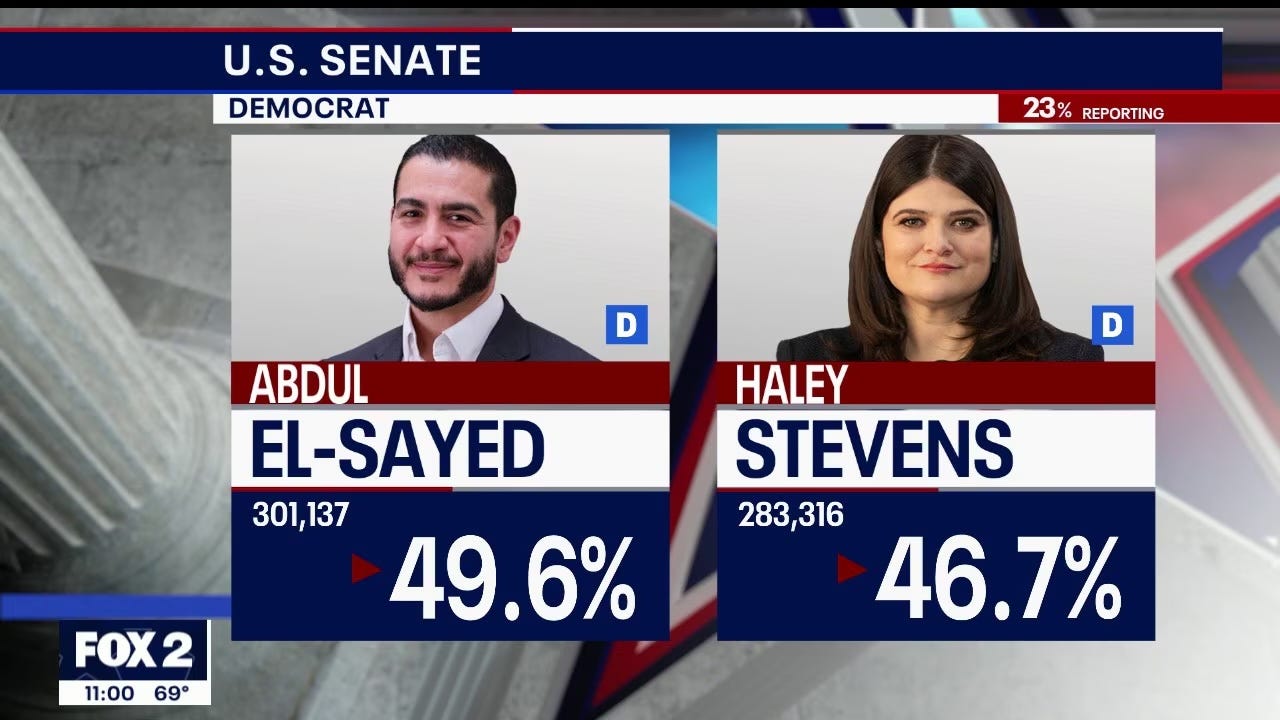
I think what you’re seeing there is more an immigration story involving Dearborn and the surrounding areas, and the change of the electorate over an extended period of time, than a low-turnout story among Democrat moderates or whatever.
Don Ma: Robin, if you’re saying that the party isn’t changing, would you also say, by extension, that the Democrat Party establishment doesn’t want to embrace democratic socialism, since it’s the voters who are changing?
Robin Biro: That is exactly what I’m saying, and I’m close to the Democrat establishment. One of my very best friends was Jaime Harrison, the outgoing former DNC leader.
I know these people firsthand, and they did not want this. They don’t want a socialist takeover of the Democrat Party. Hakeem Jeffries certainly doesn’t want this. Chuck Schumer definitely doesn’t want this.
It’s almost laughable on its face to think that they would embrace this. Think about what they did to keep Bernie Sanders out when he was a presidential candidate and nominee.
So, yes, it’s the electorate.
What the Establishment Fears
Don Ma: Robin, let me follow up. I know what the narrative has been about why the Democrat Party doesn’t want to embrace this new wave of DSA candidates, but I want to hear it from you. Which policies don’t they like?
Robin Biro: Specifically, they start talking crazy talk about canceling the U.S. Senate and canceling the U.S. Supreme Court. Those things are wildly out of touch with what any rational, mainstream, red-blooded American is going to think.
I do think the DSA has the wind at its back right now. They’ve been mastering social media, Don, and putting out things that sound great to the masses. People are starting to buy into some of what they’re saying.
But then they get their cart a little too far in front of the horse and come out with crazy policies: doing away with billionaires, for example, or taxing them again at 90 percent. I just don’t think Americans want to go back to that.
Don Ma: Rod, if the voters are changing, the establishment is not, and the establishment is pushing back against democratic socialism, can the Democrat establishment sway voters back from the far left toward the center-left as it tries to maintain the status quo?
Rod D. Martin: That’s an interesting historical question.
The first and foremost problem they’re going to have is that the voters are actually changing the establishment by replacing its members.
An awful lot of the Democrat establishment, very much like our current president, is really, really elderly. They’re not going to be there a whole lot longer, and these younger guys are moving up. So you have that problem.
But I would look back to 1983 in Great Britain, when we reached a point where Labour was actually flirting with joining the Warsaw Pact.
That might not actually be as crazy as saying you want to cancel Thanksgiving and Valentine’s Day, but it’s evil, certainly at the height of the Cold War.
Margaret Thatcher just annihilated them. Then Neil Kinnock came back in 1987, and she just annihilated him. What you eventually ended up with was a reformed moderate Labour Party under a wildly successful Tony Blair. But it took years.
I think that’s the process we saw in this country to a lesser degree in the 1970s and 1980s. People rejected Carter. They rejected Mondale. But they absolutely adored Bill Clinton.
So yes, Democrats really do have a shot at a comeback. But it may be a little bumpy between here and there.
Follow the Money
Don Ma: Robin, is the Democrat Party losing control? Are lawmakers like Chuck Schumer and Hakeem Jeffries going to be replaced?
Robin Biro: Look at the money, Don.
Right now, the RNC has $138 million in the bank. The Democrat Party has negative $2 million. We actually are in debt.
Donors are the ones having the say right now, and those are also voters. We are not courting the corporate people the RNC is courting. We’re courting small-donor voters, and they’re just not sending money to the DNC right now.
It is a massive problem as we head toward the midterms and then, beyond that, the general election. Follow the money.
Don Ma: Rod, do you think El-Sayed has a chance in the midterms?
Rod D. Martin: Unquestionably. He’s a real candidate. He did a great job in this race. Anybody who wins against a seven-to-one spending advantage is someone you should take seriously.
If he wins, that may be a bigger defeat for the Democrats than if he loses. If he loses, you get to come back and run Haley Stevens again, or somebody like that.
But we have to take him very seriously. The same thing is true of Francesca Hong, and we will.
I think we’ve got good candidates who can make a real race of this and have a solid chance of winning.
Don Ma: Robin, when it comes to the general election in November, do you think the people who didn’t vote for El-Sayed in the primary — those who voted for Haley Stevens — are going to vote for El-Sayed, or are they going to vote for the Republican?
Robin Biro: I don’t know that they would vote for the Republican, Don. I think they would sit this one out.
As you know, the largest bloc of voters — my friend Rod was talking about GOTV — is the people who don’t vote at all. I think they would probably just stay home.
That’s the risk we run in the Democrat Party, and that’s why we’ve been trying not to scare off voters. But part of that is maintaining the status quo. I think they’re tired of what we’ve been offering as a party.
Is the Democrat Party Headed Toward Communism?
Don Ma: Is there any way for the Democrat Party to maintain the status quo so it doesn’t become more socialist and potentially even Communist? We know that socialism has often turned into Communism throughout history.
Rod, has the ship sailed? Is the Democrat Party destined for Communism, or is there a way to maintain the party’s status quo?
Rod D. Martin: If something doesn’t change, that is clearly the trajectory.
There’s no question, when you have a major DSA leader stand up at its convention and say verbatim, “Our goal is Communism,” that this is not Bill Clinton’s Democrats anymore.
So, yes, there’s that potential. But these things have a way of swinging.
People flirt with crazy talk. After a while, they realize it doesn’t put bread on the table, it doesn’t put gas in the tank, and it really is harmful if you actually want to win an election.
Again, they can win in New York. They can win in a decent number of places. But this is not a national message with strong appeal.
Can the Democrats rally back from this? Lifetimes of experience suggest that they can and they will, but it may take a minute.
Don Ma: Robin, I see you nodding. What’s on your mind?
Robin Biro: I’m speaking to you from Georgia. Jon Ossoff is doing fantastically right now. Raphael Warnock is still polling well, but we’re concerned right now, of course, about Jon Ossoff.
He’s more of a centrist, and he’s doing great. People see him as one of the — look, he’s on the shortlist right now to be a 2028 nominee.
So I still have hope for the party to return to some sanity.
Critical Theory Instead of Critical Thinking
Don Ma: Robin, I looked at the Democratic Socialists of America website the other day, and it seems like they’re not even hiding it.
The difference between socialism and democratic socialism is that democratic socialism allows some form of capitalism. On the DSA website, in big, black, bold letters, it says it wants to get rid of capitalism: “a future without capitalism.” That’s what it says.
Do Democrat voters want that?
Robin Biro: I have doubts about it.
Rod brought up a great point a moment ago: You have to look at the ages. The older folks, the people who have been around for a while, don’t want that at all.
But younger people — I’ve got this kid I’m sending off to college next week. I bet you my child would think that was a great idea.
It’s up to parents to educate their children on the perils of some of the magical thinking we hear about, for example, socialism, Communism, or Marxism.
We have to really talk about what works, what good we can take from some of these ideas and adapt for the United States of America, because the more radical policies aren’t going to work. We’re just going to disenfranchise half the country and have them angry at us.
So there we are.
Don Ma: Rod, I’ll give you one more thought, and then we can end the conversation.
Rod D. Martin: I think this is a fascinating moment in American political life.
These are not your parents’ Democrats. These are not your great-grandparents’ Democrats. I don’t think they have as much staying power as some believe they do, for all the reasons Robin just outlined.
But they’re a real threat right now. Mamdani is out there saying, along with the DSA, “Let’s socialize the means of production.” That’s where a lot of these people are.
We know where that leads. It leads to one-party rule. It leads to a lot of people dying. It leads to economic catastrophe.
I don’t think the average Democrat thinks that’s a great idea.
On the other hand, we’ve just spent a generation teaching our kids critical theory instead of critical thinking. This is the natural result of that.
We marinated them in Alinsky and Marcuse and Horkheimer and Gramsci. What did we expect would happen?
We all bear some responsibility for that.
Don Ma: The analysts I’ve spoken with about this numerous times in the recent past have all said that educating the youth is a key factor in why more younger voters are supporting these democratic socialist policies, and sometimes even purely socialist policies.
It’s been a fascinating conversation with you both today. Robin, Rod, thank you for your time.
Rod D. Martin: Great to be here.


