

This analysis is free, but with Premium Membership you get MORE. Join today.
NOTE: Every Sunday, we shift from our normal geopolitical analysis to something more theological, as is fitting for the Lord’s Day. Some of our newer readers may not realize that I have served over the years in countless SBC leadership roles, including as an officer of the SBC’s Executive Committee, and in part as a result, many of our readers are pastors and lay leaders in the SBC. So as the Annual Meeting approaches, on Sundays at least, we publish a handful of items vital to the life of America’s largest Protestant denomination. This is one of them. — RDM
by Tim Overton
May 31, 2026
The Southern Baptist Convention stands at an important crossroads. Controversy has grown in recent years regarding churches within the Convention that employ female pastors. While some of these churches continue to cooperate with the SBC, others have been removed from Convention fellowship. The inconsistency of the current approach erodes trust and creates confusion.
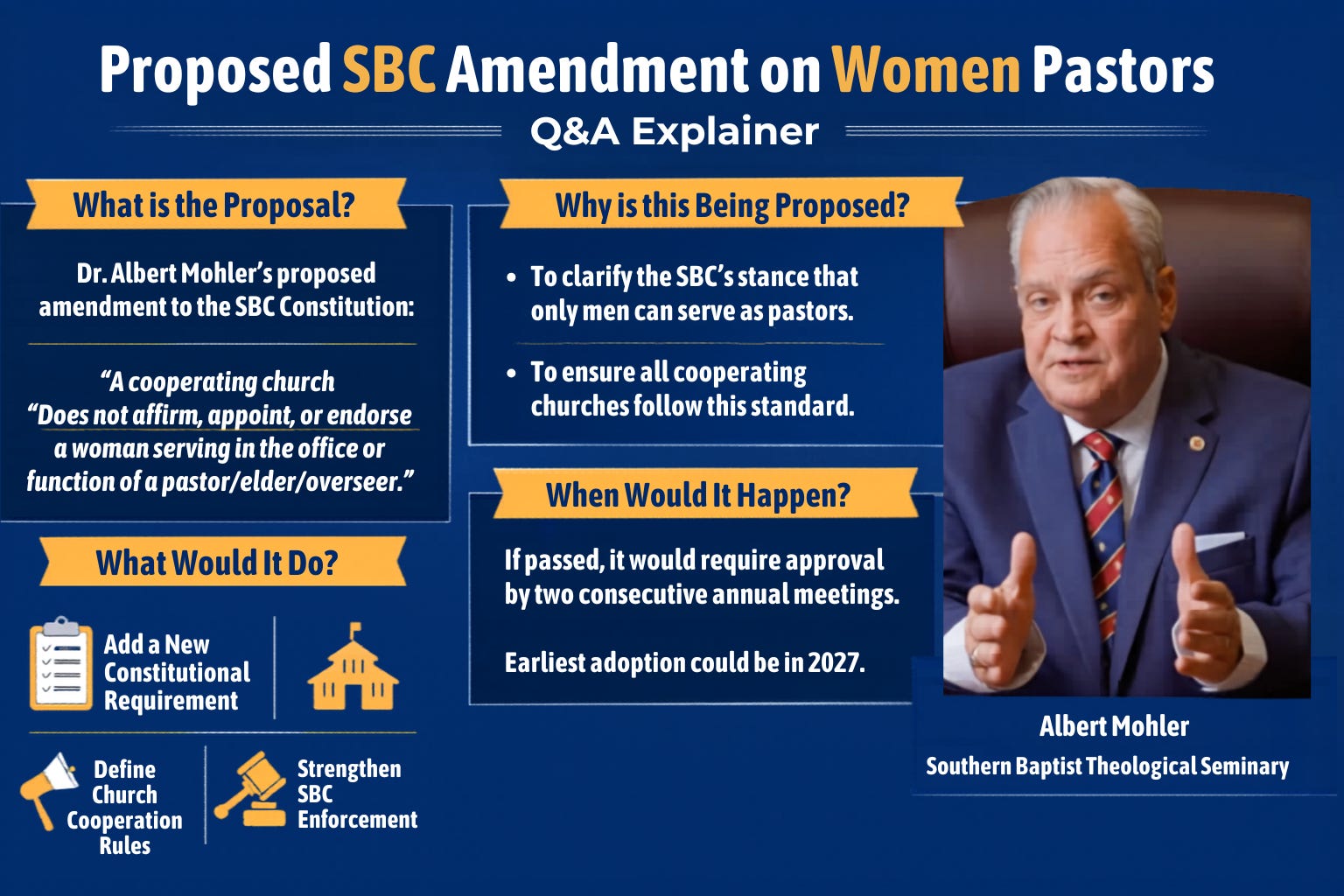
The proposed “Truth and Unity Amendment” seeks to clarify this issue by requiring churches that affirm female pastors to either repent and conform to biblical teaching or be disfellowshipped from the Convention. It does not force a requirement on any church. It merely limits participation in SBC governance to those who share our stated beliefs.
In a video announcement on May 18, Dr. Albert Mohler (president of The Southern Baptist Theological Seminary) previewed that he plans to offer this “Truth & Unity Amendment” to the SBC Constitution in Orlando at our Annual Meeting. It would add an enumerated 6th item to Article III, Paragraph 1, defining composition (exactly where the Law Amendment was attempting to amend the SBC Constitution), and the text is as follows: “Does not act to affirm, appoint, or endorse a woman serving in the office or function of pastor/elder/overseer, such as preaching to the assembled congregation.”
This amendment is not about hostility toward women. Men and women are equally created in the image of God and possess equal dignity, value, and worth before the Lord. Christianity has historically elevated and honored women in ways many cultures never have.
However, Scripture also teaches that God created men and women with distinct responsibilities and complementary roles within the family and the church. The issue before the SBC is ultimately whether the Convention will uphold what it has historically believed the Bible teaches regarding the office of pastor.
There are at least three reasons why the Truth & Unity Amendment must pass. This article will present the reasons from the least compelling to the most important.
Third, passing the Truth & Unity Amendment would provide much-needed clarity and direction for denominational leadership. Over the last several years, confusion and inconsistency have emerged regarding how Convention leaders should respond to churches that openly employ female pastors. Some churches have been disfellowshipped, while others have not, even though similar practices were involved. This inconsistency creates uncertainty, controversy, and division.
The amendment would establish a clear standard for cooperation. It would eliminate ambiguity and ensure that Convention leadership applies the SBC’s beliefs consistently and fairly. More importantly, it would help protect the denomination from future theological drift. Historically, nearly every major denomination that moved into liberal theology first embraced feminism and rejected the biblical distinctions between men and women. Once a denomination abandons biblical teaching on male and female roles, broader doctrinal compromise inevitably follows.
Complementarianism that never affects real-life church practice becomes functional egalitarianism. If churches claim to believe Scripture’s teaching on pastoral qualifications but ignore those teachings in practice, doctrinal statements become meaningless. The SBC must decide whether its convictions will remain theoretical or actually shape church life.
Second, the Truth & Unity Amendment should pass because the Baptist Faith & Message is crystal clear on this issue. The Baptist Faith & Message 2000 plainly states that the office of pastor is limited to men as qualified by Scripture. This statement represents the agreed-upon doctrinal standard for cooperation within the Convention.
To allow churches to openly violate that standard while remaining in friendly cooperation — which means participation in governance and voting on funding — creates confusion and undermines trust. Cooperation among Southern Baptists depends upon honesty and doctrinal integrity. Churches give sacrificially through the Cooperative Program because they believe they are partnering with churches and entities that share common theological commitments. When Convention leaders fail to uphold the standards the SBC itself adopted, confidence erodes.
This matters greatly for missions and ministry. The Cooperative Program has enabled Southern Baptists to support missionaries, seminaries, disaster relief, church planting, and evangelism efforts in the U.S. and around the world. Trust is essential for this cooperative system to function effectively. If churches begin to believe doctrinal standards are selectively enforced, unity and giving will inevitably suffer. In short, compromise means less money for missions.
If you or your organization are facing a sex abuse or sexual harassment claim, or if you are yourself the victim, my friends at Chalmers Adams can help. Click here.
The Baptist Faith & Message should not be treated as a symbolic document with no practical authority. It should be respected, upheld, and consistently applied for the sake of cooperation and integrity.
First and most importantly, the Truth & Unity Amendment must pass because it reflects the Bible’s own teaching. Scripture is the inerrant Word of God and the final authority for faith and practice. Southern Baptists have historically stood firmly upon biblical authority, and this issue is ultimately about whether the SBC will continue to submit to Scripture even when cultural pressures push in the opposite direction.
1 Timothy 2:12 states, “I do not permit a woman to teach or to exercise authority over a man.” Paul grounds this theological statement in the creation order by saying, “For Adam was formed first, then Eve.” The qualifications for pastors given later in Scripture refer to the pastor as the “husband of one wife.” Jesus Himself selected twelve male apostles. Throughout Scripture, the pastoral office is consistently presented as a male responsibility within the life of the church.
Again, this does not diminish the importance of women in ministry. Women serve vitally throughout the Kingdom of God in discipleship, missions, teaching other women and children, hospitality, mercy ministry, evangelism, and countless other forms of service. The church could not function faithfully without godly women. But Scripture distinguishes between valuable ministry service and the pastoral office itself.
At its core, the debate over the Truth & Unity Amendment is not really about politics, power, or public relations. It is about biblical authority. Do Southern Baptists truly believe the Bible means what it says? Or will cultural trends ultimately determine doctrine and practice?
The SBC has already fought major theological battles over biblical authority during the Conservative Resurgence of the 1980s and 1990s. Southern Baptists should not have to refight those same battles generation after generation. Instead, the SBC should move forward with doctrinal clarity and unity so that it can focus on evangelizing a lost culture that increasingly rejects even the most basic biblical truths about human value, marriage, and sexuality.
In a society that struggles to define what a woman even is, the SBC must remain anchored to Scripture. Passing the Truth & Unity Amendment would affirm that Southern Baptists still believe the Bible, still honor their statement of faith, and still desire to cooperate together in Truth for the sake of the Gospel.
— Tim Overton is the pastor of Kingston Avenue Baptist Church in Anderson, Indiana. He is also a graduate of the Southern Baptist Theological Seminary, president of the Southern Baptist Convention Home Education Association (SBCHEA.com), and director of the Indiana Prayer Caucus. This article first appeared at the Center for Baptist Leadership, which you should follow.


All the conventions, guys and gals with PHDs, historical changes, other denominations and how they have decided. None of it really matters.
You either believe that the apostles and the letters and writings were inspired from God or you do not.
God purposely did not make this difficult to understand. Only humans with an agenda have made it so.
It's so simple. You don't even need a high school degree.
There will be no excuse for those who profess to be leaders of Christ's Church. No excuse. You will be held to a higher standard.
No excuse. It's so simple a kid can understand it.