



The text of our full discussion appears after the break:
by Rod D. Martin and Frank Gaffney
August 25, 2026
My latest interview on Securing America with Frank Gaffney. Sign up NOW for Frank’s Rumble channel and don’t miss a single episode!
Frank and I discuss:
How the blockade drains Iran by $500 million a day
How new pipelines are permanently ending Iran’s leverage
How the war has shifted global energy markets from the Persian Gulf to the Gulf of America
Why is Trump pressuring South Korea?

It’s a full 27 minutes of in-depth analysis you won’t want to miss. If you prefer to read, the full transcript is below. Watch, read, like, and share!

Hillsdale College’s wonderful “The Story of America” series is now FREE for you to watch! Learn about the most important episodes in America’s Founding.
Click here for the full series!
Now, here’s our full discussion:
Frank Gaffney: We’re back. When I get to say, “So is Rod Martin,” it is a banner day here at Securing America, and I’m pleased to say that’s a weekly thing. We’re very, very proud to have him with us.
He is, of course, the chairman of the outfit that makes this program possible, the Institute for the American Future. Have I mentioned that we would love your support for making this program possible? Donate, if you can, at USFuture.org.
Rod is a serial entrepreneur, having cut his teeth in the business world as a part of the PayPal Mafia back in the day. He has also been a policy advisor to the then-governor of Arkansas, Mike Huckabee. He is, in addition, active in the Southern Baptist Convention and the author of an extraordinarily important online resource. It’s called the Rod Martin Report. You can find it and subscribe to it at rodmartin.org.
Welcome back, my friend. It’s good to have you, as always.
Rod D. Martin: Great to be here.
Frank Gaffney: I want to start with Iran, the nation that has been at the forefront of American national security policy, well, off and on, I guess, so to say, for 47 years, but pretty much on of late.
You have an interesting theory that I gather you will be propounding in the Rod Martin Report shortly, and I wanted you to explore it with our audience. It involves the Strait of Hormuz. The President says it’s going to be American territory.
That is a very interesting proposition, which it won’t really be. I want to get your take on, if so, how?
Rod D. Martin: Well, that’s not really going to happen, but it’s the kind of thing the President loves to say to make heads spin and help concentrate opinion.
I think the Oman threat is of the same vein. It’s like, look, if you guys are going to try to cut a deal with Iran to set up a joint toll booth in the Strait, you’re an enemy too. We’re coming for you. It’s not an entirely serious thing, although it’s not an entirely unserious thing.
The Strait is going to be American in exactly one sense: We’re going to dominate the chokepoint. That’s been a key portion of Trump’s strategy from day one. The Panama Canal, the waterways around Greenland, Malacca, Sunda, Lombok, Makassar, the Bashi Strait: All of these things have to be under the control, in whole or in part, of the U.S. Navy for the U.S. to be able to preserve the peace, preserve the freedom of the seas, preserve trade, and generally enable a good and not horrifying world.

Think of the world that broke down after the fall of the Roman Empire, where you’ve got highwaymen making it impossible to travel the roads and pirates making it impossible to travel the Mediterranean, and a very cosmopolitan, very wide-reaching civilization just shut down because travel was too unsafe.
The President is very focused not only on preserving American hegemony in those areas, but also on preventing Chinese hegemony and, by extension, Iran. China isn’t a good Iranian ally any more than it’s a good Russian ally, but that doesn’t mean they aren’t on the same side of this fence.
Certainly China uses Iran in lots of ways, not least being the 90 percent of Iranian oil exports that go steeply discounted to China.
That brings us to the point that you were alluding to. I’m about to write an article called “What Lincoln Taught Trump About Iran.” You and I were talking about this earlier, and it really is that same Anaconda Plan that Winfield Scott and Abraham Lincoln came up with in 1861.
The South is huge. We’re never going to be able to defeat these guys if they can trade freely. If they can sell their cotton, they’re going to have money. Their money isn’t going to inflate overly, and they’re going to be able to build more infrastructure. They’re going to be able to build more of everything, and they’re going to be able to buy weapons from abroad. So we have to prevent that.
What did they do? They clamped down a blockade on the entire South. Pick a port anywhere in the South, and it was either blockaded or eventually captured by the proverbial boots on the ground, most notably, of course, New Orleans, which was the most essential port in America for countless reasons then and now.
By capturing that, they eventually split the South in two. Then Sherman splits it in three. They just make commerce impossible. The Confederate dollar inflates into nonexistence, and they just can’t sustain the war beyond a certain point.
That’s exactly what Trump is doing with the blockade of Iran. We are getting oil out of the Strait of Hormuz. In the last 30 days, we actually got a little more oil out of the Strait of Hormuz than the peak of the average before the war.
The idea that the Iranians are shutting that down is just nonsense. It’s an amazing thing to me that the American media parrots that as relentlessly as they do. Who needs Baghdad Bob when you have The New York Times?
But the crucial point is Iran is suffering $500 million a day of damage because of the blockade, which is absolutely shutting down their ports. Nothing’s coming in or out.
Things are coming in and out of the Strait of Hormuz, not quite to the degree we would like. The container shipping isn’t back. Other things aren’t quite back. But the oil is back, and we’re routing around them, as you and I have discussed before, with pipelines to various other seas.
Two Ways for America to Win
Frank Gaffney: Let me ask you, on the oil piece, Rod. This is, as usual, fascinating and insightful and happy-warrior stuff, which is what I appreciate so much you add to this program, because there’s mostly not a lot of happiness in the rest of it.
But, Rod, talk to me about the state of oil stockpiles around the world. We were told that we were within two weeks of having them essentially completely exhausted, and unbelievable economic repercussions were that to happen, of course. This was an impetus behind, as I understand it, the original memorandum of understanding that, fortunately, is no longer with us.
But what’s the state of play if we are getting oil out of the Gulf, and I guess not so much out of the Bab el-Mandeb, but out of the Strait of Hormuz? What’s the story with those petroleum stockpiles around the world, sir?
Rod D. Martin: Donald Trump always finds two ways to win. He always goes into everything in a way where, okay, if it goes the way we think, we get this. If it doesn’t go quite the way we think, we get this other. We really can’t lose here.
That’s the situation here. Yes, this has gone on longer than anybody would have liked. There’s no question about that. That’s also true for the American Civil War. The blockade didn’t immediately shut down the Confederate economy. It took a while, and that wasn’t the only thing it took. It took kinetic action as well. But the blockade ensured that the kinetic action would be effective.
Same thing here. This is taking a little longer, but we’re not losing a bunch of American lives, for starters. The casualty count on our side is nearly nonexistent.
Donald Trump spent four years in exile planning every moment of his second term, and I can assure you he factored in the almost certain probability that we would lose the midterms. So the Iranians are holding out for that. They’re missing the boat. Trump already assumes he’s going to lose on the midterm side and has a plan for that.
Having said that, I think our chances are actually pretty good in the midterms. But that’s just all icing, so it’s irrelevant.
What you end up with is, on the one hand, you either bring the Iranians to their knees and we get to the outcome we want, which my guess is an Iranian revolution overthrowing the regime.
But even if you don’t, as you and I have discussed before, the Gulf states are building pipeline capacity at a shocking rate to the Gulf of Oman, to the Red Sea, even to the Mediterranean, possibly even through Israel. That’s transformative.
As this time passes, you end up making the Strait less and less relevant, thus taking away Iran’s chief leverage if they don’t have a nuclear weapon and they don’t have 20,000 ballistic missiles.
But also, on the other side of that, those supplies you’re talking about globally, there’s one place you can go fill in that gap, and it’s the Gulf of America. We’re transferring a huge amount of the center of gravity of global energy markets to Louisiana and Texas instead of Saudi Arabia and Iran.
So again, two ways to win. There’s really no way to come out badly here, assuming that you’re comfortable with the possibility that we might lose the midterms.
But the truth is, we always lose the midterms for the President’s party. We always do. There’s almost no exception to that historically. They think they’re scaring him with something he’s not scared of.
Frank Gaffney: Fascinating, Rod. We’ll come back to this on the other side of a short break in just a moment.
But if, indeed, the specter of energy shortfalls, acute energy shortfalls, is no longer there because we can fill up the world’s requirements, that would seem to be game-changing in everything else. The Anaconda Strategy has time to work, and we pray that it will.
Rod Martin, we’re going to have to take a break. As I said, we’ll be right back with much more with the author of the Rod Martin Report. Find it at rodmartin.org and, more to the point, subscribe to it. Make it part of your daily reading. It is required, for that matter. We’re required daily reading. We’ll be right back. Stay tuned.
Trump, Kim Jong-un, and South Korea
Frank Gaffney: Welcome back. Welcome once again to Rod Martin, one of our savants here at Securing America. We rely on him for, particularly, the glass is overflowing, not just half full.
We’re going to talk about a place where I’m wondering about that, Rod. Explain to me what’s going on with respect to the Korean Peninsula.
The President lit it up the other day with very, I think, effusive comments about Kim Jong-un, the heretofore Little Rocket Man, now a man he sends mash notes to, on the one hand. And on the other side of the demilitarized zone, a communist who seems now to be trying to take South Korea in the direction of North Korea, at the expense, of course, of its own people and their freedoms and prosperity, but also our incredibly important strategic partnership.
What is going on here, and why is it not as bad as I think it might be?
Rod D. Martin: This is another case where, at most, it’s half full. It’s certainly not overflowing. But it’s not, perhaps, as the media has reported it, because they focus on, “Oh, he said nice things about Kim Jong-un.”
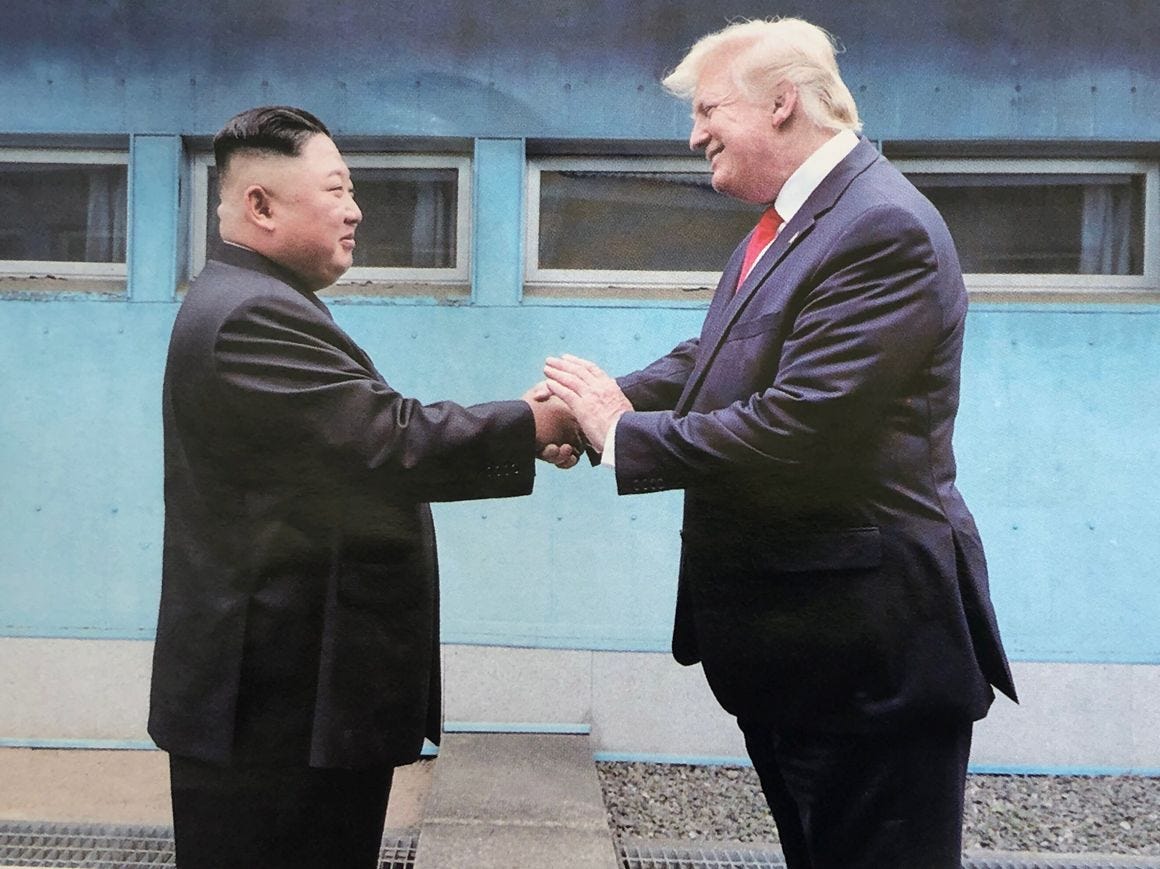
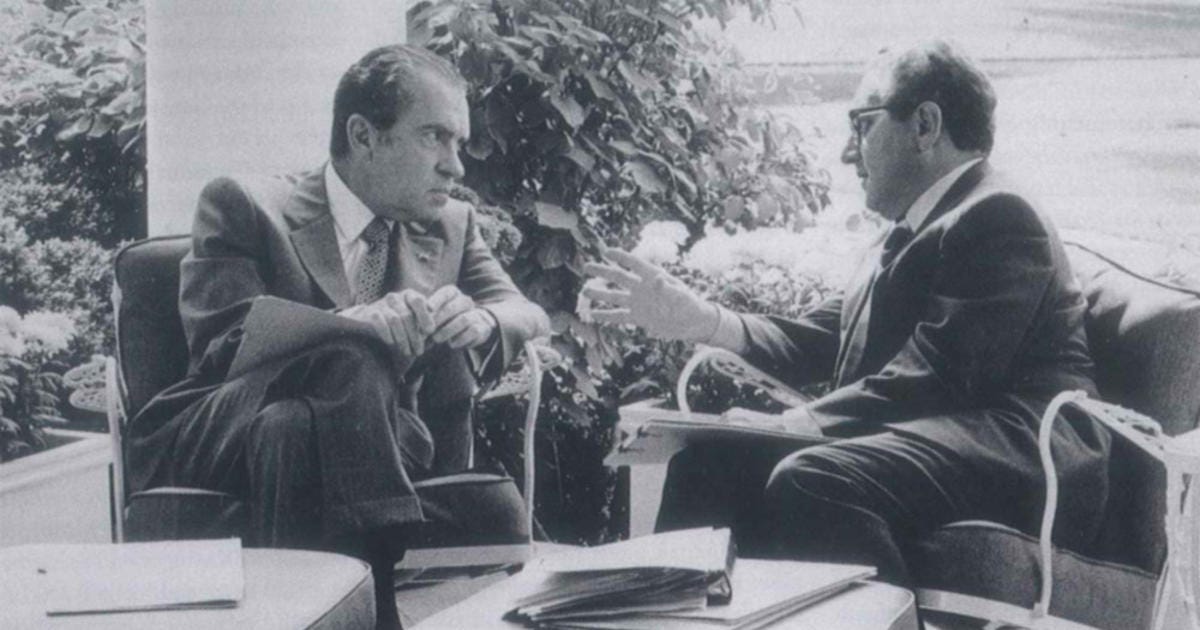
Well, you say nice things about people you want to make a deal with. The President would love to get to some normalization with North Korea that is not greatly dissimilar from the normalization Nixon and Kissinger pulled off with China in ‘71.
That’s not an unreasonable thing, not least in that it would greatly reduce our threat level and our expenditure level on an enemy that honestly can’t even keep its lights on.
Frank Gaffney: I’m sorry, I have to play the devil’s advocate. Let’s say the deal that Kissinger and Nixon wrought has brought us the greatest threat this country has ever faced, which is the Chinese Communist Party.
Don’t you think that might be a bad idea if we wind up propping up and getting American investors to help enable the North Korean regime, unreformed, still crazy after all these years, to be even more capable of putting even more weapons in place, with an even greater danger to us?
The Betrayal That Empowered China
Rod D. Martin: I think that ignores Bill Clinton. What we were doing in the ‘70s and ‘80s was triangulating against a Soviet empire that was in imminent danger of subjugating the world.
All of a sudden, Kissinger figures out, oh wait, the Chinese aren’t on board with that anymore. Oh, wait, we just nearly had a nuclear war between China and Russia. The degree of danger wasn’t known to the press when it happened, but Kissinger knew.
So they’re like, there may be an opening here. If we can turn the Chinese against the Russians in a more tangible way, one that ties down a rather large part of Russia’s forces along its longest border, that makes Europe safer, and it reduces the chance of an actual invasion and stampede toward the Rhine.
That’s what we were doing, and it may ultimately have saved the West.
But then you get Bill Clinton. Bill Clinton comes along and gives away the store.
Bill Gertz did a brilliant job of that. Everybody needs to go back and read a book by Bill Gertz called Betrayal, from 1996, that shows how Clinton just gave away every military secret under Heaven in exchange for a sea of illegal campaign cash.

That changes everything. And then, as you know, Clinton gives them Most Favored Nation status, and then he adds them to the WTO. Now the camel’s nose is under the tent.
Everything bad that we are opposing with China starts right there, not with Nixon and Kissinger. I have my own quibbles about that decision too, no question, but that’s beyond the scope of this conversation.
It’s Bill Clinton who sold us out to China. Then, for whatever reason, W., Obama, and Biden all agreed with that and continued it. It’s just the height of foolishness. But on Clinton’s part, it wasn’t “foolishness” at all. On Clinton’s part, it was betrayal.
Frank Gaffney: Rod, all I’m saying is that, generally speaking, and this is my only beef about singing the praises of enemies and signaling that you’re going to actually respond to frustrations with friends by scaling back dramatically — and perhaps, as you and Captain Fanell have said, this is just the exigencies of having a war going on halfway around the world — but still, signaling to those enemies that not only are we trying to encourage people to think well of them, but we’re also weakening our position vis-a-vis them.
That tends, in my estimation, based on hard historical experience, to almost make inevitable the Clintons or the Bushes or the Obamas or the Bidens tripling along behind bad ideas that get us into serious fixes, as we are today with China.
Rod D. Martin: Our problem in America is that we have elections at a regular clip, and eventually —
Frank Gaffney: Let the record show I think elections are a good thing, as I think you do too.
Rod D. Martin: So you go from a Nixon to a Carter in pretty rapid order, and for that matter Ford, who was a train wreck in his own ways. There’s a certain inevitability to dumb people taking over at some point. So you want to do as much good as you can while you can.
It was very hard to screw up what Reagan achieved, because he just achieved so much of it. That’s the model here.
Anyway, you asked about South Korea. As far as North Korea, the President is extremely well aware that Asians are especially attuned to maintaining face. He cannot make any deal whatsoever with North Korea without being appropriately complimentary of the leader.
However, that’s not even the point here. He’d like to do that, but that’s a tertiary thing at best. What he really wants to do is yank the chain of the communists you just mentioned in Seoul. He is not a dictator. He does have politicians around him…
Frank Gaffney: Hold the thought, Rod Martin. We are right up against the stops. We’re going to pick up with Lee Jae Myung and the dictator that he aspires to be, and is in the process of becoming, on the other side of this short break. We’ll be right back.
Trump’s Leverage Over Seoul
Frank Gaffney: Welcome once again to my conversation with the great Rod Martin about various aspects of the challenges we face around the world, and whether the dour look at things or the optimistic one is more compelling.
We faithfully get the optimistic one brilliantly presented by Rod. We’re doing so now, I guess, about the dictator, certainly aspirationally if not in being, this communist now president of South Korea.
Rod, we’re having this conversation in part as a drama plays out in a fashion. Thank you for joining in a letter sponsored by our Committee on the Present Danger: China on behalf of Morse Tan, a man who had served as one of Donald Trump’s top diplomats in the previous administration, who is now being effectively held hostage in South Korea pending some kind of prosecution for accurate remarks, for that matter, that he made over a year ago in Washington, D.C., about this communist, Lee Jae-myung.
What is your take on what’s going on with South Korea, and especially the dance that Donald Trump is clearly playing there, witness pulling back on some of these exercises, but also talking about relying on them to manufacture ships for us?
Rod D. Martin: They’re not just doing that. They’re now a major arms exporter of all kinds of land-based weapons. They’re selling tanks and artillery to Poland.
They are producing — as they do, I mean, go down to a car dealership — the South Koreans make good stuff, and they make it cheap. It’s hard to argue with that. That’s good because the United States has let so much of its industrial base atrophy that we need the help.
So I don’t have a problem with South Korea building some frigates or something. I’m glad that they’re going to have nuclear submarines. That greatly extends the capabilities of the alliance in general without meaningfully threatening the U.S. Navy if something goes wrong, because they’re not going to build that many, any more than Australia will.
But at the same time, we’re all very well aware that the current government in South Korea is not our friend. We want them to be on side, and they need to be on side. They can’t sell tanks to Poland if they cozy up too much to the Chinese. That all goes away.
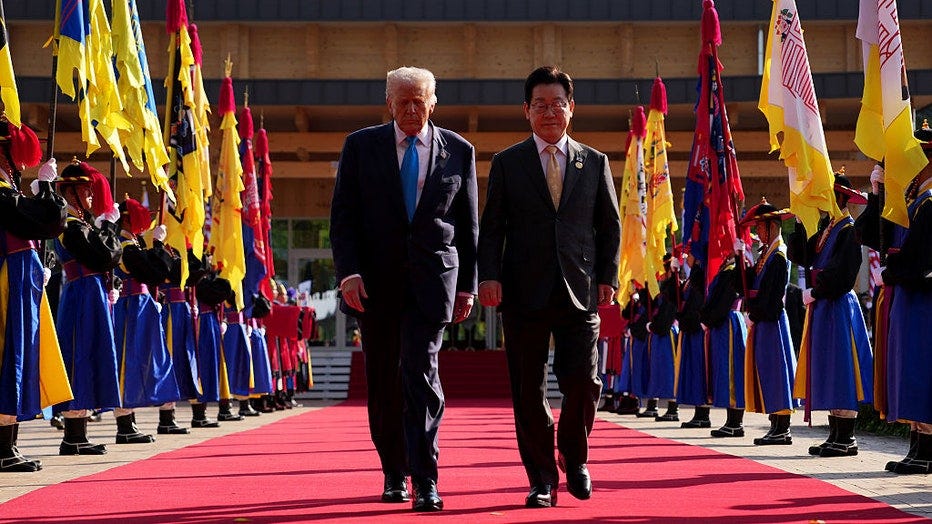
I think that’s exactly what this reduction in — notice, not a cancellation — a reduction in scope of these current military exercises is really about.
And Trump’s statements about Kim Jong-un: Yes, he says that stuff, but it’s actually aimed at Seoul, not Pyongyang. Again, he’ll get double duty out of it, but it’s aimed at Seoul.
He wants, before this guy can become a dictator — and maybe he does, maybe he doesn’t; South Korea’s had dictators before — the political consensus around him to get weirded out enough at the thought of losing all these contracts, at the thought of losing the American security umbrella.
Well, what if Trump does make peace with Kim Jong-un? What would we do then? Because he may want to be a communist dictator, but he doesn’t want to be a communist puppet of Kim Jong-un.
I think this is pretty typical Trumpian carrot-and-stick. There’s a wonderful world to be had if you’re our friend. There’s a really terrible set of worlds that you could inhabit if you aren’t. That’s the same thing as the message to Oman.
The Morse Tan Case
Frank Gaffney: We will be tracking that messaging, as well as how it is taken. But, Rod, I know we agree that what is being done to Morse is completely unacceptable.
In our letter, of course, we actually point out that this is not just the mistreatment of the human rights of a very accomplished American former official. It’s an affront to Donald Trump.
Rod D. Martin: It is.
Frank Gaffney: It was on his watch that this guy was a former diplomat. What is your take on where this should fit into the President’s agenda vis-a-vis Lee Jae Myung?
Rod D. Martin: These things are not at all unrelated. That’s the fun of Donald Trump: Nothing’s ever unrelated.
We’ve had a string of presidents that tried to compartmentalize everything into these completely separate boxes. “Oh, well, trade can’t have anything to do with defense,” and all of this hooey. Trump just connects it all.
Hillsdale College’s wonderful “The Story of America” series is now FREE for you to watch! Learn about the most important episodes in America’s Founding.
Click here for the full series!
So, yes, Tan is possibly the condition precedent to the reduction in our participation in the military exercises. No one’s going to say that. No one’s going to say that anything having to do with Kim Jong-un has to do with Seoul. That’s not how that’s going to work. But Seoul’s getting the message. They’re not stupid.
This is all connected. Trump is saying, “If you’re going to offend us, we’re going to offend you. We can hurt you, and you can’t hurt us.” That’s really fundamental.
Now, could they hurt us? Maybe in some way. Certainly we don’t want to lose the peninsula or anything. But I think the Koreans have a bigger interest in not losing the peninsula than we do. And the Koreans aren’t going to start bombing Seattle.
There’s a real limit to their ability to hurt us, and there’s virtually no limit to Donald Trump’s ability to hurt them. I’m not talking about kinetic action or invading South Korea. I’m just saying they are increasingly part of an economic web with Western countries that depends on good relations with the United States.
Unlike China, with more than a billion people, South Korea is small and immediately threatened by a hostile neighbor. It doesn’t have the leverage that China had in the last 30 years.
Frank Gaffney: Fascinating. One other place where, again, I think they could hurt us is if we do wind up having frigates or nuclear submarines, for that matter, built in South Korea with the benefit of American military technology. Aligning with the Chinese presumably translates into the transfer of some of that technology, that intellectual property, to the Chinese as well.
Rod D. Martin: Oh, yeah. Yeah.
Frank Gaffney: So we’re walking through a minefield here. Rod, we have to leave it at that for the moment.
I thank you, as always, for your insights as well as your optimism. We'll look forward to visiting with you next week. We'll look forward to talking to the rest of you again tomorrow, or next time at least. Until then, go forth and multiply.


