


by Rod D. Martin
March 20, 2026
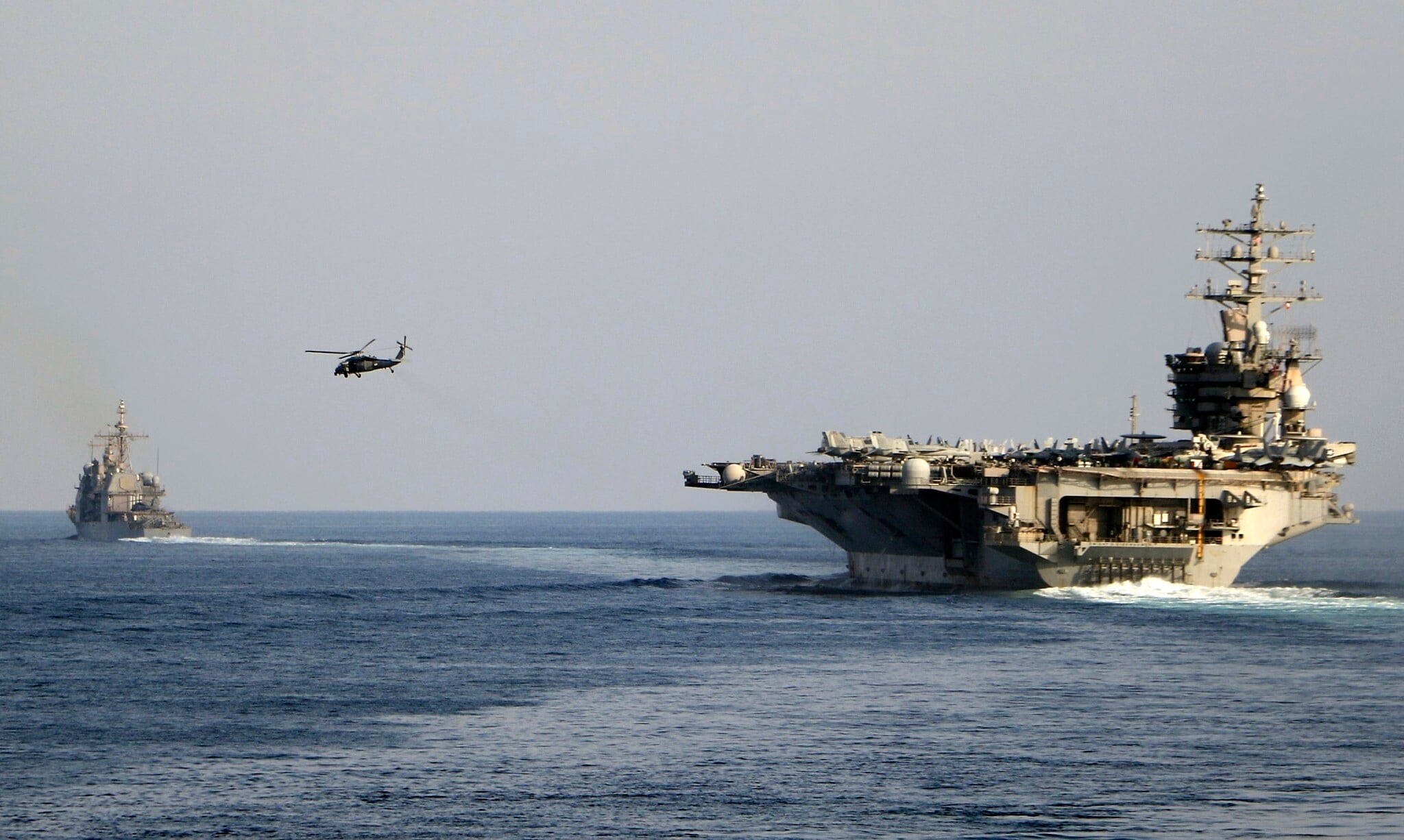
The pundit class is certain Trump had “no plan” with regard to Persian Gulf oil. It keeps asking the same question: when will the United States reopen the Strait of Hormuz?
That may be the wrong question.
Inertia is the most powerful force in the universe, especially Washington and Brussels. The assumption behind nearly all Enemedia commentary is that Hormuz is an emergency to be solved as quickly as possible, with little regard to other moving parts. Clear the danger. Calm the markets. Get the tankers moving. Restore the status quo. It’s America’s job to clean up the mess, pay the bill, provide the security, and then get lectured by its unhelpful “allies”.
Donald Trump does not think that way.
Trump’s foreign policy is not isolationism. But neither is it some neocon fantasy. It is something much harder, and much more coherent: America protects the system from which America benefits, but not for free, and not on other people’s terms.
We keep sea lanes open because global markets are good for American economic and security interests. We deter predators because chaos is expensive. But we are not Santa Claus. We are not obligated to provide premium security, premium liquidity, premium trade stability, and premium energy insurance to allies who spend their time undercutting our interests and then demanding rescue on command. And we don’t go in for the Bush era “you break it, you buy it” schtick.
So perhaps more newsworthy than the strikes on Iran has been Keir Starmer’s bombing campaign against the U.S. “Special Relationship”: refusing to send frigates or minesweepers, refusing (at first) to allow the U.S. to use its bases (which didn’t stop Iran from targeting them, as far away as Cyprus), and even restricting U.S. access to Diego Garcia, our most important Indian Ocean base, the one Starmer is trying to give away to Mauritius (and indirectly, China).
It was good when he shifted gears. It was telling that we did just fine without him.
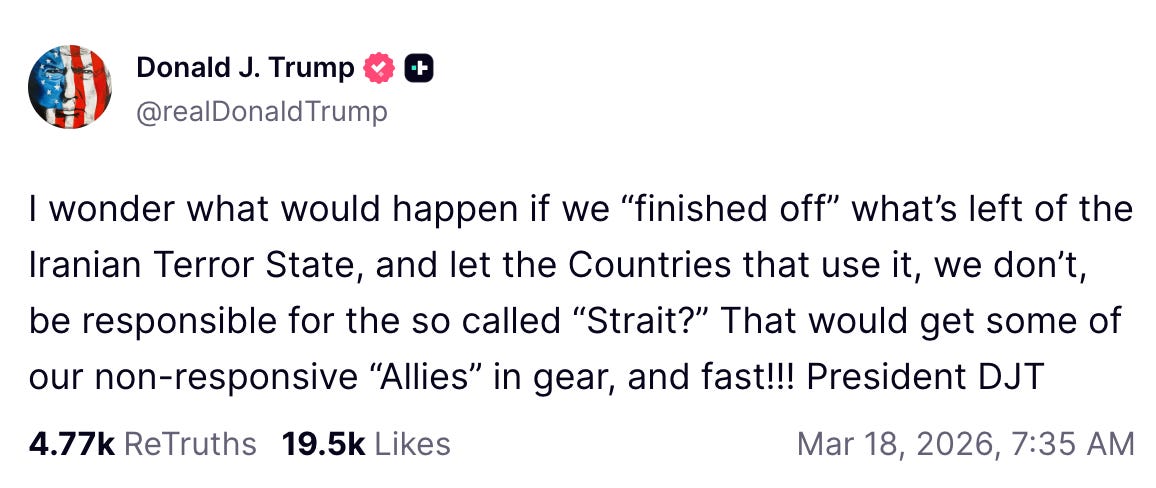
It’s even more galling to hear the German Chancellor this week saying “this is not our war”, even though Europe gets vastly more of its energy from the Persian Gulf than we do, and all Donald Trump asked of it was some help with minesweeping and tanker escort. Yesterday, all the intransigents backed off that position, with Britain, France, Germany, Italy, the Netherlands, and Japan promising in a joint statement to help ensure safe passage through the Strait. Perhaps they read Trump’s tweet. But the delay, and the dismissal, are maddening.

And even worse than the wishy-washyness, it’s more infuriating still to hear the German Defense Minister laugh about how insignificant European navies are compared to “the mighty U.S.” as an excuse for inaction.
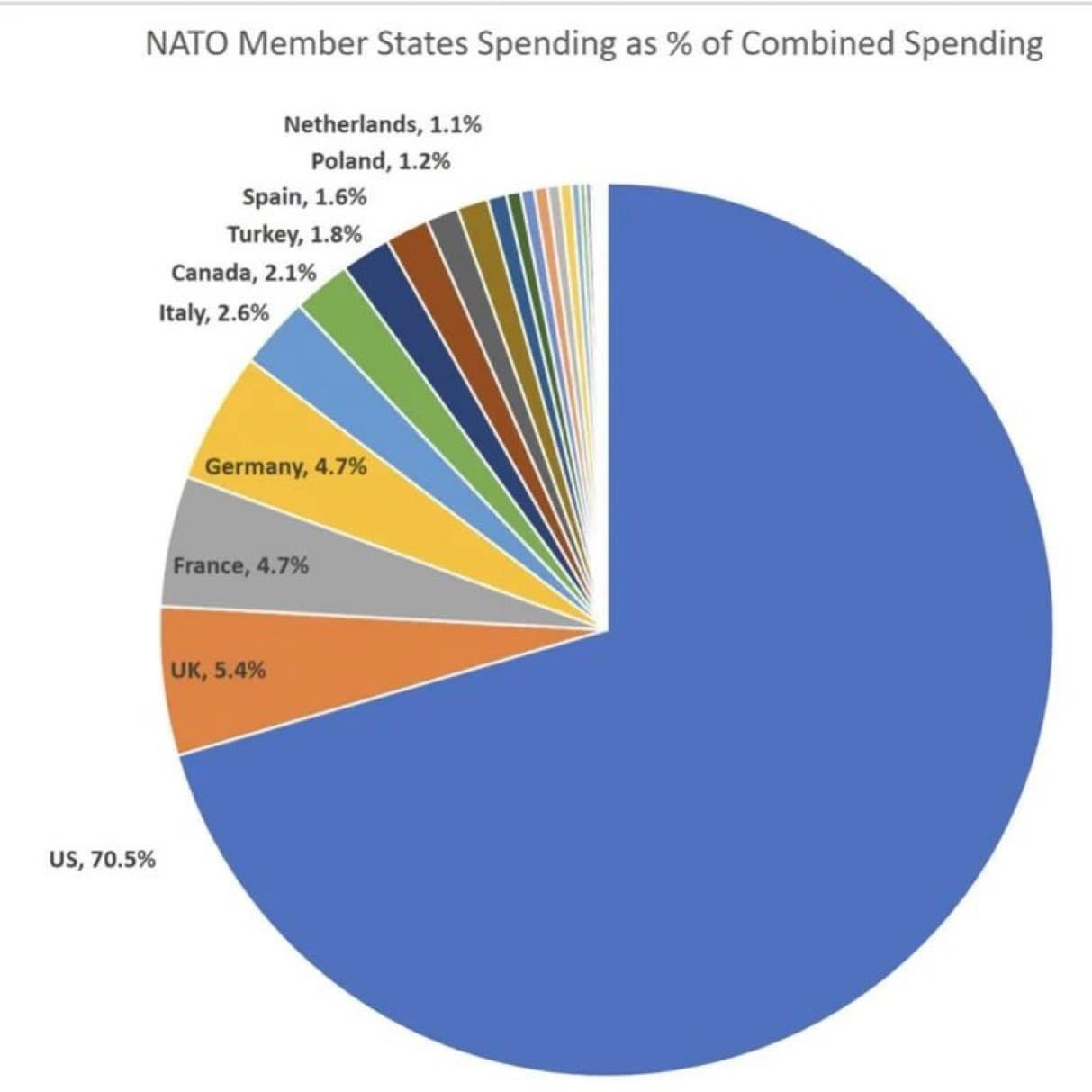
Wait, what?! How is it that 31 of 32 countries pay just 29 percent of the bill for NATO? What kind of “partners” contribute next to nothing while getting all the benefit? That sounds more and more like a dysfunctional marriage.
And if protecting the sea lanes through which Europe’s oil flows (not ours) isn’t “your” war, why have you hectored us for years over the European war in Ukraine? Isn’t that your war? (But no, it isn’t, because Europe has sent twice as much money to Putin for energy purchases as to Zelensky in aid. Playing both sides is their primary skill these days.)
Trump wasn’t wrong several weeks ago with regard to the frankly annoying Article 5 discussion when he said “We’ll be there for Europe. I’m not so sure they’ll be there for us.” Turns out they aren’t, at least not without arm-twisting, even to protect their own oil. Partners? No.
That is why Hormuz matters. This is not simply an Iran story. It is not just an oil story. It’s not merely a naval story.
It’s a leverage story. It is a London story. It is a NATO story. And behind all of it sits the administration’s larger strategic aim: boxing in China by constraining the systems that subsidize CCP power, while freeing American forces for the Pacific.
The question, then, is not how fast America can restore the old arrangement.
The real question is why, and on what terms, Trump should.
Hormuz Didn’t Close Because of Drones
Most readers hear “Strait of Hormuz” and think in military pictures: mines, missiles, drones, fast boats, destroyers. Those things matter. But they are not the key.
The key to maritime commerce is insurance. And Trump understands it better than our allies.
A tanker does not sail because it floats. It sails because somebody will insure it. Without insurance, the ship may still be physically seaworthy, but commercially it’s dead in the water: no financing, no charter, no port entry, and therefore no voyage. This is the key to Trump’s Shadow Fleet strategy: not to seize every tanker, but to seize enough of them to make the rest uninsurable.
The truth is, Iran has not closed the Strait. Lloyd’s of London has. The City of London is globally dominant in marine and war-risk insurance, and Lloyd’s alone controls roughly 45% of the global specialty insurance market.
They won’t like Trump’s solution to the current problem.
