
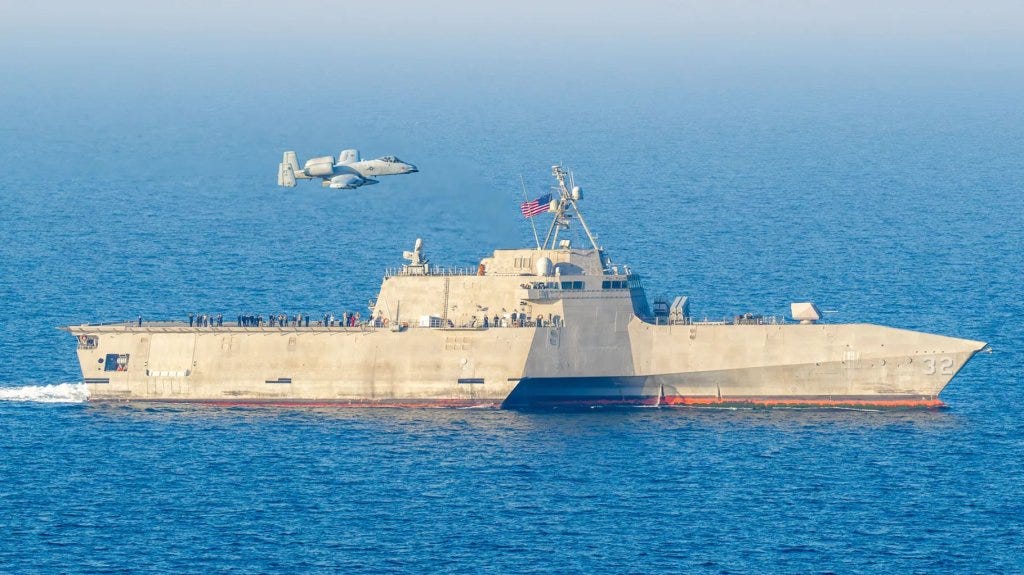
The A-10 "Sea-Hog"
Why the A-10 Warthog’s new maritime role could extend the life of a great aircraft — and give America badly needed littoral strike power at exactly the right moment.

This analysis is free, but with Premium Membership you get MORE. Join today.
by Rod D. Martin
April 7, 2026
BRRRRRT! The sound U.S. troops love to hear is now a nightmare for sailors on board Iranian IRGC fast attack boats in the Strait of Hormuz. The A-10 Warthog, everyone’s longtime favorite tank killer, has been repurposed as a boat buster. And the results are stunning.
According to Air Force Gen. Dan “Razin” Caine, Chairman of the Joint Chiefs of Staff, U.S. forces have destroyed more than 120 naval vessels, including many fast attack boats, plus another 44 mine layers. The A-10 is the star of the show, flying low and slow, using its devastating 30mm gun to turn IRGC fast boats into scrap metal. And as we speak, more A-10s are on their way to the Gulf.
The irony is rich. For years, the United States Air Force has been trying to kill the A-10. Congress has consistently refused to let it. The pilots who actually fly the thing have always loved it, while the theory class in Washington has treated it like an embarrassing relic: too slow, too ugly, too specialized, too 1970s, too insufficiently “transformational”.
Yet here we are. The “obsolete” A-10 is back in combat, back in demand, and back where reality always sends it when the stakes are high and the target is hard: at the point of friction, where the enemy is real, the battlespace is messy, and elegant abstractions go to die.
This time, however, something even more important may be happening. The Warthog is becoming a Sea-Hog. And it’s exactly the tool the U.S. has long needed for the kind of dirty, repetitive, asymmetric maritime fight we face in places like Hormuz.
If the events now unfolding around the Strait of Hormuz tell us anything, they tell us this: America does not merely need stealthy, exquisite, high-end platforms for the first days of a peer war. It also needs tough, persistent, heavily armed, relatively inexpensive aircraft that can loiter over constrained waters, identify threats visually, and kill swarming small boats, drone threats, mine-laying craft, and exposed coastal targets without wasting million-dollar munitions on glorified speedboats.
That is exactly the sort of work for which A-10s are unusually, perhaps uniquely, well suited. They are being used where their strengths matter most: over cluttered littoral waters, against small, fast, exposed, hard-to-sort targets in an environment where persistence and discrimination matter more than glamour.
That success alone should end a great deal of foolishness.
In open-ocean theory, speed is a virtue. In cluttered littoral reality, speed can be a liability. A fast jet roaring through a dense maritime picture at high closure rates may be marvelous for many missions, but this is not that. This is a dirty, visual, repetitive fight against small targets mixed into civilian traffic and coastal clutter, often appearing suddenly and requiring rapid reattack. In that environment, low-and-slow isn’t a bug. It’s a feature.
The A-10 can loiter. It can stay on station. It can visually sort. It can come back around. It can shift from missile to rocket to cannon fire on the same sortie. It can operate close to the problem instead of merely flashing through and past it.
That matters when the threat is not a capital ship steaming alone across blue water, but a swarm of cheap, fast, irregular maritime threats: speedboats, mine layers, drone boats, and other asymmetric nuisances that become deadly precisely because they are small, numerous, and inexpensive.
And the mine-laying piece matters every bit as much as the swarm boats. Fast boats can harass, strike, and scatter. Mines can close a chokepoint. In a place like Hormuz, that is the real strategic danger: not just that Iran can bloody a ship, but that it can turn one of the world’s most important energy corridors into a no-go zone. The Sea-Hog is useful not only because it can shred speedboats, but because it can help suppress the mine-laying effort that makes a prolonged closure possible.
In all these ways, the Sea-Hog changes the math.
The United States Navy can kill these threats, of course. The Navy is the most powerful maritime force in human history. But the question is not whether it can destroy them. The question is whether it should be using its most expensive tools to do so, and whether those tools are optimal for the job.
That’s where the Pentagon’s habit of confusing sophistication with fitness becomes dangerous.
Shooting down cheap drones or blowing apart fast attack craft with scarce, expensive, high-end munitions is often a bad trade. Burning through exquisite missile inventories to solve low-cost harassment problems is neither sustainable nor a sign of strength. The same is true of using aircraft designed for very different missions when what is needed is persistent, low-altitude, visually discriminating attack power with real magazine depth.
The A-10 offers exactly that. Its 30mm GAU-8 Gatling cannon was designed to fire up to 3,900 rounds per minute, or 65 rounds per second. Then the aircraft was designed around it. Its APKWS-guided rockets are far cheaper than many of the alternatives that would otherwise be used against small boats and drones. Its Maverick missiles remain highly relevant against the right targets. Its survivability, its loiter time, and its ability to absorb punishment in relatively permissive environments are operationally meaningful.
In short, the Sea-Hog is not merely lethal. It’s efficient. And in modern war, efficiency matters more than ever.
America is entering a period in which naval strain, industrial constraint, and widening maritime commitments are all colliding at once. China looms in the Pacific. Allied capacity is uneven and inadequate if it’s available at all. The Navy, for all its unmatched power, cannot be everywhere with endless magazine depth and infinite hulls. The Marines are rethinking littoral warfare because reality is forcing them to. Everyone serious is grappling with the same issue: how do we generate more practical, sustainable combat power in contested maritime spaces without bankrupting ourselves or exhausting our highest-end systems on the wrong targets?
The A-10 is not the whole answer. But it’s certainly part of it.
All this points toward a broader force-design lesson. The Marines are already rethinking how to fight from austere positions across contested littorals, using dispersed forces to complicate an enemy’s calculus and hold key maritime terrain at risk. An aircraft like the A-10 — rugged, heavily armed, able to operate close to the fight and from less elaborate infrastructure than more delicate jets demand — fits that world far better than most other available assets. The Sea-Hog is exactly the kind of practical littoral strike capability America needs much more of.
And that’s the thing. It isn’t just about saving an old airplane beloved by its pilots and admired by Congress. It’s about unlocking stranded value inside the existing force. It’s about recovering useful combat capability the bureaucracy has been desperate to throw away. It’s about recognizing that a platform originally built to kill Soviet armor in the Fulda Gap turns out also to be exceptionally useful for killing swarming drones, small boats, and other maritime threats in narrow waters half a world away.
Reality has a way of humiliating theory.
The Air Force has wanted to retire the aircraft because the A-10 does not fit the institution’s preferred self-conception. It’s not sleek. It’s not prestigious. It’s not the centerpiece of the service’s vision of future war. It doesn’t flatter people who want every discussion of airpower to culminate in stealth, speed, and cost-plus magnificence.
But neither is the F-15EX. And we’re buying at least 129 of those.
War is about solving actual military problems with actual tools under actual conditions. The people who love the A-10 know this because they fly it. Congress keeps protecting it because, however imperfectly, Congress senses a gap that has not been honestly filled. And now actual combat is vindicating the point again: there remain missions for which no fashionable substitute is nearly as convincing.
That does not mean the A-10 should fly forever. Nothing does. Airframes age. Sustainment grows harder. The calendar is real. But that is not an argument for pretending the capability is obsolete before a serious replacement exists. It is an argument for learning the lesson while there is still time.
The lesson is broader than just “keep the Warthog”, and it’s much more important: the United States needs dedicated, affordable, persistent littoral strike and interdiction capability. It needs aircraft and systems optimized not only for the opening hours of a hypothetical great-power war, but for the ugly, recurring, absolutely predictable fights short of that: convoy protection, chokepoint control, anti-swarm warfare, mine suppression, drone hunting, maritime interdiction, and coastal harassment response.
That is what the Sea-Hog reveals: that we have spent too long undervaluing useful force in favor of fashionable force; that slow can be better when the battlespace is dense and visual; that toughness and loiter still matter; and that cost-per-kill and magazine depth are not mere accounting trivia.
More than anything, it reveals that the Navy’s capabilities, and the Marines’ evolving littoral concepts, require an aircraft the Air Force elite has spent years trying to send to the boneyard.
This is exactly the wrong moment to discard capacity that still works. It is exactly the wrong moment to tell ourselves that every useful military instrument must also be exquisite, stealthy, and astronomically expensive. We do not merely need the tip of the spear. We need the shafts, the shields, the logistics, the magazine depth, and the ugly workhorses that make sustained power projection possible.
The A-10 is one of those workhorses.
Call it what you like. Warthog. Boat buster. Tank killer. Flying gun.
But in the waters around Hormuz, and perhaps in a wider future maritime role beyond it, the better name is Sea-Hog.
The Sea-Hog deserves to live. Under Gen. Caine’s leadership, the A-10 has secured a strategic reprieve until at least 2029. It’s a start.
But perhaps it’s time to give serious thought to a new A-10EX.


From what I have read (Could Be Wrong) from day 1 the AF brass hated, loathed, despised this plane. It doesn't fly High, it doesn't fly Fast, it doesn't shoot own other planes, They Hate it. All it does is support the other branches. Grunts Love it and just as important Joe/Jane Sixpack Love It,