
Has Alberta’s Brexit Moment Finally Arrived?
Pro-independence activists needed 177,732 signatures. They just submitted nearly 302,000. Now Ottawa faces a reckoning.
This analysis is free, but with Premium Membership you get MORE. Join today.
by Rod D. Martin
May 8, 2026
A lot of people thought the idea of Alberta independence, or even statehood, was crazy talk.
Guess again.
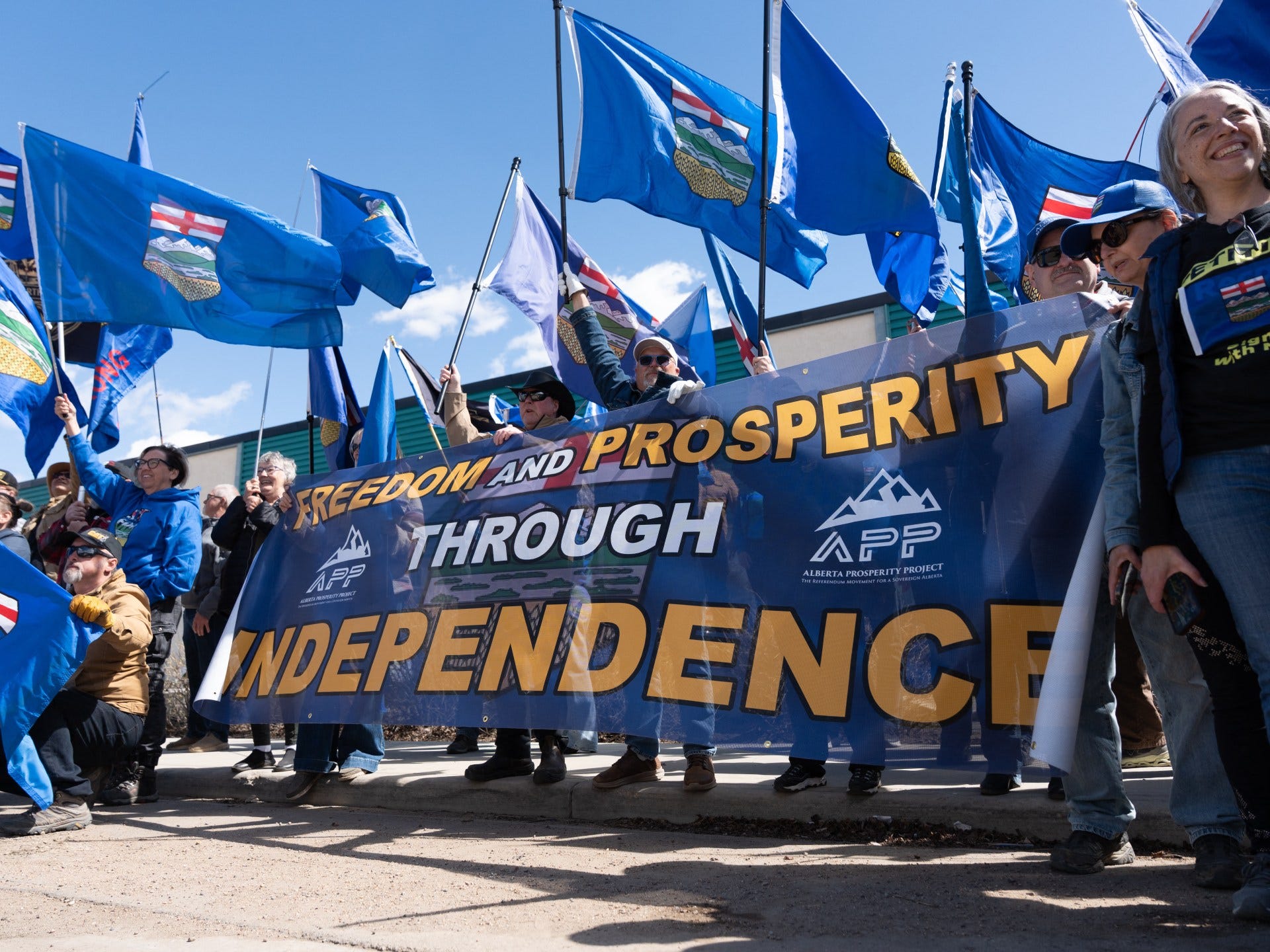
Alberta separatists just delivered nearly 302,000 signatures to Elections Alberta — roughly 70 percent more than the 177,732 required to trigger the referendum process. The signatures still must be verified, and the courts may yet intervene.
But the proposed question is as direct as it gets: “Do you agree that the Province of Alberta should cease to be a part of Canada to become an independent state?”
As a matter of fact, yes. Yes it should.
If America is annoyed by Canadian freeloading on the American defense budget and inequities in tariff treatment, Alberta has reason to be livid. Ottawa extracts wealth from the province as though it were a colony, like some North American Belgian Congo. If Mark Carney gets his wish and Canada joins his beloved EU, it will become exactly that.
Alberta is not merely another province with ordinary political grievances. It is the productive, energy-rich, conservative West, ruled by an eastern establishment that despises its industries, taxes its wealth, blocks its pipelines, mocks its values, and then demands gratitude for the privilege. For decades, Ottawa has treated Alberta not as a partner in Confederation, but as a cash cow, a colony, and a cultural punching bag.
That was bad enough under Trudeau. Under Carney, it has become doctrine.
Carney is not merely another Liberal prime minister. He is the perfect embodiment of the worldview Alberta should fear most: managerial, globalist, post-national, hostile to energy, comfortable with supranational bureaucracy, and instinctively more at home in Davos, Brussels, and London than in Calgary, much less Grande Prairie.
Nor is Europe the end of it. Carney has sought a new strategic partnership with Communist China, announcing expanded cooperation in energy, trade, public safety, multilateralism, and culture. In Beijing, he announced that Canada and China were “forging a new strategic partnership,” and suggested that China had become a more predictable partner than Washington.
For Alberta, that is not a future. It is a prison sentence.
The separation petition did not appear out of nowhere. It is the predictable response of a productive people who understand they are not being governed as partners in a federation. They are being exploited, full stop.
Alberta’s Brexit Moment
That is what makes this Alberta’s Brexit moment. The issue has crossed the line from complaint to process. Ottawa can no longer dismiss Western alienation as background noise.
Elections Alberta confirms the required threshold is 177,732 signatures — 10 percent of the votes cast in the last provincial general election. Yet nearly 302,000 have signed. The petition has been received, the boxes sealed, locked in cabinets, and stored under 24/7 security monitoring while the courts decide when verification may proceed.
Ottawa’s courtiers will wave the polls and insist separation cannot win. They should ask David Cameron how that worked out.
In June 2015, roughly one year before the Brexit referendum, Ipsos found Remain ahead of Leave 61–27, with 12 percent undecided. Among those expressing an opinion, that was 69–31 Remain. On an alternate wording — “Should the United Kingdom remain a member of the European Union?” — Ipsos had Yes leading No 66–22, or 75–25 among those expressing an opinion.
A year later, little had changed. In May 2016, just weeks before the vote, Ipsos still had Remain leading. Its May 14–16 poll showed 55 percent Remain, 37 percent Leave, 5 percent undecided, and 3 percent saying they would not vote. Among those expressing an opinion, that was 60–40 Remain.
This was obviously going to be a blowout. Brexit supporters had no chance. Even on election night, all the prediction markets said so.
And yet the final result was Leave 51.9 percent, Remain 48.1 percent. The British people had their say, and the entire governing class — including then-governor of the Bank of England Mark Carney — was humiliated.
That is the lesson for Alberta. Ruling classes routinely mistake present polling for permanent consent.
Angus Reid found earlier this year that 29 percent of Albertans would vote to leave Canada if a referendum were held immediately, with 8 percent definite and another 21 percent leaning that way. The establishment reads that number and sees a nothingburger. It ought to see danger. Political movements don’t begin at 51 percent. They begin when enough people conclude the old order has lost legitimacy.
And then the campaign begins.
Leger found last year that 58 percent of Albertans said federal actions could influence their view of Alberta’s political future, while 62 percent said the rest of Canada does not understand why some Albertans feel alienated. That is not settled loyalty. That is dry timber.
And now someone has struck a match.
Not a Nation But an Empire — And Alberta is Its Colony
Western Canada has had enough. And after the recent federal election, the rage is no longer quiet.
Once again, Alberta voted overwhelmingly conservative. And once again, that made no difference. The Laurentian elite held their grip on power — propped up by Quebec voters, hostile to Western interests, and smug in their belief that Alberta’s wealth is theirs to take, er, “redistribute.” For decades, Alberta — rich in oil, fiercely independent, and proudly conservative — has been treated not as a partner in Confederation, but as a colony of the East.
Consider the facts:
Equalization Payments: Alberta pays billions each year into a federal system that redistributes its wealth to other provinces — chiefly Quebec — despite Alberta’s economic struggles. It’s taxation without representation, and with a French accent. It renders Alberta effectively a colony.
Carbon Taxes and Energy Policy: Ottawa has launched a relentless leftwing war against Alberta’s oil sands and energy sector, crippling pipelines, delaying permits, and criminalizing prosperity.
Political Disenfranchisement: The House of Commons is weighted toward Eastern Canada. The Senate is a patronage backwater. And the Prime Minister’s Office governs by decree, often in open contempt of the West.
This isn’t unity. It’s subjugation.
From the moment Alberta entered Confederation in 1905, it was treated as an afterthought — an imperial holding ruled from the East. The so-called “national interest” always seemed to mean Quebec’s interest. And while Alberta built the pipelines, powered the economy, and filled the federal coffers, Ottawa wielded its power like a colonial governor, redistributing wealth and writing laws with no regard for the West’s values or prosperity.
Albertans noticed.
They noticed when Pierre Trudeau imposed the National Energy Program in 1980, effectively nationalizing Western oil and triggering the greatest economic crisis in Alberta’s history. They noticed when Stephen Harper — a rare Western prime minister — was replaced by Justin Trudeau, whose government made it a moral crusade to shut down Alberta’s oil sands while buying foreign oil from despots abroad.
They noticed the carbon taxes, the canceled pipelines, the equalization payments flowing east even as Alberta struggled through recession. They noticed that every federal program and regulation seemed custom-built to crush the very industries on which Alberta depends, all while extracting an ever-higher tax burden to support the welfare state back east.
And they noticed that there was no way to stop it.
Why? Because under Canada’s political architecture, Alberta pays all the bills but has no meaningful say. The House of Commons is dominated by Ontario and Quebec. The Senate is unelected and stacked with Laurentian elites. The courts, media, and civil service all lean left and east. A hundred years of democratic betrayal have taught Albertans the same lesson over and over: Ottawa is not your government. It’s your master.
That is the heart of the matter. Alberta is considering independence because Ottawa has treated it like a colony — and is shocked to discover that colonies sometimes seek independence.
Ottawa’s Response: Too Little, Too Late
Of course, now that Alberta has leverage, Ottawa has suddenly discovered compromise.
Last November, Prime Minister Carney and Premier Danielle Smith signed a Canada-Alberta memorandum of understanding that immediately suspended the Clean Electricity Regulations in Alberta pending a new carbon-pricing agreement. Ottawa also committed not to implement the oil and gas emissions cap, agreed to treat an Alberta bitumen pipeline to Asian markets as a national-interest priority, and promised an approval path that could include Indigenous co-ownership and adjustment of the Oil Tanker Moratorium Act if necessary.
Fine. Better late than never.
But this is not repentance. It’s damage control. Ottawa is not restoring Alberta to constitutional equality. It’s not returning a century of confiscated wealth, lost opportunity, canceled infrastructure, and political contempt. It’s not admitting that the entire Laurentian model — take from the productive West, redistribute eastward, regulate energy into submission, and then congratulate yourself for your “obvious” moral superiority — was rotten from the beginning.
Carney is making tactical concessions because Alberta now has a credible exit threat. And he’s seen this play before.
Even those concessions come wrapped in Ottawa’s usual net-zero straitjacket: carbon pricing, emissions reductions, carbon capture conditions, methane targets, regulatory consultation, and bureaucratic process stacked on bureaucratic process. It’s much too little, much too late.
Alberta’s destiny points south, not east: energy, markets, pipelines, defense, investment, culture, and constitutional liberty. Ottawa’s ruling class points eastward to Europe, westward to China, and downward into managed decline.
Independence Is the Door. Could Statehood Be the Destination?
An independent Alberta would be a wealthy nation. Statehood could make it more so.
This is where the debate will move next. The petition question is independence. But independence may not be the end. Once that door is opened, Alberta will have to decide what independence is for.
An independent Alberta would have energy, agriculture, minerals, capital, talent, and $45 billion a year that’s currently being siphoned east. But independence is an expensive proposition. Militaries. Embassies. Intelligence services. Central banks. International organizations. Trade negotiations. Border security. Treaty disputes. All of this costs, one way or another.
A landlocked country with world-class energy reserves but no sovereign route to tidewater would be independent on paper, but strategically vulnerable in practice.
Moreover, as I’ve argued consistently, the only true free trade zone available is the one created by the U.S. Constitution. Just 4 percent of the world’s population creates and controls 26 percent of the world’s economy. It’s the planet’s indispensable consumer market. And that U.S. market buys an incredible 89 percent of Alberta’s exports.
Why export all that through customs, across an international border?
Statehood solves all of this. Alberta would keep all the benefits of being part of a larger country — a much larger country than the one it’s leaving — but minus the plunder.
Whatever Washington’s faults, it does not and cannot place disproportionate burdens on a singled-out state in the way Ottawa does as a matter of course. Canada can, and does.
If Alberta became the 51st state of the Union, it would gain two U.S. Senators and full representation in the House of Representatives — real seats at a real table. It would gain constitutional guarantees of free speech, religious liberty, gun rights, property rights, and the rule of law, all conspicuously missing from today’s Canada. It would gain energy freedom under a federal government that’s pushing to become the world’s largest exporter. It would gain access to American capital markets, military protection, and unimpeded participation in the largest economy on Earth.
Nor is this a one-way street. The United States stands to benefit immensely from including the extremely conservative “Texas of the North.” Alberta’s oil, gas, uranium, minerals, timber, agricultural land, cattle, wheat, canola, and technological capacity would strengthen American energy security, food security, supply chains, and Arctic strategy.
Alberta’s pipelines, railroads, and highways already connect to the American economy. Its people already share much of the culture of Montana, Wyoming, North Dakota, and Texas.
Drive from Calgary to Montana, and the only thing that changes is the gas prices and the gun laws. The accident of a dotted line on a map is the only thing keeping this natural union apart.
Texas joined the Union for much the same reason. Independence is expensive. Inclusion in the U.S. market is valuable. Getting rid of needless trade barriers — and needless expenditures on embassies and armies — makes everyone richer.
Can Alberta make it on its own? Absolutely. Should it? Will it? I hope not. It’s hard to imagine a better fit.
But either way, Alberta doesn’t belong in today’s Canada.
Alberta May Not Be Alone
Alberta is the first mover. It’s not the only province watching the result.
Western alienation is not confined to Edmonton or Calgary. It stretches across the prairie like a weather front, from the Peace Country to the Red River, from the foothills of the Rockies to the flat expanse of the Saskatchewan plain. The grievances are shared, the injuries are the same, and the values — faith, family, freedom, work — remain strikingly consistent across provincial borders.
No province is more ideologically aligned with Alberta than Saskatchewan. It is similarly rural, energy-rich, Christian, and fed up. Its economy is driven by oil, gas, potash, uranium, and wheat — industries targeted by Ottawa’s green mandates and central planning. The Trudeau-Carney government has treated Saskatchewan with every bit as much contempt as Alberta, while stripping it of the means to push back.
If Alberta goes, Saskatchewan has every reason to chart the same course. And if Alberta is the 51st state, perhaps Saskatchewan can be the 52nd.
Manitoba is more complicated. British Columbia is more complicated still. But the Interior of British Columbia is not Vancouver, and rural Manitoba is not downtown Winnipeg. In any serious realignment, the gravitational pull will not merely be westward. It will be southward — toward the United States, toward markets, toward energy, toward constitutional liberty, toward the civilization these provinces increasingly resemble more than they resemble Ottawa.
This is the larger meaning of the Alberta petition. It is not merely another Canadian protest. It is the beginning of a geopolitical realignment. A rebirth. A new American frontier, and a new birth of freedom.
Canada no longer offers Alberta liberty or self-government. It offers managed decline, confiscated wealth, punished industry, regulated speech, bureaucratic contempt, and the endless demand that the West pay tribute to the East while apologizing for merely existing.
America is built differently. Its Constitution enshrines the rights Ottawa buries. Its system was designed to divide power, not centralize it. It recognizes that the individual is prior to the state. That rights come from God, not the government. That property is not a privilege. That sovereignty flows upward, from the people.
But whatever course Alberta chooses — independence, statehood, or something else — the first step is now a vote.
Will Alberta allow Ottawa to keep ruling it like a colony?
Or has Alberta’s Brexit moment finally arrived?


Interesting and hopeful.