


Normally our Deep Dives are for Premium Members only, but we think this is so important everyone should read it. Enjoy, share, and join Premium today.
by Rod D. Martin
August 14, 2026
In some of the better news of the year, President Trump just put fourteen new nuclear submarines under contract in an historic $76.6 billion shipbuilding award: five additional Columbia-class ballistic-missile submarines, nine Block VI Virginia-class submarines, and billions for shipyard productivity.
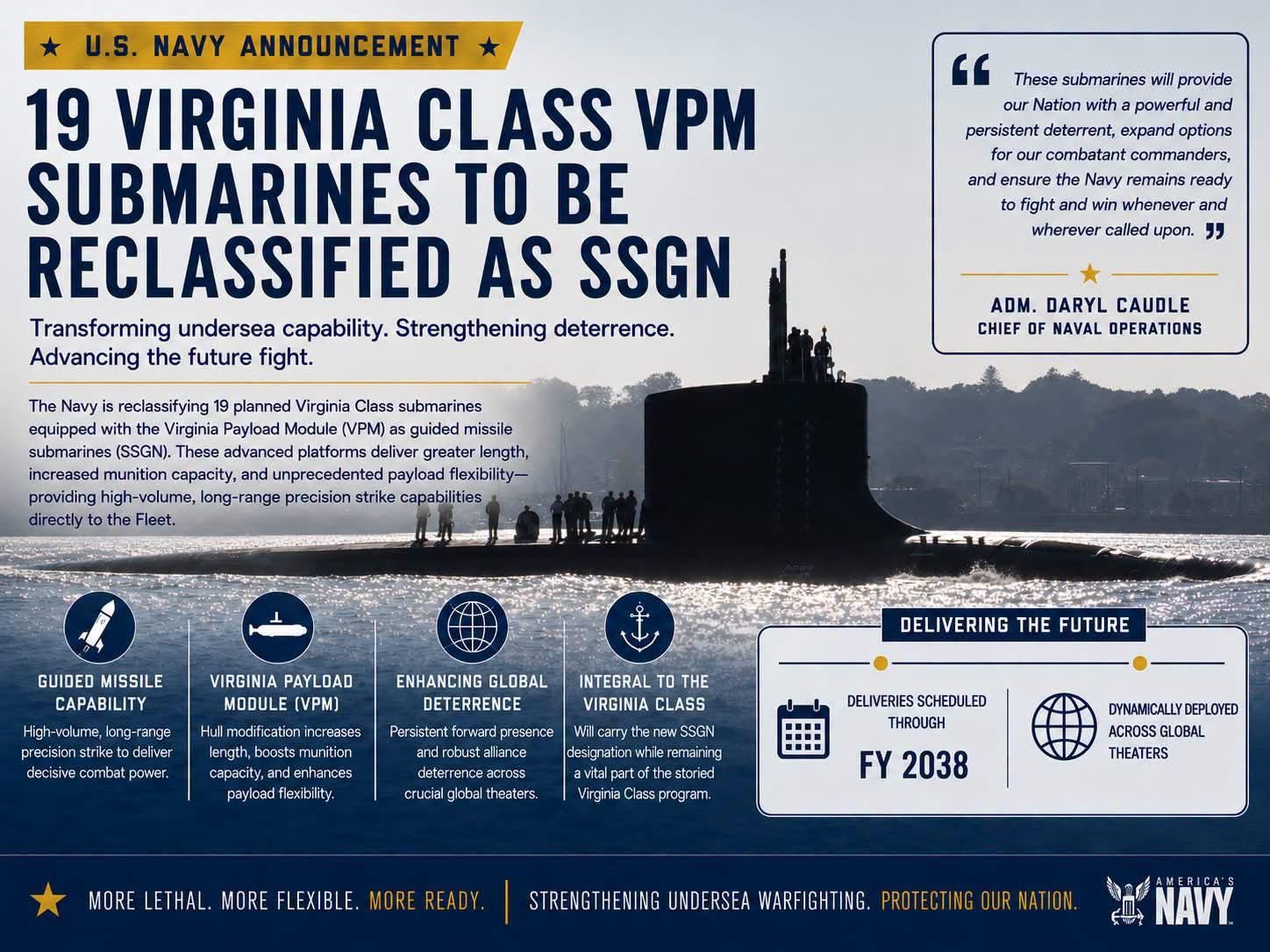
Days later, the Navy gave the enlarged, Virginia Payload Module-equipped Virginias their proper designation: guided-missile submarines — SSGNs. It plans 19 of them, every one of them needed sooner than they can possibly be produced.
Then yesterday, Trump attacked the missing half of America’s desperately needed submarine buildup: the shipyard capacity to turn those contracts into a fleet.
His August 13 memorandum orders plans for the first new public Navy yard in more than eighty years, with up to three drydocks sized for every current and projected submarine class. It also calls for a repair center stocked with complete “ship sets” of spare components, and an overhaul of the naval bureaucracy that’s focused on exactly one result: ships actually delivered.

Hillsdale College’s wonderful “The Story of America” series is now FREE for you to watch! Learn about the most important episodes in America’s Founding.
Click here for the full series!
This is the first credible plan in decades to restore America’s lost undersea striking power, strengthen the nuclear deterrent, fulfill AUKUS, and rebuild the yards. The contract buys the submarines, and perhaps even more important, provides the long-lead material investments and multi-year procurement plans necessary for the private shipyards to expand capacity. Yesterday’s memorandum creates the additional, necessarily government-owned, capacity to deliver and maintain them.
It’s exactly the right plan. It’s also dangerously late. For decades, Presidents of both parties allowed the Navy and its shipyards to atrophy while China built the world’s largest navy and moved toward submarine parity — and soon, numerical superiority.
Now comes the hard part. A contract is not a submarine, and a plan is not a fleet. The last of those 19 SSGNs isn’t expected before 2038. China isn’t waiting. America can’t either.
The Undersea Gap Is Only Part of the Threat
China already has the world’s largest navy by hull count: more than 370 battle-force platforms, with 435 projected by 2030. Most are inferior. America still leads in technology, training, combat experience, global logistics — and above all, nuclear submarines.
But quantity has a quality all its own — particularly when the larger fleet can concentrate near home while the smaller one must defend the world.

China can mass its fleet near Taiwan and the First Island Chain. America cannot. Our submarines must cover the Western Pacific, Atlantic, Arctic, Mediterranean, Middle East, and Russia, plus strategic deterrence, intelligence, special operations, training, and maintenance. A boat watching Russia can’t stalk China, and one in overhaul counts on paper but not in a crisis. America therefore needs far more than parity: enough boats to sustain simultaneous forward operations, absorb losses and delays, and retain a strategic reserve.
As I warned last year, China is on track to surpass the United States in total submarine numbers around 2030. Most of those boats will be inferior to a Virginia. That isn’t comforting. An inferior submarine can still sink ships, lay mines, threaten logistics, divert scarce assets, and complicate every Western Pacific operation. And enough inferior submarines can overwhelm too few superb ones.
Submarines are only part of the danger. China commissioned its third carrier, the Fujian, last November, and the Pentagon says Beijing intends to field nine by 2035. Its two older carriers could already serve as expendable decoys to delay an American response, as a wargame analysis I published last year explained. With nine, Beijing could actually project power.
That’s a pretty extraordinary and material change.
Behind all of it stands China’s greatest maritime advantage: industrial scale. Chinese shipyards account for more than half of global commercial shipbuilding. A Navy estimate put China’s gross shipbuilding capacity at roughly 230 times America’s. Commercial tonnage isn’t the same thing as nuclear-submarine output. But that disparity isn’t a rounding error. It’s an industrial nightmare.
Trump is making all the right moves, diplomatically and otherwise, to close the map around China. It’s an extraordinary reversal from even just two years ago.

But as with the submarine contracts and shipyards, it’s not a moment too soon. The next decade is the most dangerous. As I explained in The Illusion of Chinese Strength, China’s impending demographic collapse, economic brittleness, and political instability make Beijing more dangerous, not less. Great powers often gamble when their rulers believe time is turning against them. And China knows it’s running out of time: it has to grab what it wants while it still can.
America must build fast enough to make that gamble irrational.
Nineteen SSGNs Help Change the Equation
The urgency of the Columbia-class boats should go without saying: America is retiring its aging Ohio-class SSBNs — which carry the lion’s share of its nuclear deterrent — at breakneck speed. Extending the life of at least the final five Ohios, and adding at least four additional Columbias to the currently planned 12, is absolutely vital in the face of a rapid Chinese nuclear buildup.
But the SSGN story is far more important day-to-day.
Years ago, the Navy converted four older Ohio-class SSBNs into SSGNs. They are among the most powerful conventional-strike platforms ever built. Each can carry up to 154 Tomahawk cruise missiles, plus special-operations forces and sophisticated command-and-control capabilities. Combined, that is as many as 616 Tomahawks hidden beneath the sea, and in high demand for a variety of U.S. operations around the world year after year.
All four will be gone by the end of 2029.
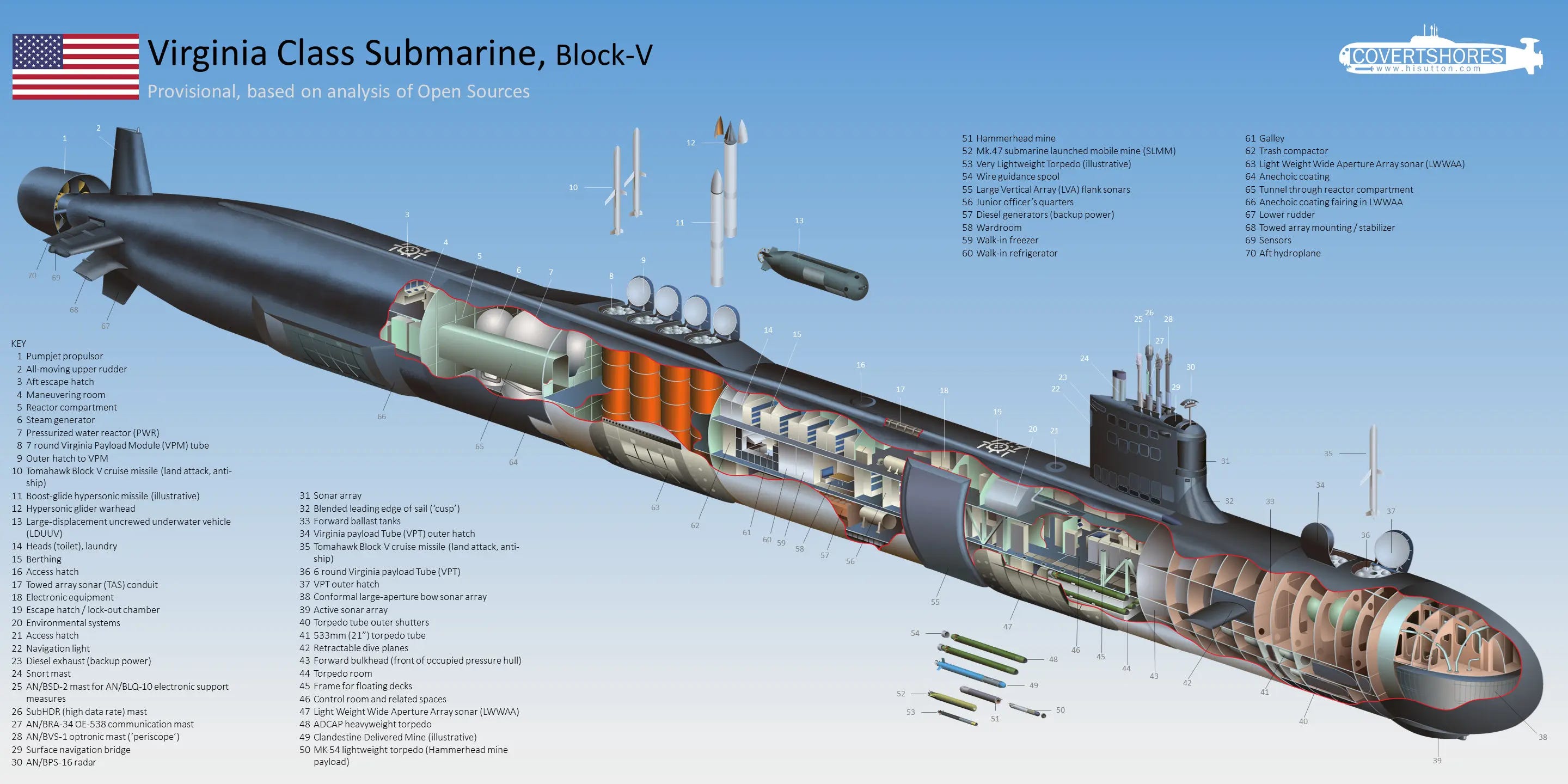
To help replace them, the Navy has created the Virginia Payload Module, which will be standard on 10 new Block V and all of the Block VI boats. The VPM adds an 84-foot hull section containing four large payload tubes to an already superb nuclear attack submarine. Those tubes add 28 Tomahawks, bringing the boat’s total potential load to 40. At full strength, 19 such boats could carry as many as 760 Tomahawks — more than the combined strength of the retiring Ohios.
But the greater advantage is distribution: four enormous magazines become 19 smaller ones, spread across far stealthier and more survivable hulls. They can cover more theaters, attack from more directions, and force an enemy to hunt nearly five times as many targets — all while hunting ships, collecting intelligence, and supporting special operations. The Navy can disperse that precision-strike power, then mass it wherever needed.
The payload module also makes these submarines more than Tomahawk trucks. Its large tubes can accommodate Conventional Prompt Strike hypersonic missiles, unmanned undersea vehicles, sensors, special-operations equipment, and payloads not yet invented. Like the Mk 41 VLS, the VPM gives the fleet room to improve without designing a new hull for every new weapon.
Nor is 19 an arbitrary number or a bureaucratic relabeling exercise. When the Virginia Payload Module design was selected in 2013, the Navy estimated that it needed at least twenty VPM-equipped boats to replace the disappearing Ohio SSGN capacity. The Navy is finally creating the guided-missile submarine fleet it said it needed thirteen years ago.
The problem is not the plan. It’s the time. The Ohios retire by 2029; the complete Virginia SSGN force won’t arrive until 2038 unless something very big changes. That gap falls directly across the decade in which China’s fleet, submarine force, and carrier arm are expanding fastest.
Shipbuilding Is the Real Weapon…and the Real Gap
You can’t command the seas with ships you can’t build, refuel, repair, or replace. And America’s atrophied shipbuilding sector has become its biggest bottleneck, as well as its greatest vulnerability.
The significance of the $76.6 billion award isn’t just the fourteen hulls. It is the certainty required to build them faster, to keep building them, and to expand production capacity.
American procurement has spent decades ordering one ship here, two there, then re-debating the entire program in every budget cycle until costs and delays mount and Congress pulls the plug. Remember the Seawolf class? It was originally 29 boats, reduced to just three, thus radically increasing the unit cost of the few the Navy got. That’s a stupid, stupid way to do anything. It guarantees too few ships at too high a price. It’s utterly self-defeating. It’s a system only the Beltway could love.

A company can’t possibly build a new facility, buy advanced tooling, finance suppliers, or order long-lead materials in bulk — much less hire and train the thousands of new welders, electricians, machinists, pipefitters, naval architects, and nuclear technicians needed to produce these boats on time — when it’s faced with a one-year promise Washington may revoke next Tuesday. Suppliers can’t add second production lines when their customers can’t tell them whether the line will still exist five years from now. Workers can’t master nuclear shipbuilding if the government repeatedly destroys the production rhythm that sustains their careers.
Long-term orders change that. Electric Boat’s president said the new contracts provide the company and its suppliers the demand certainty required to invest in capacity and hire the necessary workforce. That certainty converts appropriations into plants, machines, materials, suppliers, skills, and eventually hulls in the water. It also creates the scale and repetition that drive costs down and delivery rates up.
This is the sort of thing that a lifetime in complex construction and luxury real estate development makes obvious to the current President. He’s the first to get it in decades.
Certainty changes purchasing too. Fourteen boats require enormous quantities of specialty steel, castings, valves, pumps, electronics, cables, reactor components, and thousands of other items. With a known production run, the yards can buy in bulk, commit earlier for long-lead materials, and schedule rationally. That gives fragile single-source suppliers reason to expand. It also gives the Navy time to qualify second sources before a single failure stops an entire class.
Shipbuilding is learned by doing. Teams get faster by building the same modules repeatedly. Managers eliminate wasted steps. Engineers redesign difficult assemblies so they’re easier to build. Suppliers learn to deliver components in the order the yards need them. Digital design, automation, modular construction, and distributed fabrication all work better on a stable production line than on another tiny batch of floating prototypes.
Henry Ford understood this a century ago. Someone should have told Congress.
The law requires two new Virginia-class submarines per year. But in the real world, Electric Boat and Newport News are delivering just 1.2. Add to that the need to fulfill our AUKUS commitments while replacing the boats transferred to Australia and now you’ll need roughly 2.33 new Virginias per year, in addition to one enormous Columbia-class ballistic-missile submarine annually.
That’s not a small increase. It requires an industrial mobilization.

The contract supplies the required volume. Trump’s memorandum adopts remedies I’ve repeatedly called for. In my recent analysis of the Trump-class battleships, I said an expanding fleet required a fifth public yard because new ships accomplish little or nothing if we can’t “repair, refuel, and overhaul them.” Public yards maintain the fleet. Private yards build it.
Trump’s plan gets that division exactly right. Its fifth public yard is a readiness weapon, not a construction yard: up to three Pacific-oriented drydocks sized for every current and projected submarine class. Its Component Repair Center — the submarine facility I’ve also called for — would maintain at least one full ship set of spare equipment for the Los Angeles, Seawolf, Virginia, Ohio, and Columbia classes at all times. That means less waiting, less cannibalizing one boat to repair another, and more submarines actually at sea.
This is not to say we don’t need more private shipyard capacity: we do, starting (but not ending) with at least one more nuclear-capable yard. But the Trump team will get to that in due course.
Crucially, the President also ordered Naval Sea Systems Command reorganized around speed: strip away red tape, eliminate competing priorities, stop endless design changes, and judge its leaders by whether ships arrive. That’s quite an upgrade from the Pentagon’s normal procurement “system.” Stable designs allow teams, suppliers, and yards to learn; bureaucratic redesign destroys the repetition that makes production faster and cheaper.
This is how the Navy must operate from now on: buy the fleet America needs, hold designs steady long enough to build them efficiently, and expand public maintenance beside private construction. That’s a recipe for rebuilding American capacity. Allies can multiply it.
An Allied Arsenal of Shipyards
AUKUS, South Korea, and Trump’s new “Finland Model” do exactly that. Allies should not become permanent claimants on an American industrial base already too small for America’s own needs. They should become additional producers.
AUKUS demands more from American yards in the near term. America plans to transfer Virginia-class submarines to Australia beginning in the 2030s, and Australian sailors and shipyard workers are already training inside the American system.
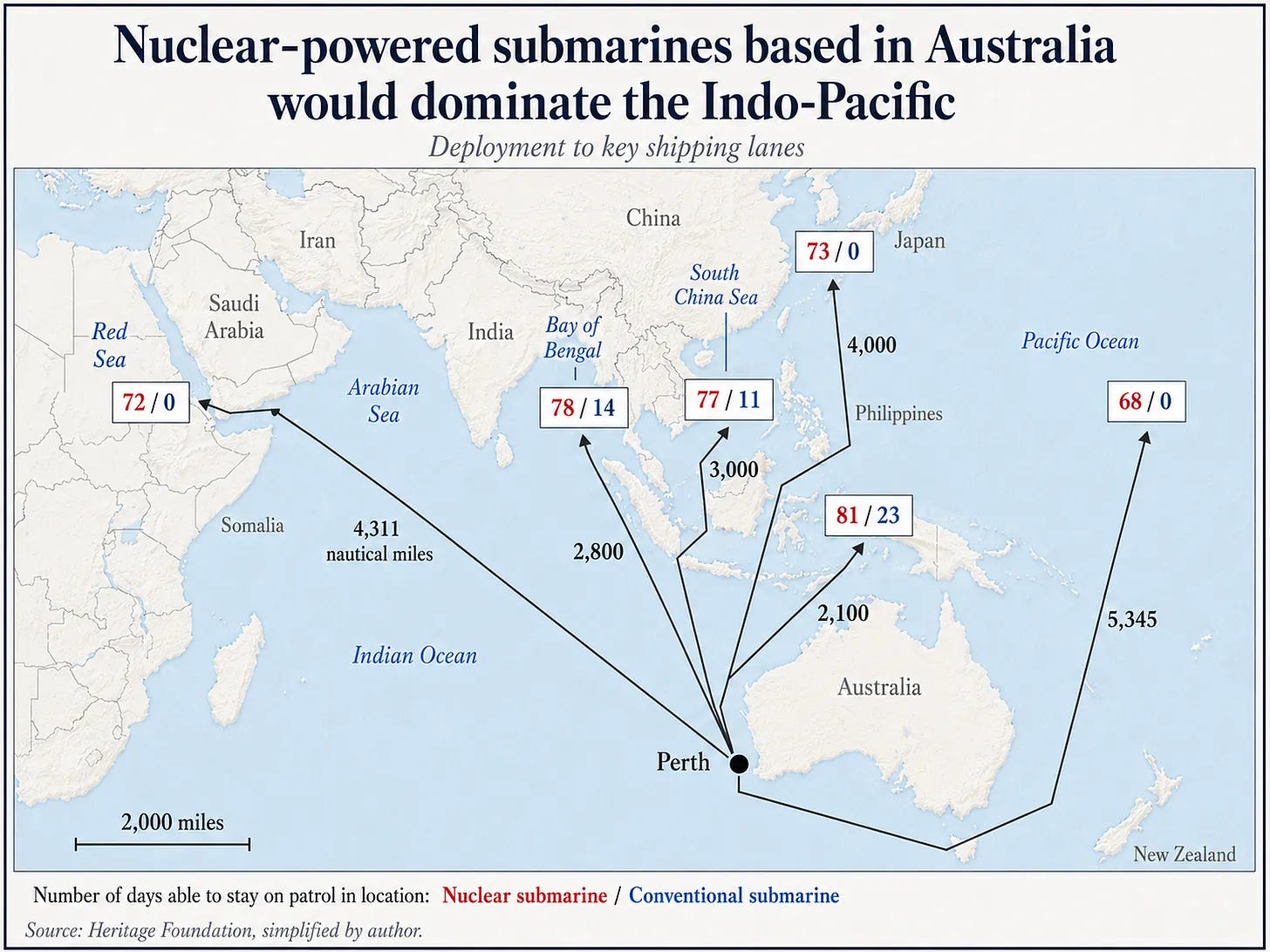
But that’s just the short-term plan. With American help, Australia is constructing a sovereign nuclear-submarine shipyard at Osborne in South Australia and plans to begin building SSN-AUKUS by the end of this decade. Delivery of the first Australian-built boat is planned for the early 2040s. It’ll be here sooner than you think.
South Korea is moving in the same direction. In May, Seoul announced the Jang Bogo N project, with plans to develop and build nuclear-powered submarines inside the Republic of Korea, launch the first in the mid-2030s, and make it operational before the decade ends.
Those are partners, not dependents. Australia and South Korea gain sovereign undersea power. America gains allied boats, trained workforces, additional production lines, and stronger supply chains. More capable partners will increasingly cover missions too few American submarines otherwise have to perform (and which America’s longtime naval partner Great Britain no longer can).

AUKUS is not a scheme for dividing too few American submarines among more flags. It’s the creation of another allied industrial base and trusted nuclear-submarine power.
Trump’s memorandum applies that principle to surface combatants and auxiliaries as well. Under the President’s new “Finland Model,” a foreign builder may construct its first two ships abroad, utilizing existing shipyard capacity we lack, but only if it simultaneously builds or takes control of a domestic American yard, trains an American workforce, licenses its shipbuilding methods, and creates a U.S. supply chain. Those first foreign-built hulls will bridge an urgent gap; everything after them will expand American capacity.
In this way, allied expertise becomes American yards, American jobs, and American ships.
In this analysis, I have focused on submarines, but the entire fleet needs urgent attention. America needs the 16 aircraft carriers I’ve argued for, not the 11 it actually has. It needs all 15 Trump-class BBGNs. And it needs enough destroyers, frigates, and smaller surface combatants to meet any need America has, anywhere at any time.
But that just makes the industrial challenge bigger. Every part of Trump’s proposed Golden Fleet depends on the sort of industrial capacity America created to win World War II and the Cold War. It cannot happen, and America cannot be safe, if we continue as we have since the 1990s just “managing decline.”
For thirty-five years, Washington treated naval capacity as overhead to be cut rather than power to be preserved. China did the opposite.
Now we’re paying the price. The boats are not in the water. The yards are not large enough, not numerous enough, and definitely not producing at the rate the danger requires.
Trump is laying the foundation, as Reagan did after Carter. The victory celebration will take longer.
But America finally has a plan. Now it has to build it, before China closes the gap so far that it decides it can afford to gamble.


