


by Rod D. Martin
August 10, 2026
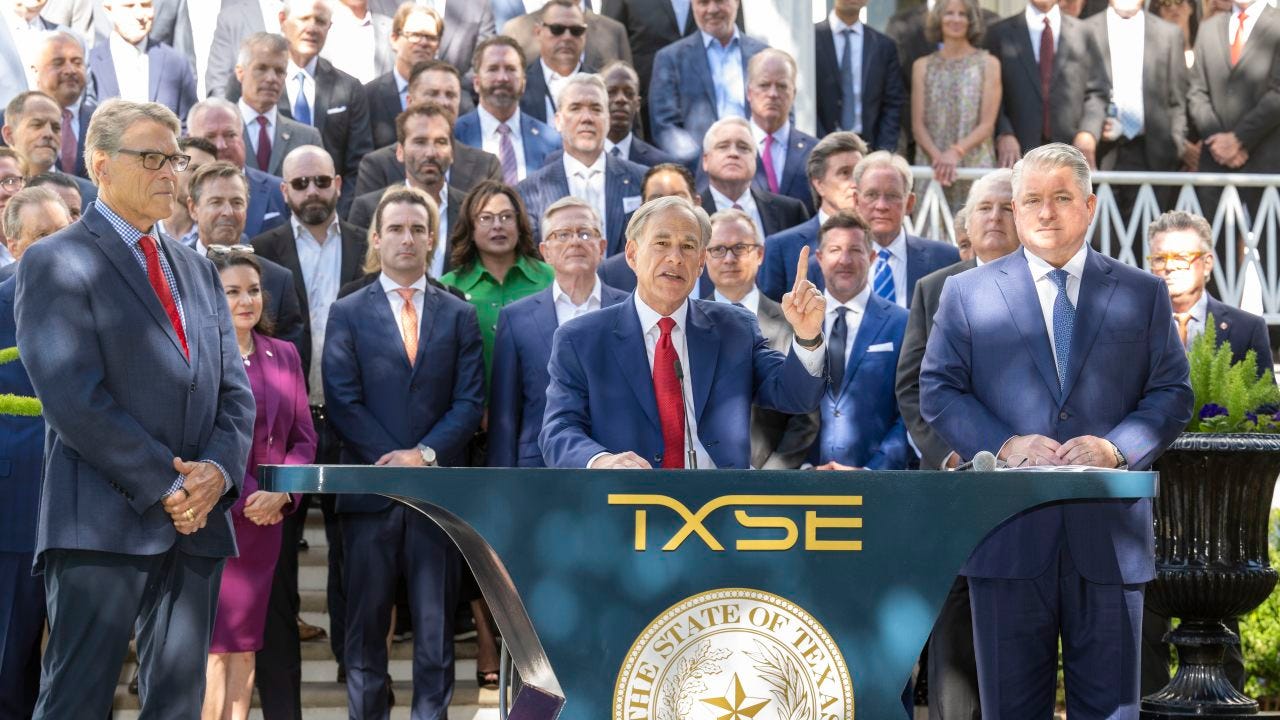
On Friday, July 31, Texas stopped merely recruiting Wall Street. It began operating one of its own.
The Texas Stock Exchange completed its phased launch and brought every stock in the National Market System into live trading. Its first exchange-traded product listing is expected in September. Its first corporate listing is expected in October. TXSE is now a functioning national securities exchange, headquartered in Dallas, built around its own technology, and preparing to compete for the listings, liquidity, and capital formation that New York has long treated as a birthright.
TXSE is more than a new exchange. It is the capstone of a migration already reshaping the American financial system. Corporate headquarters, factories, jobs and even legal domiciles are fleeing blue states: California, New York, New Jersey, Illinois and Delaware. Texas is taking an ever larger share, though Florida is close behind.
COVID totalitarianism started the exodus. But the blue states just kept piling on. Delaware, home of two-thirds of America’s Fortune 500 companies, voided a shareholder-approved pay package for Elon Musk, twice, thus destroying its reputation as a safe haven and an honest broker. By the time an appeals court overturned the activist judge, the damage had been done.
New Jersey taxed ExxonMobil away. California and Illinois did everything in their considerable power to render their states as inhospitable to business as possible. New York did likewise, went after The Trump Organization on “trumped up” charges, thus demonstrating the unsafety of its courts, and finally elected a Marxist mayor who promises to “seize the means of production.”
That’s a bridge too far even for BlackRock. Citadel founder Ken Griffin is one of the Republican Party’s largest donors. But Larry Fink spent years turning BlackRock into the corporate driver of ESG activism. Both reached the same conclusion: they needed an escape hatch. And so Texas needed a stock exchange.
Nor is the new exchange just a bunch of good ol’ boys capitalizing on the North’s unforced errors. BlackRock and Citadel Securities headlined the more than two dozen investors in TXSE’s original $120 million capital raise. JPMorgan, Charles Schwab, Fortress, Susquehanna, Jump Trading, and dozens of other financial institutions followed. TXSE has now raised more than $275 million, making it the best-capitalized new exchange ever approved by the Securities and Exchange Commission.
Beyond capitalization, the TXSE’s owners include nine of the ten largest liquidity providers in the country, firms responsible for more than 85 percent of American equity order flow. Its exchange-traded product sponsors represent nearly 70 percent of the entire U.S. market. And that’s after a single week of operation.
An exchange is one of the hardest businesses to start: it’s not something anyone would do lightly. Traders go where the traders already are; issuers list where investors already look; brokers connect where their customers already demand access. A new venue can have excellent technology and still die from an empty order book.
TXSE’s backers are the exact firms with the power to solve that problem. They supply the market makers, order flow, assets, listings, brokerage access, and credibility required to create a truly national market.
And it’s not just them. The incumbent exchanges reached the same conclusion at the same time — and began building Texas beachheads of their own.

