

Why the U.S. Must Deliver Full Nuclear Fuel Cycle Technology to South Korea Now
Washington’s hesitation to empower Seoul’s nuclear capabilities isn’t prudence — it’s strategic self-sabotage as adversaries surge ahead.

This analysis is free, but with Premium Membership you get MORE. Join today.
NOTE: My friend Fred Fleitz is a former Trump National Security Council Chief of Staff, a former CIA analyst, and a former senior staffer at the House Intelligence Committee. — RDM
by Fred Fleitz
April 25, 2026
In December 2025, North Korean leader Kim Jong Un toured a shipyard and inspected the completed hull of a supposed 8,700-ton nuclear-powered “strategic guided-missile submarine.” North Korea’s state-controlled media hailed this sub as a breakthrough in Pyongyang’s naval nuclear ambitions.
Just weeks earlier, President Trump announced that the United States would share closely held nuclear propulsion technology with Seoul, clearing the way for South Korea to build its own nuclear-powered attack submarines (SSNs).
Trump’s announcement was a long-overdue recognition of a strategic reality: in an era of nuclear-armed adversaries on the Korean Peninsula and a rapidly modernizing Chinese navy, South Korea cannot deter aggression with diesel-electric submarines alone.
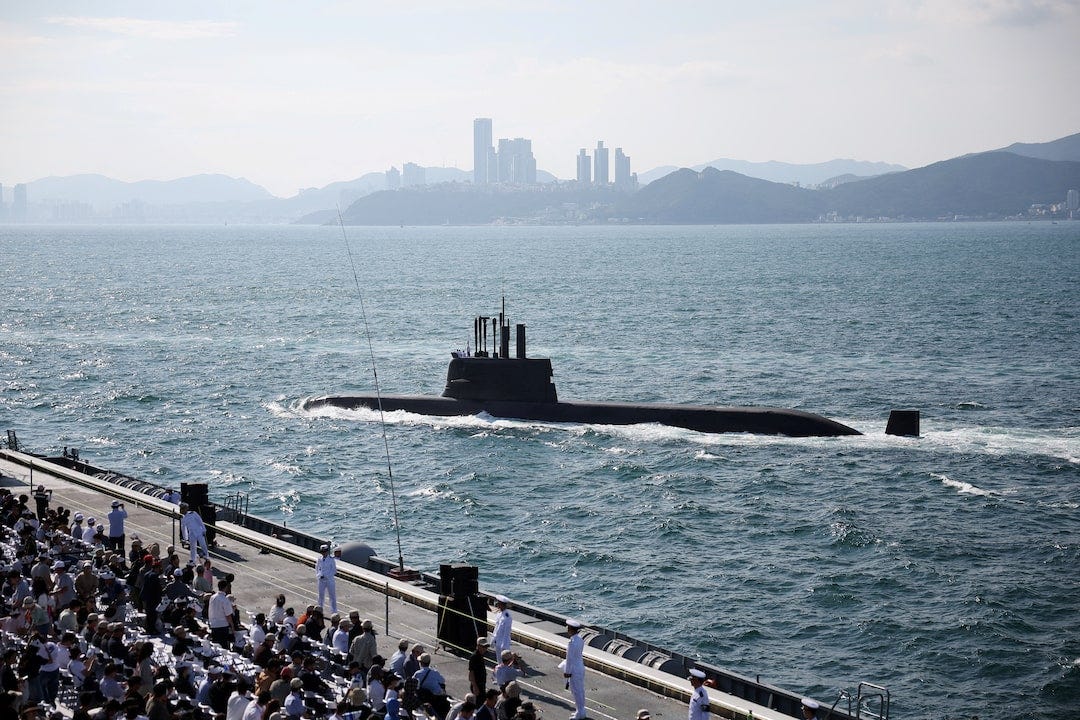
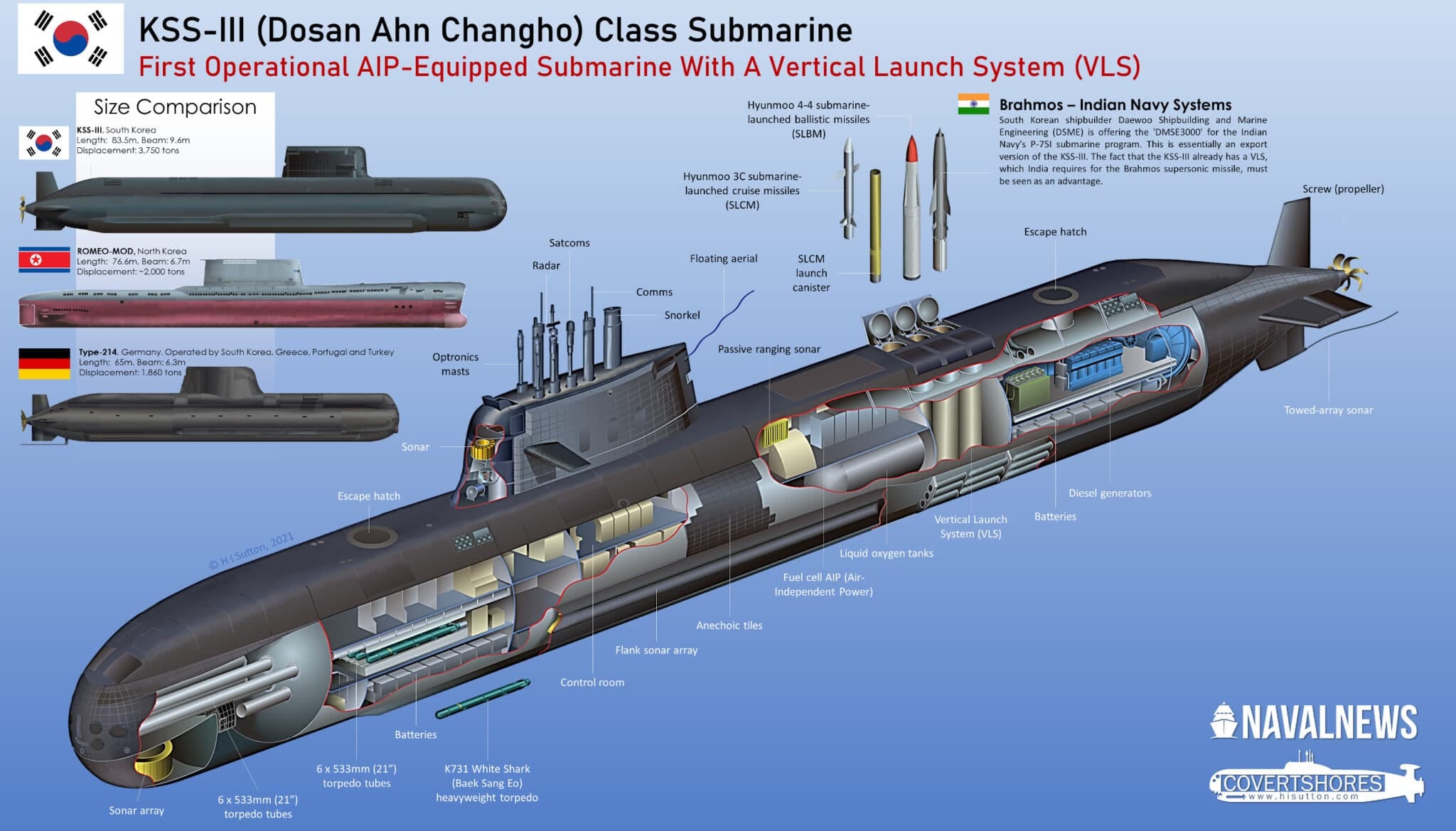
For decades, Seoul has operated some of the world’s most sophisticated conventional submarines. South Korea’s KSS-III-class subs are quiet, heavily armed with vertical-launch cruise and ballistic missiles, and equipped with advanced air-independent propulsion. They represent a remarkable indigenous achievement.
However, diesel-electric submarines have significant limitations. Range and time at sea are limited by their diesel fuel. These subs must periodically surface to recharge their batteries, limiting their time submerged to days or weeks at best. In the shallow, confined waters around the Korean Peninsula — and in any broader Indo-Pacific contingency — the KSS-III subs are vulnerable to detection and cannot sustain the persistent, high-speed patrols required for naval deterrence today.
South Korean nuclear-powered submarines can change that equation. An SSN can remain submerged for months, travel at sustained high speeds, and operate across vast distances without fuel constraints. For South Korea, this capability is a necessity. North Korea’s growing fleet of ballistic-missile submarines already threatens to complicate Seoul’s defense planning. Beijing’s expanding submarine force, designed to project power far beyond the first island chain, poses an even larger challenge.
The good news is that South Korea is ready. Its “Big Three” shipbuilders — HD Hyundai Heavy Industries, Samsung Heavy Industries, and Hanwha Ocean — are global leaders in the shipbuilding industry. They already produce world-class conventional submarines and have invested heavily in U.S. shipyards, including the Philadelphia facility acquired by Hanwha. Transferring U.S. naval nuclear propulsion technology would help bring South Korea’s advanced shipbuilding industry to the next level.
However, building and sustaining a nuclear submarine fleet requires far more than hulls and reactors. South Korea must gain access to the full nuclear fuel cycle: the ability to enrich uranium to produce nuclear fuel and to reprocess spent fuel rods into advanced nuclear fuel. Without this, both its submarine program and civilian nuclear industry would remain dependent on foreign suppliers.

Access to the full nuclear fuel cycle would also be a boon to South Korea’s broader civilian nuclear ambitions. South Korea relies on nuclear power for about 30 percent of its electricity. It is also a leading producer of advanced nuclear reactors. Granting South Korea access to enrichment and reprocessing would boost its efforts in next-generation nuclear power technology, such as the production of high-assay low-enriched uranium (HALEU) and advanced nuclear fuel needed for Small Modular Reactors (SMRs) and new reactor designs.
Moreover, providing South Korea with access to the full nuclear fuel cycle is not only a strategic imperative but also a matter of basic fairness and logic.
South Korea operates one of the world’s most advanced civilian nuclear industries. Yet it cannot enrich uranium to make nuclear fuel rods or reprocess spent fuel. This makes little sense when other non-nuclear weapon states — including Japan, the Netherlands, Germany, Brazil, and Argentina — already possess these capabilities under IAEA safeguards. Meanwhile, North Korea has secretly developed both enrichment and reprocessing technologies in flagrant violation of international law.
It is both illogical and counterproductive to withhold full nuclear fuel cycle rights from a model NPT member and steadfast U.S. ally like South Korea while granting or tolerating them for so many other nations.
Access to the full nuclear fuel cycle also would allow Seoul to sharply reduce its growing spent fuel stockpiles, extract vastly more energy from existing uranium resources, cut waste volumes by up to 90 percent through closed-fuel-cycle technologies like pyroprocessing, and establish itself as a premier exporter of complete nuclear solutions — including SMRs — to allies around the world. Recent U.S.–South Korea agreements already support this peaceful pathway, but likely will require revisions to the U.S.–South Korea “123 agreement” on sharing peaceful nuclear technology.
Transferring U.S. naval nuclear propulsion technology would be an improvement on Australia’s AUKUS agreement, which focuses on building new submarines from scratch. By contrast, under the U.S.–South Korea submarine agreement, Seoul can quickly and cost-effectively build a nuclear-powered variant of its proven KSS-III design. Joint production or technology-sharing arrangements also would strengthen America’s own submarine industry, which is years behind in production and maintenance.

Naturally, critics have raised nonproliferation concerns. These concerns are unwarranted. South Korea is a model member of the Nuclear Nonproliferation Treaty (NPT). North Korea, by contrast, has blatantly violated its nuclear treaty obligations, has constructed an estimated 50 nuclear weapons, and is now reportedly building nuclear-powered submarines.
Denying South Korea the nuclear technology it needs to defend itself while North Korea races ahead is not responsible nonproliferation; it is strategic malpractice. The Trump administration’s October 2025 decision correctly recognized this fact by supporting South Korea’s pursuit of civil uranium enrichment and spent fuel reprocessing for peaceful uses as well as the production of nuclear submarines.
South Korea’s efforts to acquire enriched uranium fuel from the U.S., to receive technical assistance to enrich uranium domestically, and to obtain the right to reprocess spent fuel rods will also greatly benefit America’s nuclear power industry.
An AUKUS-style framework with updates to the U.S.–South Korea 123 agreement is the best way forward to provide Seoul with critical nuclear technology while ensuring safety, security, and non-proliferation standards.
South Korea has the industrial capability, the strategic need, and the alliance commitment to make this new nuclear technology cooperation work. The U.S. has taken the first step. The only remaining question is speed. The Trump administration, in consultation with Congress, should move ASAP to provide South Korea with the full suite of naval nuclear technology, reactor design support, fuel-cycle cooperation, and pathways for advanced reactors, including SMRs.
Security threats from China and North Korea are growing in the waters of the Asia-Pacific. A comprehensive U.S.–South Korea nuclear partnership is one of the best ways both nations can promote peace, security, and prosperity in this region.
— Fred Fleitz is a former CIA analyst and staff member with the House Intelligence Committee. In 2018, he served as the National Security Council Chief of Staff and as a Deputy Special Assistant to President Trump. This article originally appeared at American Greatness.
Recent Articles:


 |
|
The current South Korean government is far left and wants closer relations with North Korea. How do we know that the advanced technology won't end up in North Korean or Chinese hands? How do we know there will even be a South Korea in 5 or 10 years.