

The War Powers Act Is Unconstitutional. It's Also Unworkable.
Congress has real war powers. The War Powers Act is not one of them.

This analysis is free, but with Premium Membership you get MORE. Join today.
by Rod D. Martin
May 6, 2026
Friday May 1st marked the 60th day of President Trump’s Operation Epic Fury against Iran. Supposedly, reaching that date without explicit Congressional approval means the War Powers Act’s automatic termination provision kicks in.
Supposedly.
In reality, the War Powers Act of 1973 is both unconstitutional and unworkable. It’s also unclear in a key respect the President has already made use of. Can Congress stop the President? Certainly. Can the War Powers Resolution? No.
That distinction matters. Congress has enormous constitutional power over war. It can declare war. It can fund, or crucially, refuse to fund war. It can limit, condition, or prohibit specific military actions. If necessary, it can impeach a rogue President.
If you disagree with this argument, or any other interpretation of the Constitution, there’s a solution. It’s called Article V. Learn more here.

But aside from the funding question, if it wants to do any of these things, the Constitution requires Congress to affirmatively act. It has to pass a law. It has to present that law to the President. And if the President vetoes it, Congress can only override him by a two-thirds vote.
The War Powers Act attempts to avoid that. It purports to give Congress something very much like a veto over the Commander in Chief — a “legislative veto” the Supreme Court has already rejected in INS v. Chadha (1983). And even if Congress tries to use the proper constitutional route instead, Donald Trump has a real veto.
The Act says what it says. So did laws imposing segregation. That didn’t make them valid law.
The War Powers Overreach
The War Powers Act was passed in 1973, over Richard Nixon’s veto, in the aftermath of Vietnam. It was the ultimate exercise in blame-shifting.
The irony is rich. The Vietnam War was launched, micromanaged, bungled, and morally squandered by the same Democrats who proceeded to blame Nixon for cleaning up the mess. Then, after years of authorizing, funding, and enabling the conflict, a Democrat Congress decided the real problem was not bad strategy, bad leadership, or their own inept cowardice. The problem, they suddenly “discovered,” was the institution of the presidency.

How convenient.
The War Powers Act was not some noble restoration of the Founders’ design. It was a Democrat Congress trying to wash its hands of its own war. And having lost two straight presidential elections over it, it was also an effort to blame Republicans for what Democrats had done.
But it wasn’t only that. It was also a thoroughly Beltway “solution”: avoid responsibility by inventing a mechanism. (See also: Gramm-Rudman and PayGo.)
The Act requires the President to notify Congress within 48 hours when U.S. forces are introduced into hostilities or hostilities are imminent. So far so good. It then says the President must terminate such use of forces within 60 days unless Congress has declared war, specifically authorized the operation, extended the deadline, or is unable to meet because America has been attacked. The President may receive up to 30 additional days to withdraw forces safely.
That sounds precise. It sounds balanced. It sounds constitutional.
But it’s not.
The Founders gave Congress and the President overlapping war powers. They created tension, not neatness, because war powers require both democratic accountability and executive decisiveness. Then once in office, those same Founding Fathers fought a series of declared and undeclared wars that they believed were perfectly consistent with their constitutional design.
Who would know better than them?

The War Powers Act attempts to assert Congressional supremacy over the President through mere legislation, in much the same manner as the many acts creating Deep State agencies that unconstitutionally divert Article 2, Section 1 powers away from the elected President and thus the electorate.
That’s the constitutional problem. The practical problem is no better: the countdown clock is unworkable.
Let’s say the President — in good faith — believes military operations must continue. Can the 60-day clock stop him? Obviously not.
Can Congress? Certainly, by refusing to authorize funding. But what if the war is already funded, as it is now, and simply a matter of the Executive Branch determining how best to use the appropriation it’s already been given? Well, then Congress would have to affirmatively legislate against any use of funds to prosecute the war.
So what happens then? Oh wait: the President inevitably vetoes that act.
Can Congress override that veto? Of course it can: it overrode Nixon’s veto of the War Powers Resolution itself. But it would actually have to. And certainly in the current conflict, there is approximately zero chance of that happening.
And that brings us to the part that’s unclear. The President has announced publicly that the Iran ceasefire has “paused” the Act’s 60-day clock. Wait, what? The Act doesn’t say anything about pauses. Scholars can argue, but only judges can decide, and so far, no one with standing has sued. Who knows how the Supreme Court might rule on such a question, but the bigger point is that they likely would not rule on it at all, deeming it a “political question”.
So Congress is back to the necessity of actually passing legislation. And the President can veto whatever they pass, so at least two-thirds are going to have to oppose him to make that stick.
The 60-day rule is functionally meaningless.
Presidents Have Understood This for Decades
Since its passage, Presidents of both parties have complied with the War Powers Act’s reporting requirements. They notify Congress. They send letters. They cite the statute. But they do so carefully. The usual formulation is that the President is acting “consistent with” the War Powers Resolution, not “pursuant to” it.
That phrasing is not accidental. It is the Executive Branch saying: we’ll keep Congress informed, but we do not concede that Congress may put the Commander in Chief on a statutory egg timer.
No President should concede it.
It was Democrats who passed this mess, so it’s instructive to examine how Democrats have handled it.
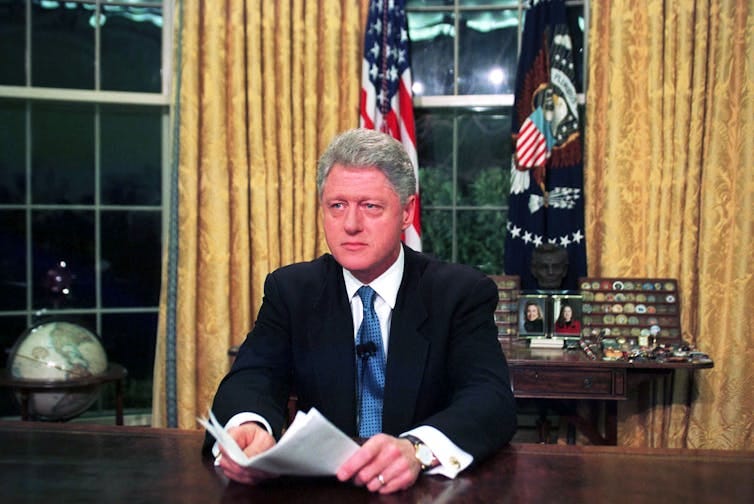
Bill Clinton’s Kosovo air campaign lasted 78 days. Congress did not declare war. Congress did not clearly authorize the operation. Congress also did not stop it. The 60-day clock ticked. The operation continued.
Barack Obama’s Libya operation lasted 222 days. As in Iran today, the campaign consisted of ongoing airstrikes with no ground forces deployed. The Obama administration argued that this did not even rise to the level of “hostilities” sufficient to trigger the War Powers Act!
And a divided Congress — Republican House, Democrat Senate — didn’t stop him. It didn’t even object.
That’s the practical problem. It’s also the Constitution’s design.
The two branches’ powers overlap. But the legislature does not get to execute anything. If it’s sufficiently unified, as it was in 1973, it can certainly take effective action. If not, it cannot. And that is exactly why the Founding Fathers replaced the legislature-driven Articles of Confederation with our current three-branch Constitution: in a crisis, somebody has to actually act.
That somebody can’t be a committee. Or at least it can’t since 1789.
One may disagree with this or that specific military action: I certainly disagreed with Obama’s Libya operation, as some of my friends disagree with Trump on Iran. But that’s a political question. It has nothing to do with the correct operation of the Constitution. And the impulse to take major decisions out of the hands of elected leaders is fundamentally an attempt to diminish the power of the electorate.
Congress Can Stop the President. The Act Cannot.
Congress controls the legal and financial architecture of war. The President commands the forces. That is why the same generation that wrote the Constitution fought the “Undeclared Naval War with France” (yes, that’s its name), the undeclared Barbary Wars, and repeated undeclared frontier wars with Indian tribes formally recognized as sovereign nations, all without treating every use of force as requiring a formal declaration of war.
They understood the difference between a general war and a limited war. They also understood the difference between Congress limiting the President through its enumerated legislative powers and Congress usurping the executive powers granted exclusively to the President under Article 2.
That is the balance. Not executive monarchy. Not legislative supremacy. Overlap.
So we are back where we began.
Can Congress stop the President? Yes. But it must affirmatively act: by funding, defunding, limiting, prohibiting, or impeaching through constitutionally valid means.
The War Powers Act attempts to avoid that. And that’s exactly where Chadha matters. Congress cannot bind the Executive’s clear Constitutional powers by resolution. If Congress wants legal effect, it must actually legislate: both houses, presentment, presidential signature or veto and (possibly) override. The War Powers Act pretends there’s a third path. There isn’t.
That is not a loophole, or “presidential lawlessness”. That’s the system.
The War Powers Act is unconstitutional because Congress cannot make itself Commander in Chief by statute. It is unworkable because the clock cannot enforce itself. And it is unclear precisely where its defenders need it to be automatic: whether “hostilities” continue when the President says a ceasefire has paused or ended them, or even if an air campaign, as with Obama in Libya, counts as “hostilities” at all.
The War Powers Act was a naked political fraud from the beginning. It exists. But it’s irrelevant.


The War Powers Act was always just a way for the Democrats in Congress who all voted for the Vietnam War with exception of Senator Wayne Morse of Oregon, to cover their rear ends and shift blame to Richard Nixon who was trying to clean up the mess they left behind. It was the Kennedy and Johnson administrations who did not take decisive action early on against the Communists in Vietnam. It was the Democrats in Congress who launched, micromanaged, bungled, and morally squandered the war. It was under Democratic administrations that the worst mistakes that led to America’s defeat in Vietnam occurred. Kennedy was the one who had Ngo Dinh Diem and his brother Nhu overthrown and unbeknownst to him, assassinated and refused to let U.S. troops go into Laos and cut the Ho Chi Minh Trail. LBJ was the one who rejected options that would have allowed the South Vietnamese to continue the war without a massive infusion of U.S. troops but turned them down because of bad intelligence and did half-a**** bombing campaigns he wouldn’t fully commit to.
It was also the Kennedy and Johnson administrations who lied to the American public about Vietnam and failed to clearly articulate what our goals for the Vietnam War were. Richard Nixon was elected in 1968 and came in to the White House to try and salvage the Vietnam War. He achieved a number of American military successes, turned the war over to the South Vietnamese, pulled U.S. troops out and brought them home while still providing aid to the South Vietnamese, and successfully negotiated the Paris Accords in 1973 with North Vietnam which got them to recognize South Vietnam and promised to resume bombing if the North broke the accords.
The Democrats in Congress wanted to handicap Nixon and stick it to him and the Republicans as revenge for him coming in and making work what they couldn’t. The War Powers Act of 1973 is unconstitutional and unworkable. Congress can stop the President during the commencement of a war. But the War Powers Act has no ability to do that. Congress can declare war, fund war and limit, condition or prohibit certain military actions. If necessary, it can impeach a rogue President. But if Congress wants to do any of these things, it must affirmatively act such as by passing a law then presenting it to the President. He can then veto it if he chooses. If they get a two-thirds majority vote they can override it. Instead this whole process is subverted, and Congress gets to veto whatever the President does militarily. No vote, no laws passed, no nothing.
The act requires that the President notify Congress within 48 hours about the war. That’s fine. But it’s the second part that is the problem. Congress gives the President 60 days to finish the war up unless they grant him an extension. He may receive an additional 30 days to safely withdraw U.S. troops. This is total nonsense! The President throughout history has always fought both declared and undeclared wars he thought necessary. It asserts Confessional supremacy over the President which is nowhere in the Constitution. If the President believes a war needs to continue, the War Powers Resolution can’t stop him. Congress can, but they have to pass a law to that effect. Also, look at how past Presidents from both parties have used the act. They’ve kept Congress informed but that was it. They continued the wars as long as they felt necessary. You may disagree with a war but only Congress itself can stop it.
The War Powers Act is at best a resolution stating the sense of Congress, an explicit warning that flouting it will lead to the legislative consequences you describe: defunding or impeachment.
But the Congress of which it describes the sense was a Congress of half a century ago. If they want to pass such a resolution today, let them — but if they aren’t willing to follow through with it, they’ll just look weak.