
Is Trump's Iran Strike Constitutional?
Many on the right have come to believe that all military action requires a Congressional declaration of war. But the Founding Fathers disagreed.
This analysis is free, but with Premium Membership you get MORE. Join today.
by Rod D. Martin
March 2, 2026
In Arlington, Virginia there is a famous monument, depicting the American victory in the Battle of Iwo Jima. One of the most famous statues in our capital, it shows six U.S. Marines and Navy Corpsmen raising the flag at the summit of Mount Suribachi, one of the most iconic moments of the entire Pacific War.
But the monument is not just to these men, or this battle.
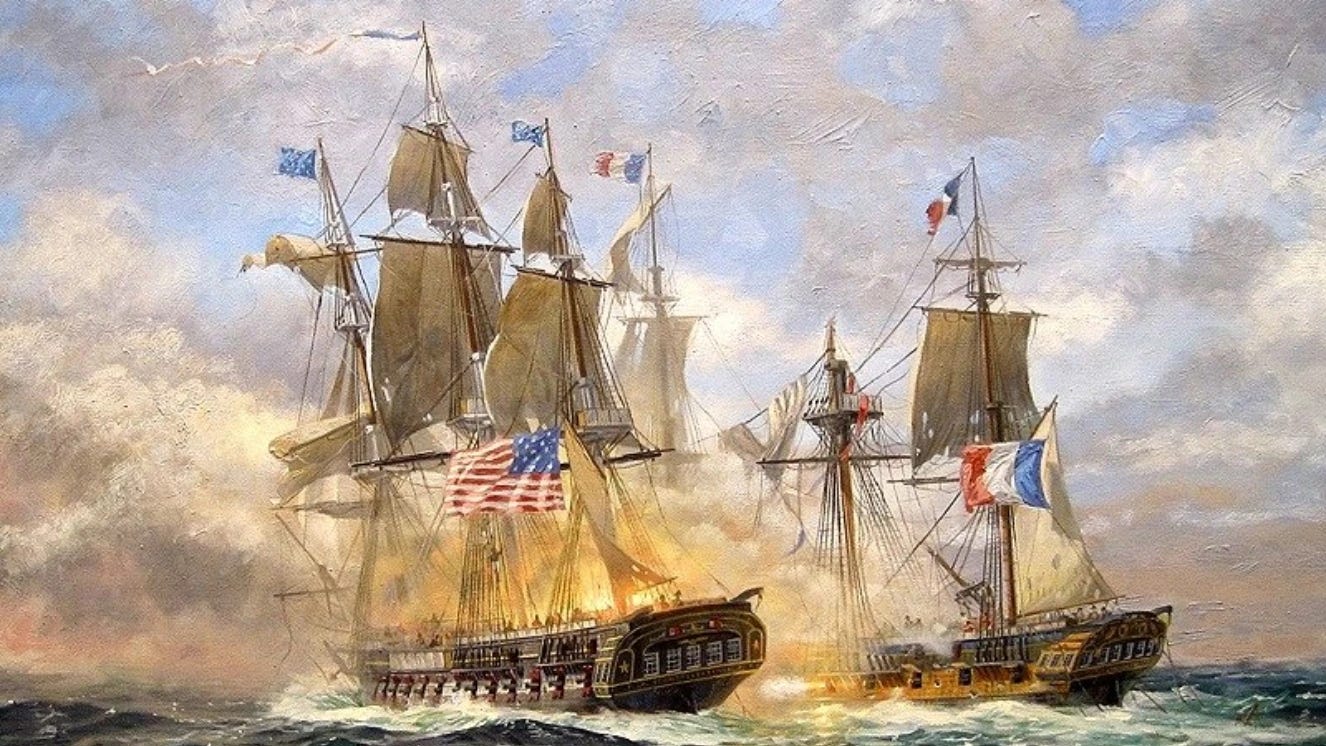
Around its base, the monument depicts every major action involving the United States Marine Corps since its founding in 1775. Many are declared wars or battles in them; many are not. But one sticks out in my mind during the current debate over the constitutionality of Donald Trump’s military actions: the French Naval War of 1798-1800, more commonly known as “the Undeclared Naval War with France”.
Undeclared. War.
In 1798, the Founding Fathers were very much in power, in the White House, the Congress, and the Supreme Court. They didn’t have to ask scholars what was meant in Philadelphia: they had been there, or if not, they had been part of the ratification debate. The Constitution was barely ten years old when war broke out.
President Adams saw no need to seek a declaration of war. Nor did Congress disagree: indeed, it authorized funds for the conflict. Later, lawsuits arose over ships captured during the war. The Supreme Court decided several of these, and set the rules we’ve followed ever since: first, that not all conflicts rise to the level of a full-on war requiring a formal declaration (Bas v. Tingy, 1800); and second, that in such circumstances, Congress may limit the actions taken by the executive branch (Talbot v. Seeman and Little v. Barreme, 1801).
In short, the Supreme Court ratified what everyone already believed: that the Constitution divides power over foreign policy and armed conflict between the legislative and executive branches, but does not spell out exactly where the line is to be drawn. The Founders believed more in the utility of elections to provide those boundaries in specific cases as they arose than do modern conservatives. But I’ll take George Washington over Rand Paul any day, with no disrespect to the latter.
The Federalist Party had championed the Constitution’s ratification and implementation. All of these actions were taken by Federalists, and the Supreme Court rulings just cited were handed down by Federalists. But when a President and Congress of a new party — Thomas Jefferson’s Republicans — were elected in 1800, Jefferson (who had bitterly criticized Adams) immediately embarked upon his own undeclared war, the First Barbary War (1801-1805), which unlike Adams’ war actually involved the overseas deployment of U.S. ground troops to the Eastern Hemisphere, giving us the line from the Marine Corps Hymn “…to the shores of Tripoli”.
Jefferson requested funds, Congress granted them without seeing any need to declare war, and indeed the war was won. That war is listed on the Iwo Jima monument too.
A decade later, in the aftermath of the very much declared War of 1812, President James Madison — the principal author of both the Constitution and the Bill of Rights — found himself needing to go to war against the Barbary States once more. He asked Congress for a declaration of war, which it declined to grant, despite providing funds for the conflict. Madison fought the war and won, and Congress ratified a peace treaty with the Barbary States.
A peace treaty, mind you, to conclude a war it had not declared, following immediately on the heels of another peace treaty to conclude a war it had declared.
Ladies and gentlemen, I present your Founding Fathers. The smartest, most principled group of men in American history understood and acted on the distinctions between different levels of military action. Perhaps we who claim to believe in “original intent” should learn from them.
Yet even all this understates the case. All five Founding Father presidents fought countless actions against various Indian tribes, treated as sovereign nations under the law. Among these were some of the most decisive conflicts of the early Republic: the Northwest Indian War, Tecumseh’s War, the Creek War, the First Seminole War, and countless smaller conflicts every one of which was larger in scope and casualties than Donald Trump’s capture of Nicolás Maduro.
In not one of these cases did Congress declare war. In not one of them did the President think he needed such a declaration. Yet these were the men who birthed the Constitution.
Which suggests that, perhaps, some modern conservatives think they’re smarter than Washington and Madison. Or, perhaps, just don’t remember their history.
The Founders assigned powers over foreign policy and military action jointly to the executive and legislative branches. That did then, and does now, blur the lines, leaving resolution to the people’s representatives at any given time. The Founders thought that was good and right. They also thought that presidents needed the power to act decisively yet in limited fashion short of full legal civilizational conflict. Would it have been a good idea to actually, officially, legally declare war on Napoleon’s mighty French Empire? No. But it was also important to defend our ships and seamen lest we be reduced to servitude.
That founding generation’s Supreme Court rulings still apply, albeit with varying implementations. In 1965, Congress passed the Gulf of Tonkin Resolution, which authorized LBJ to go to war in South Vietnam. Many in both parties have since opposed that action and decried the lack of a formal declaration of war. The question I would ask them is: on whom should we have declared that war? American forces were ostensibly in theater to defeat a communist insurgency: declaring war on the relevant sovereign nation — North Vietnam — would have invited a wider conflict with a newly-nuclear China, and virtually required a vastly larger, more dangerous engagement.
This is a good solution? I certainly think the case can be made for it, but since most of the people calling for it also think the war was a terrible idea and should never have been fought, taking actions that would have made it a far bigger war hardly make sense.
In 2001 after the 9/11 attacks, President Bush did not ask for, and Congress did not demand, a declaration of war on al Qaeda (and can we even declare war on non-state actors like al Qaeda and the Viet Cong? Is that even a thing?). Many decry this, and I among them, because I think Americans would have taken that war far more seriously, political support would have been far more sustainable, and a clear victory from Baghdad to Kabul would have been more vociferously demanded if we had in fact declared war.
But were Bush and Congress acting unconstitutionally? Not according to the Founding Fathers. Congress passed the Authorization for Use of Military Force (AUMF) and the funding required to act upon it. For policy reasons I think this was the wrong course, but I cannot disagree with them on the law, and neither would John Adams and the Federalists in 1798.
Trump’s actions are far more limited in scope. He has invaded no one, not in the sense we commonly use that term. Arguably, his Venezuelan action wasn’t even an armed conflict at all, but rather an arrest, of two people duly indicted under U.S. law by a federal grand jury. Are there ground troops in Caracas? No there are not. There aren’t in Tehran either, nor do I imagine there will be.
Yet in that case, as well as last year’s Twelve Day War and the current Iran campaign, the President has very specific Congressionally-mandated rules he has followed to the letter, just as Chief Justice John Marshall demanded in 1801. Those rules are contained in the War Powers Act of 1973. The President must notify Congress within 48 hours of the commencement of hostilities, and he has 90 days in which to conclude them without a specific Congressional authorization to continue.
That’s the law. And those are pretty serious restrictions: short of a nuclear holocaust, what kind of war lasts under 90 days? Certainly not the Undeclared Naval War with France. Indeed, compared to the rules under which the Founding Fathers acted, one could argue (and many have) that the War Powers Act might well be impermissively restrictive not on Congress but the President. Trump follows it anyway.
The conservative complaint that America no longer declares war is an appeal to follow the Constitution in an era where too many have treated it as “a scrap of paper”. Insofar as that goes, that argument is good and right. For the last eight decades, America has operated in countless unconstitutional ways, most notably in FDR’s creation of what we call the “Deep State”, the unelected, unaccountable, unfireable elite that makes most of our laws, judges most of our cases, and rules us while itself answering to no one. Donald Trump is doing his best to dismantle it, and Godspeed to him in that task.
But the Deep State was never a mechanism to increase presidential power. Quite the opposite: its existence siphons most real power away from the elected branches, especially the president. Yet the whole point is that the elected branches should rule precisely because they are accountable to the voters, and the voters may turn them out at regular intervals, something you cannot do to your postmaster, VA hospital administrator, or the legions of middle managers who run various color revolutions around the world. As with term limits, conservatives see wanton abuses of federal power and respond with “solutions” that hand even more arbitrary power to their Deep State overlords, at the expense of their own power at the ballot box.
There’s a reason we’re called “the Stupid Party”.
In any case, from Independence Hall to the present day, our constitutional order has been consistently held to permit exactly the acts Donald Trump has engaged in, under precisely the limits under which he has operated. Should he declare war on Iran? That’s a policy question, not a legal or constitutional one.
We either believe in original intent, or we don’t.


Of course it is CONSTITUTIONAL. IT IS NOT a war so Congress does NOT get to run it. That has been the problem all along. Congress gets into it and it lasts for ever just like Vietnam. Too many chiefs not enough Indians
Read the constitution and tell us.