
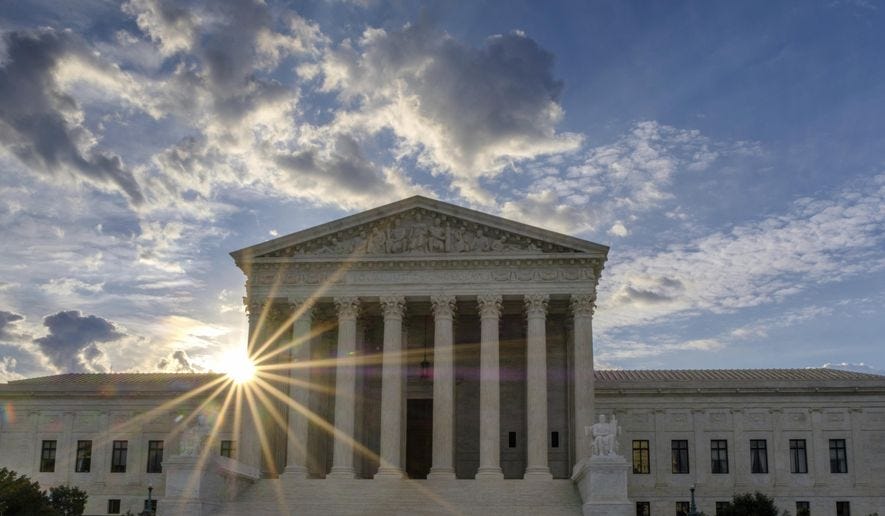
The Democrats’ Race-Based Regime is Collapsing
What the Supreme Court has “gutted” is not the Voting Rights Act of 1965 – but a nakedly racist form of gerrymandering that spotted Democrats at least 21 House seats every cycle.
This analysis is free, but with Premium Membership you get MORE. Join today.
NOTE: The Supreme Court’s long-awaited restoration of the Constitution’s Equal Protection Clause with regard to racist gerrymandering has finally come. There will be consequences.
The Enemedia says the Court “gutted” the Voting Rights Act. But that’s a lie. The Court actually restored its original meaning, in line with the Civil Rights Act of 1964, to prevent discrimination for or against either the minority or the majority. To Democrats, whether in their Klan hoods then, or their Antifa masks now, or their SPLC-funded Klan hoods now again, that is anathema.
The reason is as simple as it was in 1895. Democrats may or may not be racists, but they certainly understand the power of race to help them win. If that means discriminating against blacks, so be it. If that means discriminating against whites, so be it. Just as the Southern planters used Jim Crow to divide poor whites from poor blacks and thus thwart the rising Populist movement, modern plantation foremen from Hakeem Jeffries to Tim Walz know identity politics and DEI short-circuits reason, stokes hate, and propels their Party to victory.
And that’s the case for these 21 racially gerrymandered House districts. The lie is that whites won’t vote for blacks, so we have to give them their own districts. If that were true, in an America that’s just 12 percent black, Barack Obama could never have been elected…twice! It’s even worse than that: two-thirds of black House members are elected from districts that aren’t even racially gerrymandered. Their argument just falls flat.
But it ought to fall flat for two other reasons, one practical, the other moral.
Practically, Democrats have not used this travesty to enhance black representation: they’ve used it to spot themselves 21 House seats. In an era of razor-thin majorities, that’s an extraordinary difference on every policy matter before Congress. It is one of oh so many ways Democrats have put their thumbs on the scales. It’s wrong, and it’s ending.
Morally, though, the idea that only people of my race can represent me is an abomination. Do we not believe that men should be judged by the content of their characters and not the color of their skin? Well, no, actually: Democrats don’t. Having adopted their latest racist schtick, they now profess fealty to Dr. King while preaching race hate, standpoint epistemology, and everything America thought it had overcome not long before I was born.
But this week, the Supreme Court overcame some of it. And the nation can begin to heal. — RDM
The Democrats’ Race-Based Regime is Collapsing
by Daniel McCarthy
May 2, 2026
The Supreme Court’s decision this week in Louisiana v. Callais et al has inevitably drawn strong criticism. In ruling that electoral districts cannot be redefined along racial lines, the Court stands accused of “gutting” the Voting Rights Act, crippling civil-rights law, and effectively disenfranchising minority voters.
But the Court’s decision was correct on the merits. It also represents a great retrenchment that’s taking place in American politics.
The rules by which our political system operates have been overdue a revision — not the rules codified in the Constitution but the thicker web of precedents and practices that have served as a second constitution since the 1960s, or in some cases since the 1930s.
Yesterday’s decision will have the near-term practical effect of helping Republicans fortify their position going into November’s midterm elections, improving their chances of holding onto their majority in the House of Representatives.
But the long-term effect of the ruling also promises to strengthen the GOP, as the racial regime on which the Democratic Party has long depended collapses.
What the Court’s Republican-appointed majority has actually “gutted” is not the Voting Rights Act of 1965 — but a nakedly racial form of gerrymandering.
Louisiana had been ordered by lower courts to redraw its congressional districts to ensure that not one, but two districts would be majority-black, virtually guaranteeing that two of the state’s six members of Congress would also be black — so a third of the congressional delegation would match the roughly one-third of the state’s black population.
In effect, representation by race was assumed to be more important than representation by geography or anything else.
The Voting Rights Act has long been used to ensure that certain areas will have representation by one race. This racial gerrymandering, mostly adopted in the South, would apply to state legislative districts as well as federal congressional districts.
It’s obvious why such a heavy-handed approach might appear reasonable in the immediate wake of segregation. More than sixty years later, however, it can’t be argued that it’s a response to discrimination because it’s now an enduring form of discrimination in its own right — in essence a set-aside or quota not in the private sector but in the legislative branch of government itself, at the state and national levels alike.
This has served the Democratic party very well, not only because the black legislators elected by these black-majority districts are usually Democrats to begin with, but also because the very existence of these districts is a kind of bribe or reward Democrats provide to a loyal constituency and its leaders. It’s a racial spoils system.
Now Democrats will have to make a different kind of case to black voters — indeed to all voters in districts which are no longer so racially segregated.
Catch the irony — separating blacks from other voters, in order to create more majority-black districts, is a kind of segregation.
The Democrats, who were the party of the white segregationists, too, came to see segregation for the sake of additional black representation as a positive good.
Needless to say, in a state such as Louisiana, where the population is one-third black, perfect proportional integration of every congressional district or state legislative district would result in one-third of the voters in each district being black. That would be complete integration. It would also be politically inconvenient.
In reality, of course, geography matters, and racial and other groups are not evenly distributed throughout any state. But the Supreme Court has now ruled boundaries shouldn’t be carved up just for racial reasons. The decision allows for race to be a factor when there has been clear discrimination against a group, but racially-oriented districting can no longer be a normal practice. And without that practice, Democrats will have lost the keystone to the strategy they’ve long relied on in the South.
That doesn’t mean they’re finished in the region. Virginia is more “blue” than “red” overall, even though Republicans remain competitive there. North Carolina and Georgia have Republican leanings but still produce embarrassments for the GOP.
The Republican “solid South” didn’t last long. Yet the loss of racial gerrymandering will be felt by Democrats long beyond this November’s midterms — which, despite the wave of non-racial gerrymandering this year, still present Republicans with high hurdles to maintaining their majority.
Even if Republicans come out ahead in the tit-for-tat redistricting efforts now taking place, they may still be overcome by midterm voters who typically vote for the party not holding the White House.
Yet however rough the weather Republicans are heading into in November, their long-range outlook is bright.
Republican states are flourishing while big Democratic states — including the biggest, California — are losing population and major employers. The rules Democrats wrote to their own advantage in the heady days of the New Deal and Great Society are slowly being rewritten or repealed.
The second constitution is giving way to something like the actual Constitution.
But Democrats will be prepared to write new rules for their benefit as soon as they get the chance. Look for calls to pack the Supreme Court with liberals and to make Washington, D.C., and Puerto Rico into states to grow louder. The rules themselves are now stakes in the game.
That’s not because Republicans are acting selfishly — at least not entirely. The more important point is that the rationales behind the norms that served Democrats so well in the 20th century are losing salience and authority, not least legal authority.
Segregation in the name of fighting segregation was always a bad idea, but at one point it may have seemed like a lesser evil than letting the effects of Jim Crow linger.
Sixty years on, this racial policy has long since demonstrated the limits of what it can accomplish and promises nothing new, just the perpetuation of the spoils system. What was once for many Americans a hope has become a scam.
And now the Supreme Court has said it must end.
— Daniel McCarthy is a columnist for The Spectator, where this article first appeared, and is the editor of Modern Age: A Conservative Review.


