


This analysis is free, but with Premium Membership you get MORE. Join today.
by Rod D. Martin
November 16, 2026
Since the midterms, I have been sounding the alarm that Congress must pass the National Defense Authorization Act (NDAA) and the accompanying supplemental and reconciliation bills. Indeed, I have strongly suggested that the House repass all three as two-year appropriations, securing Trump’s reform and rearmament program out through the end of his term.
It’s not exactly news that the Democrats want to gut defense. They’ve been doing that my whole lifetime. But this new Muslim Marxist “Hate America First” crowd is a whole other thing. As China races toward an endlessly spiraling nuclear arms race and to deploy a quickly growing and ever more sophisticated fleet, their new friends on Capitol Hill want to decimate the very programs that could counter those threats and thereby keep the peace.
Donald Trump wants peace through strength. Abdul el-Sayed wants peace through surrender. Let his buddies get hold of the NDAA and that’s exactly what we’ll get.
None of these are short-term programs. They have long lead times because they are complex projects, and even much of the infrastructure required to deploy them is yet unbuilt. Losing two years could mean losing the programs altogether.
For 48 more days, Republicans control Congress. They have until January 3rd to pass these bills. From drones and hypersonics to the ultramodern M1E3 tank, these are vital and years later than they should have been (thanks, Joe Biden). A whopping 95 percent of the required funding for the Golden Dome missile defense is in the reconciliation bill, which fortunately can be passed with a simple majority in the Senate. The more difficult NDAA (60 votes required unless John Thune overrules his Democrat parliamentarian) contains (among many other things) the funding (though not enough) for the Trump-class BBGN.

We’ve talked at some length about the need to rapidly build and deploy Golden Dome missile defense to head off a ruinous arms race (and in the process, increasingly render nuclear war obsolete). We’ve covered many other crucial programs as well, and will continue to do so.
But more than anything else, the Democrats want to kill the Trump-class, in large part because it’s named for Trump. They call it a vanity project, and more than a few RINOs join them in that. They claim that large ships are obsolete because of drones and hypersonics, and that it’s foolish to put so many eggs in one basket.
They’re wrong. In fact, they have it precisely backward.
In an age of rapidly accelerating technology breakthroughs, and particularly directed-energy weapons (lasers), bigger hulls are essential. The Navy has crammed everything it can into the small, constricted hulls of the Arleigh Burke-class destroyers. It will retire the aging Ticonderoga-class cruisers by the end of Trump’s term, without any replacement at all. Only larger hulls can carry the armament needed for the mid-21st century, not to mention the nuclear reactors needed to power them.
In the process, these larger ships — four times the size of the mainstay Arleigh Burkes — become less vulnerable, not more. They will have the firepower not only to defend themselves against the vast hordes of modern weapons, but to defend the carriers and smaller ships that anchor the entire fleet. They aren’t a luxury. They’re a necessity.

Let’s be clear: as important as our other services are, the foundation of American power is its Navy. America is and always has been a maritime nation. It has huge oceans between it and its enemies, but without a strong navy, those become not moats but highways. It has global trading interests, which requires it not only to patrol the seas but to be able to seize control of key chokepoints. In controlling those, it can contain Chinese aggression, preventing the possible nuclear war that’s looming.
No one can do this but the Navy. And the Navy has 287 ships in a world that requires at least 450.
The Rest of the World Got the Memo
Around the world, friend and foe alike are moving toward larger warships.
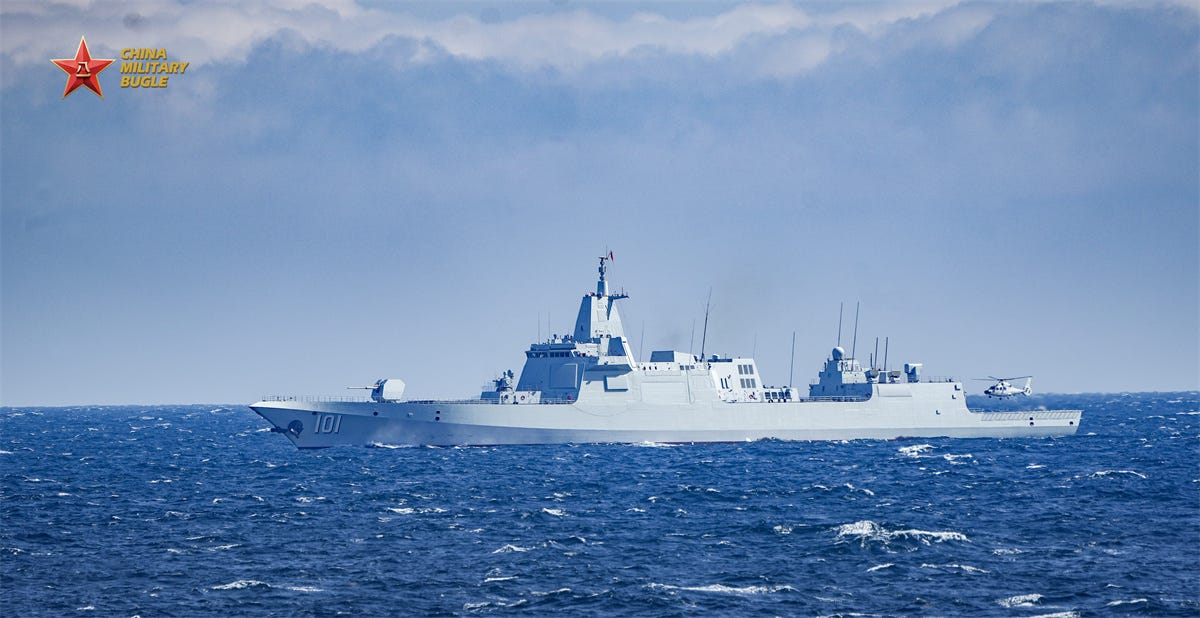
China has been putting Type 055 destroyers to sea for years. They’re over 10,000 tons, cruiser-sized warships, whatever the Chinese call them, and larger than America’s retiring Ticonderogas. While the American defense press debates whether big ships are obsolete, the Chinese are churning them out as fast as they can.
But it’s not just the enemy. It’s also our allies. On this point, the whole world agrees we’re stupid.
Japan lives within range of China’s missiles. Its response is a significant upswing in armaments for itself and for our collective allies, including two missile-defense ships of about 12,000 metric tons standard displacement apiece half again as big as Japan’s current Maya-class destroyers and almost that much larger than the Arleigh Burkes. They call these ASEVs (Aegis System Equipped Vessels) “destroyers” too. But then, they also call their aircraft carriers destroyers. Funny, these Japanese. Funny, but smart.
The Japanese understand what The Atlantic does not: they need room for the radar and interceptors to defend against the missiles China already fields: it’s the smaller hulls that are the sitting ducks. They’re also making room for better defenses against the hypersonic weapons they’ll face later. A ship that has just enough room for this year’s equipment will have to live with it a lot longer than the people who bought it.
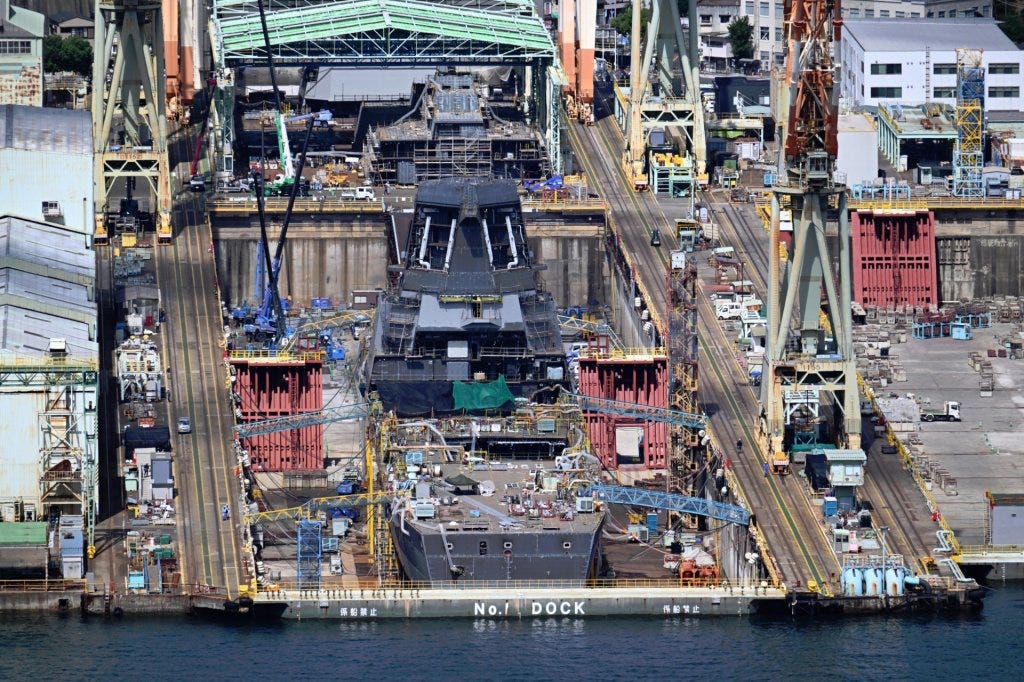
Italy has ordered the first of its new 13,500-ton DDX destroyers, even larger than Japan’s ASEVs. These large cruisers (but we mustn’t call them that) are deliberately designed to make room for enough equipment to supply electricity to future weapons systems and to carry away the heat. Try carving out space for that machinery once you’ve loaded a ship to the limit. The Italians are buying enough room for directed-energy weapons years before they need it, because the ships will still be around long after that.
At the extreme end of the absurd-designation race, Germany’s proposed F127 “frigate” (seriously?) displaces 12,000 tons. Take the radar and interceptors needed to defend against ballistic missiles, leave room for better ones, and see how much ship that takes. And at 10,000 tons, France’s proposed stealth destroyer — the SCX26 — is in the same range as the Ticonderogas. Its drone bay goes aboard the same hull as a substantial missile battery and a laser. Drones give the ship more to do. It still has to defend itself.

The logic of the emerging technologies requires larger hulls, not smaller. The same people who endlessly tell you that the carrier is obsolete and larger warships are “sitting ducks” also believed the propaganda that Iran had successfully attacked the USS Ford. In the real world, America’s carriers have proved virtually invulnerable, because bigger ships are better defended.
Just imagine a nuclear-powered battleship providing air defense for a Carrier Strike Group (CSG) or an Amphibious Ready Group (ARG). No one’s laying a finger on them. No one’s getting close.
China and Japan agree on very little about what should happen in the Pacific. But they agree on this point, and are building accordingly. Neither can afford to get that wrong. Both have bet the same way.
Meanwhile, the United States has allowed its Navy to atrophy year after year, during administrations of both parties. And when Donald Trump tries to do something about it, well, we can’t possibly support anything the Orange Man wants.
Trump’s Answer: More and Better
Modern air defense has an ugly economic problem. An enemy can send so many $35,000 drones that you run out of $4 million missiles (do enough of that and you’ll also run out of money).

By contrast, firing a laser from a system like the Navy’s HELIOS costs about $2. It also operates at the speed of light, something the drone swarm most definitely does not. Every drone brought down by a laser preserves a missile for a threat that actually needs one. Throw in systems like the Leonidas High-Powered Microwave (HPM) system, which can fry 100 drones at a time, and the game really changes.
But a ship has to be able to supply the electricity to run such weapons, something no warship has ever had to do before. And it has to do it while moving at speed and running its radar. It also has to get rid of the heat.
Ergo, if increasingly capable directed energy systems are the no-brainer answer, you need a ship that can really field them. And not just today’s systems or tomorrow’s, but the best we can anticipate existing someday. The Navy’s ships have to last for 50 years. How much do you think technology will advance in the next half century?
Trump’s answer is simple: if the world’s navies are building bigger hulls, that’s your proof of concept. If they’re already planning for directed energy weapons, we absolutely have to. And if we’re going to, let’s not do it half-assed: let’s define the field, as Jackie Fisher once did with the HMS Dreadnought.
At 35,000 tons or more, the Trump-class begins its life with what the 9,000-ton Burkes no longer have: margin. The planned ship (which I’ve argued for incessantly) carries an enormous 128 Mk 41 VLS cells for missiles of every type, plus larger launchers for even bigger weapons. But that’s not the show-stopper. That honor goes to the directed energy weapons and railguns, the future-tech that will change everything, especially the cost differential between offense and defense.
That makes nuclear power far more than a matter of speed and endurance. Nuclear gives the sailors the electrical power and the cooling they’ll need to power those very power-hungry systems. And not just what we can deploy today: what we can imagine out to the end of the class’s service life.
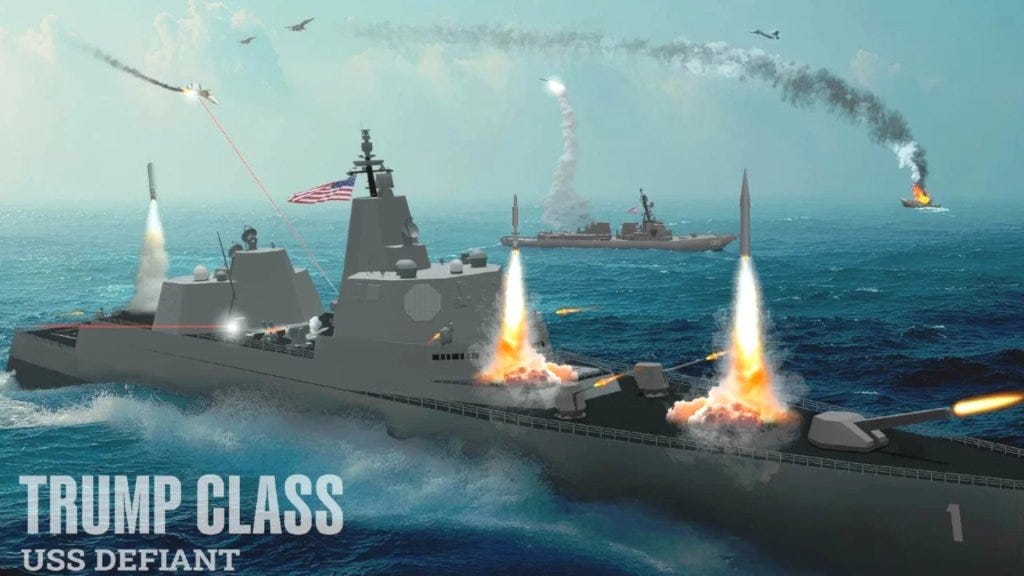
The 15 Trump-class BBGNs will be the most advanced, most powerful warship in the world. They will replace the VLS cells we’re losing with the retiring Ticos and Ohios. They will provide room for an admiral and his staff to command large formations from the sea. And they will also provide impenetrable air defense to whatever fleet formation they join. And it will stay that way, because its weapons can be upgraded as fast as we can create new ones.
Another point lost on the critics: just because the Navy stopped building cruisers doesn’t mean we don’t need them. But in the new normal, we’re going to need them to be a lot bigger. A Trump-class ship can take care of many missions all on its own: you do not want to see that show up off your coast. The BBGN lets destroyers be destroyers again, and restores the possibility of missions we gave up on after the Cold War.
This is a no-brainer. Of course we need these ships. So of course the Democrats want to kill them.
48 Days to Save the Future
Republicans have 48 days to do something about it. Pass the defense bills and secure the money for the next two years, not just one. Commit to all fifteen ships, with nuclear power from the first hull. Pay for the design, order the materials and components that take the longest to get, and give the shipyards and suppliers contracts they can actually hire against.
Congress can vote in an afternoon. It takes years to train the people who will build these ships. If the orders don’t come, suppliers will put their money elsewhere and skilled workers will take other jobs. And if the next House wants to stop the ships once the contracts are signed, let the Democrats figure out how to do that over Trump’s veto.
Ronald Reagan understood what was at stake coming out of the horrific Carter years. The Republican Senate needs to show the same resolve now. Get the bills through before January 3rd. Fund the ships and start the work.
Call your Congressmen and Senators (especially your Senators). Demand action now. It cannot wait. What you do now will have ramifications that last decades.
America can’t afford two lost years. China won’t waste them. Neither should we.


