


This analysis is free, but with Premium Membership you get MORE. Join today.
NOTE: I originally wrote this essay ten years ago. It’s well worth a re-read, on this holiday that no one takes seriously (yet everyone should). — RDM
by Rod D. Martin
May 5, 2016
Cinco de Mayo is more important than you probably realize. And in some respects, it is more important for us as Americans than for our genuinely heroic neighbors to the south.
Oddly enough, in Mexico the day is barely celebrated. While public schools are closed in its honor, it is not a national holiday. And in America, despite being celebrated in California since the 1860s, Cinco de Mayo would be virtually unknown here if beer companies hadn’t popularized it beginning in the 1980s. Hardly anyone can tell you why it matters.
So I will.
From 1858-1861, Mexico was wracked by civil war (the Reform War, as it was called). In the aftermath, exhausted and bankrupt, the Mexican government found itself unable to pay its debts to European lenders.
The Framers’ Plan to Stop a Runaway Government. Here Is How It Works.
Article V of the Constitution gives state legislatures the authority to call a convention to propose amendments, bypassing Congress entirely. The Framers designed this mechanism deliberately, with structural safeguards that prevent any faction from seizing control of the process. Convention of States Foundation has produced a full account of how it works — including why constitutional scholars recognize it as the most controlled amending mechanism in the Constitution. Learn more here.
Under normal circumstances, this might have been a relatively minor crisis. And in fact, Britain and Spain sent naval forces and troops to Veracruz, negotiated a settlement and withdrew, more or less business as usual for the mid-19th Century.
But France was another matter.
France, under Emperor Napoleon III, saw an opportunity. The United States was convulsed in its own Civil War. There were no spare resources available for it to enforce the Monroe Doctrine (whether or not there would have been without the Civil War is another question). Mexico looked like an easy conquest. It also looked like the perfect jumping off point for further meddling to the north.
So in January 1862, a powerful French fleet landed its own well-armed force at Veracruz and drove the Mexicans into retreat. After consolidating its position, the French began their march on Mexico City, with the intent to depose the Mexican Republic and set up a puppet Mexican Empire, under an Austrian archduke named Maximilian, believed by many to be the illegitimate grandson of Napoleon I. (Interestingly enough, Mexican monarchists had previously invited Maximilian to take the throne during the Reform War, albeit minus the invading French army.)
The Mexican commander, a 33-year-old named Ignacio Zaragoza Seguin, born in Goliad, Texas and a cousin of the great Texas Revolutionary hero Juan Sequin, struggled to hold off the superior French force. Eventually, he retreated to Puebla, where he mounted his defense.
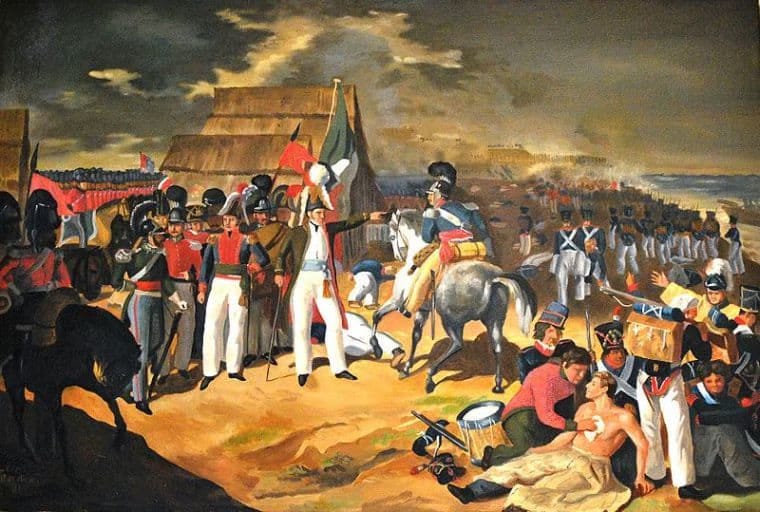
It was at Puebla that Zaragoza and his outnumbered, outgunned heroes decisively defeated the premier army in the world, May 5th, 1862.
New Orleans had fallen to Union forces just days before. Antietam was months away. Had Napoleon rolled the Mexicans at Puebla, he likely would have had an almost unlimited ability to reinforce the Confederacy, making him the master of America’s fate. How he would have used that power is anyone’s guess. But forcing a Southern victory, at the price of Mexican recovery of the western lands lost in 1848 with the Confederacy rendered a French client state had to be high on the agenda.
Instead, thanks to the Mexican heroes at Puebla, the French were forced to retreat and regroup. Napoleon doubled down on his invasion, eventually defeating the Mexicans at the Second Battle of Puebla a year later, and installing Maximilian as Emperor almost a year after that.
The delay made all the difference. Puebla was immensely inspirational, encouraging resistance throughout Mexico. Even once victorious, the French were never able to pacify the country, much less project power north. And by the time Maximilian was seated on his throne in Mexico City, the South had long since lost Gettysburg and Vicksburg, and Sherman was preparing to march on Atlanta. The French opportunity had passed.
That proved to be the least of their troubles. Barely a year into Maximilian’s reign, a victorious Union, possessed of the largest, best-armed military force in the history of the Earth, was far more inclined to remind the French of the Monroe Doctrine. In 1866, as General Sheridan began transferring tens of thousands of Union rifles directly to Mexican Republican forces, the French announced they would withdraw. And withdraw they did; but not before the Mexicans inflicted upon them an ever-growing string of defeats.
The Republicans retook the capital, evacuated by the French in February 1867. Maximilian stayed. He lived to regret it, but not for long: the Mexicans executed him that June, just over five years after Cinco de Mayo.
Few of America’s drunken partiers tonight, celebrating some confused combination of Mexican heritage, Corona and Dos Equis, will have the slightest idea of any of this. But they are right to celebrate. Much like the heroes of the Alamo, the courageous Mexicans at Puebla gave their lives to delay what seemed inevitable, and in the process, made it anything but.
They saved their country. They very likely saved ours too.
Feliz Cinco de Mayo!
-- This article was originally published at The Daily Caller.


Consider this the official Cinco de Mayo reading list:
* El Cinco de Mayo: An American Tradition by David Hayes-Bautista
* Hapsburgs on the Rio Grande: The Rise and Fall of the Second Mexican Empire by Raymond Jonas
* Maximilian in Mexico: A Woman’s Reminiscences of the French Intervention, 1862-1867 by Sara Yorke Stevenson
* The Last Emperor of Mexico: The Dramatic Story of Austrian Archduke Who Created a Kingdom in the New World by Edward Shawcross
* Maximilian and Carlota: Europe’s Last Empire in Mexico by M.M. Allen
* The Mexican Adventure, 1861-67 by Rene Chartrand
* The Shadow Emperor: A Biography of Napoleon III by Alan Strauss-Schon
* A Life of Benito Juarez, Constitutional President of Mexico by Ulick Ralph
I saw Maximilian’s tear-stained pillow in the Texas Ranger Museum (Waco, Texas) in the 1990s. It was there for a limited time. It was the pillow Maximilian slept on the night before his execution. Thank you, Mr. Martin, for this history lesson.