


Don’t miss “the greatest story NEVER told!”

This analysis is free, but with Premium Membership you get MORE. Join today.
Our full discussion transcribed after the break:
by Rod D. Martin
October 21, 2026
Don Ma and I discuss why Russian and Chinese support has limits, how Iran’s proxies threaten global shipping, and what Trump needs from Ukraine to bring energy prices under control.
Don and I discuss:
Why Russia and China can’t rescue Iran
The Houthis’ role in Iran’s war strategy
Saudi Arabia’s choice on the Abraham Accords
MOAB (the “Mother Of All Bombs”) needs the right target to matter
Why Trump wants Ukraine to temporarily ease energy pressure
It’s 9 minutes of the in-depth analysis you need: watch it, and pass it along!

Our Full Discussion:
Don Ma: And we’re welcoming back Rod Martin. He’s author of the new book,
Don Ma: And joining us now to discuss this new book is Rod Martin, geopolitical analyst and founder and CEO of Martin Capital. He is also a member of the Committee on the Present Danger China and author of the book titled Trump’s New World Re-Order: Dismantling the Deep State and Ending Postwar Globalist Rule. So Rod, we finally meet each other in person! I’ve been speaking with you for so long. I’m really glad to have you here in the studio. How are you doing today?
Rod Martin: Doing well. It’s great to be here.
Don Ma: Okay. So let’s discuss some current events happening right now. I wanted to go to the Middle East as well as Ukraine.
Rod Martin: Well, there’s a limit. I mean, there’s no question, the blockade is incredibly effective. The land routes are difficult. To Mr. Zelensky’s credit, the Russians tried to ship some arms across the Caspian Sea recently, and Zelensky blew them up in the water. So good for him.
This, however, doesn’t negate the reality of what they’re sending to the Houthis, which is very, very real.

It also doesn’t negate the intelligence sharing. They are definitely giving Iran advantages it would not have if they were dependent on their own intelligence. That is a problem. That’s something that we need to address. But I think we can expect it to be true, at least at a low level, for the foreseeable future.
Don Ma: So this support, would you characterize it as, at any level, meaningful? Has it extended the war? Has it prolonged the Iran war?
Rod Martin: I really don’t think so. They are not receiving enough from either of those two countries to prolong things. The intelligence certainly helps them, but it only helps them so far.
Their systems are largely destroyed. It’s not that they don’t have missiles still, drones. That’s not what I’m saying. But their air defenses are gone.
We’re not going to invade. So, you know, the protracted land war that they had planned for just isn’t going to happen. And that’s where the intelligence would be especially fruitful for them, versus, you know, attacking U.S. naval vessels, that gets them nowhere. We’ll just keep blowing up Iranian oil tankers if they do that. They’re never going to get close to a U.S. warship. So far, it has not done them a lot of good.
The Houthis, Saudi Arabia, and the Abraham Accords
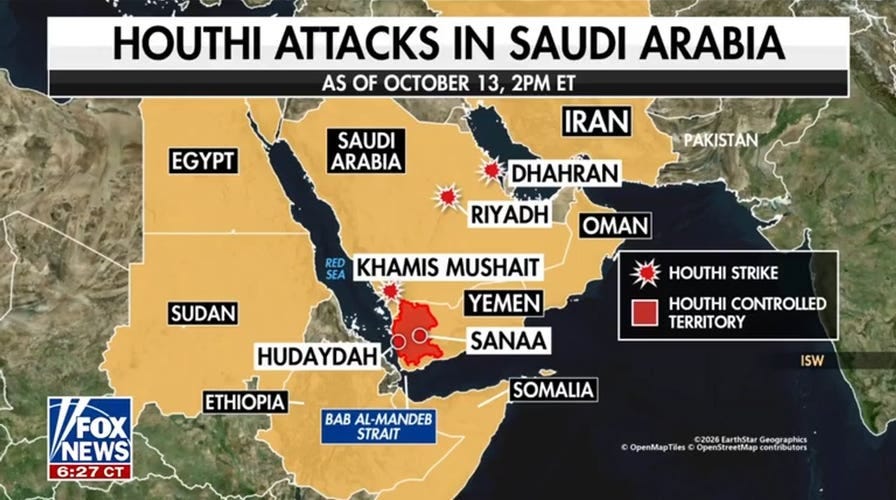
Don Ma: Okay. So you brought up the Houthis earlier. What is your concern level with regard to escalation, the airport attack, all that within the Middle East region?
Rod Martin: I think the airport attack makes very clear to Pakistan and Turkey that if they want the Mecca Pact to mean anything, they’re going to actually have to give the Saudis some help. We’ll see if they do. I’m not super optimistic about that actually being meaningful.
As far as Yemen itself, the government has been successful in driving them back from control of the strait. That’s crucial.
We would be willing to help the Saudis with this problem if the Saudis would help us with a couple of things. They have been less than entirely forthcoming in the Iran conflict, even though they’ve been under attack from the Iranians repeatedly.

They also haven’t signed on to the Abraham Accords, and we absolutely want them to. And they have clearly said they want to do the nuclear power deal with Trump that they worked out. The only way that’s going to happen is if they accede to the Abraham Accords. I think they understand that’s the direction this has to go, but Trump’s pretty quid pro quo. He’s going to get what he wants for them to get what they want.
Don Ma: Where do you think these Houthi attacks are going? Do they have a goal in mind? To what degree is Iran involved? How much is Iran pulling the strings behind the scenes?
Rod Martin: Oh, highly. I mean, it’s just like Hamas and Hezbollah and the Shia militias in Iraq. There is not an armed conflict in the Middle East that isn’t armed, funded, and directed from Tehran.
Now, having said that, the Houthis do have additional aims. They would like to displace the Yemeni government in Aden. They would like to be the sole government in that country. And they would like to be able to harass global shipping going through the Red Sea. They would like those things independent of Iran, but they probably would not be threatening that shipping if Iran did not want them to.
Iran has — I don’t care what they say — they’ve completely lost control of the Strait of Hormuz. This is their backup plan.
Don Ma: Okay, so if Iran is pulling the strings, does that mean the ultimate goal here is the United States with the Houthi attacks with regard to Saudi Arabia? Like, what is the ultimate goal here?
Rod Martin: Well, the ultimate goal, in their dream world, would be to be able to control both of those straits and therefore set prices on global commerce in virtually everything, but especially oil and liquefied natural gas. That’s probably beyond their grasp.
What they would like to do in the near term that could be thought of as an ultimate goal, but that is short of that, is just wear down the American electorate.
And they believe that if Donald Trump loses the midterms, they seem to think of us as a parliamentary system. They seem to think that a Democratic House is going to be able to prevent him from doing what he wants to do. There is a very meaningful limit on the reality of that. We have coequal branches of government. The president is the commander in chief. A Democratic Congress, certainly one house of Congress, is not going to be able to change that.
MOAB: The Right Weapon…for the Right Target
Don Ma: And I did want to get your comments on what President Trump said earlier before we came on. He was talking about a bomb. It’s not a nuclear bomb, but it’s a significant bomb. Potentially, I would assume that there might be consideration, there may not be consideration as well of using this bomb on Iran. What are your overall thoughts on the situation as it develops right now?
Rod Martin: It could be the right weapon for the right target, if we can determine what that is. It’s not an all-purpose weapon. It isn’t nuclear. It is much, much smaller than a normal nuclear weapon, but it is massive, no question about it.
It’s called MOAB for “Mother of All Bombs.” It was developed across the bay from me at Eglin Air Force Base. It’s really cool. It can do a lot of damage, but you’ve got to have the right target for it.
So, for example, when we attacked Fordow last year, MOAB would not be helpful for that because it’s not designed to penetrate hundreds of feet of rock. So, you’ve got to have the right target. But I agree, if it’s the right weapon, we should use it.
Ukraine, Starlink, and Energy Prices
Don Ma: Okay. Just one final question before we go to a commercial break, and then we’ll come back and talk about your book. I want to ask you about Ukraine. So, they’re saying sudden Starlink-Starshield restrictions have disrupted drone operations. Zelensky raised concerns about missing missile warnings as well. What is your analysis? What could explain the Starlink-Starshield situation restrictions?
Rod Martin: The president needs them to back off a little bit on diesel. It’s just that simple. He negotiated an energy ceasefire. Both sides immediately violated it, of course. Duh. But that doesn’t mean that it couldn’t hold.
And the reality is that we did this earlier this year in a different dimension, which was lifting sanctions for a 30-day period on Russian crude sales. That helped regulate prices and keep them under $100 a barrel. This is a temporary measure.
The president needs Zelensky to help. Zelensky doesn’t want to help. I understand why. They’ve been incredibly successful disrupting the Russian oil industry, which used to be the biggest in the world. They’ve taken 58 percent of Russia’s refining capacity and pumping stations offline. Good for them.
And by the way, Donald Trump is the one who enabled that because Joe Biden wouldn’t let them touch any of those targets. But right now, we need a little bit of payback. Mr. Zelensky needs to back off just a little bit, just briefly, to help us get prices under control.
Don Ma: Okay, fair enough. Let’s go to a quick break. And when we come back, we’re going to talk about this book right here. So stay tuned for more.
See the rest of the interview here.


