


by Rod D. Martin
October 20, 2026
For a long time, I have been sounding the alarm about America’s atrophied shipbuilding capacity. China’s now exceeds ours by 232 times. That disparity isn’t a rounding error. It’s an industrial and strategic nightmare.
The effect that necessarily has on the U.S. Navy and, more to the point, the ability to maintain U.S. naval dominance, is bleak. And inasmuch as that is the essential foundation of American power, change must happen sooner than later.
Fortunately, we have a President who gets what his four predecessors did not.
President Trump just gave Palmer Luckey’s Anduril Industries an opportunity to do for defense production what Elon Musk has done for the rocket launch business. On October 6, Trump announced Arsenal-2, a new submarine-component shipyard at Sparrows Point, Maryland, just outside Baltimore.

America desperately needs the ships. It also needs someone willing to challenge the procurement system that has made them so expensive and so late. Anduril, which has already demonstrated that capability with its shockingly fast development of unprecedentedly low-cost drone and missile systems, is committing $3.7 billion of private capital. The Navy’s contract, worth up to $2.9 billion, ties payment to demonstrated production. As always, Luckey puts his money where his mouth is. For once, the government actually pays for results.
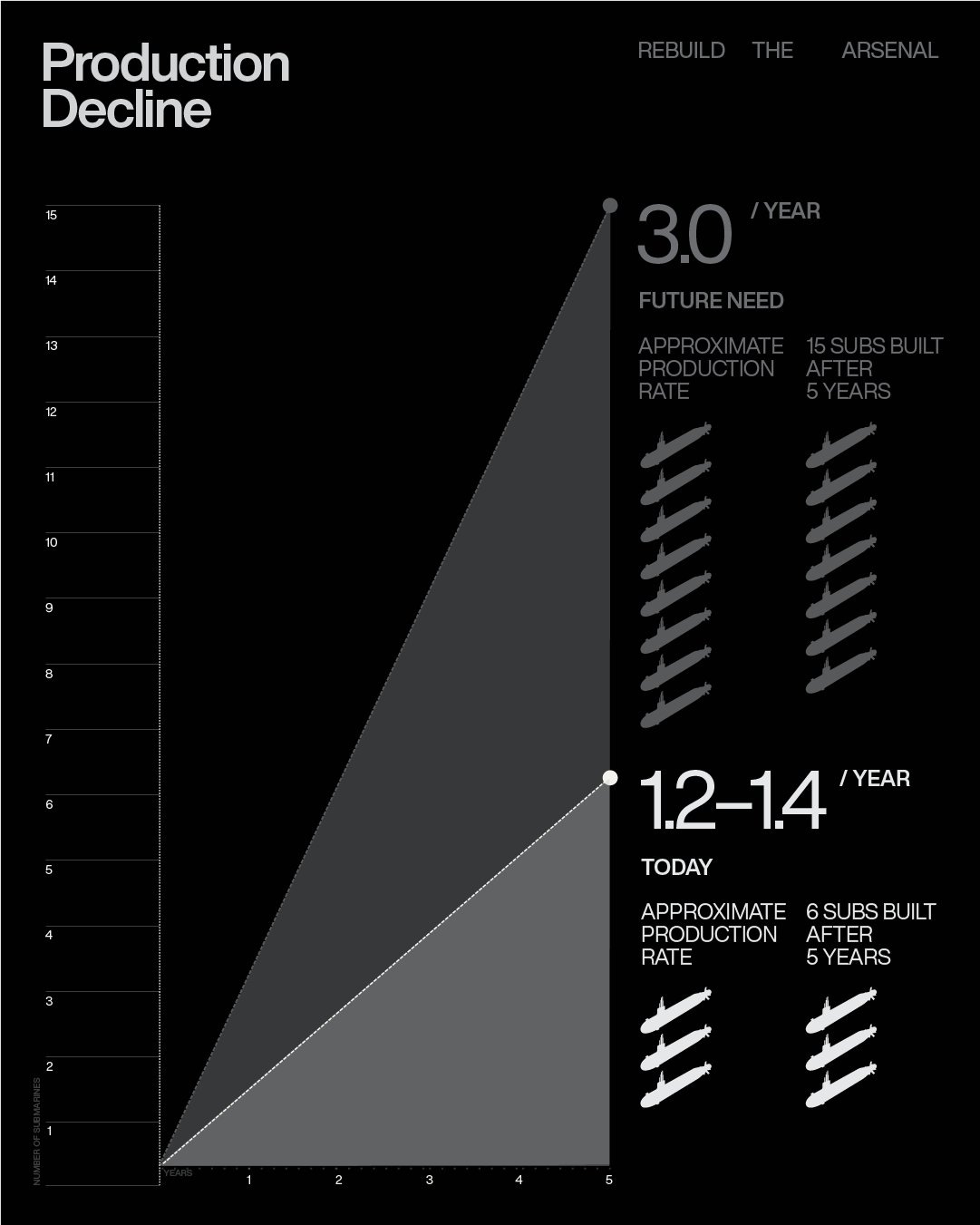
The situation is grave. The Navy is required to build two new Virginia-class submarines per year just to replace retiring hulls; it actually produces 1.2, and that’s before you add in our commitment of new boats to Australia under the (exceptionally positive) AUKUS deal. It’s so bad that the Navy doesn’t even have enough torpedo tubes. Some Virginia-class submarines already under construction are behind schedule while waiting for them.
Bottlenecks of this sort are rampant in America’s defense industry, and nowhere more so than in shipbuilding. Anduril will start by filling gaps like these, working quickly toward larger assemblies that Electric Boat and Newport News can integrate into finished subs.
But Palmer Luckey represents far more than an additional supplier. He wants to build military hardware faster, cheaper, and better, using the commercial discipline that made Silicon Valley so productive and SpaceX so disruptive. Trump is giving that approach an opening in an industry where we can no longer afford business as usual.
In 2024, China accounted for more than 53 percent of global commercial shipbuilding. The United States? Just 0.1 percent. In just that one year, China’s largest state-owned shipbuilder built more commercial vessels by tonnage than the entire U.S. shipbuilding industry has built since the end of World War II.
America once possessed an industrial machine that built the largest navy the world has ever seen in just three years, while also creating the largest air force and supplying all the allied armies. It emerged with half the world’s GDP and went on to win the Cold War. But then Washington spent the last generation dismantling all that on the theory that “history had ended” and China was our friend.
While we collected the fanciful “peace dividend,” Beijing determined to build the yards, suppliers, and workforce needed to dominate the world.
But China doesn’t have to beat us all over the world to win. The CCP can concentrate its fleet near Taiwan. America has to defend everywhere at once. A ship protecting the Atlantic approaches can’t also screen China; one in overhaul counts on paper but not in the crunch.

As a result, America needs far more than mere parity. And to maintain its lead, it must create an industry that can not only produce enough ships — which at present it can’t — but maintain them and, in a fight, replace lost vessels fast.
We did this, with lower tech and a lot less money, in World War II. Trump gets it. But he’s the first President since the Cold War who has. And the result is a dangerous race America could actually lose.
