


This analysis is free, but with Premium Membership you get MORE. Join today.
by Rod D. Martin
July 25, 2026
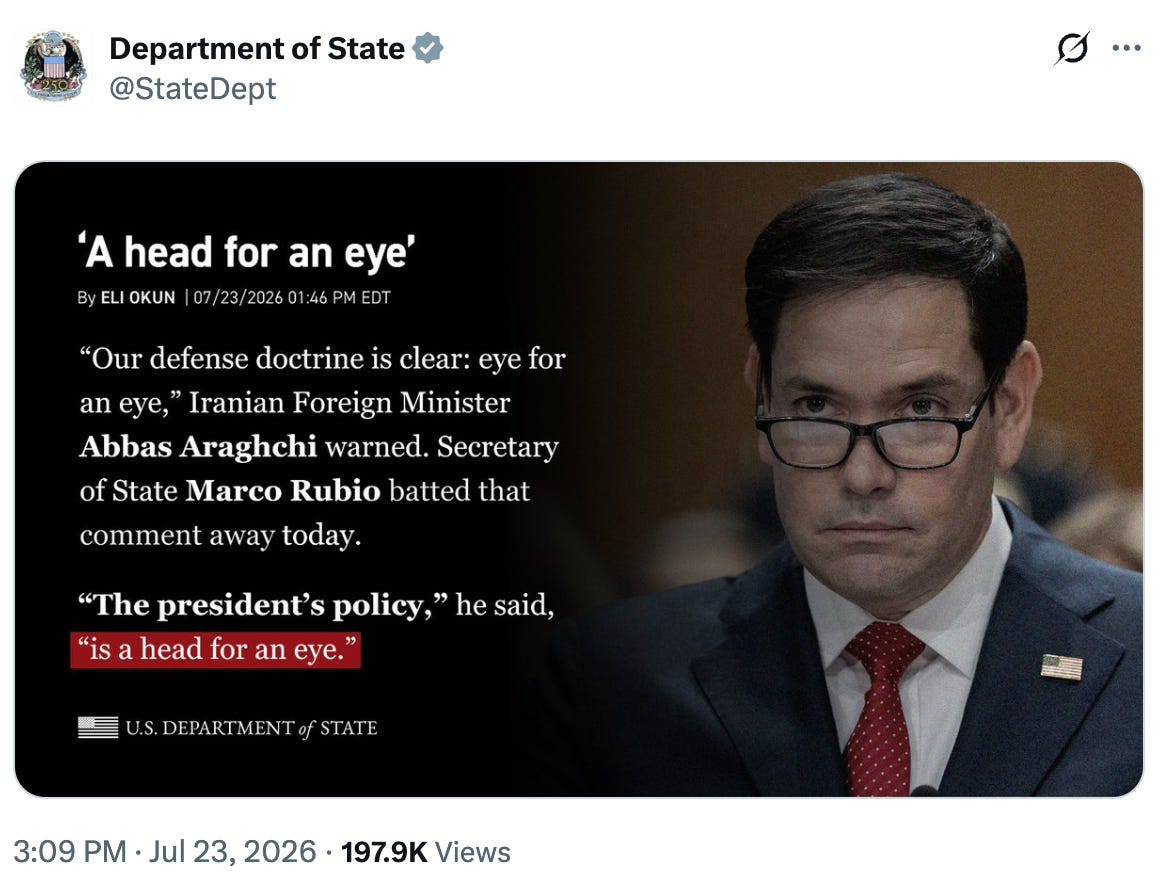
On Thursday, Iranian Foreign Minister Abbas Araghchi announced that Tehran would answer America “an eye for an eye,” which he intended not as proportionality but as a threat. Secretary of State Marco Rubio responded that the President’s policy is “a head for an eye.”
The usual pearl clutchers erupted in horror. But this is exactly the right policy. And not just “right” in the sense of “correct.”
War is terrible, and should not be engaged in lightly. But once the decision is made to go to war, America must use disproportionate force to actually win, as it did routinely prior to Korea and Vietnam. The days of Colin Powell’s “you break it, you buy it” rule are over. Iran — which has considered itself at war with the United States for 47 years and acted accordingly — can stand down, stop attacking its neighbors, stop attacking civilian ships, stop destroying civilian water plants, stop attacking hotels, or we will compel it to do so in the most “convincing” ways available.
Which one is up to Tehran.
Rubio’s words unleashed outrage from the NeverTrump, “America Only” crowd, among them some Christians claiming the statement was a gross violation of Just War Theory. One must consider the source, of course: in many cases these are the same people who now support Tucker Carlson’s jihad against Israel and call openly for Iran (and China and Russia) to defeat the United States. Yet “a head for an eye” does sound at odds with Christian teaching, and the question itself must be answered.
So here’s the answer. The Facebook theologians don’t know what they’re talking about.
“An eye for an eye,” used properly rather than as Araghchi’s promise of vengeance, is the Biblical Lex Talionis, or law of proportional justice. It requires that “the punishment fit the crime” in civil and criminal proceedings.
But war is not a judicial proceeding. Real, non-internet lawyers and theologians have developed what is known as “Just War Theory” for nearly 2,000 years, with essential contributions from such leading figures in the history of the church as Ambrose, Augustine, Aquinas, Luther, Calvin, and Grotius. This is well-trod ground. And the principles are clear.
Just War Theory does not require America to trade blow for equivalent blow, nor does it limit us to attacking only the same number and kinds of targets Iran is capable of striking. If Iran damages one ship, we are not morally confined to damaging only one of theirs; if it is incapable of attacking any U.S. Navy vessels at all, that does not restrict the United States in its attacks on the Iranian Navy (now sunk). If Iran fires ten missiles, we are not restricted to answering with ten. War is not some deranged sporting event in which the officials must keep the score close.
A just war must be fought justly. It must also be fought to win. This is not optional: Just War Theory requires it.
Trump’s Cause Is Just
The classic Christian requirements are straightforward.
Just Cause: Force must be used to correct a grave, public wrong, such as defending against aggression or protecting innocent lives.
Legitimate Authority: War must be undertaken by a lawful sovereign authority, rather than private individuals or factions.
Right Intention: The motive for war must be to secure a just peace, rather than merely seeking revenge, territorial conquest, or economic gain (though the mere fact that those occur incidentally does not by itself render the war unjust).
Last Resort: No less-destructive reasonable alternative may remain likely to achieve the just objective.
Reasonable Chance of Success: There must be a realistic probability of achieving the war's objectives to ensure lives are not wasted on a futile cause.
Proportionality: The anticipated overall destruction and loss of life caused by the war must be outweighed by the good it will achieve, and the level of violence used must be limited to what is militarily necessary to achieve victory.
Note well that last bit. A war fought with inadequate means to achieve victory is inherently unjust, because it wastes lives and treasure on both sides. If one must go to war, it must be for a just purpose, and that purpose must be served or the war is not just.
The internet experts ignore that part entirely.
Just War also requires a just peace. The victor may vindicate the original cause, disarm the aggressor, punish those responsible, and secure the peace. It may not turn victory into an excuse for gratuitous vengeance, plunder, or conquest.
But this does not impose Colin Powell’s rule. America may choose to rebuild and rehabilitate a defeated enemy, as it did with extraordinary generosity in Germany and Japan. It is not morally required to occupy and reconstruct every society whose war-making capacity it destroys. They started it, after all.
Trump’s approach satisfies all these tests. The United States is not a private mob seeking revenge. It is a sovereign nation acting through its President and armed forces to defend its people, its forces, its allies, and the freedom of the seas, not to mention deterring the evil Iranian regime from further massacres of its own citizens.
Moreover, Iran’s aggression is not hypothetical. The Islamic Republic has waged war against America and its neighbors since 1979, directly and through proxies. It has attacked U.S. personnel, civilian shipping, airports, hotels, residential areas, energy facilities, and desalination plants that provide drinking water to the desert populations of countries not at war. And this is before we even consider Iran’s internal atrocities, among which is executing young girls for having been raped.
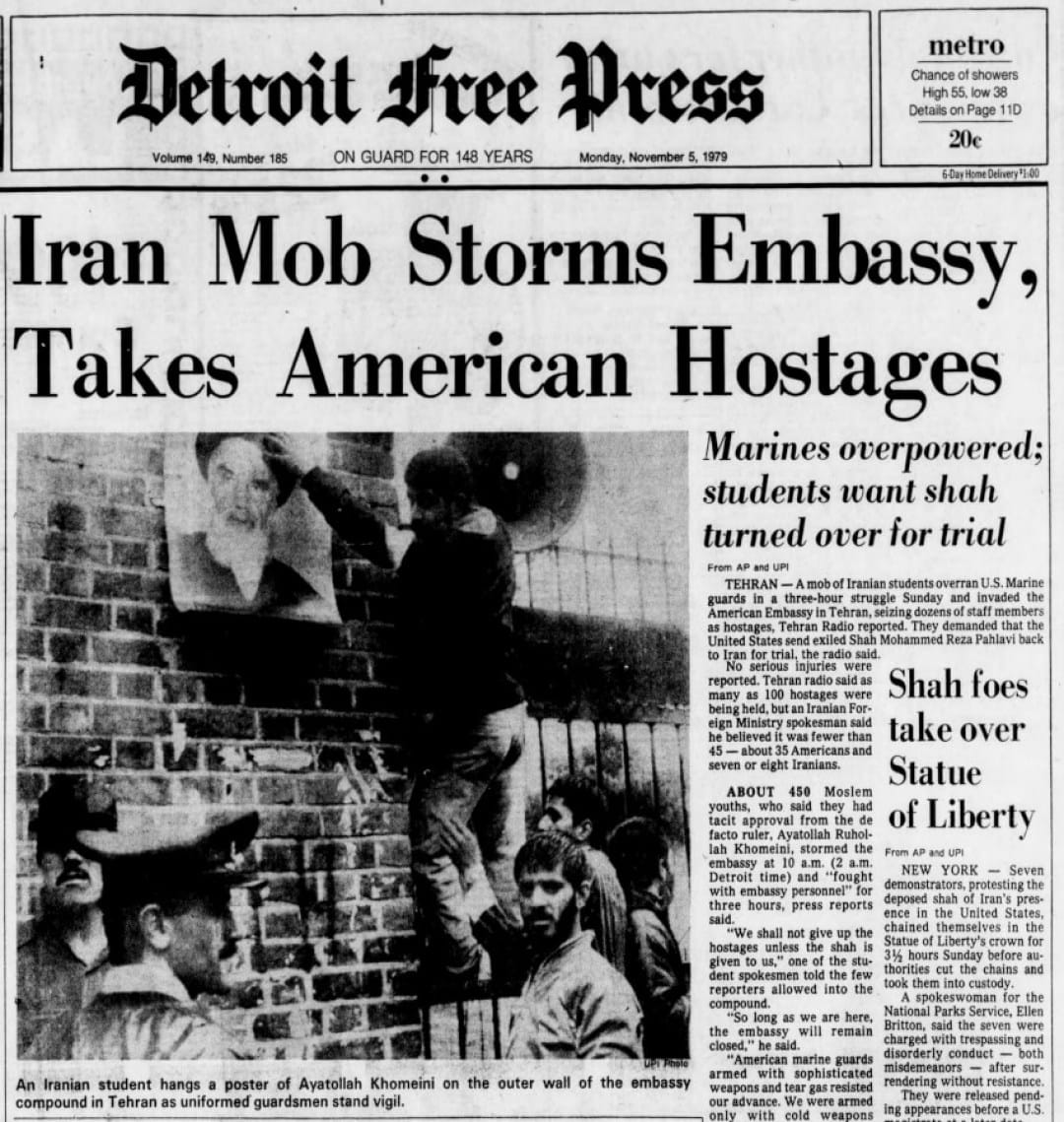
To defeat Iran is a just cause if there ever was one.
Trump’s intention is also right. The President is not trying to conquer Iran, annex its territory, plunder its wealth, or occupy it for twenty years while State Department social engineers write a new and useless constitution. His objective is to end Iran’s aggression, deny it nuclear weapons, destroy the military capacity with which it terrorizes its neighbors and us, and compel its rulers to accept real peace.
That matters. Augustine did not teach that all violence is evil. He taught that peace must be the object of our desire, and that war may be waged when necessary to obtain peace. Aquinas likewise required legitimate authority, just cause, and right intention: force must seek the advancement of good or the avoidance of evil, not mere cruelty, vengeance, or aggrandizement.
That is precisely Trump’s position. Iran can stop the war immediately, simply by stopping the behavior that makes war necessary. Likewise, Japan could have stopped its war well before Hiroshima. And both countries could have chosen not to start their unjust wars at all.
That part gets left out too. Trump is charged with starting a “forever war.” That’s precisely wrong. He’s ending one.
Disproportionate Force Is a Requirement
The moral imperative of proportionality is the issue. But the misapplication of the Lex Talionis obscures the actual requirement. Proportionality does not mean parity. It means that no more force should be used than is necessary to achieve the legitimate objective.
But that necessarily means no less force than is necessary. Victory can never be achieved without using greater force than the enemy can sustain. And without a reasonable chance of victory, the war is a waste of lives on both sides and thus unjust from inception.
Military superiority is not a moral defect. In a just war, it must be used to break the enemy’s ability and will to continue fighting. You must impose costs he cannot bear and thereby make continued aggression hopeless. That is not vengeance. It is the purpose of just war: to compel the aggressor to stop and restore peace.
Disproportionate force is thus merciful. If overwhelming force ends a war in weeks while “measured” retaliation prolongs it for years or decades, the former course saves vastly more lives. Mercy is not measured by how little force one uses today, but by how many innocents still live tomorrow.
This is what Johnson forgot in Vietnam. America used enough force to keep the war going but refused to use enough to win. That restraint looked moral to the men imposing it from conference rooms thousands of miles away. In practice, it prolonged the conflict, squandered lives, exhausted the public, and delivered millions of innocents to die at the hands of their Communist conquerors.
Harry Truman understood the difference. In 1945, he did not have the luxury of choosing between Hiroshima and a bloodless peace. His only realistic options were an invasion expected to kill 11 million and destroy the entirety of Japan, an open-ended blockade that would starve millions more (and mostly civilians), or such a shock to the system that the militarist regime would lay down its arms. Hiroshima was not a war crime. It was the decisive defeat of a murderous enemy and the end of its criminal war. It killed the fewest, spared the most, broke the enemy’s will, and produced a lasting peace.

That is what Rubio meant by “a head for an eye”: a sudden, overwhelming destruction of the regime’s war-making capacity and will to continue. The alternative is not Christian mercy. It is the sort of self-satisfied pietism that would leave one’s wife defenseless before a home invader, as one celebrity pastor notoriously suggested. A ruler’s duty is not to preserve his own self-righteous feelings of piety. It is to protect the people God has entrusted to him.
David understood this. Trump understands this. His critics do not.
Weakness is not mercy. Indecision is not justice. And losing a war slowly is foolishness, not morality.
Our cause is just. Our means are right. And the weak-kneed among us should be remembered, so that we never trust them to lead anything of importance.
Iran can stand down. It can stop attacking. It can choose peace.
But it has chosen war, without fail, for 47 years. President Trump has a moral duty to win it.


👏👏👏 A terrific and sobering article from start to finish! The “rules-based international order” is a pipe dream. Only strength and using overwhelming force can defeat evil, make the world a better place and bring about justice and liberation for oppressed peoples around the globe!
Thank you for clarifying the context of an eye for an eye: a measure for carrying out justice. But in war, when a particular people were a festering menace to Israel, God commanded His people to destroy them completely. That is to remove all traces of the threat so that peace could now be built. Alas, often, Israel fudged on this and a root of turmoil was allowed to thrive and continue to create havoc for centuries.