


This analysis is free, but with Premium Membership you get MORE. Join today.
by Rod D. Martin
September 22, 2026
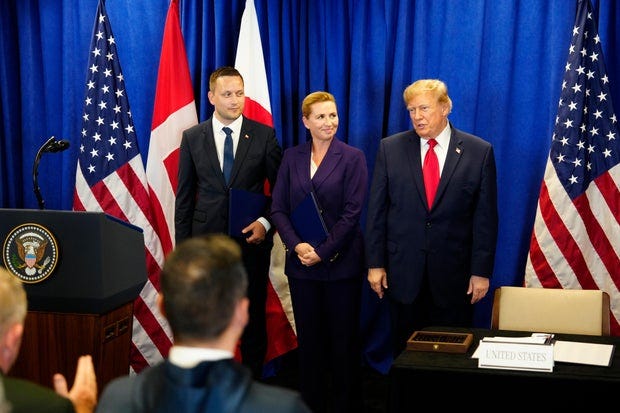
With today’s signing of the tripartite deal between the United States, Greenland, and Denmark, Donald Trump has achieved yet another masterstroke — like the NATO commitment to increase defense spending more than two-and-a-half times, like the EU trade deal, like booting China out of Panama — that the Enemedia unanimously told you was not merely impossible, but laughable.
Lesson: don’t listen to the Enemedia. It’s not just that they’re biased. They’re also almost always wrong.
To quote Greenland Premier Jens-Frederik Nielsen, the “world has changed a great deal since 1951,” referring to the original security agreement. The people of Greenland “recognize the long-term security threats that you, Mr. President, have rightly spoken about.”
“This agreement should put to rest any doubt today and in the future about where Greenland’s loyalty lies,” Nielsen said.
Indeed.
The deal itself is important, but not so important as what it represents. We’ll come back to that in a bit: it’s the part you most need to understand.
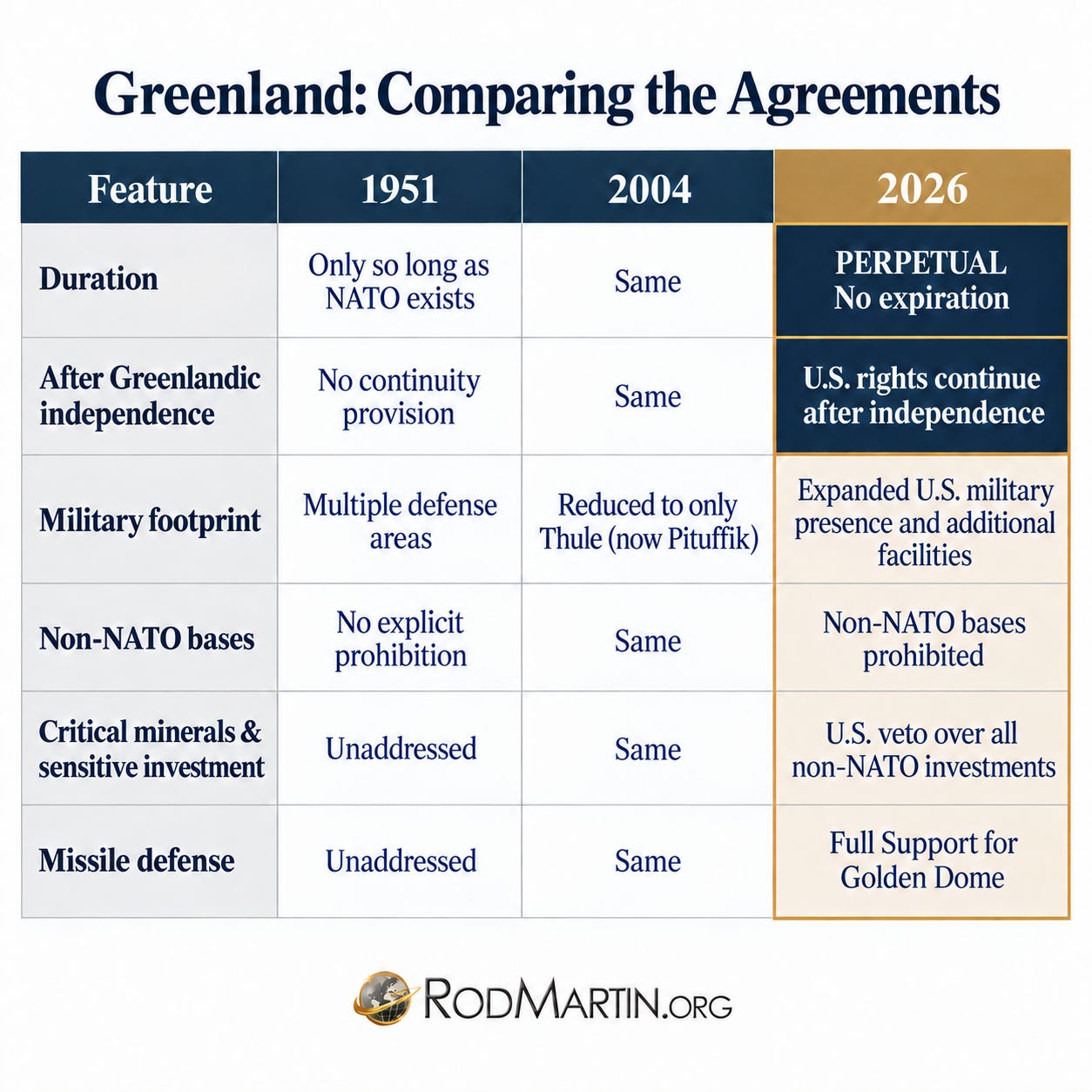
Trump’s enemies are out in force saying the President achieved nothing he didn’t already have. That position proves only that their time horizon is that of a toddler. What the Greenland deal gives the United States is perpetuity: no matter what happens in Denmark, Greenland, or some future Eurabia, U.S. rights in Greenland survive.
Key points:
Under the prior deal, U.S. rights only lasted so long as Greenland was part of Denmark, and so long as NATO exists (or the U.S. remained a member). All of that is gone.
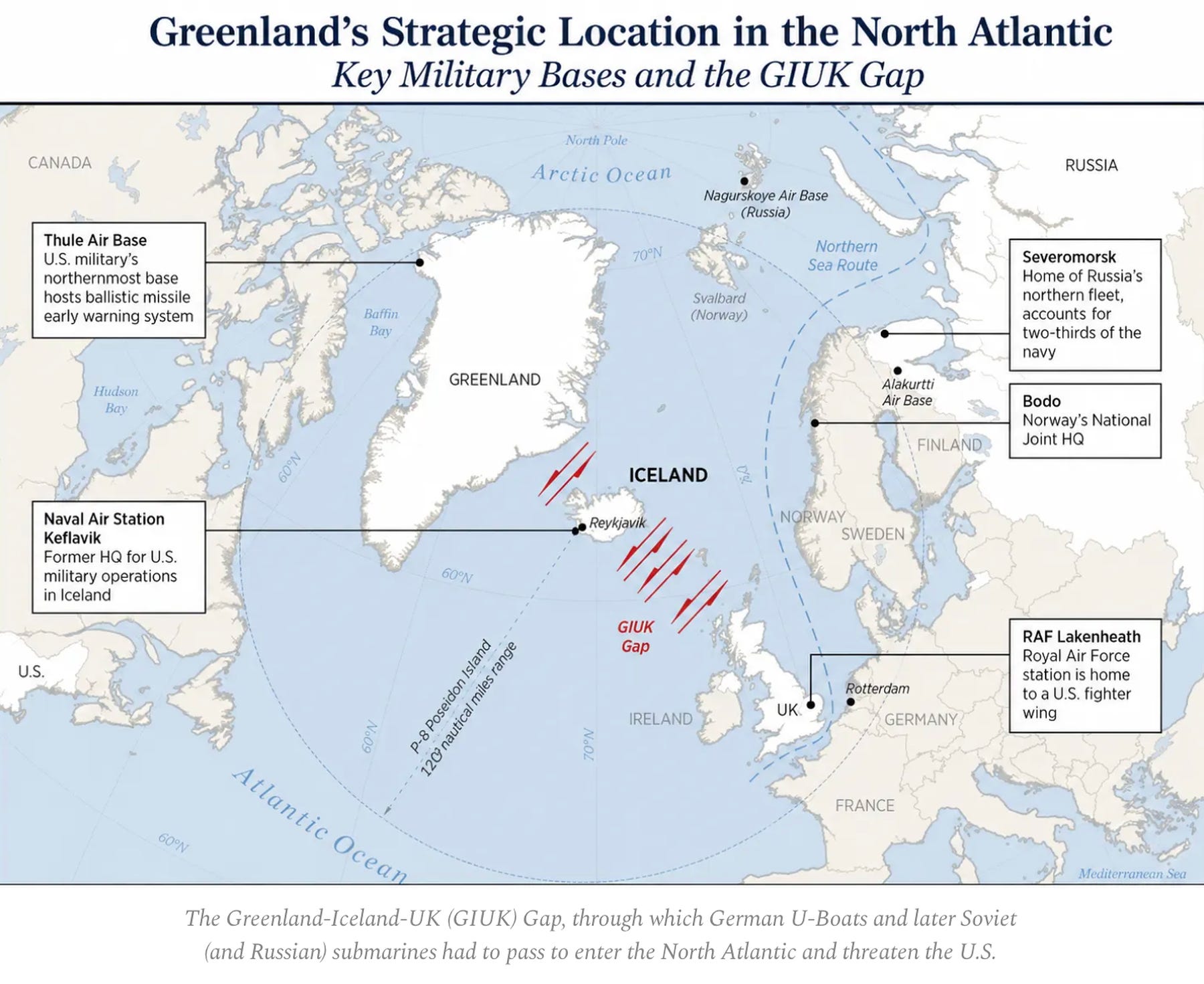
Under the (foolish) 2004 amendments to the treaty, George W. Bush gave up our basing rights outside Thule Air Base (now Pituffik Space Base). Those rights are now restored, allowing a significantly expanded U.S. presence for Golden Dome, for interdiction of enemy fleets in the GIUK Gap, and for such other needs as may arise.
The U.S. now has an absolute veto over military access and even strategic investments by any non-NATO ally. The Chinese and Russian initiatives toward Greenland are now thwarted, forever.
These things matter, a lot. But there’s more.
A Sea Change in U.S. Foreign Policy
For decades, American foreign policy has assumed the permanence — and the permanent utility — of various international organizations and agreements. This has continued long after the utility of many of them has disappeared.
NATO is a key example. Did NATO once have utility? Absolutely: in the beginning it shored up nations lying in ruins under the American aegis. Later, our allies contributed essential forces and expenditures to oppose a Soviet threat that grew almost until the day it collapsed.
That ended in 1991. When it did, the foreign policy establishment did not adjust. They reasoned from the long-held presumption that NATO was essential not just to peace but to survival. They did not rethink that presupposition when the facts on the ground changed. So American leaders of both parties allowed Europe’s (and Canada’s) militaries to atrophy, allowing them to freeload on the American taxpayer while subsidizing stifling anti-competitive economies and a vast Islamic invasion. They did so because, to them, the alternative was unthinkable.
Am I arguing that NATO cannot be valuable? Absolutely not: I think an alliance of (mostly) free countries with strong militaries that support one another and deter aggression by unfree powers is tremendously worthwhile. Moreover, I would be happy for that alliance to be NATO, and for there to be other such alliances (like AUKUS, or the Quad, or the growing informal Asian NATO, or the military cooperation inherent in the Abraham Accords) that serve the same role.

What I’m arguing is that NATO is not valuable, or at least that it hasn’t been for a long time. If it rearms — as Trump has singlehandedly strongarmed it into doing — that can change. Otherwise, it’s just another American welfare program. And that does not serve the interests of the American people. It is actually a net-negative.
Yet Washington’s presuppositions remained, and but for Trump’s team, remain. NATO is less an alliance than a religion, one in which America is supposed to pay permanent penance (for what is unclear) to its European “betters” by giving them free stuff. Whole Beltway think tanks exist to tell us the importance of this ritual. Trump’s sacrilege in questioning it is the source of much of the irrational hate spewed in his (and your and my) direction. He’s “obviously” a madman, or an idiot, or a traitor.
Many of the same people, or the people who hired them, said the same of Reagan.
Trump’s view is entirely different, and it is best summarized thus:
The government of the United States has the right to tax the people of the United States because of its corresponding duty to protect the people of the United States.
No international arrangement that fails to serve that purpose is legitimate.
No treaty, and no “friendship” among nations, is permanent; and therefore each country must do whatever it must to secure its people long after such things might end.
This is where time horizon comes into play. And the world got an object lesson in Diego Garcia.


Diego Garcia is America’s most important base in that most important area, the Indian Ocean. It is in the Chagos Islands, a British possession and thus supposedly safe. The deal establishing the base was for 70 years. Socialist former Prime Minister Keir Starmer negotiated a deal to extend that for 99 more.
The catch is how he went about it. For reasons known only to God, Starmer’s deal included a transfer of the island chain to distant Mauritius, a Chinese client state 1,250 miles away that has never in history ruled the islands. The President rightly called this “an act of great stupidity”.
Now, if this is what a supposedly close ally and one of the world’s handful of nuclear powers will do under the wrong government, what might tiny Denmark do in the course of the next half-century?

Trump succeeded in blocking the deal's implementation. But he learned the lesson. Alliances are not forever; nor are allies always mindful of our interests. The American President has a duty to protect the American people, not to soothe the feelings of freeloading foreigners. As Lord Palmerston put it, nations do not have permanent friends, only permanent interests. So long as those interests align, that’s swell. But if you think they’re going to align forever, you need to go read some history.
That’s the greater significance of the Greenland deal. Henceforth, American foreign policy will stop assuming that impermanent things are forever. We don’t know whether there will even be a NATO in 50 years. We don’t know if we’ll still want to be part of it. We don’t know if Greenland will be independent, or thoroughly dependent on a new Denmarkistan, or the CCP.
So henceforth, America will plan for uncertainty. We will grow up. And we will not plan our future security around wishes, ponies, and unicorn farts. Those days are over.
Will Greenland Join the United States?
So will Greenland join the United States? In the short term, Trump’s objectives have been met exactly as in Panama: we have “taken back” the Canal not through conquest or a transfer of sovereignty but by booting out the Chinese and reestablishing American bases. As is always the case with Trump, the opening position is always grander than the actual aim, so that the aim may be achieved.
The people who don’t understand this, after all these years of Trump, should not be allowed anywhere near a car dealership.
What one must not miss, however, is the long term. Greenland has every reason to want to be free of Denmark: what it doesn’t have is the ability to pay for it. In the real world, it turns out that matters.

Greenland’s 57,000 people have no means to develop their own island. Neither does Denmark, which lacks both the cash and the tech to do so. The result is an impoverished island dependent on what Denmark can provide: welfare, to the tune of about $1 billion per year. 72 percent of Greenland’s people are under 40. And they have no future.
America provides a pathway out of that. The new bases will be big employers. The development that follows will pour money into the island’s economy, first in investment, later in profits and royalties to the islanders. As the economy booms, the independence Greenland has long demanded but simultaneously failed to act upon will become affordable.
Moreover, today’s agreement marries Greenland to the United States in perpetuity. That provides a pathway to the sort of Compact of Free Association the U.S. currently has with Palau, the Marshall Islands, and Micronesia: all the independence, none of the costs. Remarkable what a tiny population can achieve when it doesn’t have to pay for embassies or a military. Today’s deal makes that the island’s logical future.
But the truth is, it really doesn’t matter. Today Trump got everything he actually wanted in Greenland. He also established a longer view of U.S. foreign policy needs. Americans should not be held hostage to the feelings of those who depend upon it. America is a net positive for virtually the whole world, but it can only remain so if its own security is, well, secured.
Today was a big step, long overdue, in that direction. And as with NATO’s 5 percent commitment, it never would have happened under any other President.


A rebuilt and fortified Adak controls the Western entrance and egress to the Arctic ocean. Nothing from the Pacific is getting in without permission or a fight.
Greenland effectively controls the Eastern side of the Northwest Passage, and thus the US will control the CA-G-I portion of the Canada - G - I - UK gaps from the Arctic to the Atlantic regardless of what the Canadians want.
We once again control the Canal, and have friendly-ish governments in Chile and Argentina. We now could, at need, pretty much stop all traffic between the Pacific and the Atlantic.
With Diego Garcia, and friendly governments in Malaysia and the South Pacific, we can also do a good job of controlling shipping between the Indian and Pacific as well.
This agreement is a massive event for America, on the order of similar strategic military assets such as: Alaska, Hawaii, Guam, and Diego Garcia.