


NOTE: Our Deep Dives are normally for Premium Members only; however, the following is so important that we want to give it to you for free. It paints the picture of a truly wondrous future, one that is far more dependent on who wins the next few elections than we should like. For more of our deepest analysis, join Premium, on sale now for my birthday weekend.
It is also an excerpt from my new Trump’s New World Re-Order, available for pre-order now at Amazon and other fine stores. Get yours today! — RDM
by Rod D. Martin
October 2, 2026
Donald Trump’s stated goal is to create a Golden Age. The President has spoken of this often. It sounds to many like grandiose nonsense. It isn’t.
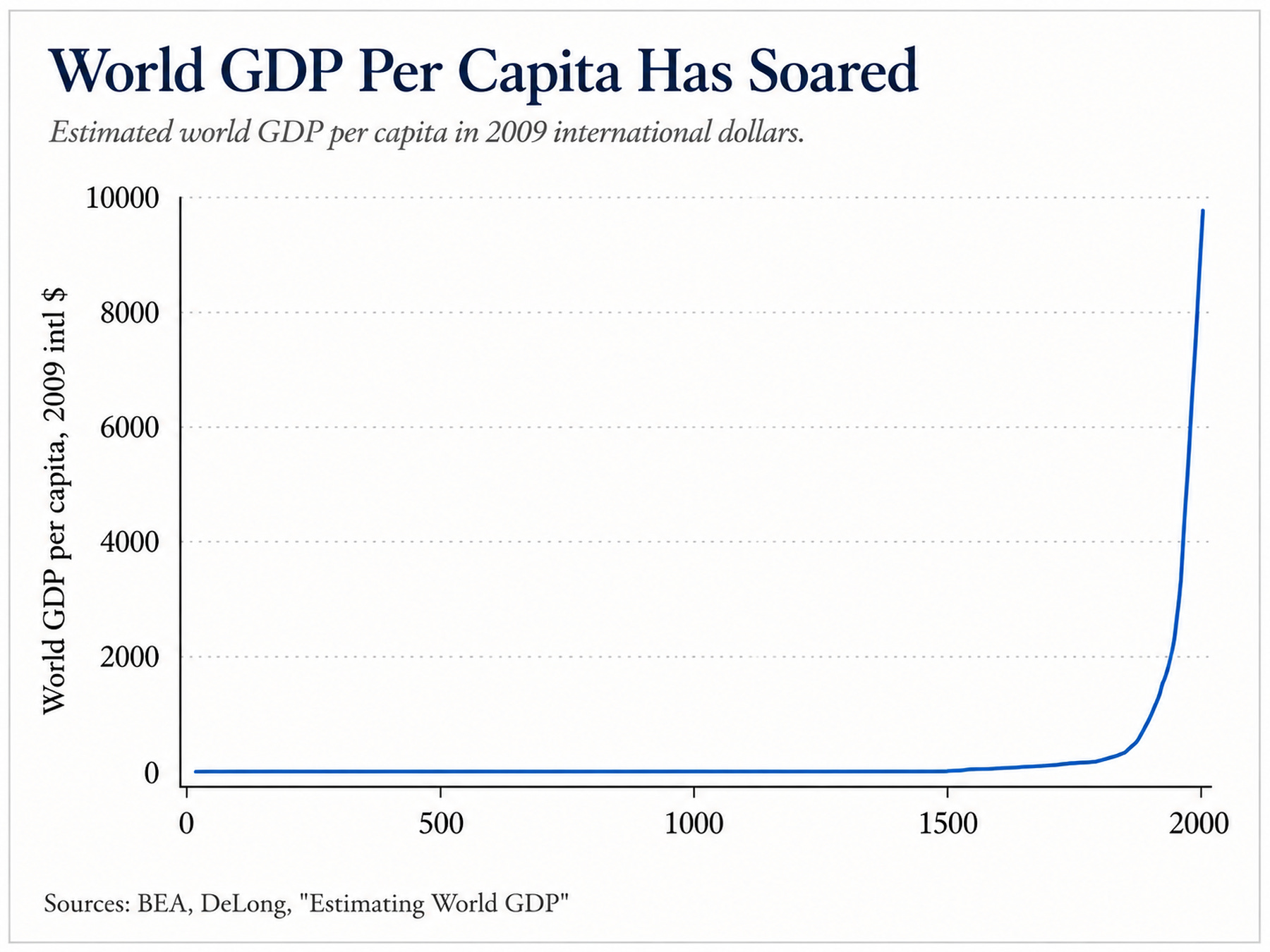
On a certain level, the entire last three centuries have been humanity’s Golden Age. Eighty percent of humanity once toiled in manual labor on farms, with no hope of advancement, education, or anything remotely resembling “self-actualization.”
And then Capitalism, and with it the Industrial Revolution, came.
The climb has been steady and, by historical standards, rapid. But long before most of the growth we benefit from had even happened, the left took the view that virtually everything of importance had already been invented, and that it was the job of government now to “redistribute” the results of that.
The idea that there might be more, and better, and greater opportunities for an ever-increasing share of humanity, was utterly lost on them. It still is.
Leftist historians have labeled one past American Golden Age especially derisively: the so-called “Gilded Age.” They speak of “robber barons,” who raped and plundered all before them. Generations of schoolchildren have learned of this horror.
But what exactly would Rockefeller or Carnegie have stolen? The wealth of the nation exploded in their era: You can’t steal what doesn’t yet exist. Rockefeller is known, in the earliest days of the oil industry, for “standardizing” kerosene production in a way that made it safer, by which I mean, far less likely to explode in your house (as it was known for doing up till then).
But that’s not what Rockefeller ought to be known for. Before Rockefeller, nearly every American lived in darkness from sundown to sunrise. Their light came from their fireplaces, or for the wealthy, whale oil lamps (yes, the oil industry saved the whales). Much of what we take for granted was simply impossible.
In a few short years, Rockefeller illuminated the night: lamps by which to study, or attend plays and concerts, or add a second or even third shift at factories. Life’s boundaries and opportunities were no longer dependent on the Sun, a far greater benefit to the masses than to the wealthy. The entire modern world became possible because of that enlightenment (never mind the machines oil also made possible). Rockefeller sold light to a benighted world. He also steadily reduced its price—by over 90 percent—while he did so.
Robber baron? Hardly. None of that wealth existed until he created it. His cut of it was barely a tip.
Likewise, Carnegie, who invented the modern steel industry. Likewise, Henry Ford, who introduced mass production and thus lowered the cost of automobiles to a point at which normal people could own them. Likewise, a young Steve Jobs, who created the personal computer industry and transformed the world.
These men stole nothing. They created new possibilities, enabling an ever-increasing number of people without privilege to live up to their fullest potential. Was it really necessary for 80 percent of humanity to be tied to manual farm labor? Was it really necessary for women to spend more than eleven hours a week just on laundry (as was the norm in 1920; it’s less than two hours today)?
Yes, it actually was necessary, until someone invented labor-saving devices that freed up the one commodity no one gets more of: time. The brilliance of Rockefeller and Carnegie, Morgan and Edison, Ford and Chrysler, Jobs and Gates, was not merely in invention, but in distribution. It is the mass consumer economy that brings prices down to a level which allows all to afford such things, by enabling the sale not of a few items to the rich but of an enormous number to the vast masses of humanity.
There’s a reason none of these wonders took place in the authoritarian parts of the world, nor in the universally authoritarian past. There’s a reason that modern Europe has fallen so far behind America, and why countries with the vast mineral wealth of Russia or Venezuela are nevertheless so impoverished. There’s a reason Elon Musk is a citizen of both South Africa and Canada, but chose to become an American and build his companies here.
So it is of the utmost importance that we eliminate needless barriers to creation, that we increase prosperity so people can afford to buy the inventions that improve their quality of life, and that over time not only do we make it possible for expensive things to become cheap, but in doing so, we free up liquidity to do things we couldn’t previously even imagine.
And Donald Trump means to double down.
Creation vs. Redistribution
That’s harder than it sounds. In our era, thanks in no small part to the deliberate efforts of Barack Obama and others like him, class envy is at an all-time high in American history. That translates directly to policies that stifle growth, which is to say, opportunity for the young. If the economy grows at the average of 3.4 percent annually that prevailed from World War II until Obama, it doubles every twenty-one years. If it grows at 5 percent, it doubles every fourteen years.
How many job opportunities does that create? How much easier is it in that climate to buy a home, or put kids through school, or to support a family on a single income?
By contrast, under Obama, growth averaged just 2 percent, and dropped as low as 1.6 percent. At that rate, the economy does double, but it takes nearly half a century. Stagnation becomes the norm, with high-paying, high-responsibility jobs held far longer by the people already there, and many younger people never reaching those ranks at all.
So of course there’s resentment. Of course there’s anger. Did “the Boomers” deceitfully “steal our future”? No: the Democrats did, through a deliberate top-down stifling of all the things that make growth, innovation, and entrepreneurship possible.

There are more than a few separate dimensions of that, including the $2 trillion burden placed on the economy just by the Obama-era “Endangerment Finding.” But one measure that is often missed is the dearth of initial public offerings, or IPOs. Since the Pandemic (which is to say, under Biden), American IPOs have dropped by a staggering 80 percent.
This is not a Wall Street problem. It’s a problem for all of us. When promising companies stay private for longer—or indefinitely—they restrict access to public capital that could fuel expansion, job creation, and productivity growth. That narrows pathways for entrepreneurs, workers, and everyday investors. It also reduces the overall dynamism of the economy, which always hurts the poor more than the rich.
A healthy IPO pipeline democratizes opportunity by allowing broader participation in economic upside and ensuring that groundbreaking ideas reach markets faster. As a rule, those ideas are “groundbreaking” in direct proportion to how much happier, healthier, safer, and more productive we can be for the same amount of money (or less). The goal of capitalism is not to make a few people rich. It is to make everyone richer, and in the process, eradicate as much poverty as possible.
Donald Trump, who made a career out of expanding access to luxury items, intuitively understands the power of this idea. The Democrats, by contrast, have made a political program out of expanding envy. So of course they hate Elon Musk’s trillion-dollar IPO, the largest in history, and the many others expected in 2026 and beyond.
But you should.
What is SpaceX Really Worth?
Pundits, and markets, can and will argue endlessly about the exact dollar value that SpaceX is worth. That’s the wrong question. The right question is whether any other company on Earth is remotely positioned to own the transportation layer between this planet and the rest of an inhabited, productive, militarily contested solar system.
SpaceX no longer merely sells rocket launches. Launch is becoming its production line. The old business model was carrying someone else’s payload to orbit for a fee. It still does that: in 2025 it launched at least 85 percent of the entire world’s total payload mass to space.
But SpaceX’s new business model is much bigger: using its own rockets to put its own products into orbit—Starlink first, orbital data centers next, manufacturing, mining, and whole cities after that. By reducing the price by 95 percent, Musk’s rockets enable a far bigger expansion of human civilization, just as wooden ships and railroads once enabled the creation of America.
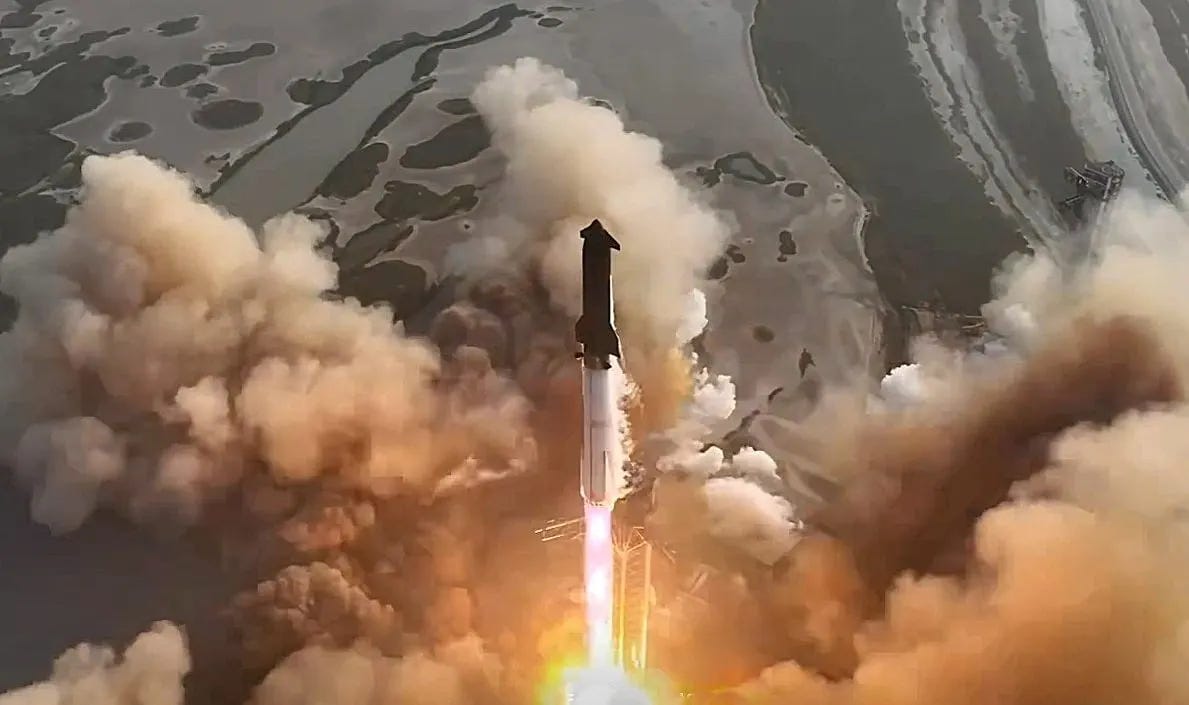
SpaceX dominates launch. Starlink dominates satellite broadband. Starship, once fully operational, changes the payload economics of orbit, the moon, Mars, point-to-point terrestrial transport, even military logistics. And Elon intends to build hundreds if not thousands per year.
Thousands of Starships mean ubiquitous, cheap, regular travel between continents in less than an hour. They’ll also enable the deployment of whole armies around the world in that same short time.
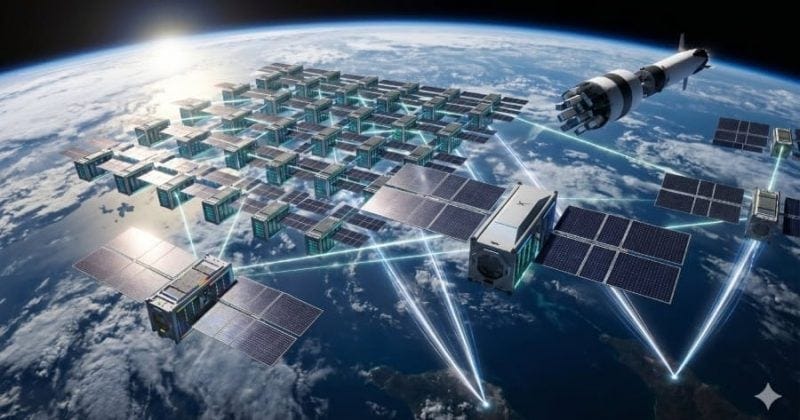
The company’s AI infrastructure adds another layer. Its future is not one market but an interlocking sequence of markets made possible because first it collapsed launch costs.
That is what the skeptics cannot value. They see only today’s revenue and tomorrow’s capex, not the radical expansion of human civilization that is finally upon us, much less the geopolitical (indeed, astropolitical) stakes.
How would you measure that? How would you have measured it in 1492?
To do anything in space, you need mass. You need to put physical stuff where there is almost no physical stuff. Fully reusable rockets are the answer. Over time, the real breakthrough they enable will be getting more of that mass from space itself—from lunar resources, asteroid mining, mass drivers, and other systems that make Earth the starting point and the consumer market, not just the supply depot.
To move mass you need energy. In space, that’s nearly limitless. Solar power, completely unobstructed by weather and available nearly continuously in the right orbits, is effectively limited only by the collection systems deployed. There are still meaningful engineering problems—storage, thermal management, radiation, assembly, repair, transmission—but the basic strategic fact is obvious: the solar system is powered by the sun. And Elon’s “other” company, Tesla, is at the cutting edge of that too.
To coordinate all this, you need process: communications, AI, robotics, autonomy, manufacturing, and data centers, for a start.
Mass plus energy plus process creates value. Not national vanity projects or pure-cost exploration. An entirely new and vastly larger economy.
SpaceX already owns more of the mass layer than anyone else. Starlink owns the communications layer. Starship gives SpaceX the chance to dominate orbital logistics. AI infrastructure and orbital data centers point toward the next layer.
Those data centers also solve an enormous problem on Earth. AI is exploding, but it’s running into a wall of energy, cooling, land, water, permitting, grid interconnection, and local opposition. Everyone wants AI. The power plants, transmission lines, water use, heat, and industrial footprint are turning out to be another matter: America is suddenly in the grips of NIMBY, in part CCP-funded.
Space eliminates the problem—and turns it into a staggeringly lucrative opportunity for the one company that can launch, power, connect, and maintain the infrastructure at a price and scale with which no one can compete.

Today, Starlink funds Starship. Starship lowers the cost of Starlink and increases its profits. Orbital data centers create enormous demand for launch, power, communications, and maintenance. Lunar infrastructure supplies mass and materials. In-space manufacturing creates more valuable things in space. Mars settlement—not bases, cities—becomes just the inevitable next step in a rapidly expanding economy.
The 1492 Premium
The Moon, Mars, cislunar space, Lagrange points, orbital data centers, lunar fuel, and in-space manufacturing will not remain abstractions for long. They will be financed, built, occupied, governed, and defended by someone.
In the process, either we will define the human future, or China will. If you want a better future than censorship, genocide, and social credit scores, the CCP must not be allowed to seize the vast domain opening before us.
China has already shown us how it behaves when given an opening. In the South China Sea, it has staked out uninhabited atolls, poured concrete, militarized them, and then used them to claim sovereignty over international waters. Space will be no different.
The lunar South Pole is of particular importance, because its abundant water ice is not just water, as life-and-death important as that is. It’s oxygen and hydrogen: fuel. The Moon is the first gas station between Earth and Mars. Whoever can deliver the most equipment there, fastest and cheapest, gets to shape and control all that follows.

That is one of many ways in which the valuation argument escapes every ordinary spreadsheet. Analysts are trying to price rockets. They should be trying to price the ships to the New World, and the value of the modern equivalents of Spanish forts and cities from the Canary Islands to Cuba.
Imagine being able to invest in 1492, not just in the ships, but in the ports, trade routes, colonies, mines, farms, cities, and the entire opening of a hemisphere.
That is the magnitude of the question. The terrestrial applications would be more transformative than the entire aerospace industry till now. The off-world opportunity dwarfs our planet.
Revolutionizing Travel and Shrinking the World
But before those cities in the sky take shape, Starship is going to transform our own planet in ways that are best compared to the rise of airplanes a century ago.
Imagine waking up in Tokyo and attending a lunch meeting in Paris. Imagine delivering a two-hundred-ton payload from Florida to the UAE—without overflight permissions, staging bases, or weeks of lead time.

This is the promise of Earth-to-Earth Starship: to collapse distance into time, to deliver cargo and people between any two points on the planet in under sixty minutes. Not by flying through the air, but by briefly exiting it.
Take off vertically from an offshore platform outside New York City. Burn through the atmosphere in three minutes. Coast over the curve of the Earth for twenty-five. Reenter over China. Land softly on another ocean platform off the coast of Shanghai. Total flight time: thirty-nine minutes.
That trip would be a fifteen-hour direct flight on Air China today.
The capability to transport two hundred tons of cargo anywhere on Earth in under one hour is not just useful: it’s transformational, in exactly the same way that airliners and automobiles changed a world of steamships, trains, and horses. It changes the rhythm of war, disaster relief, diplomacy, and commerce. It also changes what, and who, we consider “nearby”.
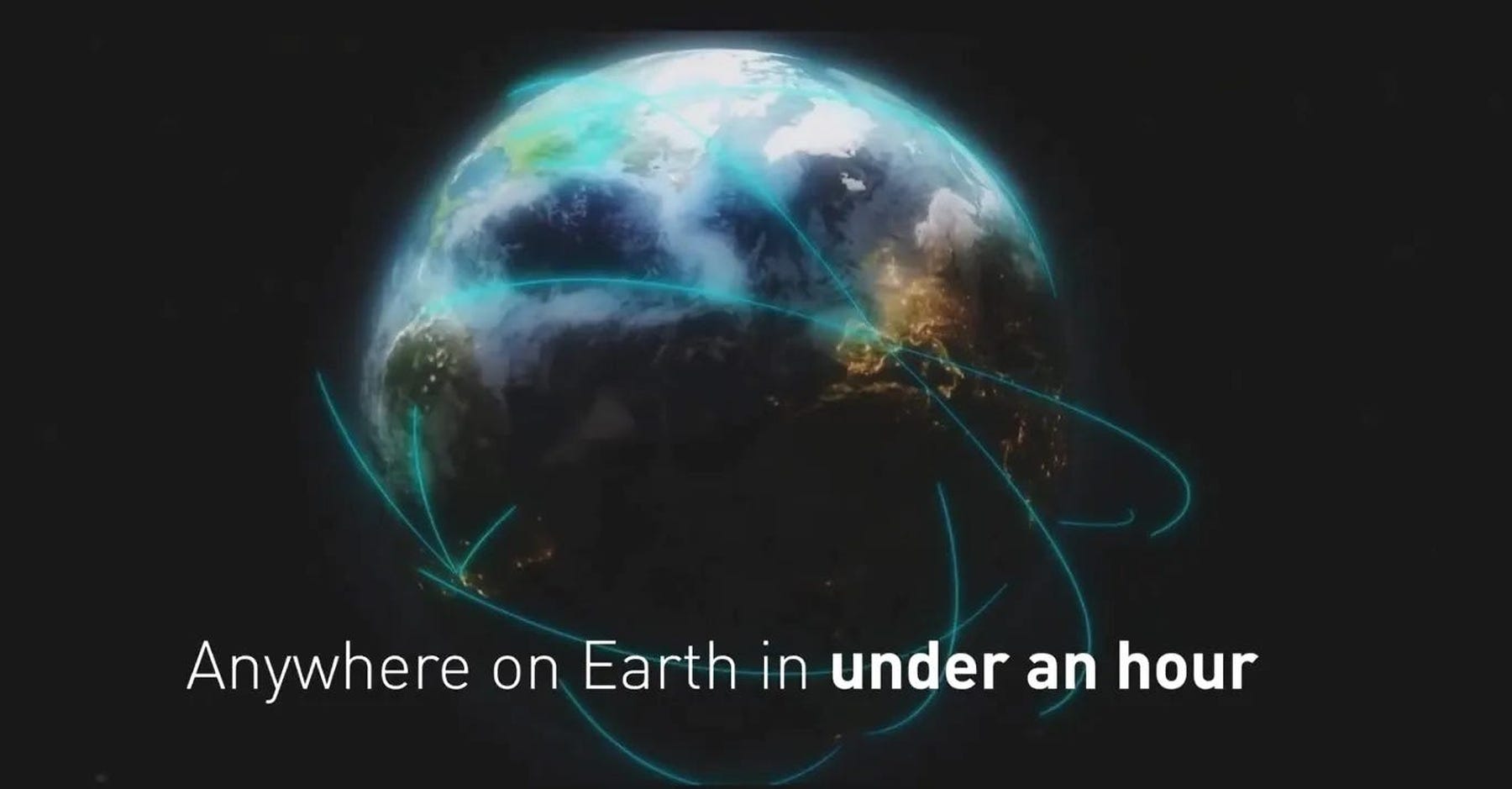
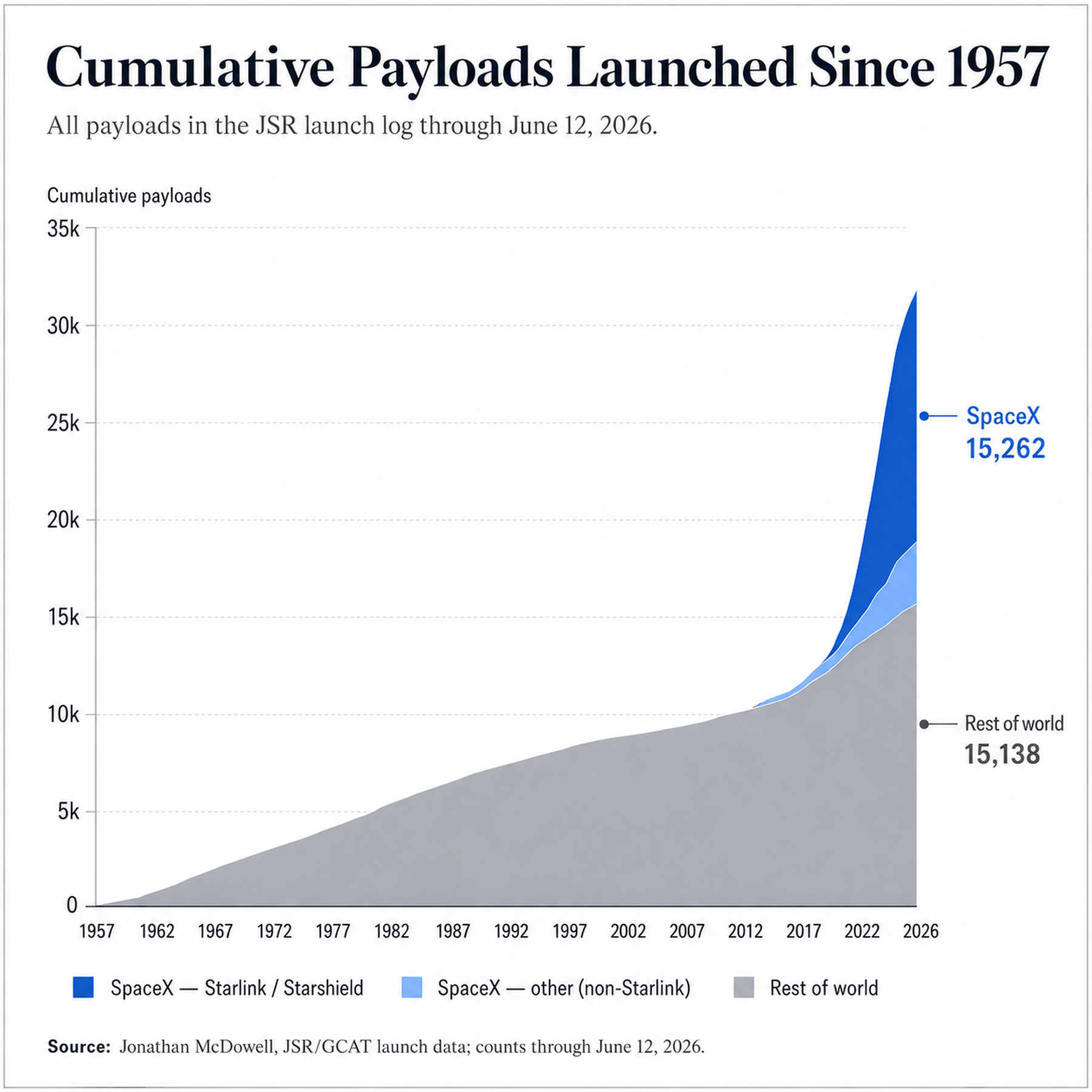
Nor is this going to have some “astronomical” price tag. A payload on the Space Shuttle costs $30,000 per pound. The same payload on SpaceX’s Falcon 9 costs $1,850 per pound: No wonder SpaceX has now launched more spacecraft than all other companies and countries in history combined.
But with Starship, that cost is expected to drop a lot more, possibly as low as $5 per pound at scale. That’s comparable to modern airliners, not NASA.
Starship’s fundamental advantage is economic: full reusability. In case you were wondering how Starship can so badly undercut the pricing of traditional rockets, consider this. If you built a new airliner every time you flew, on average (based on list price for a new 737), that would increase the cost of each and every plane ticket you buy by roughly $493,650.79. Each way.
The earliest use will be cargo, of course. After that, early adopters won’t be tourists: they’ll be diplomats, executives, and military personnel. But the pattern is familiar. Once a high-end, government-subsidized infrastructure is proven safe and profitable, the price curve crashes.
The same infrastructure built for Mars and the Moon is about to make the Earth very small.
Military Starship
Earth-to-Earth Starship is not just about passengers. It’s about troop transport, cargo—and speed.
In war, in disaster relief, in global business, time is the one non-renewable resource. Traditional logistics move mass, but they move it slowly. Starship moves it now.
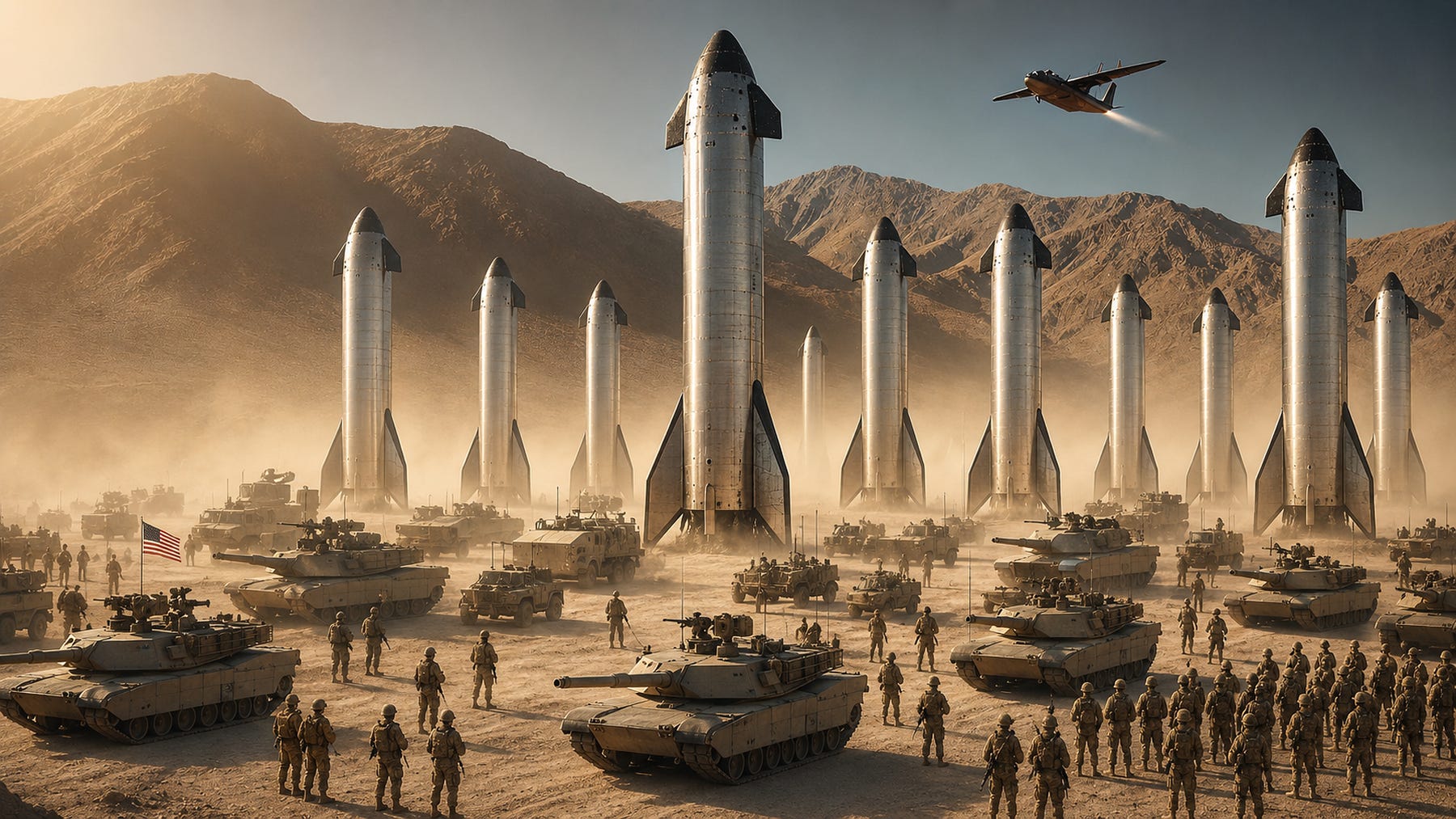
Imagine the Pentagon being able to deploy an entire armored division to Eastern Europe in an hour. Or deliver ten thousand tons of humanitarian aid to a tsunami-ravaged island before the first helicopter takes off. Or supply critical munitions to an ally mid-conflict, with no airbases or ports required.

Better still, imagine a complete logistics solution that replaces (for example) the supply line from America’s East Coast by sea to Karachi, up the Peshawar railway, and by truck over the Kyber Pass to Kabul or Kandahar. Real-time resupply, in an hour, not a month. And without armed resistance along much of the path.
The Department of Defense is already investing in this use case under its Rocket Cargo program. The Space Force, Air Force, and US Transportation Command are actively funding research into how to use Starship to deliver military cargo and humanitarian aid.
No runways. No sea lanes or chokepoints. No haggling with corrupt countries along the route. Just a pad and a payload. And even the pad is optional: Starship is designed to land and launch again from undeveloped, uneven planetary surfaces. The shipment arcs over oceans and continents—and lands right where you need it. A field outside Kharkov or Kaohsiung will do just fine until a proper base can be built.
But once that infrastructure is in place, those same facilities enable civilian applications. A world with Starship delivery is a world where Amazon can ship goods internationally—not next day but next hour. Where hospitals can source life-saving medication from the other side of the planet. Where chipmakers in Taiwan and manufacturers in Germany can operate as if they’re across the street.
Medical supplies. Satellite parts. Human organs. High-value microchips. Crisis-response equipment. Food in a famine zone. A water purification system for a devastated island. Starship can deliver intercontinental shipments before a FedEx jet is wheels-up.
And yes, it can deliver Christmas gifts across the globe in less time than Santa Claus.
That’s not just progress. That’s liberation. It’s also the formula for American global dominance.
Tesla is the Missing Multiplier
The lazy analyst still thinks of Tesla as an electric car company. But Tesla is batteries, motors, power electronics, manufacturing, autonomy, real-world AI, sensors, energy storage, solar power, charging infrastructure, and robots. Especially robots.
Every one of those things matters more off Earth than on Earth.
The Moon and Mars don’t need “cars” in the Detroit sense. But they do need an ever-increasing number of pressurized rovers, autonomous haulers, mobile power platforms, mining vehicles, robotic construction equipment, distributed batteries, solar fields, factories, repair systems, and machines that can work in a hostile environment both before and after humans arrive.
That is Tesla.
Starship can move civilization. Tesla can build out that civilization once it gets there.

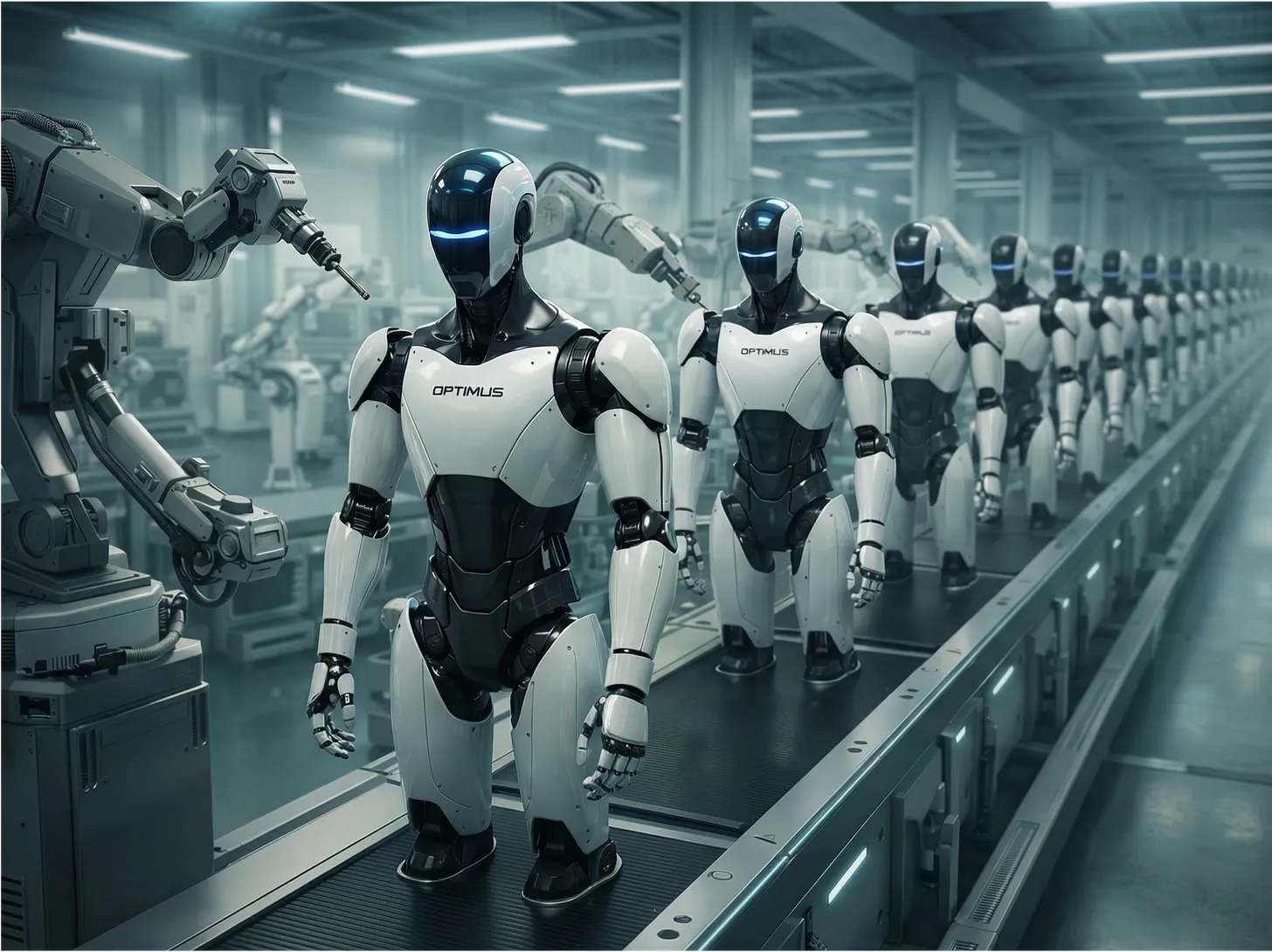
Indeed, Tesla’s defining product may be its Optimus robots. On Earth, Optimus will transform manufacturing, elder care, logistics, construction, agriculture, warehouses, and domestic labor. If you think washers, dryers, microwaves, and vacuum cleaners saved people time, wait till you have your own robot butler.
In space, Optimus will massively multiply the off-world workforce, collapsing the time needed for large-scale human expansion. But back here on Earth, there will be a billion humanoid robots sold by 2035, and a very high percentage will be Optimus variants.
The question is, would Tesla be even more valuable as part of SpaceX?
Yes, it would. A combined Tesla-SpaceX-xAI structure would be vastly more cost-efficient and create far more shareholder value. It would also be a lot more to Elon’s liking.
A combined company would not merely own pieces of the future. It would own the stack: launch, satellites, autonomy, robotics, batteries, solar, AI, communications, vehicles, orbital infrastructure, and eventually the infrastructure of off-world mining, manufacturing, and settlement. That’s not a conglomerate: It’s the operating system for the next era.
It would also give Elon one cap table—unified control—and perhaps even more important, one equity currency.
That matters. The best of the best don’t just work for a salary. The world’s foremost engineers, roboticists, AI researchers, manufacturing leaders, chip designers, launch operators, mission planners, battery experts, and tunneling specialists work for equity: a piece of the fast-growing pie.
The Left believes the pie is static: it neither grows nor shrinks. Life to them is a zero-sum game, despite everything in the world proving otherwise. So, in their view, lower population is better, and wealth redistribution—not growth—is the aim. All of that is wrong.
Elon builds what others hold conferences about. He needs a megaphone? He buys one. He needs AI? He builds his own. He needs launch? He reinvents it. He needs energy, robots, vehicles, and manufacturing? He creates those too.
Who doesn’t want to own a piece of that? And who doesn’t want that mind-boggling complexity simplified into a unified structure that’s easier to run, more efficient in its operations, and provides multiple revenue streams instead of counting on just one?
Freedom Enables the Future
All of this—and all the many other ideas across all possible fields from all other entrepreneurs who aren’t named Musk—require the freedom to innovate, to share uncensored ideas, and to press forward without regulation so burdensome that startups become impossible and IPOs become rare.
That’s rarely an all-or-nothing thing. Both freedom and unfreedom advance and retreat in degrees. Rockefeller and Carnegie were able to build two of the largest enterprises in history in an extremely low-tax, low-regulation environment. Henry Ford and William Boeing faced more government resistance and moved more slowly. Steve Jobs and Jeff Bezos faced needless hurdles their predecessors would not have imagined.
Innovation did not cease, but it slowed noticeably. Rockefeller lit the world, only to see Edison and Morgan do so with an even newer, more radical technology in just a handful of years. Cars and planes took longer. We had 747s when I was born. After rapid development for several decades, airliners haven’t changed much in the more than half-century since and have become no faster at all. When I was a child in the 1970s we were promised ubiquitous cheap nuclear power, flying cars, Moon bases and Mars missions. We’re still waiting.
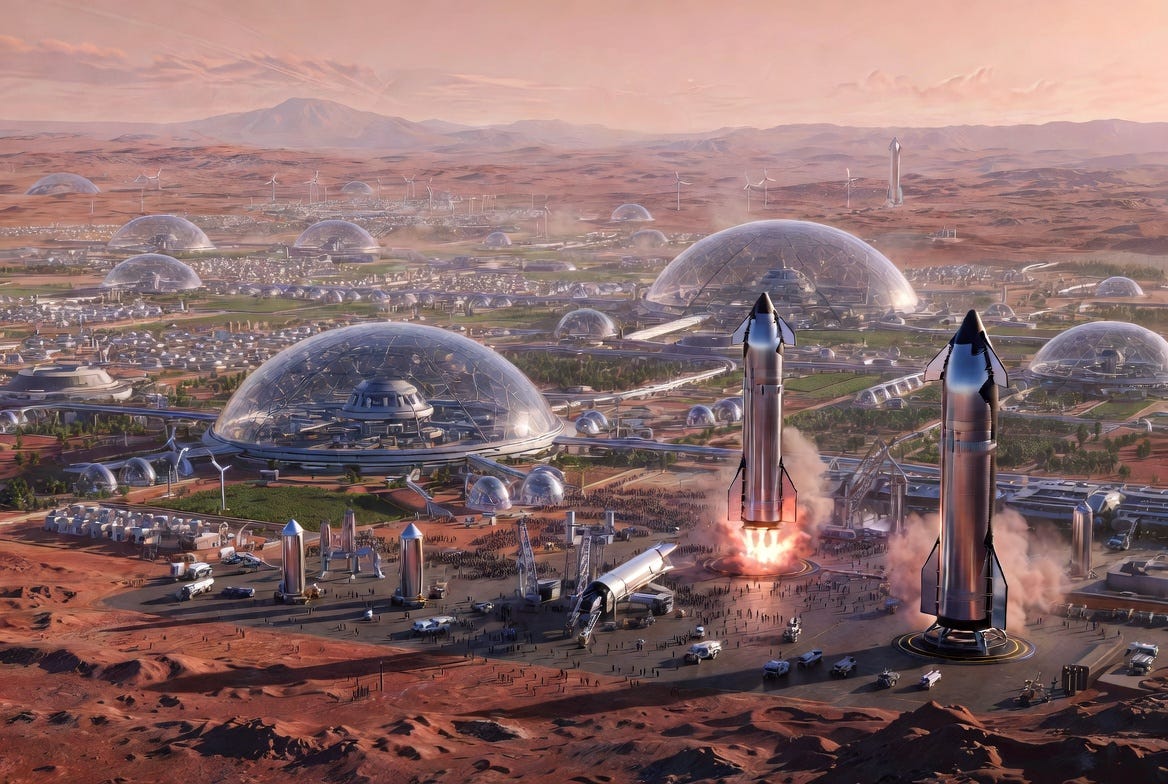
Can Donald Trump imagine the world of 2076? No, and neither can you or I with any precision, no more than anyone in 1926 could have imagined 1976.
But Trump understands that the future must be free or be stillborn. The CCP’s social credit score, panopticon future is a prison; the Democrats are doing their best to implement it from within.
America has had a taste of that future, in a California from which the most innovative companies are fleeing, and nationally under the ever-heavier hand of the Obama-Biden era. The stultification of Europe, where the richest countries are now poorer per capita than Mississippi and falling further behind, teaches the same lessons. The less accountable government is, the more it rules the people rather than responding to them—and the further behind everyone falls.
Everyone except the elites, of course.
Trump’s economic agenda is about freedom. But it’s also about American leadership. The multilateral institutions that defined the postwar saeculum are increasingly dominated by the enemies of freedom. An America-centric economic order is essential to safeguard the future that ought to be.
Of course, that requires that America itself remain free.
— This essay is an excerpt from my Trump’s New World Re-Order, available for pre-order now.


