
The "Evils" of Capitalism
Capitalism’s critics cling to a mythic past, but the record shows the factory age ignited rising living standards, broader opportunity, and the modern prosperity we now take for granted.
This analysis is free, but with Premium Membership you get MORE. Join today.
by Roger Kimball
March 28, 2026
“It ain’t so much the things we don’t know that get us into trouble as the things we do know that ain’t so.”
— Mark Twain (attributed)
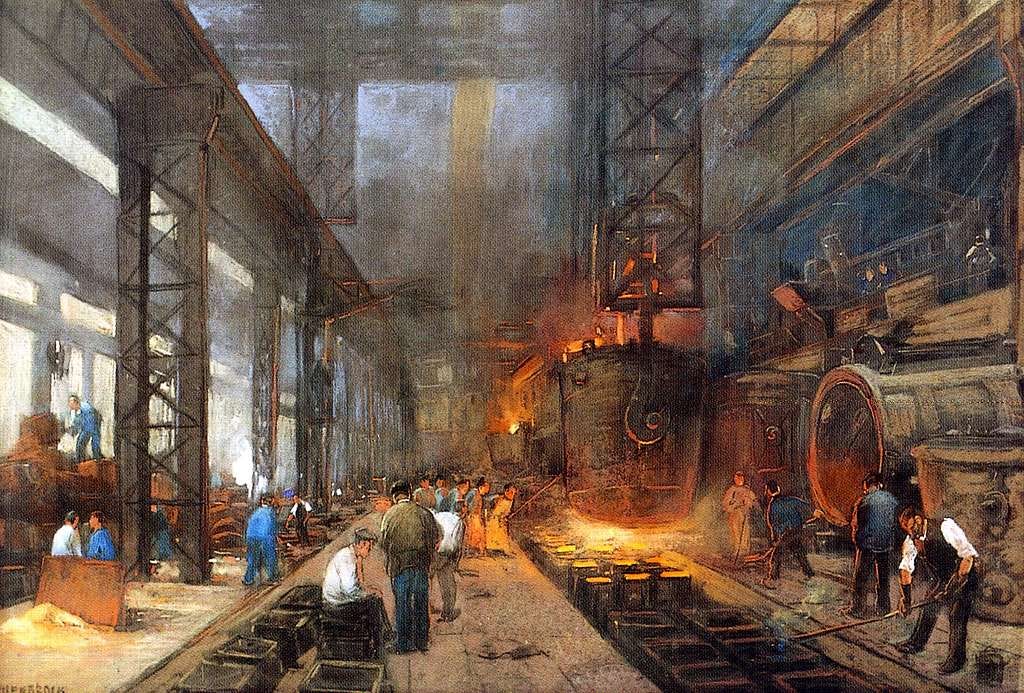
What’s the one thing everyone knows about capitalism? Why, that it started out as a mean, nasty tool of greedy industrialists, of course. “The Industrial Revolution,” we all learned, was a terrible Moloch that devoured children, put profits before people, and, though it made great fortunes (or, perhaps, partly because it made great fortunes), was a wicked development. The Industrial Revolution, we’ve all been taught, was the original sin of capitalism, necessary, perhaps, to prime the engine of economic progress, but lamentable nevertheless.
Ask anyone: the Industrial Revolution is a stigma that no amount of societal amelioration can remove. The “factory system,” an integral part of the Industrial Revolution, was an urban nightmare, a Dickensian melodrama in which rural innocence was mauled and blighted in those horrific, unsanitary “Satanic mills” that William Blake anathematized.
Once upon a time, before the advent of the factory system, workers enjoyed
a passably comfortable existence, leading a righteous and peaceful life and all piety and probity; and their material condition was far better than that of their successors. . . . They did not need to overwork; they did no more than they chose to do, and yet they earned what they needed. They had leisure for healthful work in garden or field, work which, in itself, was recreation for them, and they could take part beside in the recreation and games of their neighbours . . . [which] contributed to their physical health and vigour. . . . Their children grew up in fresh country air, and, if they could help their parents at work, it was only occasionally.
Alas, this Eden, as described by Frederick Engels in a fairy tale called The Condition of the Working Class in England in 1844, was destroyed by the advent of the machine. “The proletariat,” writes Engels, “was called into existence by the introduction of machinery.”
The consequences of improvement in machinery under our present social conditions are, for the working-man, solely injurious, and often in the highest degree oppressive. Every new advance brings with it loss of employment, want, and suffering.
That’s the sad story of capitalism we all imbibed with mother’s milk, or formula. No less an authority than Bertrand Russell has assured us that “the Industrial Revolution caused unspeakable misery both in England and in America. I do not think any student of economic history can doubt that the average happiness in England and early nineteenth century was lower than it had been a hundred years earlier.”
As Friedrich von Hayek points out in Capitalism and the Historians, an extraordinary collection of essays he edited and published in 1954, “The widespread emotional aversion to ‘capitalism’ is closely connected with this belief that the undeniable growth of wealth which the competitive order had produced was purchased at the price of depressing the standard of life the weakest elements of society.” This picture of economic depredation, notes Hayek, is “one supreme myth which more than any other has served to discredit the economic system [capitalism] to which we owe our present-day civilization.”
When we move from the realm of myth-making to historical truth, however, we see that the Engels-Russell narrative, the narrative upon which we’ve all been fattened, is a tissue of exaggerations, misrepresentations, and outright lies. A “careful examination of the facts,” which is what Hayek and his colleagues provide in Capitalism and the Historians (or, to give it its full title, Capitalism and the Historians: A Defense of the Early Factory System and its Social and Economic Consequences), has led to a “thorough refutation of this belief.”
The refutation is indeed thorough, and I heartily recommend this short, bracing volume to anyone still laboring under the impression that “early capitalism” was a moral enormity. Zohran Mamdani, for instance, might have spared himself the embarrassment of his mayoral victory speech in New York on November 4 and such sundry juvenile declarations as “Taxation isn’t theft. Capitalism is” had he taken on board some of what Hayek, T.S. Ashton, Louis Hacker, W.H. Hutt, and Bertrand de Jouvenel have to say in this brisk and fog-dispelling volume. Alas, Mamdani is a disciple of Frantz Fanon, author of the revolutionary’s vade mecum The Wretched of the Earth, and, behind him, Jean-Jacques Rousseau.
Engels, closely following the work of the Rev. Philip Gaskell (a man, says T.S. Ashton, “whose earnestness and honesty are not in doubt, but whose mind has not been confused by any study of history”), contrasts the idyllic world of rural life, living close to the land, with the sooty urban alternative. But the truth is, as Ashton and others show in meticulous detail, that life was indeed “solitary, poor, nasty, brutish, and short” in the world of pre-industrial England.
Ashton demonstrates how, by the 1830s, life was being transformed throughout the realm due to the wealth the factory system brought to England. Along the way, he has some tart observations on the nostalgic romanticization of rural life. “The idea that agriculture is the only natural and healthy activity for human beings,” he writes, “has persisted, and indeed spread, as more of us have escaped from the curse of Adam — or, as the tedious phrase goes, ‘become divorced from the soil.’”
It is worth noting that the very phrase “Industrial Revolution” was coined, not by English industrialists, but by French writers “under the spell of their own great political ferment.” “Industrial Revolution,” in other words, is a polemical, not a descriptive term, redolent of Jacobin insinuations. (Ashton also notes the interesting evolution of the phrase laissez-faire, first used by the Marquis d’Argenson in 1755, when it meant “non-interference with industry,” to its use by Alfred Marshall in 1907, when it meant “let the State be up and doing.”)
Louis Hacker, in “The Anticapitalist Bias of American Historians,” his contribution to Capitalism and the Historians, notes how critics of the factory system often took aim at the fact that now, for the first time, man’s ingenuity was able to turn out an abundance of “cheap goods.” The word “cheap,” Hacker notes, is “invested with a sinister connotation,” but what it actually meant was that young women could now buy inexpensive dresses in a variety of patterns instead of having to make their own clothes — a more romantic pastime only if you happen to be rich enough to have escaped the necessity of doing so.
The early nineteenth century, according to the conventional wisdom, was a time of great economic oppression. In fact, it was the debut of an era of progress and wealth creation the likes of which the world had never seen. “The nineteenth century, for the first time,” notes Hacker, “introduced on a broad scale state policies of public health and public education. The nineteenth century, by turning out cheap goods, made possible the amazing climb of real wages and living standards in industrialized economies. The nineteenth century, by permitting the transfer of capital in large amounts, opened up the interiors of backward countries for development and production.”
Was there squalor and misery and poverty in the early nineteenth century? You betcha. And a lot of it was abetted by poor government policy. The window tax, for example, and the high excise on building materials. (You want houses to be made in a sturdy manner? Don’t make it more difficult for builders to build them.) As Hacker notes, “Poor houses and overcrowding in the towns were not evidence of the rejection of moral responsibility on the part of the new industrial class but the result of natural forces of immigration and internal population movements and bad fiscal policy.”
The truth is that after 1820, for the first time in recorded history, the standard of living for ordinary people was rapidly improving in British society and, as Ashton points out, “the factory played a not inconsiderable role in the improvement.” Even Edwin Chadwick, whose 1843 classic Sanitary Conditions of the Laboring Population of Great Britain is a major primary source for our knowledge of the subject, noted that “the comforts of the laboring classes have increased with the late increases of population” and that “the means of obtaining the necessaries of life for the whole mass of the laboring community have advanced.”
Capitalism and the Historians is a welcome historical corrective, full of illuminating data and record-correcting observations. For example, anyone who studies the period will soon look into the so-called “Sadler Committee” report, published in 1832, which presented a grim picture of life for children consigned to the factory. It is, as one sympathetic commentator put it, “one of the main sources of our knowledge of the conditions of factory life at the time.”
The problem is, as W. H. Hutt notes in “The Factory System of the Early Nineteenth Century,” it was a biased partisan report written for overt political ends. As another observer put it, the Sadler report “gave to the world such a mass of ex-parte statements and of gross falsehoods and calumnies . . . as probably never before found their way into any public document.” Even Engels, who was at one with the spirit that informed the report, acknowledged that it was “emphatically partisan, composed by strong enemies of the factory system for party ends.”
The deeper virtue of Capitalism and the Historians, however, transcends its fine trove of historical argument. The writers, unlike so many contemporary sages (and contemporary politicians), understand that capitalism is the greatest engine for the production of wealth that the ingenuity of man has ever devised. And they understand, too, that the activity of capitalism cannot be divorced from the corrective of risk and the spur of competition.
The possibility of failure, in other words, is inseparable from capitalism. As Louis Hacker points out, the failure rate of early telegraph, canal, railroad, mining, and automobile industries in the U.S. was “enormous.” But it was only by providing an environment in which risk, ambition, and entrepreneurship could flourish that real progress could be made.
The prerequisites are a government that guarantees a level playing field for economic activity and that refrains from interfering in the law-abiding entrepreneurial enterprises of individuals: “Sound monetary and credit policy as a public function; risk-taking as a private one — here in epitome is the history of capitalism.” As Hayek put it in his introduction, “Much that has been blamed on the capitalist system is in fact due to remnants or revivals of pre-capitalist features: the monopolistic elements which were either the direct result of ill-conceived state action or the consequence of a failure to understand the smooth-working competitive order required an appropriate legal framework.”
And this brings me to my final point. Not a day goes by without lamentations about the evils or limitations of capitalism emitted by some of capitalism’s most conspicuous beneficiaries. Alexandria Ocasio-Cortez, for example, is full of such imprecations, as are many, if not most, spokesmen for the Democrat Party these days. Barack Obama set the standard when he derided a “certain crowd in Washington” for believing that “the market will take care of everything.”
Of course, that is a rhetorical overstatement, but we all know what he meant. Do we want big government, high taxes, and intricate regulation? Or do we prefer lean government, low taxes, and the minimum regulation consistent with public safety?
Or consider Does Capitalism Have a Future?, a collection of essays by “a global quintet of distinguished scholars,” published by Oxford University Press in 2014, arguing that the capitalist system is teetering on the brink of collapse, and it’s a good thing, too, because the socialist system that may ensue will be far better. It’s a hysterical (not in the sense of “funny”) volume, full of tired Marxoid clichés about the “internal contradictions” of capitalism and impending ecological crisis, but it is also a thoroughly typical product of the comfy intellectual caste that has enjoyed all the benefits of capitalism without bothering to understand what has made those benefits possible.
Despite this anti-capitalist narrative, however — a narrative we hear repeated by “progressive” politicians and iterated in more barbaric, polysyllabic strains by academics everywhere — the capitalist system has made possible over the last century, and especially in the last several decades, the greatest accumulation of wealth in the history of the world. One data point: in 1982, the Dow Jones Index cratered to about 700. Today, it is north of 50,000. How much wealth does that represent?
In the nineteenth century, England was the crucible of this modern prosperity in part because of the freedom of economic activity that it, unlike the states of continental Europe, enjoyed. And that freedom, in turn — unlike the continent — was underwritten by the limited government England also enjoyed. “The rapid growth of wealth” in England in the early nineteenth century, Hayek observes, “is probably in the first instance an almost accidental byproduct of the limitations which the revolution of the seventeenth century placed on the powers of government.”
We’ve been working diligently in this country to remove those limitations. How far will we have to sink before the people once again rise up and repudiate the elites who wish to fetter them in manacles forged by statist overreach?
Whatever else it portends, the Trump America-First counterrevolution limns a liberating alternative and a return to sanity.
— This article first appeared at American Greatness.


