


This analysis is free, but with Premium Membership you get MORE. Join today.
by Rod D. Martin
May 27, 2026
For decades, Democrats have treated Sweden as an argument-ending word. Say “Sweden,” and somehow the entire socialist wish list is supposed to become reasonable: higher taxes, bigger government, cradle-to-grave dependency, socialized medicine, union dominance, and an economy subordinated to the administrative state.
That was always a caricature. It is now an antique.
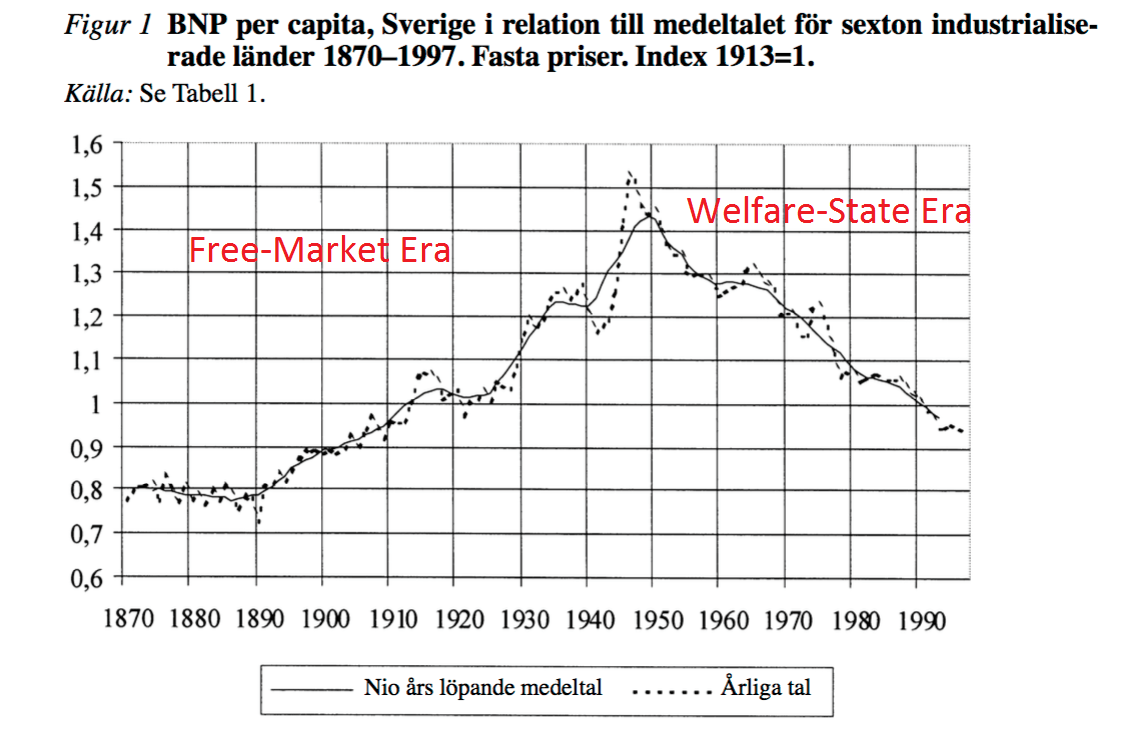
The Sweden that Democrats rhapsodize doesn’t exist. Oh, it’s still a high-tax country, and no one should pretend otherwise. But socialism impoverished a once-wealthy Sweden. And the Swedes fought back.

The Courts have taken liberties with the Constitution for far too long. An Article V convention could close the loopholes. Learn more here.
Over the last generation, Sweden has abolished taxes Democrats want to impose here, slashed marginal rates, expanded school choice, reformed pensions, disciplined spending, and opened large parts of its welfare state to private competition and delivery.
The result? Instead of persistent economic decline, Sweden’s reforms kicked off a long-term economic boom. The most famous “socialist” country in the Western left’s imagination survived and thrived by abandoning socialism.
Larry Kudlow and his Fox Business panel recently featured Sweden’s “massive capitalist turn.” Senior Democrats like Bernie Sanders know the truth: they just brazenly lie about it, knowing none of their supporters will ever go to Sweden. But the new Sweden isn’t even very new. It is the result of a thirty-year national course correction, born out of crisis and sustained because the old model stopped working.
By 1990, Sweden was no longer the Scandinavian case study American leftists imagined. It was a warning. The country faced a brutal fiscal and financial crisis: a bloated public sector, a currency crisis, a banking collapse, and gross public debt approaching 80 percent of GDP (without the cushion of being the issuer of a global reserve currency). The old bargain — endless government expansion paid for by an increasingly burdened economy — had reached the end of its rope.
As Margaret Thatcher taught us, “the problem with socialism is that eventually you run out of other people’s money.” Socialism spends down the inheritance of wealth created by others. It consumes their capital without creating. It expands obligations faster than the productive economy can sustain them. It promises compassion and delivers stagnation (and corruption), promises security and delivers insolvency, promises equality of wealth and delivers equality of misery (except for the elites, of course).
Sweden hit the wall. But then, unlike many other countries, Sweden changed course.
The Reset That Saved Sweden
The Swedish reset was not a cosmetic tax cut or one election’s campaign slogan. It was a restructuring of the country’s operating system. The 1991–1994 center-right government began the turn. Realizing the dire straits Sweden was in, the Social Democratic government that followed continued in the same direction on many crucial reforms.
That bipartisan continuity is one key reason the Swedish story was a success. Even the guardians of the old order repented and changed their ways.
My friend Sven Otto Littorin, who served as Sweden’s Minister for Employment in the reform government that carried this capitalist turn forward, was the tip of the spear, untangling decades of stifling quasi-governmental power handed to the labor unions. He and his Alliance colleagues later deepened and accelerated the free market reforms: make work pay, stop punishing ownership, discipline the state, let enterprise breathe.
The reforms were not small. Sweden made its central bank more independent and adopted an inflation target. It imposed a serious fiscal framework: a surplus target over the economic cycle, statutory spending ceilings, and balanced-budget discipline for municipalities. It reformed pensions into a defined-contribution system with automatic balancing, so politicians could no longer promise endless benefits with imaginary money. It created a partly privately managed premium tier. And it adopted a nationwide school-voucher reform that gives Swedish parents more school choice than parents have in most American states.

Pause over that. Democrats invoke a mythical “socialist” Sweden while opposing the reforms that saved Sweden from the disaster Democrats plan for America.
They hate school choice; Sweden expanded it. They want more political control over money; Sweden made monetary policy more independent. They want crippling taxes on wealth, inheritance, corporations, property, capital, and successful families; Sweden moved the opposite direction. They want looser spending under ever more emotional slogans; Sweden imposed hard budget discipline.
The American Left is not trying to copy Sweden. It is trying to copy the version of Sweden that failed. And it’s lying to you about it.
The tax story is the part almost no one in American politics understands. Sweden remains a high-tax country for labor and consumption. The VAT is 25 percent. Top income-tax rates remain high by American standards. Total taxation as a share of GDP is still above ours. But Sweden made a decisive distinction: it taxes labor and consumption heavily to fund a universal floor, while taxing capital, ownership, and succession far more lightly than American progressives would ever tolerate.
That distinction is everything. Sweden abolished its death tax. It abolished its gift tax. It abolished its wealth tax. It largely replaced its property tax with a low capped municipal fee. It cut its corporate tax to 20.6 percent, slightly less than Trump’s. It introduced and repeatedly expanded its earned-income tax credit — the jobbskatteavdrag — to make work pay across the income distribution.
There is a lesson here: you can’t punish capital formation and expect prosperity. You cannot confiscate ownership and expect entrepreneurship or innovation. You cannot tax family businesses out of existence and expect long-term investment. You cannot treat accumulated capital as a sin and then wonder why the economy stops compounding.
Capital is tomorrow’s factory, tomorrow’s startup, tomorrow’s payroll, tomorrow’s research lab, tomorrow’s technology, and tomorrow’s higher wages.
Destroy capital, and you destroy the future.
The Real Nordic Model
Modern Sweden is not a socialist economy, no matter how many times Bernie Sanders and AOC claim otherwise. The state does not own the means of production. It doesn’t run industry. It doesn’t operate a command economy. Property rights are strong. Contracts are reliable. The rule of law is among the best in the world.
The productive economy is overwhelmingly private. Even much of the welfare state is now delivered through market mechanisms: private schools, private health clinics, private eldercare, private providers under public financing, and a purchaser-provider split that makes the state more funder than operator.
That is not socialism. It is a capitalist welfare state.
I wouldn’t import that model wholesale to America, but it’s a massive improvement on what Sweden had before, and it has many features we should adopt. America is larger, more diverse, more dynamic, more constitutionally decentralized, and founded on very different assumptions about liberty and government. We should oppose Scandinavian income-tax levels, a VAT of any sort, or an enervating universal welfare state.
But that’s the point. If Democrats told the truth about Sweden, they would lose the argument. The honest Swedish model is not “tax the rich and everything is free.” Swedish socialism drowned the country in red ink and decline. Capitalism set its hardworking people free.
That doesn’t support Elizabeth Warren’s and Zohran Mamdani’s wealth-tax fantasies. Sweden got rid of its wealth tax because it was destructive. It drove capital away, punished ownership, and harmed the investment base on which even the welfare state depended. Sweden abolished its death and gift taxes for the same reason.
Democrats treat these taxes as moral sacraments. Sweden treated them as the economic catastrophes — the unforced errors — they are.
The sad truth is, a founder can build, hold, and pass on a company more cleanly in Stockholm than in San Francisco.
And the results are neither theoretical nor trivial. Sweden, a country with a population roughly the same as Michigan, North Carolina, or New Jersey, has become one of the great startup factories on Earth. Stockholm is regularly ranked near the very top of the world in unicorns per capita, often second only to the Bay Area.
Spotify, Klarna, Skype, Minecraft, King, iZettle, Truecaller, Oatly, Epidemic Sound, Voi and Kry did not emerge from a command economy. They emerged from talent, capital, property rights, global markets, technical competence, and a political system that learned not to strangle the goose that laid the golden egg.
Sweden’s old industrial base — Ericsson, Volvo, ABB, Saab, AstraZeneca — seeded the technical and managerial class that built the new economy. Early digital infrastructure helped put computers in Swedish homes before much of Europe caught up. English fluency and a culture oriented toward global markets gave Swedish founders international ambitions from day one.
But none of that would have mattered if Sweden had kept treating capital as prey.
The Lesson for America
Sweden did not prove socialism works. It proved that even a rich country with a high-trust culture, an educated population, and extraordinary institutional advantages cannot keep squeezing the productive economy forever. Eventually the math wins, the inheritance is spent, and poverty comes upon you like a thief in the night.
That is why the Swedish story is so deadly to America’s Democrats. They are selling a model Sweden rejected. They want the wealth taxes Sweden abolished. They oppose the school choice Sweden expanded. They sneer at the corporate-tax competitiveness Sweden embraced. They want more state control over services Sweden increasingly opened to private provision.
And of course, they want skyrocketing spending after Sweden learned that fiscal discipline is the price of national survival.
Even Sweden stopped trying to be the imaginary Sweden Democrats try to sell. That Sweden exists only in memory, and rightly so. The real Sweden escaped its socialist debauch by embracing capitalism, freedom, fiscal discipline, and entrepreneurship.
Democrats lie about it. They can’t admit it.
Because if they admit it, they’ll have to admit why.


I didn’t know any of this. I don’t spend much time thinking about Sweden three things. I like the best about this that I wish we would adopt here. Universal school choice. No inheritance or gift tax. Lower property taxes.
Personally, I think the ideal tax on income and capital and wealth is zero. But I understand how difficult that would be to implement, because you’d have to replace it with a sales tax, which is highly unpopular, but would be very effective and would not be regressive if done correctly.
👍👍Awesome post, Rod! This should be required reading for every American!🇺🇸