

India Seizes Shadow Fleet Tankers — and BRICS Begins to Break
In an historic realignment, India quietly tilts toward America — and Moscow, Tehran, and Beijing feel the heat. The consequences could reshape the balance of power for the rest of the century.

This analysis is free, but with Premium Membership you get MORE. Join today.
by Rod D. Martin
February 24, 2026
Sometimes, major historical shifts are virtually invisible. That’s what just happened in India, and it upends 80 years of geopolitical calculus.
80 years is a very, very long time.
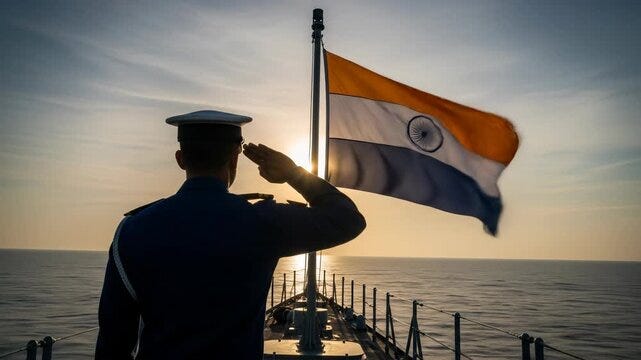
So here’s what happened. The Indian Ministry of Defense posted on X (formerly Twitter) that the Indian Navy has been carrying out raids and capturing Shadow Fleet vessels in India's Exclusive Economic Zone, starting on February 5th. About an hour later, someone deleted the post.
Hardly anyone noticed: Peter Zeihan, me, a handful of others. But then Reuters and the Wall Street Journal (neither of which gave it serious coverage) confirmed the key details. It’s really happening, in the plural.
Why should you care? A little background will help.
India, Our Old Frenemy
India’s mythology is independence. Its identity since independence has been that it bows to no one. It has been reinforced for decades by a justifiable civilizational confidence: poor though it may be, India is not Belgium. India is a continental-sized power. It doesn’t “join blocs.” Blocs join it.
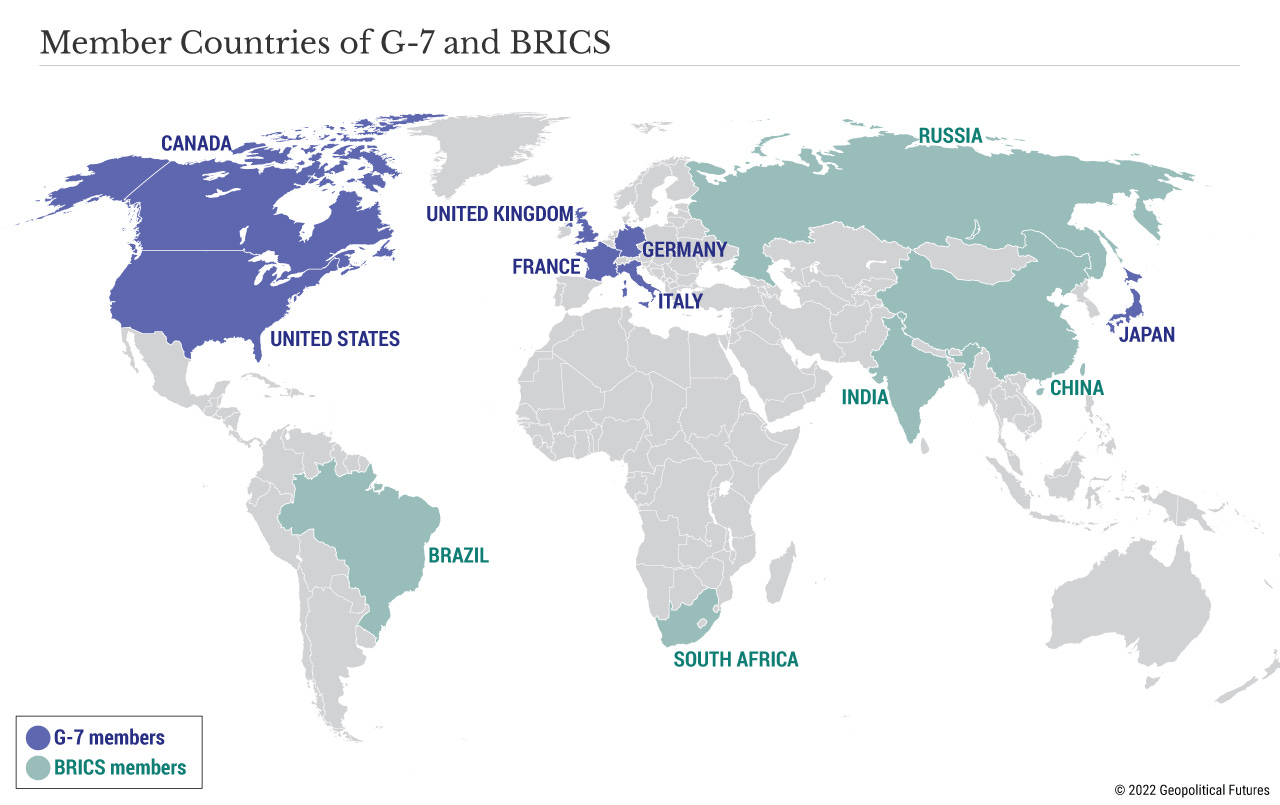
India founded the “Non-Aligned Movement” at the beginning of the Cold War, a mostly anti-American, mostly pro-Soviet group led through the years by such paragons of freedom and democracy as Josip Broz Tito, Gamal Abdel Nasser, both Fidel and Raül Castro, Robert Mugabe, and perhaps my current favorite, Mahmoud Ahmadinejad. It’s also a founding member of BRICS (it’s the “I”), the transparently anti-U.S. alliance that will surely displace us, replace the dollar, blah blah blah.
And that’s the thing: for all its talk of “nonalignment”, India has always been all too aligned. For reasons that might best be described as “confusing the U.S. with the UK” — and often vocally forgetting that we are both postcolonial nations who threw off our British overlords — India made itself a key Russian partner shortly after independence and down to the present day, in defense procurement and strategic habit. It was never actually communist, but it was certainly socialist and, not coincidentally, impoverished.
It blamed much of that on the West, because, well, of course it did. From its earliest days India has used Moscow as leverage against the West, against sanctions risk, and against the idea that Washington could ever dictate terms to New Delhi. Despite its ancient history, modern India has often behaved like a young power: proud, touchy, and reflexively oppositional — especially toward America.
Nor did it change course after the Cold War ended in a resounding U.S. victory. Even as U.S.-Indian relations began to thaw, large numbers of Indians migrated to America, and New Delhi began detoxing from socialism, it also helped start BRICS. It continued to buy Russian arms (now shown to be junk: impotent smouldering ruins from Iran to Venezuela). And for the last four years, it heavily subsidized the Russian invasion of Ukraine by buying staggering quantities of discounted, sanctioned Russian oil.

Not shockingly, Donald Trump eventually got fed up with this. Last summer, he imposed a 50% tariff on Indian goods to enforce the global sanctions regime: you can buy Russia’s oil, Mr. Modi, but you’re going to pay, and not just Russia.
Trump’s “hurtful” act set off all manner of howling in New Delhi, but also our own Enemedia, which is united in its opposition to “Russia! Russia! Russia!” until Trump does anything that actually hurts it. Indian Prime Minister Narendra Modi stormed off to Beijing, where Xi Jinping hosted a military parade featuring lots of nuclear missiles, reviewed by a rogues gallery including Russia’s Putin and North Korea’s Kim. “Clearly” Trump had set back U.S.-Indian relations by decades, solidified BRICS, and all the other normal TDS.
And yet, it turns out that’s not what happened at all.
A Complete (But Quiet) 180
On February 2nd, Trump announced a sweeping trade framework with heretofore protectionist India that the foreign-policy priesthood long insisted could never happen, one that reduces U.S. tariffs on Indian goods from 50 percent to 18 percent, and most Indian tariffs on U.S. goods to zero. The President announced that the deal was explicitly tied to India ending purchases of Russian energy.
India was relatively quiet. Western media scoffed.

Yet just days later, the Indian Navy began operations against Shadow Fleet oil tankers. In one fell swoop, India switched gears from enabling Russia to strangling it. And it’s not just Russia. Iran uses that same Shadow Fleet to export its own sanctioned oil, as Venezuela did before Trump shut the tap. China buys 90 percent of Iran’s oil exports and 48 percent of Russia’s, all at predatory discounts. And virtually all that oil has to sail past India.
The first-order effects are obvious, and they are severe.
Russia: Russia’s war is financed by hydrocarbon revenue. The Shadow Fleet system is not “some detail,” it’s the lifeline. Disrupt it, and you dry up Putin’s ability to pay for his war. No battlefield miracle is necessary if Trump can constrict the money that buys the drones, shells, parts, and political loyalty. China and North Korea will continue to supply all the equipment Putin can pay for. They won’t provide free samples. And as we’ve seen in the last few weeks, a drone war where the Russians can't get enough drones is one where the Russians start losing territory.
Iran: Without oil exports, the Islamic regime can’t keep the lights on. Already, its currency and banking system have collapsed. Hundreds of thousands are in the streets, tens of thousands of peaceful protestors dead. And the U.S. Navy is closing in. It won’t be easy for the mullahs to sustain themselves when they can’t pay their troops.

China: China benefits massively from being the sink for discounted barrels and the buyer of last resort. Disrupting the Shadow Fleet and cutting off Russian, Venezuelan, and Iranian exports significantly raises China’s energy costs, reduces its leverage over Russia and in our own trade talks, and makes its strategic environment less forgiving. It forces China toward legal purchases at market prices, thus meaningfully reducing its unfair trade advantages, at exactly the moment Trump is negotiating terms.
Let’s put that another way. Full disruption of the Shadow Fleet costs China three to four million barrels per day. Remove that much oil from the global system all at once, and the whole system will feel it. Remove it from one country all at once, and that country is toast, whether you’re talking about China or its suppliers.
This isn’t a technical enforcement story. It’s an earthquake. A formerly reliable BRICS founder just switched sides, to the existential harm of three of its key “allies”.
And it’s not just that. India has historically been the Shadow Fleet’s second biggest beneficiary: it clearly must believe what it’s getting from the U.S. outweighs that. And according to Zeihan, the tankers it briefly admitted interdicting are actual Russian vessels with Russian flags. The side-switch could not be more in-your-face.
India hasn’t said this aloud. It even deleted the one MOD tweet that confirmed what’s happening. But the shift is real, and dramatic: India is helping police the American-led system rather than continuing to undermine it. And if that sticks, if that solidifies, it’s the biggest realignment in India’s history, and one of the biggest geopolitical shifts of the last four decades.
India cannot look like America’s client. Its entire postwar identity has been built on “strategic autonomy” — public independence, even when its arms pipeline, diplomatic habits, and energy opportunism leaned heavily toward Moscow. This is why someone, presumably higher up, deleted the tweet. The change is real, but India must save face.
So What Happens to the Shadow Fleet?
As I’ve been telling you for months now, the days of the Shadow Fleet are nearly done.
That whole machine rests on one premise: that major powers won’t consistently enforce maritime law against it. Once any major power does, the economics change instantly. Ships become expensive to operate. Insurance becomes harder, if not impossible, to procure. The discounts demanded by buyers get steeper. The captains and owners who stand to lose everything start to rethink their life choices. The intermediary network begins to collapse.
In Trump’s “carrot-and-stick” diplomacy, this was always the most likely outcome. Trump’s critics poo-hooed the thought, pretending he’s “pro-Putin” instead of honestly analyzing the facts. But I’ve told you from the first: Trump will always try negotiation first, and to get a deal, it needs to be win-win. He was always going to offer the carrot — peace, sanctions relief, investment, prosperity — in hopes that Putin could be convinced to do the right thing.

But since Putin likely won’t, Trump has increasingly wielded that big stick: thousands of cheap ERAMs that can destroy Russia’s oil infrastructure, ever tightening sanctions, and now outright seizure of the Shadow Fleet that pays Putin’s bills. Ask Fordow’s nuclear scientists, or Venezuela’s former dictator Nicolás Maduro, if Trump “chickens out”.
In any case, when the U.S. Navy began seizing Shadow Fleet tankers off Venezuela — and even chasing them across the Atlantic and into the Indian Ocean — the jig was up, a point certainly not lost on New Delhi. Add (somewhat sporadic, but growing) allied participation, plus now the very real, blue-water Indian Navy, and the Shadow Fleet’s days are nearly done.
That’s very bad news for America’s enemies. It’s also very good news for Ukraine, and for the Permian Basin.

The Changed Indo-Pacific Geometry
Honestly, this is all rather breathtaking, no matter how quiet the beginning. America has been pursuing India since the 1990s. It’s made some real progress. Bangalore is proof. So is the Quad. But this is…remarkable. An 80-year geopolitical alignment between two major powers just flipped. That happens, but not often.
This isn’t an oil story. It’s a future-of-Asia story. Because a coalition that can enforce maritime order, control insurance markets, protect chokepoints, and coordinate economic pressure is a coalition that writes the century. India’s geography, naval reach, and demographic mass make it a decisive variable in Donald Trump’s strategy to contain Communist China, a country facing demographic collapse, frustrated ambitions, and perhaps now the consequences of attacking its southern neighbor one time too many.
Perhaps India will reverse field again next week. But I don’t think so. Too many things have come together at once. This looks structural, a broad simultaneous rearrangement not only of India’s policy toward the rest of the world but of the facts on the ground across Russia, Ukraine, Iran, Venezuela, Cuba, and China. It certainly blows a hole in BRICS. It weakens, and in several cases cripples, our key enemies. And it radically reshapes Indo-Pacific security — in America’s favor — going forward.
Of course, that means in India’s favor too. It always did. But better late than never.


EXCELLENT analysis! Including tidbits of sarcasm: “enemedia.”
Great job! 👏 👏👏
Every time I read one of your essays, I learn so much. Thank you for your expertise!!