
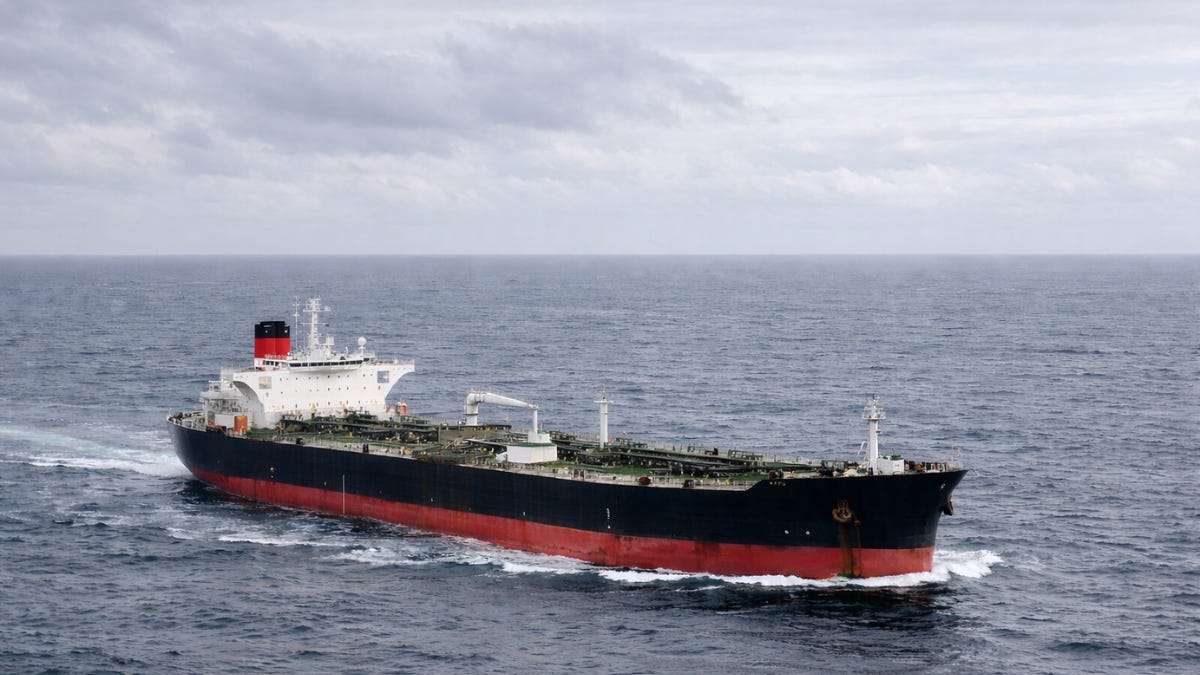
How Trump Humiliated Putin on the High Seas
The president did not so much call Russia’s bluff as dismiss it outright, making official the view we've long espoused that the former superpower is a Potemkin village, a czar without clothes.

This analysis is free, but with Premium Membership you get MORE. Join today.
NOTE: The shadow fleet is composed of unflagged or false flagged ships: smugglers, essentially. It is the lifeline by which Russia sells the oil that finances its war, and by which Iran, Venezuela, and Cuba cling to life. The latter aside, the chief recipient is China, which gets 40% of its oil illicitly in this manner.
The shadow fleet exists because of sanctions. And yet clearly trade has continued, to the great benefit of the world’s rogue states.
That game is over.
With the capture of Nicolas Maduro, Venezuela’s oil is offline for both China and Cuba: the former will manage, the latter cannot. But Donald Trump is not content to stop there. He has repeatedly offered Vladimir Putin the carrot: peace on decent terms, reconstruction investment, re-entry into the global community. Rebuffed, he is now taking away Putin’s ability to rebuff much longer.
The marvel here, of course, is that the world has assumed that even if Trump went after Venezuelan tankers (which they didn’t believe possible), he would never dare to go after (nuclear) Russia’s. Guess again. As I’ve repeatedly predicted, the day has come for Trump to tighten the noose, and leave Putin without the slightest pretense that he still leads a global power.
2026 is going to see a reordering of the world. It’s a new American century. Everyone else just gets to enjoy the ride. Or not. — RDM
How Trump Humiliated Putin on the High Seas
by Adrian Blomfield
January 9, 2026
Ever since coming to power more than a quarter of a century ago, Vladimir Putin has yearned for Washington to treat him as the leader of a great power, an equal of the United States, as it did during the Cold War.
Instead, in the wintry waters of the North Atlantic, Mr. Trump has treated Russia as a minnow, swatting aside its president in the most chastening, humiliating way.
Moscow had staked its reputation and geopolitical credibility on protecting the rusting oil tanker boarded and seized by U.S. forces south of Iceland on Wednesday. It reflagged the vessel with Russian colours, added it to its official registry, issued formal diplomatic warnings to Washington and finally dispatched a submarine and other naval assets to shield it. It was all in vain.
Putin has once again demonstrated his inability to protect Russia’s clients and dependents. He failed to save either Bashar al-Assad in Syria or Nicolás Maduro in Venezuela, despite extending patronage to both men. Now he has shown he cannot even safeguard a Russian-flagged tanker, directly protected by the Russian Navy, on the high seas.
When Putin intervened in the 19-day pursuit of the Bella 1 across the Atlantic — an operation likened to the slow-speed chase of O.J. Simpson’s Ford Bronco along California’s freeways 31 years ago — the gamble must initially have seemed a reasonable one.
The Bella 1, as it was then known, formed part of the shadow fleet of tankers used to move oil from Russia, Iran and Venezuela in defiance of sanctions imposed by the United States, Britain and other Western allies.
That fleet has been a vital lifeline for Moscow, allowing Russia to sell oil, prop up its economy, fund its war in Ukraine and conduct a hybrid campaign against Europe, using shadow-fleet vessels to conduct sabotage operations against undersea infrastructure and launch drones into European airspace.
Recently, however, the shadow fleet has come under mounting pressure. European states have moved to intercept vessels more robustly, while Ukraine has attacked them in the Black Sea and the Mediterranean.
Pressure on the Kremlin intensified last month when the U.S. imposed a maritime embargo on sanctioned oil tankers operating in and out of Venezuela.
U.S. forces subsequently intercepted and boarded two shadow-fleet vessels and then attempted to stop the Bella 1 — which had been under U.S. sanctions for 18 months on suspicion of carrying cargo for Hezbollah — in the Caribbean on Dec 20 as it neared the Venezuelan coast.
Previously registered in Panama, Palau, Liberia and the Marshall Islands, the tanker was flying the Guyanese flag — fraudulently, according to U.S. officials, who noted that it did not appear on Guyana’s shipping register.
The Russian, Indian and Ukrainian crew ignored orders to stop, turned the ship around and fled towards the Atlantic, repeatedly broadcasting distress signals to nearby vessels. The chase had begun.
As Christmas Day passed, the panicked crew hauled down the Guyanese colours, painted a Russian flag on the hull and appealed to Moscow, which they believed alone had the power to save them.
Under international maritime law, a vessel falsely flying a flag is regarded as stateless and may be boarded by the authorities of any state. A legitimately flagged ship, by contrast, enjoys protection from such interference.
On New Year’s Eve, Russia relented. It added the tanker — along with four others that had operated in Venezuelan waters — to its official shipping registry. The Bella 1, Moscow insisted, was no longer stateless. It was now a Russian vessel, sailing a Russian flag, registered to a Russian port. It was also given a new name: Marinera.
This, the Kremlin calculated, was a sanctuary of last resort — and surely sufficient. Personal ties between Trump and Putin aside, the United States might be expected to give up the pursuit, given that the vessel had turned back before reaching Venezuela, was not carrying oil and that boarding it risked breaching international law and triggering a diplomatic incident or even armed conflict between nuclear powers.
Yet as Bella 1 steamed towards what it hoped would be the safety of Russian waters, the Trump administration showed no sign of abandoning the chase.
Moscow doubled down, issuing a formal diplomatic reprimand demanding that Washington halt its pursuit. Then, in a final escalation, it dispatched a submarine and other naval assets to escort and protect the vessel.
The Russian president clearly hoped to deter the Americans with this show of force. Such tactics had worked before. In May last year, the Russian air force scrambled a fighter jet to prevent the Estonian navy from boarding the Jaguar, another shadow-fleet tanker, in the Baltic Sea.
But the United States is not Estonia, as Russia has now discovered. Trump did not so much call Russia’s bluff as dismiss it outright. Backed by Britain, which provided naval and air force assets and authorised the use of its bases, the U.S. seized the vessel, delivering the Kremlin a stinging rebuke.
Putin may have assumed that his warm personal relationship with Donald Trump would work in his favour. It did not. Indeed, the intervention may have further soured relations between Moscow and Washington, already strained after Putin claimed last month that Ukraine had targeted one of his residences with drones. Mr Trump initially expressed outrage on Putin’s behalf, but then reversed course after a U.S. intelligence assessment concluded that Russia had fabricated the claim.
The deception was not lost on the president.

At the same time, Mr. Trump is likely to have been irritated by the Russian leader’s failure to heed a message his administration has been making with increasing force: South America is Washington’s backyard.
In early December, his administration published a new security strategy declaring that the region falls squarely within Washington’s sphere of influence under his so-called “Donroe Doctrine”, a muscular update of the 19th-century Monroe Doctrine asserting U.S. primacy in the Western Hemisphere.
By reflagging a vessel attempting to breach the U.S. blockade of Venezuela, Putin was directly challenging that doctrine — and Mr. Trump did not like it one bit.
The Kremlin has seen potential upsides in the Donroe Doctrine. Russian officials hope the United States will become bogged down in South America, and, Putin hopes, there could be scope for Moscow to exploit post-Maduro instability in Venezuela by backing rival factions vying for power.
Yet even as Putin seeks advantage in Ukraine, he has watched Mr. Trump deliver a serious blow to Russia’s global pretensions. The raid in Caracas demonstrated that the Russian air defences Mr Maduro so often boasted of were as ineffective as those that failed to protect Iran’s military facilities from Israeli and U.S. strikes last year. That by itself strikes not just at Russia’s prestige and alliance structure but at the heart of a key Russian source of needed cash: arms exports. Who wants an S-300 or S-400 now?
But the more urgent threat is the new U.S. willingness to impound shadow fleet tankers. Without them, Russia cannot fund its war effort. The embattled Iranian regime faces a similar catatrophe. And of course, China is the recipient of much of that oil, from Russia, Iran, and Venezuela. It too seems utterly impotent in the face of Trump’s action.
In what other Russian partners will see as a further sign of weakness, Putin has neither condemned Mr. Maduro’s ousting nor commented on it at all — just as he was largely silent after the fall of Assad, despite Russia’s substantial military presence in Syria.
Painful though it will be, the Kremlin has little choice but to absorb its failure to defend the Bella 1. It’s likely just the beginning of a dégringolade that forces him to the peace table. But one conclusion is unavoidable: in his latest display of raw power, the U.S. president has laid bare Russian weakness before a watching world.
— This essay also appeared at The Telegraph.


This is most excellent. Boldness and courage is the only way to go. It's a hallmark of great leaders! They make change happen and more than ever, we need change. For too long we've capitulated, playing into the hands of wicked globalists and hard-core enemies. Thank God for Trump and his most excellent cabinet.
If you believe such... https://www.handofhelp.com/vision_1.php