

Cuba is America's Taiwan
While headlines obsess over China and Iran, the real Trump doctrine is hiding in plain sight 90 miles off the Florida coast. It's about 70 years overdue.
This analysis is free, but with Premium Membership you get MORE. Join today.
NOTE: Yesterday while the world was watching the Beijing summit, CIA Director John Ratcliffe led a U.S. delegation to Havana to meet with Cuban government officials. As in Iran, the word “surrender” wasn’t used, but as in Iran, it didn’t have to be.
Ratcliffe offered the Communist leadership $100 million in immediate humanitarian relief. That plus a lifting of the embargo and massive U.S. direct investment are all in view, but not for free: Cuba must accept wideranging democratic reforms and boot the Chinese, Russians, and Iranians off the island, just 90 miles offshore.
Havana can choose the easy way or the hard way, but the outcome is not meaningfully in doubt. All the traffic to and from the Gulf of America must flow past it. Cuba is existentially important to the United States, and essential to any enemy who wants to threaten us. Donald Trump has no intention of allowing that loose end to go untidied.
This is 70 years overdue, a failure of both the Eisenhower and Kennedy administrations. Even a year ago the island was becoming a real threat again. That will never, ever be allowed to happen again. — RDM
by Jacob L. Shapiro
May 15, 2026
While headlines obsess over Iran, the real Trump doctrine is hiding in plain sight 90 miles off the Florida coast. Cuba isn’t a Cold War relic — it’s the next domino in a U.S. hemispheric strategy that’s already toppled Maduro in Venezuela. Cuba is America’s Taiwan, and it’s clear the U.S. has not forgotten about the island.
The Situation
It may feel like a long time ago now, but two of the Trump administration’s first geopolitical actions had nothing to do with the Middle East, China, or Russia, but with U.S. power in the Western Hemisphere.
On his first day in office, President Trump renamed the Gulf of Mexico the Gulf of America — theatrical, sure, but also a clear articulation of U.S. power. Secretary of State Marco Rubio’s first trip abroad, on February 2, 2025, was to Panama, where he warned the country to reduce Chinese influence in the Canal Zone lest the U.S. “take measures necessary” to do so itself (no idle threat to a country the U.S. invaded as recently as 1989).

The first core foreign policy interest in the Trump administration’s December 2025 National Security Strategy is control over the Western Hemisphere. And in January, the administration experienced a spectacular geopolitical success: It removed Venezuelan dictator Nicolás Maduro without a single American fatality and now has such a grip on that thorn in America’s side that Trump is “seriously considering” making it the 51st state (or so he says).
His focus on, and success in, the Western hemisphere makes perfectly clear: the obvious next target is Cuba.
A Brief and Unnuanced History of U.S.-Cuba Relations
U.S.-Cuba relations trace back to America’s victory in the Spanish-American War under President William McKinley (one of President Trump’s favorite role models), with the U.S. briefly occupying the island in 1899. Rather than annex Cuba, the U.S. opted to help the island achieve its independence but intervene when its interests were at stake — reoccupying in 1906 and later backing Batista’s 1952 coup.
That arrangement ended in 1959 when Fidel Castro’s guerrillas defeated Batista’s U.S.-backed forces. Castro declared Cuba a Communist state, pulling U.S.-Cuba relations into the Cold War. From there came the failed Bay of Pigs invasion in 1961, the nearly-nuclear Cuban Missile Crisis in 1962, and decades in which Castro made himself a dutiful Soviet client, arming guerrillas throughout Latin America and even sending a proxy army to maintain Communist rule in distant Angola.
Many of today’s unresolved conflicts — North vs. South Korea, the U.S. vs. Iran, Russia vs. Ukraine — are Cold War anachronisms, proxy battles that outlived their strategic logic when the Soviet Union collapsed. U.S.-Cuba is no different, and the world is still paying the price.
The Hemispheric Case
President Trump’s intent to replace Cuba’s leadership has been clear since Day 1 of his second term. That makes enormous strategic sense, considering his hemispheric strategy to return U.S. dominance to North and South America. After Chinese control of the Panama Canal, there is no greater geopolitical threat to U.S. hegemony in the Western Hemisphere than the presence of anti-American regimes in Venezuela and Cuba.
Cuba is particularly problematic. Remember: The 1962 Cuban Missile Crisis is the closest the world has ever gotten to nuclear annihilation. The Soviet attempt to develop a nuclear-armed enemy so close to the U.S. mainland was the biggest foreign threat the U.S. had faced since the British burned the Capitol in 1814.
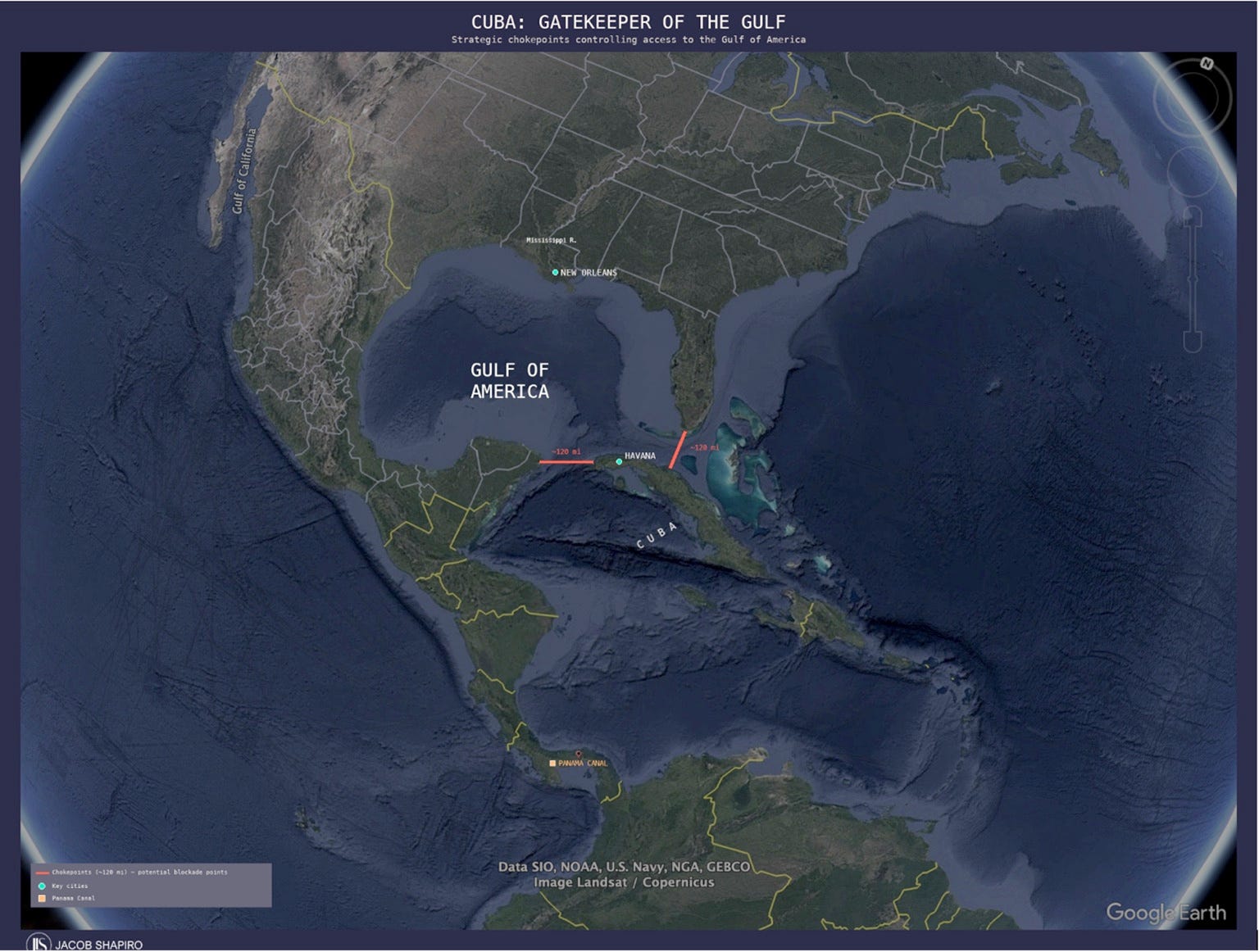
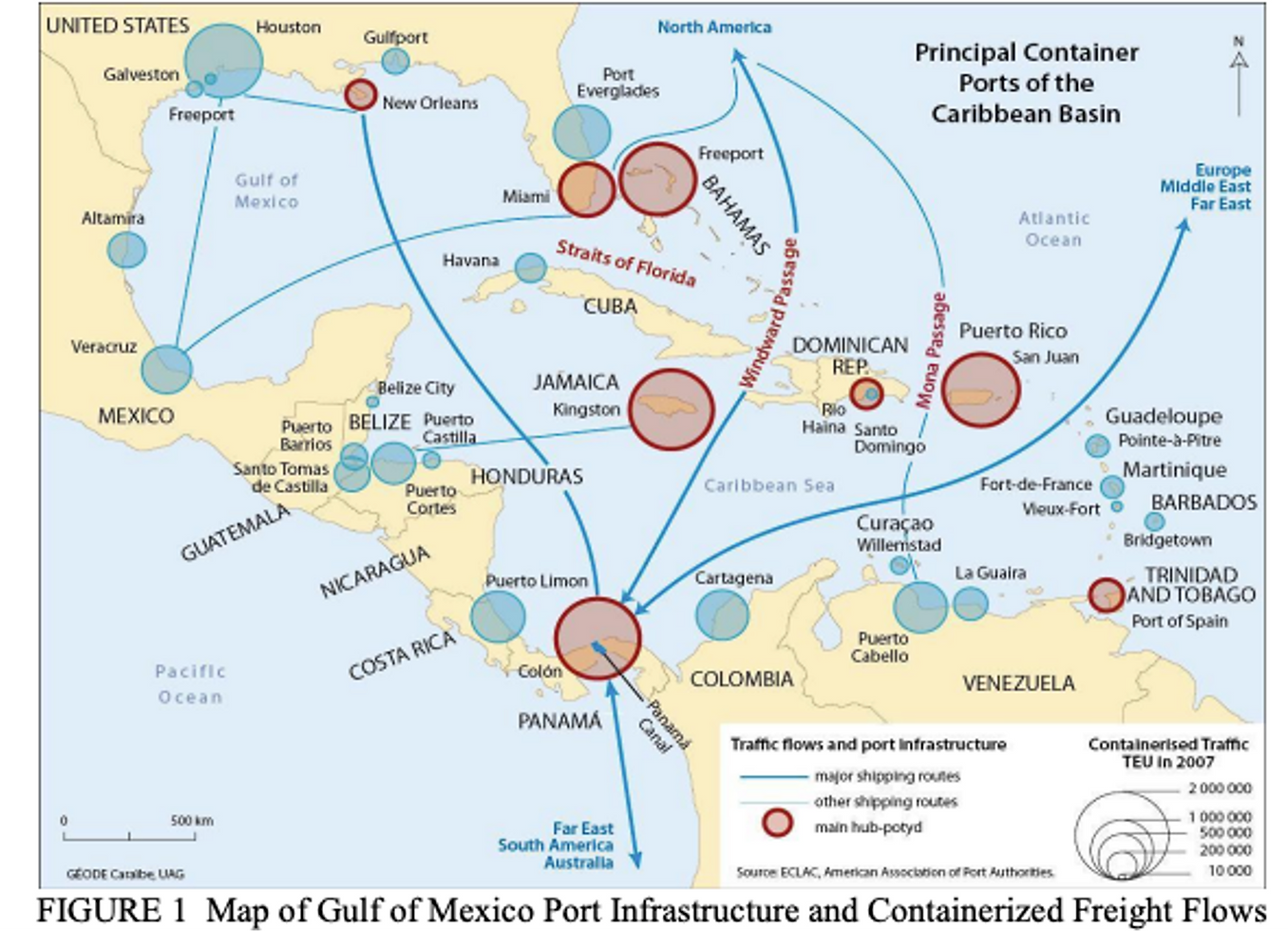
There can be no “Gulf of America” if a state hostile to U.S. interests sits astride that very gulf, a perfect base for any external rival to set up shop to block U.S. exports from the Mississippi River — and thus the entire center of the country — or even to block the U.S. from Atlantic and Gulf approaches to the Panama Canal.
Much ink predicting World War III and global disaster is spilled over China’s relationship with Taiwan. But Cuba is America’s Taiwan. The situation in Taiwan would be like if after the U.S. Civil War, the Confederates had slipped out of the mainland, taken up residence ~120 miles south of the mainland on Cuba, become a strategic gadfly that could potentially block U.S. shipping lanes, declared that it represented the only true government of the United States, and then accepted military support from a rival global power.
Just look at this perspective map of Cuba’s location: One does not need to be a geopolitical analyst to see how strategically important Cuba is to the U.S.
Even while the war in Iran continues, President Trump has joked as recently as May 1 that the U.S. will be taking over Cuba “almost immediately.” Now add to the bombast the CNN report from over the weekend that U.S. military intelligence-gathering flights are surging off the coast of Cuba, and it becomes clear this is no joke. This is a display of the depth of U.S. power.
Then yesterday, the Director of Central Intelligence went in person to Havana to dictate terms. The symbolism alone makes the message shockingly clear. The regime will have a brief time to consider its options. It’s options are somewhere between few and none.
Previous U.S. experience in Cuba leaves much to be desired, but Fidel Castro is dead, Raúl Castro is a nonagenarian, and the Revolution has clearly failed. Sporadic anti-regime protests since 2021, driven by the visible deterioration of the Cuban economy — hyperinflation, medicine shortages, the population turning to crypto to protect wealth, and the surge in Cuban migration to the U.S. — are all elements similar to the situation that brought U.S. military force to bear against Venezuela.
Moreover, Cuba is not a millennia-old civilizational nation-state: it is an island off the coast of North America whose political and economic status will always be subject to stronger powers around it. Finding a Cuban “Delcy” — maybe from the Castro family itself, if reports are to be believed — will not be hard. Nor will converting Cuba’s immense potential riches to the economic benefit of its long-suffering people and of the U.S.
Cuba Is a Frozen Asset
Cuba is one of the last great frontier market economies left in the world. When Castro declared the island Communist and the U.S. imposed its embargo on Cuba in 1962, Cuba’s economy was effectively suspended in the past.
Cuba is a frozen asset. Everything about the island’s geography, resources, and human capital suggests an economy several multiples larger than what it currently produces. The gap between what Cuba is and what it could be is staggering.
To call out just a few ways in which that is so:
Tourism and real estate: Cuba’s 5,746 km of undeveloped Caribbean coastline, 90 miles from Florida, is arguably the largest untapped real estate opportunity in the Western Hemisphere.
Agriculture: Cuba produced 8.5 million tons of sugar in 1970. This year it will produce under 150,000 tons, the lowest in over a century, a 98 percent collapse. Cuban cigars are still the best in the world: Even under sanctions, Habanos S.A. posted $827 million in revenue in 2024, up 15% year-on-year, with zero access to the American market. Coffee production has fallen 51% in five years from an already depressed base.
Energy: The USGS estimates 4.1 billion barrels of undiscovered, technically recoverable oil and 13.3 trillion cubic feet of natural gas in Cuba’s offshore waters. Cuba currently produces just 32,000 barrels/day, covering roughly 40 percent of domestic needs. Drill baby drill.
Minerals: Cuba holds the world’s fourth-largest cobalt reserves at ~500,000 tons, and its sixth-largest reserves of nickel at ~5.5 million tons. Its laterite deposits also contain rare earth elements and platinum group metals. Cobalt and nickel are critical inputs for EV batteries and defense applications.
Benchmarks: Puerto Rico, with one-third of Cuba’s population and one-tenth of its land area, has a GDP of ~$126 billion and a per-capita GDP of $39,343. If Cuba achieved even Dominican Republic levels of development (~$11,000 per capita), that would imply a GDP of roughly $110 billion. At Puerto Rican levels, roughly $370 billion.
Ending Communism turns out to be an incredibly effective path to prosperity; even a partial repeal does wonders. Poland’s economy grew 177 percent in the 18 years following Communism’s fall. Vietnam’s poverty rate fell from 80% to 5% in three decades of market reform.
That future is closer for Cuba than ever, especially with nearly 2 million comparatively wealthy Cubans in South Florida anxiously awaiting the liberation. It’s relatively clear that the U.S. will try to replace the Cuban Communist Party, and that Cuba represents a significant economic opportunity for all those able to access it.
— Jacob L. Shapiro is the former director of geopolitical analysis at Geopolitical Futures and currently serves as geopolitical analyst at Mauldin Economics, where this article first appeared.


California, take notice!
Cuba faces total fuel collapse as shortages worsen under ongoing US sanctions
The Washington Examiner
https://www.youtube.com/watch?v=vPY-CLzhcGM
May 14, 2026 #cubafuelcrisis #uscubasanctions #energycollapse
Cuban officials said Wednesday that the island has completely run out of fuel needed to keep much of it running, blaming a monthslong U.S. sanctions campaign that has sharply restricted fuel imports and pushed the country deeper into an already severe energy crisis.
Energy Minister Vicente de la O Levy said that the country has “absolutely nothing” left in diesel fuel and oil reserves, leaving Cuba’s fragile power grid reliant on limited domestic crude production, natural gas, and renewable energy sources that have struggled to meet demand.