This analysis is free, but with Premium Membership you get MORE. Join today.
by Rod D. Martin
September 23, 2026
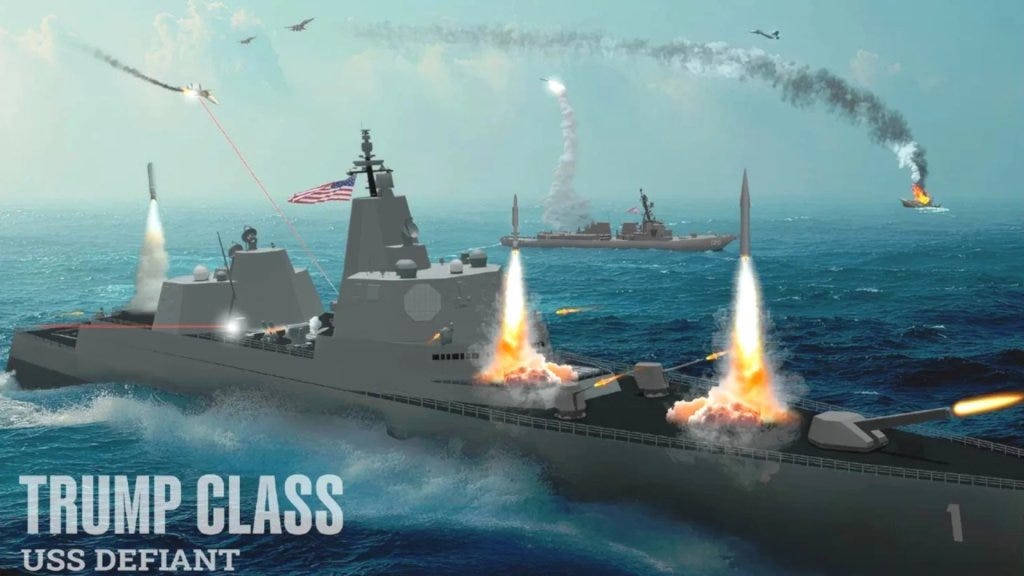
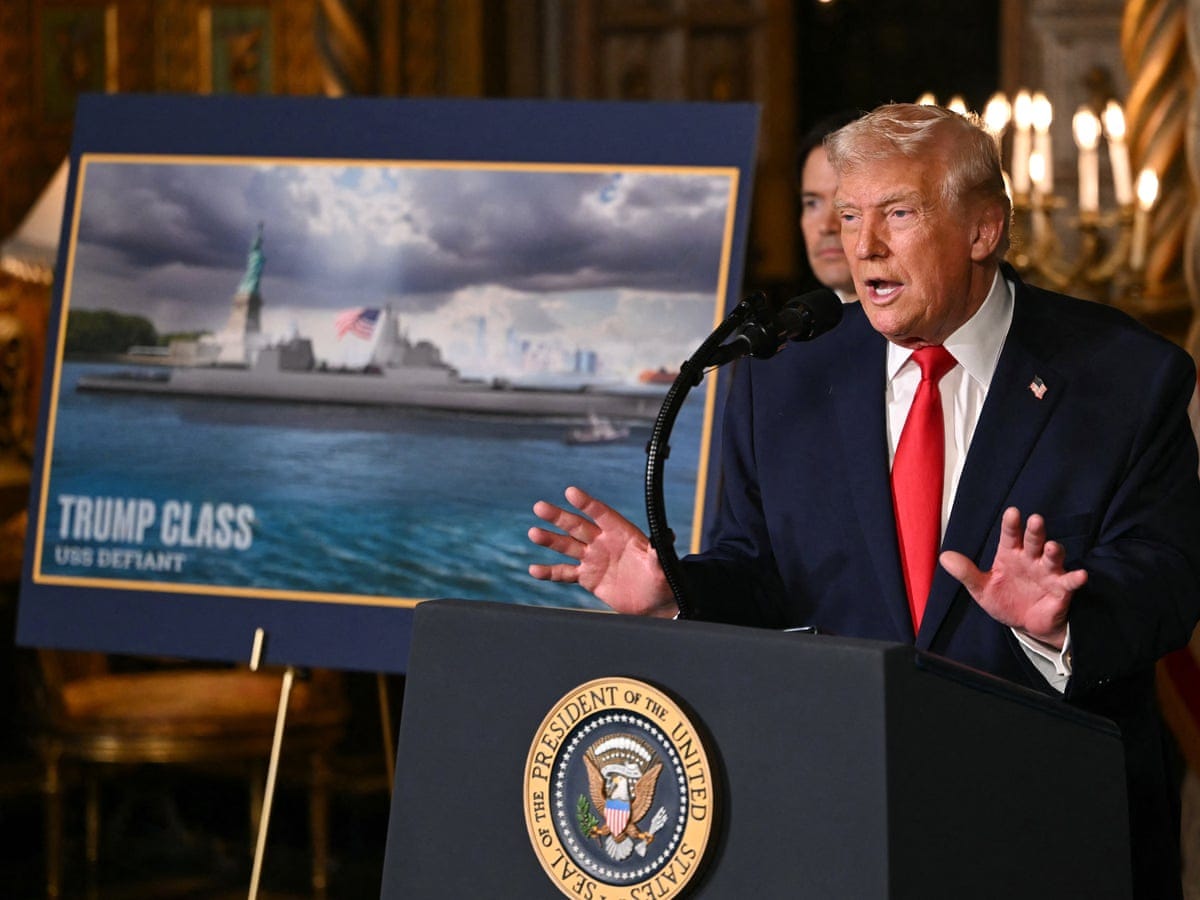
When Donald Trump announced his vision for 15 Trump-class battleships, the Enemedia and much of the defense establishment reacted in derision: the whole idea was “ridiculous,” and “dead on arrival.” Which, of course, is also what they said about Trump’s Greenland deal until it was signed, yesterday.
So imagine the inconvenience of having Chinese naval scientists make Trump’s case for him.
According to a September 7 report in the South China Morning Post, researchers at the PLA’s Dalian Naval Academy propose using large-caliber naval guns to fire shells that burst near a swarm, scattering fragments across multiple drones. Instead of buying an expensive missile engagement for each cheap attacker, the gun would attack an area containing several of them. Low tech, big guns, high return.

Of course, that’s exactly why you’d need a battleship. Indeed, that’s why we built them a century ago (the firepower, not the drones). Such a ship could meaningfully contribute to the air defenses of an entire Carrier Strike Group. But it would need to be big. If China’s about to build them, you also need a lot of them.
But bigger hulls mean more than just added space for large guns. They also mean bigger power plants for electricity-driven systems — lasers and railguns — and more space for the Vertical Launch System cells on which the Navy currently depends. VLS consists of modular launch tubes with rapid multi-mission responsiveness and 360-degree target-engagement capability. Each VLS cell can hold and fire different types of missiles: land attack, air defense, anti-ship, whatever the mission demands. The more cells a ship has, the more punch it can pack.
The catch? VLS cells have to be pre-loaded in port before the ship deploys. Run out of missiles and you have to go home. So more cells matter.
But America is losing cells, not gaining them. The 22 Ticonderoga-class cruisers now finishing retirement carried 122 cells apiece, 2,684 across the class. Likewise, the four Ohio-class guided-missile submarines (SSGNs) can carry up to 154 Tomahawks each, for another 616 much-in-demand missiles hidden beneath the sea.
Together, roughly 3,300 sea-based launch positions, out of a total of 8,120 in the entire U.S. Navy, will disappear over the next two years. Replacing them may take well into the 2040s.
That would be dangerous in any era. It’s especially foolish right now. China is rapidly building the world’s largest navy — perhaps now even including battleships — backed by a shipbuilding industry so much larger than ours that the comparison is embarrassing. China’s commitments are regional: America’s are global, which is to say, spread out. The enemy can concentrate forces, and it’s building them fast.
The Navy plans fifteen Trump-class BBGNs carrying 128 Mk 41 cells apiece, plus larger launchers for hypersonic and future weapons. That means 1,920 standard VLS cells restored to the fleet aboard ships designed to defend a Carrier Strike Group, or to strike out on their own.
VLS would be reason enough to expedite construction of significantly bigger warships. But it’s not the only one. The Chinese idea has legs. So does directed-energy — lasers — which are already operational as Israel’s “Iron Beam” air defense, and which the Navy has now tested in combat.
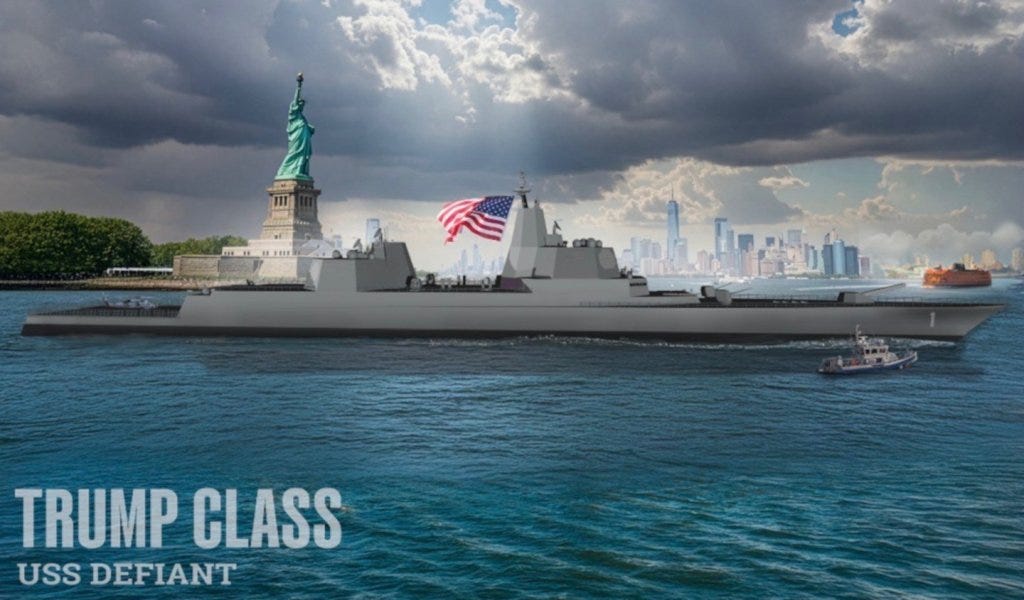
Understood this way, the Trump class is an offensive monster, but it’s also an air-defense fortress for our carriers, an independent cruiser, and a platform with enough electrical power to operate those directed-energy weapons and railguns as they grow bigger, more powerful, and more power-hungry. It also gives the Navy a first-in-kind platform designed for constant upgrades as new technologies arrive.
The BBGN is not a replacement ship. It’s a strategic leap. It’s also a design philosophy.
This is the thing the technology-illiterate Beltway can’t grasp: The logic of the new technologies drives hulls larger, not smaller. A properly armed carrier or battleship is not a “sitting duck.” It’s a force of nature.
And China knows it.
A Fifty-Year Hull Should Stay First Rate for Fifty Years
A warship commissioned now has to be at the top of its game all the way out to 2080. When you consider how much technology has changed from the 1970s to now, or from the 1920s to the 1970s, that’s a pretty daunting task.
And yet America has gotten very good at exactly that.
The Mk 41 VLS entered service under Reagan. The missiles it carries have changed repeatedly, and they’ll just keep changing. Tomahawks have gained new range and accuracy, new guidance systems, and new missions. Standard Missiles have evolved from fleet air defense into ballistic-missile defense and anti-ship weapons. ESSMs can be packed four to a cell. The launcher has remained not just useful but vital because the Navy didn’t design it around one weapon, one threat, or one era.
That is the Trump-class design philosophy writ large.
The BBGN is a nuclear-powered weapons platform that can evolve throughout that time, precisely because it’s huge and it’s nuclear-powered. The establishment wants to keep cramming more into Arleigh Burke destroyers, but that’s a dead end. There’s simply not enough room in those hulls, and they can never have the power generation the 21st century is already beginning to demand.
Over the century ahead, virtually everything aboard the Trump-class will change. Their missiles will get faster and smarter. Their sensors will see farther. Their computers will make today’s look like a calculator. Directed-energy weapons will grow in power, evolving from an experiment to primary air defense to main armament. Systems not yet conceived will replace equipment that today seems cutting-edge.
That’s the reason to build big.
At 35,000 tons, the Trump class starts with what the 9,700-ton Burkes no longer have: margin. Not waste, not empty space for its own sake, but room for whatever fifty years of invention might produce. The Navy’s own shipbuilding plan says the ship should ensure that “the hull forms of today do not constrain the genius of tomorrow.”
That may be the wisest sentence anyone in the Pentagon has written in decades.
The critics say the tech is “insufficiently mature”. That’s just nonsense. It ignores the VLS problem that the larger hulls help solve. But even more than that, in the 1920s, no one postponed aircraft-carrier construction just because planes were still primitive. Ford-class carriers will operate aircraft that don’t exist yet, and thanks to their nuclear power plants, laser-based air defenses as well. We built the flight deck precisely because we knew the aircraft would evolve.
And they did, fast.
The same is true here. VLS is mature. Nuclear propulsion is mature. Aegis is mature. Large-caliber naval guns are certainly mature, even if the Chinese have found a new (and advantageous) use for them. If the best railgun or laser available when USS Defiant commissions is not the best available ten years from now, well duh. We’ll replace it. That’s exactly what a platform is for.
The BBGN answers an immediate missile crisis. That’s very real. But it also spends America’s money far better than any ship class before it, precisely because it’s so intentionally extensible.
The Most Versatile Ship in the Navy
Between its size and nuclear power, the Trump-class ships will be the most versatile in the Navy.
As part of a Carrier Strike Group, a BBGN’s reactors can keep pace with the carrier regardless of speed or distance, while bringing a missile magazine deeper than any other surface combatant. Even more important, it can bring enough electrical power to defend the whole formation with directed energy rather than one-shot missiles and ammunition.
That’s more consequential than the 128 VLS cells. It will only become more so.
Modern air defense has an ugly economic problem. An enemy can launch $30,000 drones or rockets and force an American ship to fire million-dollar interceptors against them. That’s crazy. It’s also unsustainable.

Directed energy upends that math. For around $2 per shot, lasers and high-powered microwave systems can deal with many of the cheap, massed threats using electricity, preserving Standard Missiles for the aircraft, ballistic missiles, and hypersonics that actually require them. Lasers don’t replace kinetic interceptors, at least not initially. They augment and preserve them.
In this case, they preserve VLS.
That makes nuclear propulsion far more than a matter of speed and endurance. The reactor powers the sensors that find the threat, the electronic systems that disrupt it, and the directed-energy weapons that destroy much of it, all without consuming a single missile. Every drone burned down by a laser leaves another VLS round available, thus extending that essential capability even more than was accomplished by deploying more cells.
A Carrier Strike Group built around both a Ford-class CVN and a Trump-class BBGN would be a monster. The carrier brings the air wing. The battleship brings massive missile firepower, fleet command, and an essentially inexhaustible defensive magazine. The destroyers and submarines expand the group’s sensors, anti-submarine warfare, missile defense, and offensive reach.
There would be nothing like it in the world. Or in all of history.
And note well: the BBGN does not replace the destroyers. It makes them more important.
Every additional carrier group, Amphibious Ready Group, lightning carrier, and battleship formation requires more Aegis coverage, more anti-submarine warfare, more ballistic-missile defense, and more distributed sensors. The BBGN lets destroyers be destroyers again, rather than forcing them to double as the cruisers the Navy stopped building.
There’s another option. A battleship-led Surface Action Group would be formidable in its own right. A BBGN accompanied by Burkes, attack submarines, unmanned systems, and maritime patrol aircraft could operate far from a carrier while presenting an enormous threat to any hostile fleet, coastline, or sea lane. Moreover, its command spaces allow an admiral and staff to direct a major operation from sea rather than depending entirely on a land base that may be politically unavailable or vulnerable to attack.
And there’s a third role. The Navy stopped building cruisers. It couldn’t eliminate the need for them.
The Trump class restores that independent capital-ship role, but on a far greater scale. A BBGN can secure a chokepoint, reinforce an ally, protect commercial shipping, or appear off a hostile coast without requiring half a destroyer squadron to make it survivable.
America’s interests are too broad to make every naval operation carrier-dependent. We need enough carriers to dominate the most important theaters, and capital ships capable of creating powerful independent formations everywhere else.
That’s what cruisers were for. The role never disappeared. The Navy just forgot.
The Need Is Now
Donald Trump is always thinking about the future. Yesterday’s Greenland deal isn’t about next year or the next NATO summit: it’s about 50 or 100 years from now when alliances may have shifted and new threats may have emerged. That’s true across the President’s foreign policy initiatives, from Venezuela to Indonesia.
His proposal for 15 Trump-class battleships caught Washington off guard, and they reacted as they always do when the President proposes anything: derision and dismissal combined with confident predictions that it will never, and can never, happen.
They’re wrong. Nearly always. And they’re especially wrong about this.
At present, the first Trump-class isn’t expected until 2036. But by 2036, the Ticonderoga CGs and Ohio SSGNs will be long gone, and China will have spent another decade widening a truly dangerous shipbuilding advantage. It is now clear that Xi’s navy is likely to build the very sort of large surface combatants Trump is proposing. A program that arrives after that multifaceted crisis isn’t a strategy. It’s an obituary.
Perhaps we should give the contract to SpaceX or Anduril. They get it. They’re forcing the Pentagon to get it. Congress has not yet caught up.
But the answer is clear. Commit now to all fifteen. Buy long-lead materials in blocks. Expand the reactor and supplier base before scarcity becomes another excuse for delay. Give the yards enough certainty to hire and train the skilled workers they lack, and enough volume to invest in the equipment needed to build far faster.
America needs the Trump-class. And it needs them now.