


This analysis is free, but with Premium Membership you get MORE. Join today.
by Rod D. Martin
August 9, 2026
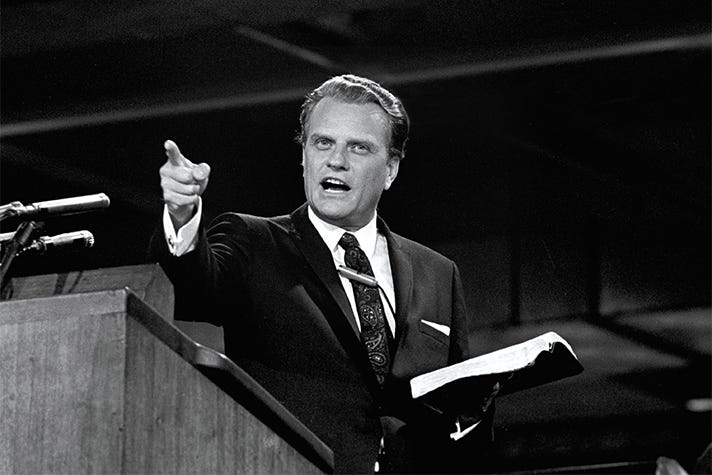
I actually think evangelists and revivals were valuable. I wish we still had them.
I grew up in churches that brought in evangelists and had revivals regularly. I can distinctly remember at least one who was quite manipulative. He was never brought back. The rest seemed valuable to my young mind, at the very least for shaking things up and causing people to actually bring other people to church.
Oh, and they were also useful for proclaiming the Gospel.
It seems to me that the reason Southern Baptists (and specifically, the North American Mission Board) killed their evangelism and revival emphases was a growing dismissal of such things among then-younger seminarians and their “cool” younger professors. Perhaps I’m mistaken. But I don’t think there’s any reasonable doubt that this growing culture was the leading edge of the trend away from all such things.
That hasn’t worked out very well. There are many reasons Southern Baptists lost 4 million out of 16 million members — 25 percent of total membership — over the last 15 years. There are many reasons for the inflation-adjusted collapse in Cooperative Program giving (never mind that Nashville never adjusts for inflation: the real numbers are ghastly, but never reported). There are many reasons we’re baptizing fewer people than we have in over half a century.
But wouldn’t it make sense that one of those reasons might be that we no longer ask people to become Christians? You know: actually ask them.
We did once. Now we don’t. And the difference in results is pretty obvious.
Nothing I say here is intended to step on anyone’s soteriology. I affirm that God is sovereign. I’m talking about what is expected of us. I would argue this just the same with Tom Ascol as I would with Jerry Vines (although with the former, I’m sure we’d veer off into a discussion of the Regulative Principle).
The thing is, the Great Commission teaches us one particular lesson of universal applicability: that for us, God commands persuasion rather than force. This applies to economics, to politics, and certainly to discipling the nations.
At the Final Judgment God will use force. But in this life, he does not send Paul to Mars Hill with a sword (like a jihadist); and at the same time, He does not refrain from sending Paul to Mars Hill (like a Zoroastrian). He does not plead like a beggar (as some maintain, shamefully), but he pleads nevertheless, as a Father who knows the fate of His wayward children and earnestly desires their return.
He would have been entirely right to kill Adam and Eve in the Garden; and likewise, to give no warning to Noah and let His greatest of resets be complete. He would have been entirely within His right and His power to create men who would entirely choose Heaven.
He did not. And He chose persuasion as His mechanism of action. We are commanded to persuade. By implication, we are also commanded not to compel.
Now anyone who’s sold, or been sold to, recognizes what’s happening when the salesman hands his prospect off to his manager. And likewise, the Holy Spirit must close the sale. None of us are that persuasive.
Yet persuade we must. And I invoke the Great Commission as a universal principle, because it informs everything else. If God would entrust the most important matter in all of life to persuasion (humanly speaking), that fact teaches us how He addresses other lesser matters too. Government must be by the consent of the governed. There is a time for force (as there will be at the Judgment), but it is limited. Even the offerings for the construction of the Tabernacle and the Temple were voluntary, and God Himself (in 1 Samuel 8) limits the government’s legitimate taxing power to less than the tithe, leaving the state with very little capacity for compulsion.
We should live as free men. We should reason lovingly with our wives and children as we disciple them. We should organize our economies on market principles rather than state planning. In all things, we should be imitators of Christ, applying God’s own chosen priorities.
So as Zig Ziglar would have said, we are all salesmen, and everything is selling.
Now if God has made persuasion a guiding principle in virtually all arenas, how much more so in that core arena of the Gospel, in which He states it boldly and explicitly?
I am persuaded by our many Calvinist friends that invitations, and revivals, and evangelistic appeals may be manipulative. I have witnessed it myself. But I am equally persuaded by our many Provisionist friends (and what Calvinist could disagree?) that the mere fact that there are bad evangelists should not abolish evangelism.
Church planting is wonderful, and sometimes involves evangelism (though it often relies far more on proselytizing). But it is not itself evangelism. For fifteen years, NAMB has gutted the latter in favor of the former, and the results are plain to see. But NAMB did not do that alone.
Our numbers bear out our neglect of such things. We are told our prior numbers were inflated by the aforementioned emotional manipulation, and perhaps that is so. But is the current system working? And did the prior system actually fail? Or are these two assertions without adequate evidence, and once we examine the evidence, we find that it was the innovators who were wrong?
The Great Commission commands persuasion. We grant that the Holy Spirit must “close the sale”, but “how will they hear without a preacher?” Evangelistic meetings and revivals incentivized members to invite their lost friends (and to come themselves) to hear the Gospel, night after night. They came, they heard, and many were unquestionably saved. They multiplied. They were made new, they went about making new converts, and the world was made better with them.
The less we do of this, the more we preach only to the faithful. Except even that is not true, because in fact, our churches now hardly meet at all. Where is Sunday night? Where is Wednesday night? Prayer Meeting is gone. Church Training is gone. How can we even consider whether or not to give an invitation at a service that never takes place?
The first rule of political advertising is that a voter must hear your message seven times before it connects. How many fewer times do average people hear the Gospel message now than they did 25 years ago? Than 50?
This all began at NAMB and in the seminaries. It culminated in the SBC’s ill-fated “Great Commission Resurgence”. The men who led that effort tried to do something great, no matter what their detractors may say. And yet like the men who brought you Betamax, Pets.com, Billpoint, and the Zune, they were still wrong.
We are failing by our own hand. We have lost a quarter of all Southern Baptists in a country that is growing. We are doing so in precisely the same way so many businesses have failed: by ceasing to do what we originally did that succeeded.
It’s not too late to change course.
We could start at your church.


"The Great Commission" Therefore go and make disciples of all nations, baptizing them in the name of the Father and of the Son and of the Holy Spirit, and teaching them to obey everything I have commanded you.
The Mission statement. THIS IS OUR JOB. We do other things for money, to make a family, a society, BUT This is our job.
"Always be prepared to give an answer to everyone who asks you to give the reason for the hope that you have. But do this with gentleness and respect"
Simon Peter.
Rod, you definitely have a point. I recall when I was growing up in an SBC church that most of the salvations and baptisms were a result of the week-long revival services that we had every summer. However, I think the greater cause for the decline of the SBC is that the pastors in the pulpits no longer preach the Gospel in a straightforward and unapologetic manner. I left the SBC after 40 years for a Bible church and now am a part of a Calvary Chapel church. While we are not perfect, the Gospel is preached unapologetically every Sunday and Wednesday and we have well over a thousand conversations and baptisms in our church every year.