


This analysis is free, but with Premium Membership you get MORE. Join today.
by Jeffrey A. Tucker
June 24, 2026
Quietly, and with no great fanfare, President Donald Trump has resurrected the most innovative strategy of his first term. In fact, I’ve argued that this one measure is the single most creative approach to government reform to advance in a century.
Trump’s executive order creates a new category for federal employment, set to apply to any civil servant who is working on policy and its implementation. It’s a resurrection of a similar executive order from late in his first term — promptly reversed by President Joe Biden — and the finalization of another announced in the earliest days of Trump’s second term.
What this means is rather dramatic. It brings the public sector, or at least part of it, to fit with the usual labor practices of the private sector. This helps restore some part of people’s government. The people elect a president. The president can control employment in the executive branch rather than be beholden to a permanent civil service class.
This is precisely what the Founders created. It’s something of a wonder how and why that system was ever replaced with something so completely different. The United States never had an entrenched class of civil servants until the 1880s. Even then, it was another 75 years before it became standard for employees of the federal bureaucracy to have permanent jobs regardless of the will of the president.

Of course, there is shock and alarm among the usual suspects. But actually, this reform makes perfect sense in a society that calls itself free.
In a free market economy, any worker can walk away from his job at any point without legal penalties. Depending on the contract, there might be a settlement to offer, but no one can compel another to work against his will. That is standard and consistent with the 13th Amendment: “Neither slavery nor involuntary servitude, except as a punishment for crime whereof the party shall have been duly convicted, shall exist within the United States, or any place subject to their jurisdiction.”
Forced employment is involuntary servitude. We don’t do things this way.
There is, of course, another side to the deal. No employer can be forced to employ a person if the business does not want the worker or wants his position terminated. Yes, that means employment at will: You can quit anytime, but you can also be fired at any time.
Does that sound scary? Maybe a bit. Who doesn’t want a permanent job and a boss who cannot fire you no matter how incompetent you are? Sure, but that cannot be the case as long as the worker can also leave at any time. Freedom goes both ways.
Everyone in the private sector is aware of this. Sure, the firm can act like a family. You can be on great terms with the boss. You can be valued by your colleagues. But if the economics don’t work out, priorities shift, or you get on the wrong side of your manager, you can be sent packing in an instant. Everyone knows this and behaves accordingly.
That system is coming to the federal government now. It’s long past time. Already we have seen a historic drop in the number of people who are willing to work for the government. We are now at a 60-year low.
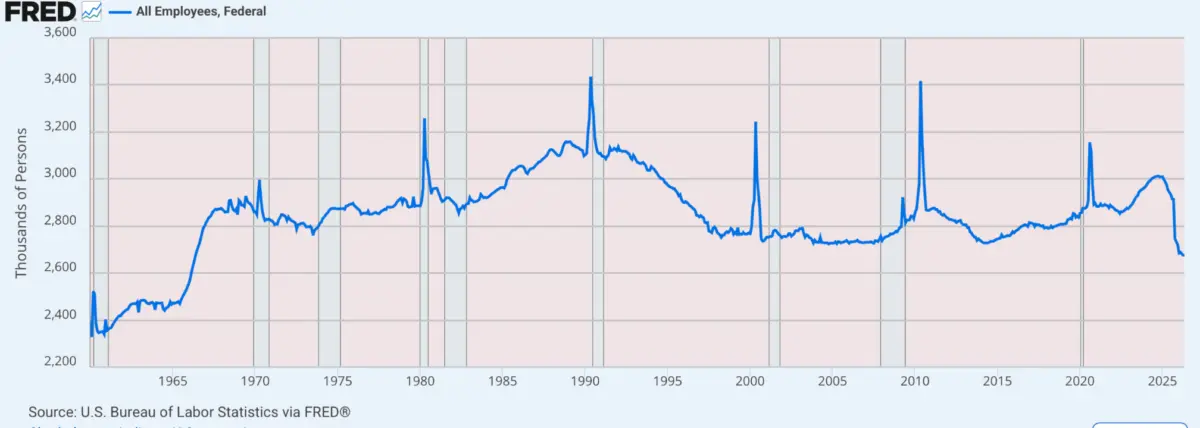
That’s good. Government should not be anyone’s sinecure. Work there should be a calling in service to the public, not a lifetime guarantee insulated from results. Schedule F reintroduces that basic reality.
The reform is elegantly simple. It carves out a new category — Schedule F — for federal employees whose duties involve policymaking, policy implementation, or significant advisory roles.
These positions will no longer enjoy the near-ironclad protections of the old civil service rules. Instead, they will operate under at-will employment principles familiar to every private sector worker in America.
The president, as head of the executive branch, regains the ability to hire, manage, and, if necessary, remove people who are not advancing the agenda voters endorsed. In other words, he can operate as president, not a figurehead.
This is not radical. It is restorative. The Pendleton Act of 1883 began the professionalization of the civil service with seemingly good intentions: ending the spoils system and reducing outright patronage. But over decades, it metastasized into something the Founders would have found unrecognizable. It created an insulated administrative class that views elected leadership as temporary and itself as permanent. It meant moving the government from people’s control to bureaucratic control.
By the mid-20th century, the norm was lifetime tenure, union-like protections, and bureaucratic inertia that no election could fully dislodge.
James Madison warned in Federalist 51 about the need for competitive pressures in government: ambition versus ambition. The modern administrative state inverted that. It created a fourth branch. It is unelected, unaccountable, and often hostile to the very democratic will it claims to serve.
Schedule F begins to claw back constitutional order. The executive can now shape the executive. That should not be controversial in a republic.
Critics say that this will “politicize” the bureaucracy. The irony is rich. The bureaucracy has been politicized for years, in one direction only. Career officials leaked against Trump in his first term, slow-walked legitimate orders, weaponized agencies against political opponents, and even launched an elaborate scheme to drive him from office.
The “resistance” inside the agencies was not hidden; it was celebrated in major media. Restoring presidential authority does not introduce politics; it makes politics answerable to elections again.
Others warn of a “purge.” Actually, no one is talking about firing park rangers, air traffic controllers, or scientists running basic research. Schedule F targets roughly 8,000 positions — policy analysts, senior advisers, regulatory writers, and program implementers — out of more than 2.5 million civilian federal employees. That is a modest start. These roles are inherently political because policy itself is political.
A president elected on a platform of deregulation should not be thwarted by officials who believe that their job is to preserve the regulatory state. Voters, not bureaucrats, decide the direction of government.
The private sector analogy remains the strongest defense. In business, poor performers are removed. Strategic shifts happen. Innovation requires fresh thinking. No serious company could survive if it could never replace managers who actively undermined the CEO’s vision. Every company needs a “spoils system,” else it atrophies.
Government has pretended that it could operate under different rules. The result was bloated agencies, contradictory regulations, mission creep, and a growing disconnect from the public. The historic drop in federal workforce interest is telling. Talented people sense the dysfunction. Schedule F will attract a different kind of civil servant, namely those who want to execute policy energetically rather than obstruct it safely.
The Supreme Court’s recent skepticism toward the administrative state — evident in cases such as Loper Bright Enterprises v. Raimondo overturning Chevron deference — suggests a more receptive judicial environment. Still, the administration should move deliberately: clear criteria for Schedule F placement, transparent processes, and documented performance standards.

There is a deeper cultural point. For too long, the federal workforce operated under the assumption that competence and loyalty to elected leadership were optional. Performance reviews were often pro forma. Firing was rare even for egregious misconduct. Schedule F changes the incentive structure. Employees will know that their success depends on delivering results aligned with the administration’s priorities. That alignment is not blind loyalty; it is democratic accountability.
Schedule F is not the end but a beginning. It pairs naturally with other efforts: regulatory budgeting, sunsetting old rules, agency reorganizing, and reducing the overall federal footprint. A government that is smaller, not captured, more responsive, and genuinely under democratic control is the goal.
The administrative state grew without serious constitutional scrutiny for a century. Reversing that requires creativity and persistence. Americans have a right to a government that reflects their consent. When millions of people vote for lower taxes, fewer regulations, secure borders, and energy abundance, they expect those preferences to translate into action and not be diluted by a permanent class that prefers continuity above all.
The Founders designed a system of separated powers and popular sovereignty. They could not have imagined today’s vast and captured bureaucracy wielding legislative, executive, and judicial functions with minimal oversight. Schedule F is a modest but crucial correction. It tells civil servants: You serve the public through the president they elected, not the other way around.
In a free society, no one should be forced to retain workers who no longer fit the mission, and no worker should be trapped in a job that no longer fits. Applying that principle even partially to Washington is long overdue.
— Jeffrey A. Tucker is the founder and president of the Brownstone Institute and the author of many thousands of articles in the scholarly and popular press, as well as 10 books in five languages, most recently “Liberty or Lockdown.” He is also the editor of “The Best of Ludwig von Mises.” This essay is published in cooperation with The Epoch Times.


Another good step would be a law eliminating Federal Public Sector Unions. I’d love to see that at the state and local level as well.
Amen. Let the housecleaning begin!