


This analysis is free, but with Premium Membership you get MORE. Join today.
by Rod D. Martin
October 8, 2026
In case you missed it, Elon Musk has some unfinished business with PayPal.
I have more than a passing interest in this. I worked for Peter Thiel when he was CEO of PayPal, before and after the IPO, until we both left after the merger with eBay. We were an insurgency out to change the world, and we did.
We asked people to trust a bunch of kids in Silicon Valley — our average age was 23 — with their money. And they did. In the company’s first two and a half years, in fact, around 25 million of them did. In the process, we enabled the creation of over two million small businesses, small firms that used us instead of a then-stupidly expensive credit card merchant account. Despite that, our fraud rate was just one-third of Visa’s and MasterCard’s.
But we had bigger ambitions than that, ambitions that weren’t fully achieved before the sale. Coming off the Mexican and Argentine currency devaluations, Peter was particularly interested in giving normal people around the world a free or near-free offshore bank account to protect themselves from their own governments. Crypto has partially achieved that now; stablecoins will be even bigger. But none of that existed yet.
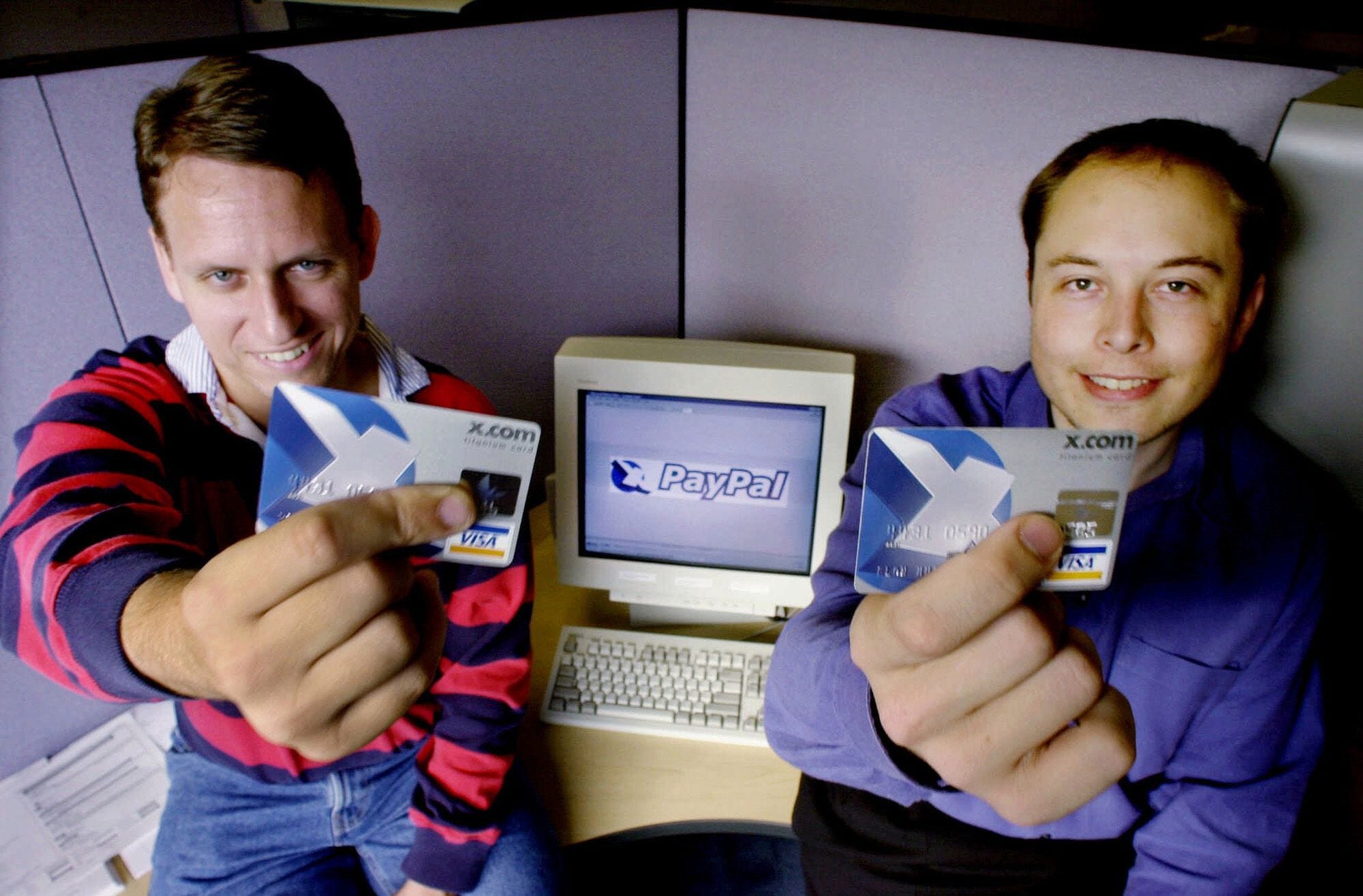
Elon had his own take on things. In 1999, he launched X.com as an online bank. That turned out to be a regulatory nightmare (one of several PayPal faced) and was quietly undone. But X merged with Confinity, which had developed PayPal, in March 2000. The combined company kept the X.com name before adopting the product’s name as its corporate identity in 2001.
Along the way, in September 2000, Elon was ousted as CEO. Peter replaced him. Elon stayed on the board, remained the largest individual shareholder, and began plotting the creation of SpaceX. But he never forgot his original vision.
He made that distinction explicit to X employees in 2023. He said he and David Sacks had written the X/PayPal roadmap in July 2000, but that eBay never implemented much of it. What he wanted now was “someone’s entire financial life,” reaching the point where “you won’t need a bank account.”
X Money promises to become the fulfillment of that vision, this time attached to a social network whose users already have people they want to pay. PayPal can be assured of stiff competition from the world’s only trillionaire, a man who is literally smarter than nearly anybody. But the banks that think this is just a fight between payment companies will be in for a very unpleasant surprise too.
Believe me: getting people to join a new financial service is expensive. Paying someone who isn’t a customer is a wonderfully effective way to recruit him. We learned that at PayPal, with initial signing bonuses of $10 to each new customer and also each person who referred them. An email arrived saying someone had sent you money; opening an account suddenly seemed like a very good idea.
X can do that with an @handle. Keeping some of that money there is much easier than persuading someone with no connection to the platform to move his paycheck. And the feature set is only going to grow.
Getting Paid Is Just the Beginning
Your @handle becomes the address where people pay you. The money arrives instantly, and you can spend it with a titanium (!) X-branded Visa debit card anywhere. Your paycheck can land in the same account through direct deposit, for which Elon will pay you a higher rate of interest. Bill payments and mailed checks cover the less glamorous necessities.
Access is still expanding among eligible U.S. users, but Elon is already giving them fewer reasons to open their bank’s app, and a lot of reasons to leave their money in his.
Premium+ users like me currently qualify for 6 percent APY. Other users start at 4 percent, but can reach 6 percent with qualifying direct deposits or creator payouts. The rates can change, and New York residents currently receive no interest at all (thanks, Democrats). But this is money you can spend, earning a high rate of interest in the meantime.
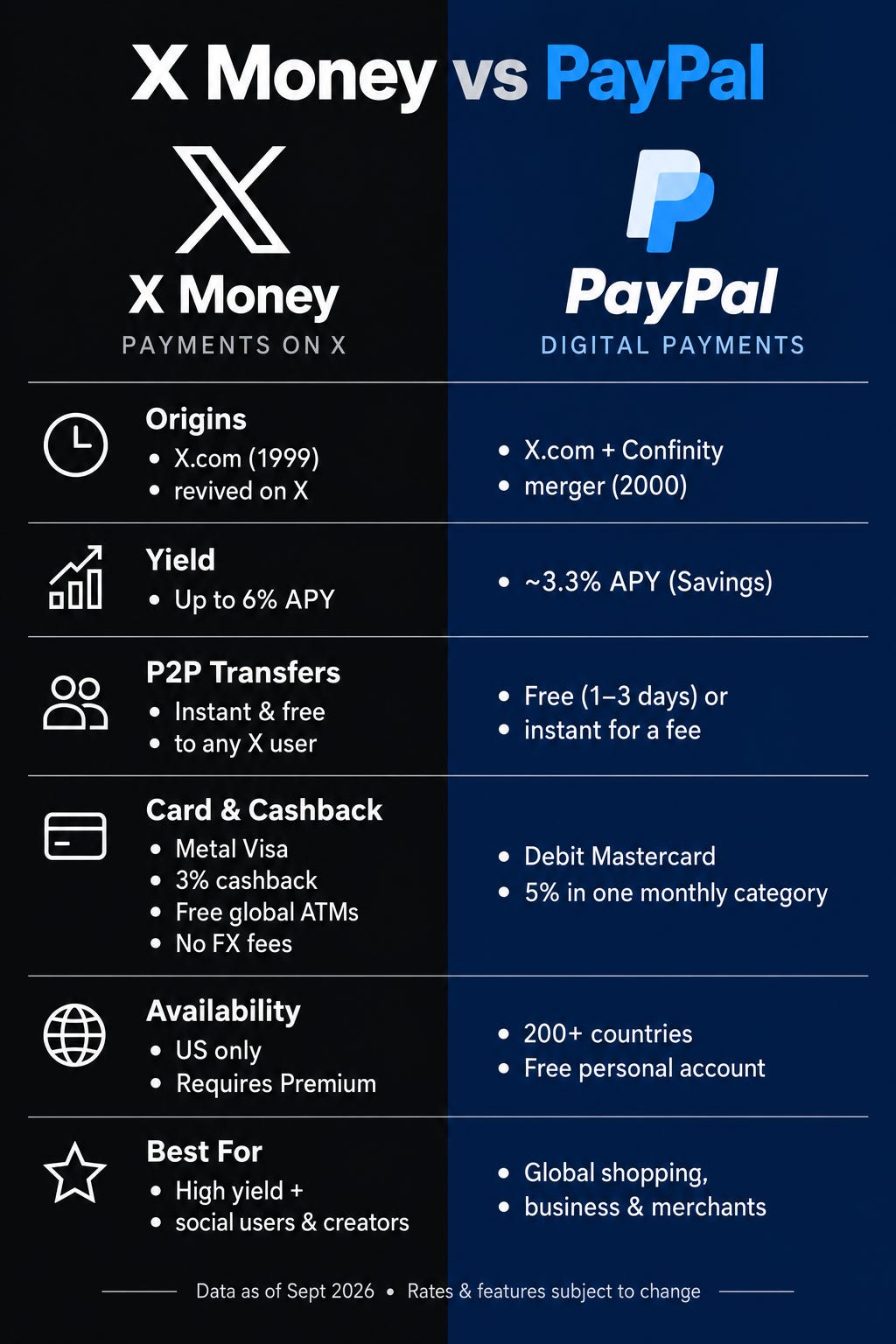
The card also adds up to 3 percent cashback on eligible purchases. Premium and Premium+ users get unlimited ATM operator fee reimbursements, and the card charges zero foreign transaction fees. You can earn on your balance, you get cash back when you spend it, and you can pay anyone on X without a transfer fee.
Those numbers start adding up.
X has begun moving U.S. creator payouts into X Money, and its new Original Content Rewards program requires it. Each creator has an audience, and some of those followers have things to sell too. Hundreds of millions of people — and the commerce they create — are already there.
Elon calls his larger ambition “WeChat++.” WeChat is a popular Chinese app that combines communication and commerce. X already connects people through public posts and private messages. Payments let those connections become transactions. A small business that finds a customer on X can now collect from him there. That incentivizes platform use, growth, and ad revenue.

And that’s just the beginning. Lending, securities, and crypto have been part of Elon’s ambition for years. Rumored additions include an in-app crypto wallet, stablecoin support, and buying digital assets with your X Money balance. Stablecoins could carry Peter’s original vision across borders. Add investments, then an AI assistant that helps you manage the money (Grok Finance is already a thing). Each addition would give you less reason to leave X and more reason to move more and more of your financial life into it.
PayPal Has a Problem
X Money could kill PayPal like Facebook annihilated MySpace. Don’t think Elon hasn’t thought about it.
The next decisive step will be merchant tools and international expansion. Give a seller the ability to find a customer, close the sale and collect inside X, at a better price point, and both sides have a reason to stay. Merchant services supplied through X would seriously cut into PayPal’s processing business. PayPal would have to persuade customers to insert it into a transaction they could already complete without it, making it an unnecessary middleman.
PayPal processed $486 billion in the second quarter of 2026. But its online branded checkout volume grew just 2 percent. Venmo and Braintree give it businesses beyond the checkout button; it’s also investing in AI-assisted commerce.

But PayPal has handed Elon a reason for customers to want it gone, one X is uniquely positioned to take advantage of.
In October 2022, PayPal published new Terms of Service allowing it to punish its customers to the tune of $2,500 per incident of what it called “misinformation.” Not “misinformation” on PayPal’s site: “misinformation” anywhere the customer posted it on social media. And that didn’t just extend to your PayPal balance, but to any linked bank account: PayPal could reach into your offsite checking account to punish you for your offsite opinions.
Can you just imagine how much money I would “owe” these Marxists every single day?
The company’s former president, David Marcus, condemned the idea. Elon agreed. After the uproar, the company withdrew the language and claimed it had appeared by mistake: “oh that was just an internal draft, we didn’t mean it” or some such. Sure.
I called that a lie, and closed my account. I told my readers to do the same. For someone who helped build PayPal, it was a heartbreaking day.

Think about the reversal. The company we built to give people control over their money and a refuge from confiscatory leftist governments had become a part of exactly that machine. Worse still, PayPal’s management didn’t wait for Biden’s team to instruct it in whom to punish: it set out to be the socialists’ enforcer all on its own.
Withdrawing the policy spared the customers who remained. It didn’t answer the question of why anyone inside the company thought this was vaguely acceptable. A financial service that threatens your livelihood based on your opinions has forfeited something no cashback offer can restore.
Let me say that more plainly: if you’re doing business with PayPal, you’re an idiot. Stop it. Get some help.
Elon bought Twitter precisely to restore free speech in an America that was quickly eradicating it. He paid a steep price for that at the newly rebranded X as leftist corporations pulled their advertising from the platform, but he survived and thrived anyway. Everybody knows it.
(The “Bob” called out in the video is Bob Iger, then-CEO of Disney.)
That lesson won’t be forgotten. More to the point, Elon won’t forget it. Elon doesn’t forget anything.
The Banks Are Next
Banks have depended on a different kind of customer loyalty: you’re busy, moving accounts is a nuisance, and your paycheck and automatic payments already work. You may know perfectly well that another institution would pay more interest. Yet no matter how annoyed you may be, it’s a serious pain to switch, and the new bank won’t be better.
Your bank assumes that. It’s made money off that for a very long time. But artificial intelligence could make it a very expensive assumption.
Ed D’Agostino recently explored this at Mauldin Economics, drawing on Apollo economist Torsten Sløk’s warning about an “agentic bank run.” Your AI agent could easily compare accounts, move idle cash into a better-paying one, and even move it back when a bill comes due. Give it your instructions and limits, and it could do the work you’ve been putting off.
Opening a bank account can be labor-intensive. Opening an X account is dead easy. And it can be automated.
Consider $25,000 earning 0.1 percent. That produces $25 a year. At 4 percent, the same balance produces $1,000. At 6 percent it’s $1,500. You tell me which is better. And collecting the difference becomes a lot more attractive when someone else, or something else, handles the paperwork.
Now multiply that across millions of households. Banks will have to pay more to keep deposits or replace them with more expensive funding. An institution accustomed to paying nothing, or almost nothing, for your cash could face stiff competition for that same money every day.
And that’s before we even get to the wire fees and other things X Money does not charge. Did I mention the unlimited free wire transfers? Yeah, that’s kind of a big deal.
Elon has a place for that cash to go, a social network that can recruit its owner, and an AI business that can help manage it. X Money’s terms already allow for agents accessing accounts and initiating transactions. That same AI agent will soon help a customer find what he wants to buy and pay for it from his X Money balance. Elon’s companies are preparing for money to move in ways for which the banks are uniquely unsuited.
Now add lending, securities, and crypto, and watch X Money become a family of institutions: a money transmitter, a bank, even a brokerage. And God help its competitors then, because Elon won’t.
X Money could make a great many people richer, freer, and less dependent on institutions that at best neglect them and often actively hate them.
Peter wanted to give ordinary people more power over their money. Elon wanted to rebuild the way they used it. X Money gives him a chance to finish that unfinished work, this time with a vast social network supplying the customers.
It’s also a chance to settle some old scores.


Sounds too good to be true. No downside(s)?