



This analysis is free, but with Premium Membership you get MORE. Join today.
by Rod D. Martin
December 21, 2025
Every year, right on schedule, the same argument resurfaces: that Christmas is “really” pagan, that December 25 is a fraud, and that Christians only picked it to baptize Roman revelries. They don’t attack the Incarnation itself — the audacious, civilization-shaping truth that God took on flesh and entered history. They strike at the calendar, preen over their “deeper knowledge,” and insinuate that the Church is naïve at best, heretical or idolatrous at worst, for celebrating the coming of our Lord.
Out come the familiar talking points: Saturnalia and Sol Invictus, usually delivered with the smug certainty of people who get their history from Facebook posts. The insinuation is always the same: the early Church was either too ignorant to know what it was doing or too corrupt to care.
Some of the people repeating these claims just reflexively distrust authority (often a virtue). A few enjoy the feeling of possessing “hidden knowledge” (which is not a virtue at all — it’s pride, or gnosticism, or both). But whatever the psychology, the argument boils down to this: pagans had festivals in December, Christians celebrate Christmas in December, therefore Christmas is “really” pagan.
That’s not scholarship. In fact, it’s just dumb: historically illiterate and theologically unserious.
But before we even touch the historical details, let’s do what modern Christians too rarely do: remove the supposed “gotcha” entirely.
Even if Christmas’s origins were pagan (and they aren’t), it just wouldn’t matter. Christ came to redeem and to sanctify all things — even time itself. The Incarnation is God planting His flag in the physical world and announcing that all creation, culture, and calendar are His domain alone. The end of the story is not “Christians politely sharing December with the sun-god.” The end of the story is that every knee will bow and every tongue confess that Jesus Christ is Lord.
Still, the claim is false. So let’s examine the evidence.
The Central Claim: Pagan Parallels
Let’s start with the Saturnalia, because it’s the one people cite with the most confidence and the least knowledge. Yet in reality, the claim shouldn’t survive a glance at the calendar. Saturnalia was not on December 25. It was held on December 17 and expanded over time to run through December 23.
That’s not a minor detail; it’s the whole ballgame. When someone says “Christmas was originally Saturnalia,” what they’re actually saying is: “Romans had holidays in December.” Which is like saying Christmas is really Hanukkah, or the Fourth of July is really Bastille Day.
Yes, pagans feasted in December. So do college students. The existence of December parties proves nothing about the origin of a Christian feast day that is anchored to a specific date. And yes, December 25th is quite specific. We’ll get to that.
Sol Invictus is the more serious claim, because it at least can be connected to December 25. But here again, the internet’s certainty outruns the evidence.
What do we actually know? The earliest document that clearly shows both (1) a Christian commemoration of Christ’s birth on December 25 and (2) a December 25 entry for “Natalis Invicti” is the Chronograph of 354, whose calendar material is commonly traced to Rome in 336. That compilation contains the famous line “VIII kal. Ian. natus Christus in Betleem Iudeae” (Dec. 25, “Birth of Christ in Bethlehem of Judea”), and it also marks on Dec. 25 “Natalis Invicti” (“birthday of the Unconquered”) with games listed.
So first, the obvious: who could be more “unconquered” than a Messiah who rose from the dead?
The text does not specify “Sol” as “the Unconquered”. Maybe it’s Sol. Maybe it’s not. But if this were the ancient centerpiece of Roman paganism that Christmas supposedly “stole,” you’d expect it to be clearer, older, and better attested than a cryptic entry that only shows up in the same era in which Christmas on December 25 is more plainly attested.
But even if “the Unconquered” does refer to the sun god and not the Son of God, here’s where the meme-makers commit a classic bait-and-switch: they treat “both appear in a fourth-century Roman calendar” as if it proves “paganism came first and Christians copied it.”
That’s not a legitimate inference: it’s an assumption, the same sort of assumption as that Moses plagiarized Hammurabi. The question isn’t whether Rome had a solar cult. It did. It isn’t even whether Sol Invictus came first: since the Sol Invictus festival wasn’t instituted until three centuries after Christ (assuming Aurelian instituted it at all), it probably did not.
The real question is whether Christians substituted one for the other. And there’s no evidence of that at all.
In fact, some evidence suggests that the Romans created the Sol Invictus festival to compete with Christmas. Constantine converted in 312. Christianity became the official state religion in 380. In between came bitter resistance — sometimes lethal — culminating in an attempted (but failed) pagan revival from the very top under Julian the Apostate. Christianity was rising, pagans were on defense, and counter-programming would have made a lot of sense when the Empire struck back.
But here is the most important point: Christians did not need Sol Invictus to land on December 25. They had their own internal logic for doing so, and it was older, deeper, and far more coherent than “we wanted a winter party.”
The Church Chose December 25th For a Reason
The early Church did not treat Jesus’ life as a string of disconnected episodes — cute nativity scene here, tragic crucifixion scene there. The Child is born to die, and to rise. The manger already points to the Cross. That isn’t sentimentality: it’s theology. And that theology shaped how the early Christians thought about time.
One of the most revealing witnesses is Augustine. In On the Trinity, he records a tradition that many early Christians held: that Christ was conceived on the same date on which He died. From this he draws the obvious implication:
Christ “is believed to have been conceived on the 25th of March, upon which day also He suffered… But He was born, according to tradition, upon December the 25th.”
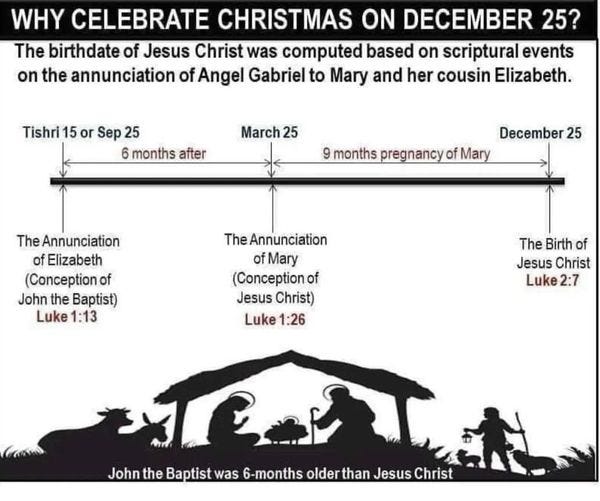
Notice what Augustine is not doing. He is not saying, “We picked December 25 to compete with pagans.” He is explaining a Christian framework that ties the Incarnation to the Passion (and the Passover) in deliberate symmetry. In this logic, conception and crucifixion are not separate, unrelated moments: they are bound together as one saving mission. And if you anchor conception to March 25, then nine months later you land on December 25.
Scholars sometimes call this the “calculation” approach. It reflects a broader ancient idea sometimes described as “integral age” — the instinct that a great life forms a complete, providentially ordered whole, with meaningful correspondences between its beginning and end. Moderns do not think this way. But the Church is not modern.
Early Christians had a theology of time. They didn’t need a sun festival to teach them how to count to nine. The early Church never claimed to have a Roman birth certificate. They claimed something far more radical: that Christ is the center of history, and history itself can be read in light of Him.
Which is why March 25 carried symbolism beyond chronology. The Church Fathers saw Mary as the New Eve, and they reveled in the reversal: the undoing of the Fall beginning where the Fall began, the knot being untied, the curse being reversed. Irenaeus memorably put it, “the knot of Eve’s disobedience was loosed by the obedience of Mary.”
That’s not pagan borrowing. That’s Christian typology: Scripture interpreted as one continuous story of promise and fulfillment, of sin and redemption, of death and resurrection.
In other words, the date wasn’t a random dart thrown at December. It was a theologically informed estimate rooted in how the early Church read the whole Gospel story.
Once you see that, the “Sol Invictus” story looks even sillier than it already did. The pagans didn’t give the Church its calendar. The Church read the Cross and counted forward.
Cultural Accretions Are Not Origins
At this point the critics usually pivot from dates to decorations: trees, candles, feasting, gifts, evergreen wreaths, “winter customs,” and all the rest. But this is just the argument changing clothes. It’s no longer about whether the Church chose December 25 for a pagan reason. It’s about whether anyone, anywhere, ever did anything festive in winter.
Well of course they did. Winter is cold, dark, and dangerous. In every culture, people respond to winter the same way: they gather, they light fires, they hang greenery, they sing, they tell stories, they give gifts, they feast when they can. None of that is inherently pagan, and none of it tells you where Christmas came from. It tells you that Christmas — like Easter — became so loved that whole civilizations built traditions around it.

And more importantly: most of the customs people point to are late. The Christmas tree is European and early modern. Santa Claus as we know him is mostly American and post-Civil War. Even the details of gift-giving vary enormously across Christian cultures and across time.
These are not “origins,” nor are they pagan. They’re adornments. They’re what happens when a feast day becomes a civilization’s focal point. To confuse the two is like confusing a wedding with its flowers, or a funeral with the headstone. Or worse still, claiming that weddings and funerals are illegitimate if they include flowers or headstones.
Christmas Celebrates Christ
Christianity did not conquer the Roman world by flattering paganism. It conquered it by contradicting it. The early Church refused to burn incense to Caesar. It refused to treat Jesus as just one more option in a religious buffet. It refused the pantheon — and it paid in blood for that refusal. The notion that these same people then turned around and quietly built their calendar around pagan gods is not just unsupported. It is psychologically absurd.
The question “why does the Church celebrate the Nativity?” is answered by Luke, by the Creeds, and by two thousand years of Christian worship — not by whether Germans in the 1500s, centuries removed from paganism, put a fir tree in their living room.
So was Jesus certainly born on December 25?
We don’t know. The Church never pretended to know with modern precision. What it did know is more important: that the Incarnation is the hinge of history. The modern obsession with “the exact day” turns a feast of worship into a test of pedantry.
The early Church did the opposite. It used the calendar as catechesis: to teach Christians that Christ enters time, redeems time, and reigns over time. And yes, it chose a date that fit its theology and its reading of Scripture, and it did so without fear of pagan proximity — because it did not believe paganism owns December, or anything else whatsoever.
Christ owns December. Christ owns history. Christ owns humanity. Christ owns the world. And the day is coming when every knee shall bow and every tongue confess that Jesus Christ is Lord.
So no, there is nothing arbitrary, much less pagan, about December 25th. The early Christians understood it was a guess. But to their minds, it was an informed guess, anchored to the Passion, coherent with Luke’s narrative framework, saturated with theological meaning, and set for the very practical purpose of uniting the Church in worship.
And that, not crypto-paganism or internet memes, is why Christians celebrate the birth of their risen Savior and Lord on December 25th.


Beautiful.
"They don’t attack the Incarnation itself — the audacious, civilization-shaping truth that God took on flesh and entered history."
Some time ago an Actual Thought occurred to me. Jesus (aka GOD) wore diapers that had to be changed All The Time, had to be toilet trained, had to learn to walk, learn to speak & read, hit puberty (did a 5 year old Jesus think girls were icky?) . Just Like Us!
For ME this was one of those the sky opened up and the Choir Eternal started singing moments.