

Can China Reverse Its Demographic Decline?
After decades of its brutal One Child Policy, China is on track to lose 75% of its population. The road back will be exceedingly difficult, if not impossible.

Don’t miss our Deep Dive “The Illusion of Chinese Strength: Power, Paranoia, and the Temptation of War”. It’s one of the most important things we’ve ever published.


This analysis is free, but with Premium Membership you get MORE. Join today.
by Yi Fuxian
January 27, 2026
China has just announced that births in 2025 plunged to 7.92 million, from 9.54 million the previous year — and almost half of what was projected (14.33 million) when the one-child policy was repealed in 2016. In fact, China’s births have fallen to a level comparable to that of 1738, when the country’s total population was only about 150 million.
Having finally acknowledged the country’s grim demographic reality, Chinese authorities introduced new pro-natalist policies last year, expecting the number of births to rebound. But the decline in the fertility rate was inevitable, like a boulder rolling down a hill. Even if it can be pushed back uphill, it will not happen quickly.
The downward trend in marriages will be especially difficult to reverse, since the number of women aged 20-34 — the group responsible for 85% of Chinese births — is expected to drop from 105 million in 2025 to 58 million by 2050. Compounding the problem, China’s marriage market suffers from a pronounced mismatch. Decades of sex-selective abortion have created a severe shortage of women of childbearing age, and women’s higher educational attainment has created a “leftover women” phenomenon, with female students outnumbering males.
Whereas the male-to-female ratio among six-year-olds in 2010 was 119:100, by 2022, when this cohort entered college, the ratio in undergraduate admissions was only 59:100. As a result, more men are unable to find wives, and more women are likely to remain unmarried, given their preference for more highly educated husbands.

China’s current policies are a scaled-down version of Japan’s ineffective response to demographic decline. In Japan, fertility fell from 1.45 (far below the replacement rate of 2.1) in 2015 to 1.15 in 2024. With China facing even deeper structural demographic constraints, it is not surprising that its fertility rate has already fallen below Japan’s.
It is an ecological law that density inhibits the growth of bacteria, plants, and animal populations, and humans are no exception. Across wards and cities in Tokyo, population density is negatively correlated with fertility rates, and the same pattern can be found in London, New York, and Shanghai. Built-up urban areas in the United States typically have 800-2,000 people per square kilometer, compared to about 6,000/km² in Tokyo. In China, the average is 8,900/km², with many districts in first- and second-tier cities — where young people flock — often reaching 20,000-30,000/km².

High population density drives up housing costs, and higher price-to-income ratios negatively affect fertility. In recent years, declining fertility in Canada, the U.S., and European countries has been partly driven by soaring housing prices. Since China’s price-to-income ratio far exceeds Japan’s, and since its housing bubble is much larger, boosting fertility would require transforming (demolishing and rebuilding) its cities to lower their population density and housing costs. Doing that, however, could trigger a financial crisis or even an economic collapse.
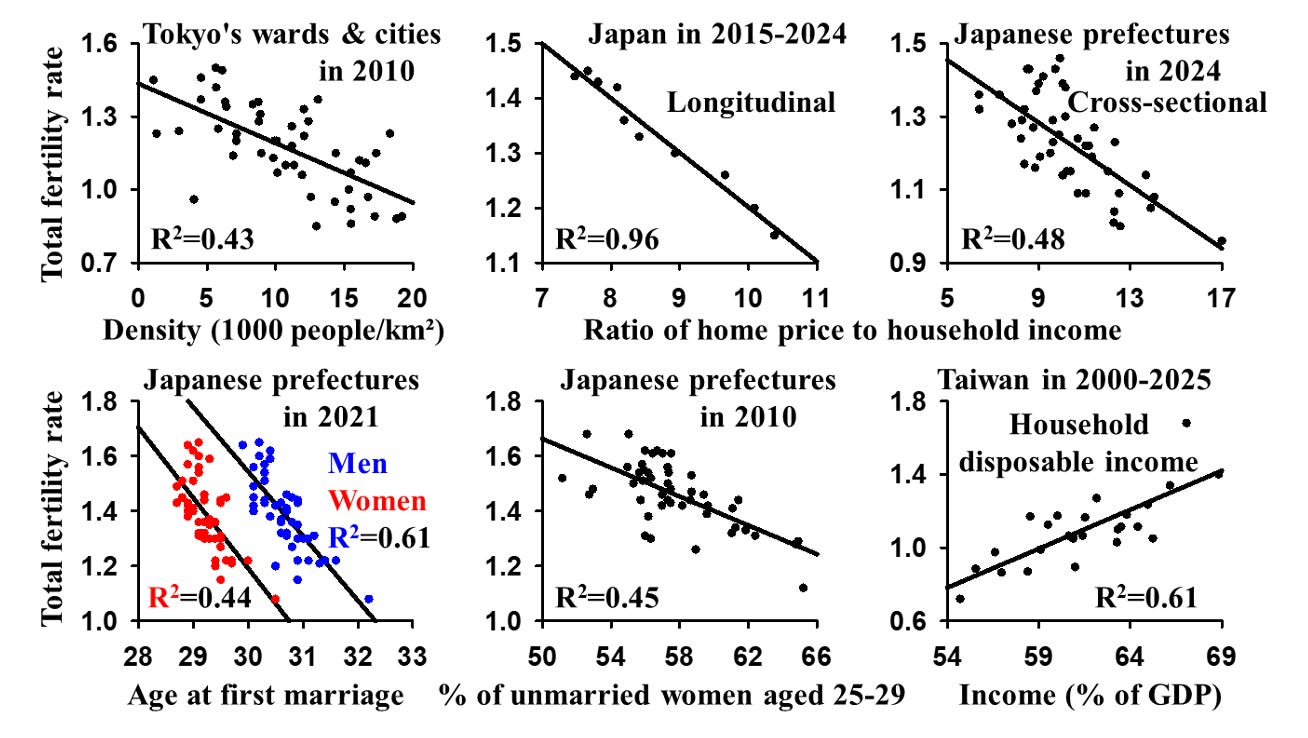
Japan’s experience also shows that the average age for men and women at first marriage is negatively correlated with fertility, as is the proportion of unmarried women aged 25-29. In China, the average age at first marriage rose from 26 for men and 24 for women in 2010 to 29 and 28, respectively, in 2020. Worse, the share of unmarried women aged 25-29 surged from 9% in 2000 to 33% in 2020, and to 43% in 2023.
The Chinese government has introduced a “new quality productive forces” policy to offset the drag of aging on the economy. But such pro-growth measures will inevitably prolong education, which will delay marriage and childbearing, increase the proportion of unmarried individuals, and lower fertility further.
Again, Japan shows that there are no easy solutions. It funded childbirth subsidies by raising the consumption tax. But as the saying goes, the wool comes from the sheep: the burden ultimately fell on households, reducing disposable income as a share of GDP, which has fallen from 62% in 1994 to 55% in 2024 — a loss that subsidies can scarcely offset.
Similarly, Taiwan’s fertility rate fell from 1.68 in 2000 to 0.72 in 2025, partly reflecting the decline in household disposable income from 67% of GDP to 55%. In mainland China, household disposable income already accounts for only 43% of GDP, making child-rearing even more difficult.

China’s best option to increase fertility would be to raise its household income share, which would also boost consumption and absorb excess capacity. But the government is unlikely to pursue such a paradigm shift, because doing so could weaken its own finances and power, potentially reshaping China’s political landscape.
Moreover, even if China could afford to increase fertility by providing generous social benefits, the effects would not last, because such interventions risk weakening family structures and reducing male labor-force participation. After Nordic countries adopted similar policies, the proportion of children born out of wedlock surged to 50-70%, with taxpayers serving as “public fathers” and the “public children” supporting the elderly.
This collectivist model — itself reminiscent of China’s Great Leap Forward (1959-62), which led to tens of millions of deaths from famine — is unsustainable. In Finland, the fastest aging of the Nordic countries, the fertility rate fell from 1.87 in 2010 to 1.25 in 2024; and in Sweden, it has dropped from 1.85 in 2016 to 1.43 in 2024, reflecting the tension between elderly welfare and the survival of the unborn.
The strength of a chain is determined by its weakest link, and in China’s case, several links might qualify. Fertility can rise only if China addresses them all. With many countries in need of viable solutions to low fertility and population aging, one hopes that it can set an example that does not violate human rights. But other countries’ experience suggests that no one has yet figured out how to make boulders roll uphill.
— Yi Fuxian, a senior scientist at the University of Wisconsin-Madison, spearheaded the movement against China’s One Child Policy and is the author of Big Country with an Empty Nest (China Development Press, 2013), which went from being banned in China to ranking first in China Publishing Today’s 100 Best Books of 2013 in China. This article originally appeared at Project Syndicate.



Thank you very much to Fuxian Yi and Dr. Rod Martin for a sobering and important piece on a subject I’d long wondered about! Indeed, China’s situation seems hopeless and it will be an uphill battle to turn around its demographic decline. There are NO easy answers as Fuxian Yi explains here. Who’s fault is it for all this? The Chinese government! Their inhumane and misogynistic one-child policy triggered this demographic disaster. What can China do to fix this? I’m no expert and there is no magic cure all, but I have some ideas.
1) GET RID OF XI JINPING AND THE CCP! The Chinese government is the one who caused this mess and is making sure it can’t be cleaned up. So it is clear to me that if China wants to begin to do so, they must get rid of the termites that are eating up the foundations of their country. I call on the people of China to follow in the footsteps of the protesters in Iran and take to the streets! The United States, Britain, the EU, Japan, Taiwan, and South Korea should give the Chinese people their full support. Securing the support of the Chinese military will be crucial to topple the party. I think a good old fashioned shadow war is the way to deal with that. The CIA, MI-6, French Intelligence, and the Mossad should work together to turn top Chinese military brass. Once this is done, and the protesters march to Beijing, Xi Jinping and CCP officials will be arrested. All dissidents will be freed, Chinese technocrats would temporarily run the government until such time as free elections would be held.
2) Gradually destroy all this excess housing and shift to building lower density cities.
3) Robust fertility education for Chinese children from a young age.
4) The Chinese government should do a campaign calling on family, friends and neighbors to help in child rearing.
5) Increase household incomes
6) Implement gradual measures to turn the economy around which will take decades but the earlier you start the better.
7) Show positive images of family and children in the media.
8) Bring in officials from Israel the country with the highest fertility rate in the western world and have them provide advice and share their expertise.
9) Start valuing your women and girls. Start an education and literacy program for girls and women. Mothers and wives should receive a special bonus from the government. I think it’s the least the government can do considering they committed genocide against predominately female babies.
10) Loosen restrictions on immigration to a degree and adopt a merit-based immigration system with a focus on high skilled labor to attract the best and the brightest from around the world to China.
Can China reverse its demographic decline? Yes, I believe it can. It will be an uphill battle and will take decades to do, but I believe it can be done if action is taken quickly. I despise the Chinese government but I believe the Chinese people will endure and outlive them! There is no reason humanity in general can’t solve the fertility crisis. If we figured out how to master fire, navigate the seventh seas, take to the skies, put a man on the moon, eradicate numerous diseases, end legal slavery, save endangered species of animals, explore the depths of the oceans, build impressive engineering and architectural achievements, and invent the automobile, electric lights, locomotives, toasters, ovens, dishwaters, laundry machines, telephones, and traffic lights, why can’t we solve the global fertility crisis? I don’t see why it’s so impossible.
Something I hate about the discourse around this issue is that it’s nothing but doom and gloom. Everybody wants to lament this problem and cry and whine about how hopeless it is. “The sky is falling! All is lost!” they shout for all to hear. In the rare case a constructive solution is brought up, they shoot it down and declare it won’t work. But I firmly believe just as sure as I sit here we can and will solve the demographic crisis even in challenging places like the West and the Four Tigers. I think the key is to realize it won’t just take one solution-it will take many. Each solution will also need to be tailored to that country’s individual situation. Yes, it will take a long time, but I think in twenty or thirty years, fertility rates will start to rise again, in countries where fertility rates aren’t THAT low like the United States, Great Britain, Canada, Australia, New Zealand, France, Germany, Ireland, Italy, etc. I could see them bouncing back as soon as ten years from now. We must remember that fertility rates have fallen below replacement level before such as during the Black Plague and the worldwide Great Depression of the 1930s. Yet, we have all survived. Fertility rates have fluctuated wildly throughout history and they bounce back in due time. The fact that countries recognize this is a problem and are at least trying to do something about it is a start.
I can well understand Fuxian Yi’s pessimism. But I disagree, I think though it will take fifty years, China will rebound and recover and life will begin anew in the Middle Kingdom. I have a belief it’s not a proven fact by any means, but I feel that this crisis along with everything else going on is God reminding us NOT to take the things that are so important to us for granted and that’s the lesson he’s teaching us right now. But as all this is happening, he is quietly planting the seeds of revival and renewal. We just need to be patient, water those seeds and let them grow. China, Japan and Taiwan will never die and its peoples and cultures will endure!
"Can China Reverse Its Demographic Decline?"
Insert Tab B into Slot A many Many MANY times? If I recall my High School Biology correctly.