

Trump’s National Security Strategy Ends Canada’s Security Discount
After decades of underinvesting in defense, Ottawa now faces intense pressure to boost spending and secure the North — or risk becoming a liability instead of an indispensable ally.
This analysis is free, but with Premium Membership you get MORE. Join today.
NOTE: The following is a fascinating Canadian perspective on Donald Trump’s effort to turn allies who’ve functioned as dependents into real partners. It won’t surprise you that the freeloaders aren’t too happy about that. But a Europe that believes it can’t defend itself against Russia should actually create the capability to do so; and a Canada that unendingly asserts its sovereignty against the United States shouldn’t function as its protectorate.
If our allies want respect, they should grow up. We didn’t choose their weakness: they did. Now Trump is sending them to the gym. — RDM

by Stephen Nagy
December 17, 2025
The Trump administration’s November 2025 National Security Strategy (NSS) marks a watershed moment for American foreign policy and a potential crisis for Canada. Unlike previous iterations that championed a “rules-based international order,” this document explicitly embraces what it calls “flexible realism” and acknowledges that “the unipolar moment of American predominance is over.”
For Canada, the implications are profound and immediate.
The so-called “Trump Corollary to the Monroe Doctrine” explicitly states Washington will “deny non-Hemispheric competitors the ability to position forces or other threatening capabilities, or to own or control strategically vital assets, in our Hemisphere.”
The document positions hemispheric nations as expected to align their economic policies with American interests while developing capabilities useful for “collective defense.”
The strategy emphasizes that hemispheric countries should build stronger domestic economies that become “increasingly attractive markets for American commerce and investment.” Nowhere does it treat Canada as the equal partner of conventional diplomatic rhetoric. Instead, Ottawa appears as one element within America’s sphere of influence, expected to support American priorities.
Some will argue that geographic proximity and NORAD make U.S.-Canada rupture impossible. But proximity cuts both ways. It gives Washington leverage to demand compliance, knowing Canada has limited alternatives. The Trump NSS makes this explicit, stating that hemispheric nations must align with American strategic priorities.
Consider what this means practically. The Northwest Passage, which Canada claims as internal waters, has never been recognized as such by Washington. The Trump strategy’s emphasis on ensuring American “access to key strategic locations” and control over “transportation networks” in the hemisphere suggests the US may prioritize its own interests over Canadian sovereignty claims as northern sea routes become more commercially viable.

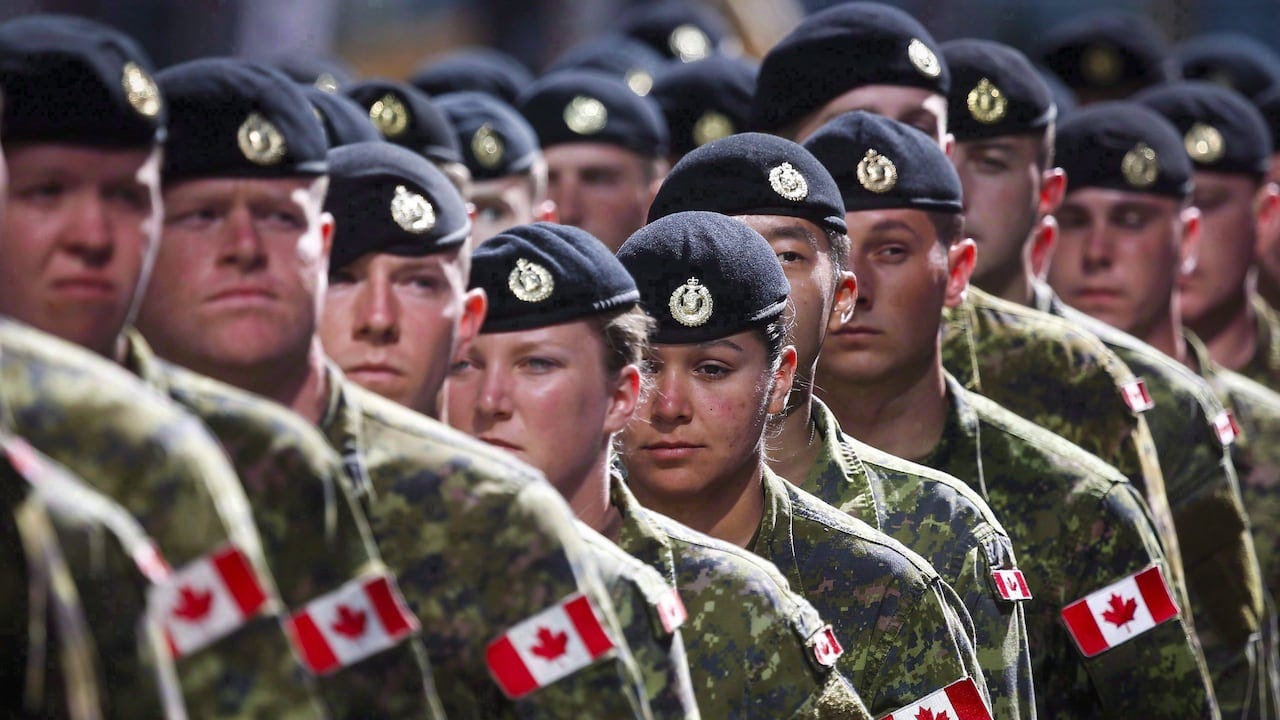
What makes this particularly concerning is how unprepared Canada is for this reality. For decades, Canadian security policy has rested on a simple proposition: invest minimally in defense because geography and the American alliance provide safety. Canada maintained defense spending around 1.3% of GDP — currently about $40 billion annually — well below NATO’s 2% target and laughably distant from the Trump administration’s new 5% “Hague Commitment” it expects from allies.
But this bargain assumed American willingness to underwrite Canadian security regardless of Canadian effort. That assumption is dying. The Trump NSS explicitly emphasizes “burden-sharing and burden-shifting” as core priorities, stating that “the days of the United States propping up the entire world order like Atlas are over.”
The window for adaptation is narrow. China is investing heavily in Arctic capabilities and influence operations within Canada itself. Russia is militarizing its northern territories. Meanwhile, Canada lacks an adequate number of icebreakers, Arctic patrol vessels, or comprehensive northern surveillance, which creates vulnerabilities that Washington increasingly views as American security problems.
This is the core issue. As long as Canada’s choices are seen as American vulnerabilities, Canada will be pressured by any U.S. administration. The solution isn’t fantasies about diversifying away from the United States. With roughly 75% of Canadian exports flowing south, hundreds of thousands of cross-border interactions daily, and deeply integrated supply chains, institutions, and defense arrangements, significant economic diversification is unrealistic at best and self-destructive at worst.
The Canada-U.S. relationship isn’t a problem to solve; it’s a reality to manage wisely. The question is whether Canada will make itself indispensable to American security and prosperity, or remain a potential liability.
Making Canada indispensable requires addressing the two areas where Canadian weakness most threatens American interests, the Arctic and Chinese influence operations.
First, the Arctic. Canada’s inability to patrol, monitor, and defend its northern territories doesn’t just compromise Canadian sovereignty: it creates a gap in continental defense that China and Russia are eager to exploit. When Chinese research vessels probe Canadian Arctic waters without adequate Canadian response, Washington sees a threat to North American security. When Russian activity near Canadian waters goes unmonitored, NORAD’s northern flank looks exposed.
Canada must achieve comprehensive Arctic domain awareness and patrol capability within the next five years. This means icebreakers, Arctic patrol vessels, northern infrastructure, satellite surveillance, and underwater monitoring systems. Defense spending must increase to at least 2.5% of GDP, an additional $25-30 billion annually. This is substantial but manageable for the world’s ninth-largest economy, particularly when compared to the cost of American pressure or loss of sovereignty.
Second, Chinese influence operations. Beijing’s systematic efforts to penetrate Canadian institutions, political systems, and critical infrastructure make Canada a vulnerability in the US-China competition. The Trump NSS explicitly warns against allowing adversaries to “own or control strategically vital assets” in the hemisphere. Every Chinese acquisition of Canadian critical mineral deposits, every influence operation targeting Canadian politicians, every espionage success against Canadian research institutions becomes an American security concern.
Canada needs laser-like focus on Chinese influence operations. This means comprehensive foreign influence transparency legislation, robust counterintelligence capabilities, stringent investment screening for critical sectors, and protection of research institutions. When Canada fails to address these threats, Washington sees a back door into North American security.
The Trump NSS states plainly, “It is natural and just that all nations put their interests first and guard their sovereignty.” Canada must take this principle seriously, including when applied to our own country.
The paradox is that Canada’s best path to maintaining sovereignty within the North American partnership is making that partnership more valuable to Washington. By securing the Arctic and eliminating Chinese influence vulnerabilities, Canada transforms from a potential American liability into an indispensable strategic asset.
This isn’t subordination, it’s strategic realism. Canada and the United States share fundamental security interests. But a partnership requires both sides to pull their weight. Geography granted Canada a security discount that’s now expired. The question is whether we’ll invest in the capabilities needed to remain indispensable partners or discover too late that weakness was the most expensive option of all.
— Dr. Stephen Nagy is Professor of Politics and International Studies at the International Christian University, Tokyo, and a fellow of the Canadian Global Affairs Institute (CGAI). This essay also appeared at National Security Journal.


Sharp analysis on the hard pivot Trump's NSS forces for Ottawa. The Arctic domain awareness gap is the killer issue, especially when you look at how Chinese and Russian activity has ramped up. Spending 1.3% of GDP while essentially relying on American guarantees worked as long as Washington was willing to subsidize that arrangement. The strategic shift here is that Canada becomes a vulnerability in US-China competition if it cant patrol its own Arctic waters or screen out Beijing influence operations. I've seen similar dynamics play out in other alliance structures where one partner's weakness becomes everyones problem and eventully forces a recalibration.
Excellent analysis 👏!