


by Rod D. Martin
March 25, 2026
Britain is an island.
An island trading power does not get to treat sea power as optional. It does not get to assume that trade routes, undersea cables, overseas territories, distant bases, and maritime deterrence will somehow take care of themselves. And it certainly does not get to discover, in the middle of an actual crisis, that it has preserved more brass than ships.
Yet that is where Britannia is today. She no longer rules the waves, not even in junior partnership with the United States. She can barely put to sea.
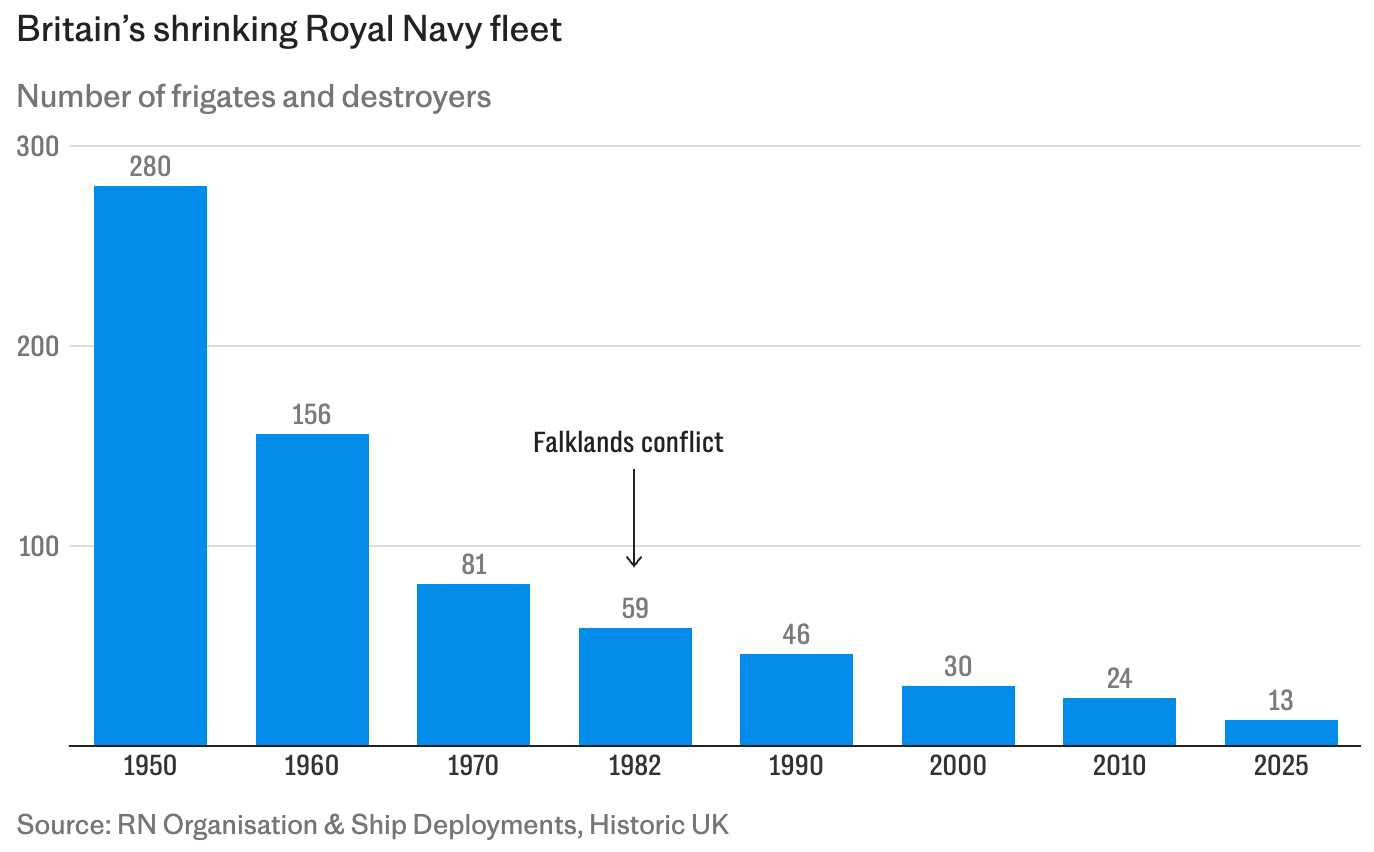
The Royal Navy’s escort fleet is down to just 13 destroyers and frigates, only a handful of which are actually usable at any given time. Britain began the year with only seven frigates in service, one already in deep maintenance, with only around four effectively available.
For shameful perspective, the last official parliamentary count showed 41 admirals across Navy Command, the Ministry of Defence, other government service, and NATO. The Navy’s headquarters culture is robust, the brass is plentiful, and the fighting fleet is vanishing.
That’s not a statistic. It’s an indictment.
Nor is it merely Britain’s problem. Britain is not some modest continental state freeriding quietly under somebody else’s umbrella. It sits astride the North Atlantic approaches. It anchors the GIUK Gap. It is a nuclear power, a veto-wielding permanent member of the UN Security Council, and a nation with sovereign territories scattered across the globe. It is supposed to be, alongside the United States, the premier maritime power in NATO.
Instead, it has spent decades dismantling the material basis of that role while continuing to speak as if the role still existed.
That is the essence of the British failure, across seven prime ministers beginning with Gordon Brown (poor Liz Truss gets a pass): rhetoric without hulls. Pretension without readiness. “Global Britain” without the fleet required to make the phrase mean anything at all.

If Donald Trump and Scott Bessent are able to threaten the City’s hold on global maritime insurance, this is the biggest reason why.
From Global Sea Power to Managed Decline
The most damning comparison is not with the age of Nelson. It is with 1982.
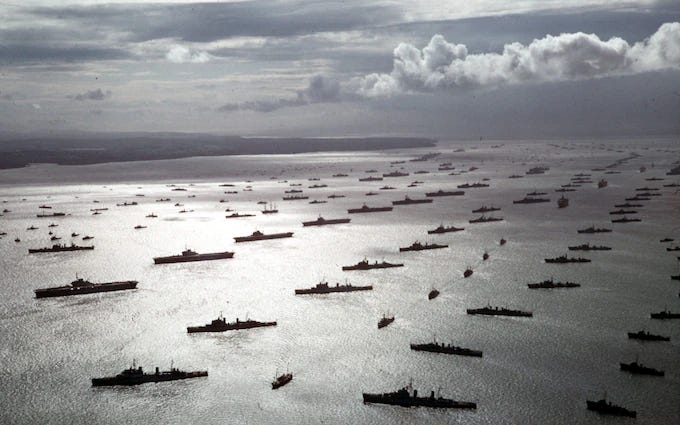
When Argentina seized the Falklands, Admiral Henry Leach was able to tell Margaret Thatcher that a task force could be assembled in 48 hours. Britain still possessed a real navy then, second or third-best on Earth depending on your point of view, with enough ships to engage, enough depth to sustain the fight, and enough margin to act decisively at a distance.
At the end of the Cold War, Britain still had 51 destroyers and frigates. When David Cameron took power in 2010, it had 24. Today it has 13.
That’s not modernization. That’s liquidation. And notice what did not disappear during that same period: the country’s commitments.
Britain still depends on maritime trade. It still imports more than half its oil from across the seas. It still has a nuclear deterrent to protect, North Atlantic obligations to meet, interests in the Mediterranean, the Gulf, and the South Atlantic, and bases and territories whose security cannot be delegated to press releases.
What vanished was not the UK’s need for sea power. What vanished was political seriousness about it.
That reality was exposed in humiliating fashion this month.
