


This essay is free, but with Premium Membership you get MORE. Join today.
by Rod D. Martin
December 25, 2025
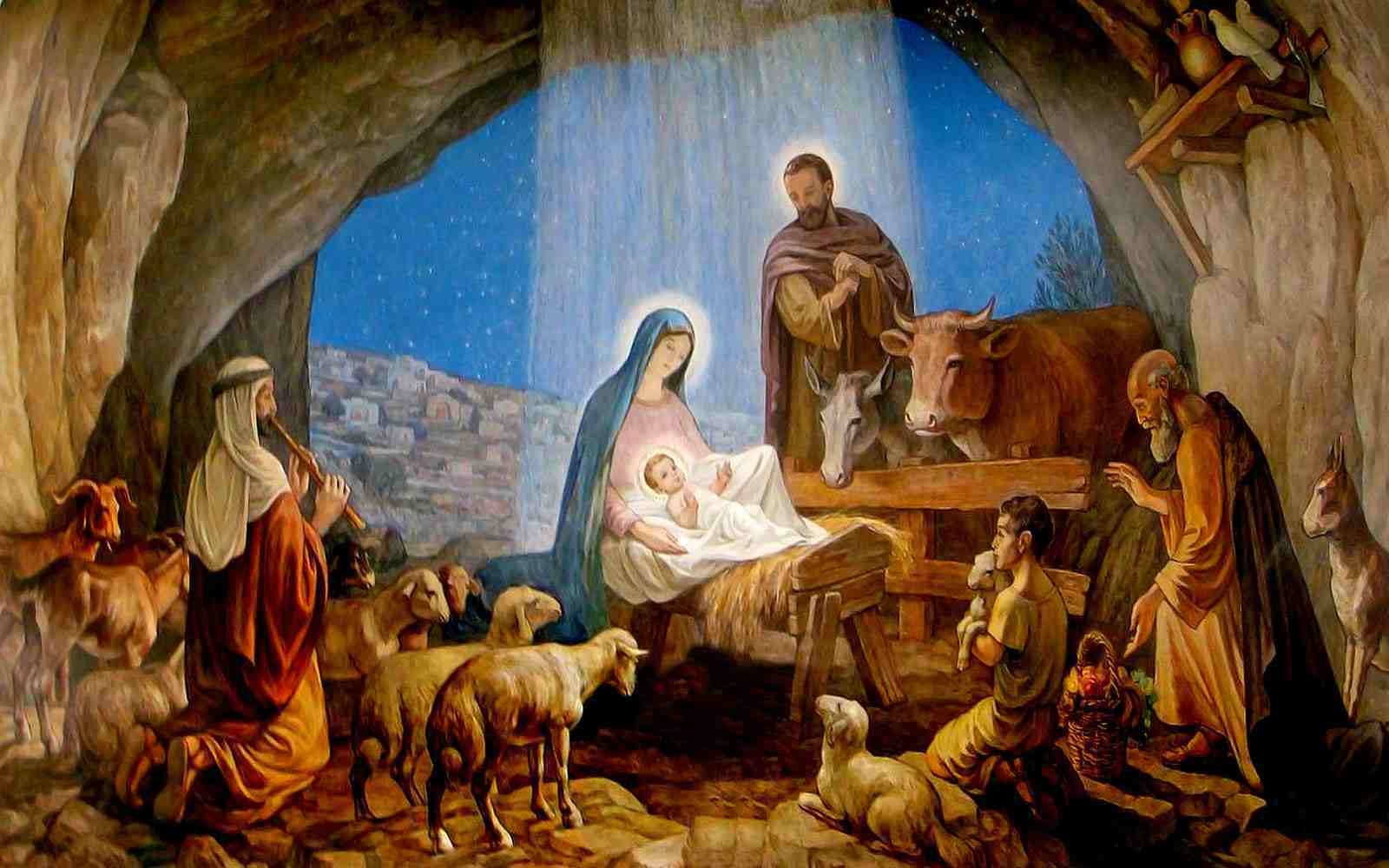
Every year on Christmas morning, billions of Christians celebrate the birth of a child in Bethlehem, Christ the Lord, the Savior of the world, the King of kings and the Lord of lords. Heaven itself announced His birth. The calendar itself is dated from it.
But Christmas is not the beginning of the story. It is the hinge of history — the moment the Bible’s deepest storyline steps out of shadow and becomes flesh.
Isaiah and Matthew tell us the child’s name (among many others) is Immanuel. It is not a seasonal flourish. It is the metanarrative of the entire Bible in a single word: God with us.
God’s immediate, immanent presence was the normal human state in Eden. The Fall shattered that — shame, hiding, exile. The rest of the Old Testament is not a detour from the “real” story, but the long, deliberate restoration of God’s presence: first with individuals, then with a family, then with a nation — and then, in the Tabernacle and the Temple, with God enthroned above the cherubim, truly among His people, yet behind blood and boundaries and a veil, because He is holy and we are not.
The Prophets warned that even this mercy can be withdrawn in the face of abject rebellion. And indeed it was: Ezekiel watched the glory depart, as God removed Himself from the Temple and from the Land. But the Lord forgave and returned even so.
And then, Christmas.
God comes personally. The child grows into history’s greatest teacher, fully God and fully man. Christ’s shed blood — far superior to that of bulls and lambs — once and for all pays the sin debt, the price of treason, each and all of us bear. The decisive miracle of history tears the veil of the Temple in two. Buildings and sacrifices are no longer needed. The Lord directly indwells each of us: we are each His new Temple.
Christians everywhere proclaim this: “If you confess with your mouth that Jesus is Lord, and believe in your heart that God raised Him from the dead, you shall be saved.” Not through ritual but redemption. Your bloodguilt expunged, God needs no more veils, no more intermediaries. Immanuel is come.
But as glorious as that is, the story doesn’t end there. Revelation completes what Genesis began — the Garden restored and made a City, with no temple at all, because God and His Son are its temple, walking among us as in Eden.
Christmas is not the beginning of the story. It is the hinge of history.
Eden: God’s Presence as the Normal Human State
Genesis begins with the most important fact in the universe: God is. He is transcendent. He speaks. Reality obeys. Light flashes into existence. Then order. Then life. And at the climax of creation, He makes man in His own image — not merely alive, but moral; not merely clever, but creative; not merely a creature, but a son — made for communion with his Maker.
And the single greatest blessing in Eden is not the fruit or the rivers or the gold.
It is God’s presence.
Before there is prayer, there is conversation. Before there is “religion,” there is fellowship. The Creator is not distant, and He is not silent. He is present — personally — with unfallen humanity. This is not a minor detail. Like eternal life, it is the normal human state. It is the design.
Which is why the Fall is described the way it is. Sin — treason and betrayal — enters, and the first consequence is not merely that rules are broken, but that relationship is ruptured. Shame appears instantly. And shame does what it always does: it drives us away from the very One we most need.
Genesis captures it with devastating economy: they hide. Not from lions, not from weather, not from enemies, but from God. (Gen. 3:8)
That is the fracture. Not merely moral, but relational: the loss of communion, the beginning of exile. Death and estrangement feel unnatural because they are.
And yet even here the story turns in a way no man would write. God comes looking. God speaks. God judges — because holiness requires it — but He also promises. The gate will close. The exile will be real. But the last word in Eden is not abandonment. It is the first hint of restoration: the seed of the woman, the crushing of the serpent, the beginning of a war God wins. (Gen. 3:15, 23–24)
So the Bible’s metanarrative appears almost immediately, in miniature: Treason requires death. Holiness requires judgment. But God does not wipe out all the traitors and start anew. Instead, He chooses to redeem what was lost and realize the vision He’d set out from the beginning.
All of this takes place in the first three chapters of the first book of a book of books. Everything that follows, from Genesis to Revelation, is the long, deliberate restoration of what was shattered there: how a holy God can dwell again with men who have made themselves unfit for His presence — and do so not by lowering His holiness, but by conquering sin.
From Exile to Dwelling: Presence Returns by Stages
Eden closes. Exile begins. And yet the story does not become the story of man searching for God.
It becomes the story of God returning to man.
He draws near first to individuals — not as scattered mystical episodes, but as the beginning of restoration. He speaks to fathers. He binds Himself by covenant. He meets men in fear and failure and makes promises they cannot possibly fulfill on their own. In other words, He reasserts the thing sin tried to destroy: relationship. Presence. “I will be your God, and you will be My people.”
This presence is personal. Pointed. Merciful. But it’s only the beginning of the restoration.
His next step comes at Sinai.
The Tabernacle — and later the Temple — is not God finally finding a place to live. It is God giving His people the staggering gift they cannot create for themselves: ordered nearness — a means for a holy God to dwell among sinners without consuming them in righteous wrath.
He does not need square footage. Solomon will say that plainly: the highest heaven cannot contain Him. (1 Kings 8:27) Paul will say it again: the Creator is not served by human hands as though He needed anything. (Acts 17:24–25) The point is not that God is “housed.” The point is that God is present.
Enthroned above the cherubim. In the midst of His people. Not merely issuing laws from on high, but dwelling among them in covenant reality. (Ex. 29:45–46)
But Scripture immediately presses the other half of that truth: God is holy.
That is why the Old Testament is full of boundaries — washings, sacrifices, priestly mediation, courts, curtains, the veil. This is not needless complexity. It is mercy in architectural and ritual form. In a fallen world, proximity to holiness is not neutral. It is dangerous. It kills that which is unclean.
So God provides a way for the unclean to live near the Holy without being destroyed by Him: blood, mediation, and distance — boundaries that are not barriers to God, but protections for man.
This is where the architecture becomes theology: concentric circles of holiness.
The Holy of Holies is the center — the locus of God’s enthroned presence. Around it are the inner and outer courts of the Temple. Beyond those are the city and the Land, a land set apart unto God and distinct from the surrounding nations. In that sense, the Land becomes the Temple’s “outer outer court,” and the ceremonial law functions as a system of cleansing. The closer one comes to that innermost circle, the more holy — purified and set apart — one must be.
This is Immanuel, returning — but not yet restored.
God with His people, truly — and yet still behind blood and boundaries and a veil.
The veil is no mere decoration. It is a declaration: something still stands between God and man.
The Horror of Absence: God Leaves His House
In a covenant mediated through ritual holiness, sacrilege carries enormous weight. If the Tabernacle and Temple teach the mercy of presence, Ezekiel teaches the terror of its withdrawal.
God destroys His chosen nation in 586 B.C. He did not do so capriciously. He had given Israel a covenant. He spelled out the blessings for faithfulness and the curses on rebellion in advance — in public, in writing, as law. Deuteronomy 28 is not poetry. It is a treaty. It is the warning label on the relationship.
And then He was patient anyway. Generations of patience. Prophets sent, warnings repeated, mercies piled upon mercies. With their ever-increasing provocations He was longsuffering.
They were insufferable. They filled the land with violence. They filled the Temple with abominations — with idolatry so brazen that even His priesthood turned the house of God — the place of His presence — into a pagan shrine. They mocked the Giver Who had provided them with everything. So God brought judgment on the house of Israel, raising up the Babylonian king — whom He explicitly calls His “servant” — to destroy the Land He had given them.
But He did not merely take their possessions. He also removed His presence. In Ezekiel 10-11, you watch it happen. The glory departs. The presence withdraws. The Temple remains, but it becomes an empty shell: form without fire, ritual without Reality, ready for destruction.
God enforces His covenant. This is judgment at its most severe: You have insisted on living as if I were not among you. Very well. You will learn what that means.
Exile is not merely geopolitical. It is estrangement.
And yet even here, God does not merely punish. He promises. Ezekiel’s later temple vision in chapters 43-48 is not an architectural blueprint for a physical structure. It is a picture of the coming salvation — deliberately “too big” to be confined to stone. God returns by the same East Gate from which He departed — just as man was exiled from the East Gate of Eden. The vision’s logic is unmistakable: He will come, and He will not leave again.
Living water flows out and heals the land. And the city’s name becomes the banner over the whole story: “The LORD is there.” (Ezek. 48:35)
Which raises the question the whole Old Testament is driving toward: How can a holy God dwell permanently with sinners? And can there be a more permanent solution?
Christmas is where the answer stops being theoretical.
Christmas: Immanuel Without Walls
Christmas is not God sending a better messenger. It is God returning personally. John tells us the Word “became flesh and dwelt among us” — tabernacled among us. (John 1:14) That is not seasonal poetry. It is continuity.
Jesus forces the Temple question to its conclusion almost immediately. He honors the Temple as His Father’s house — and then He claims to be that to Whom the house was pointing all along. When He speaks of the Temple’s destruction and rebuilding, John tells us plainly what the hearers missed: “He was speaking about the temple of His body.” (John 2:19–21)
Everything the Tabernacle and Temple embodied — God’s presence among His people — is now embodied in His flesh, openly, walking among them. Not behind a veil, not confined to one city, not mediated by a priesthood: God with us. “Immanuel” is not an ornament on the Christmas tree. It is the storyline arriving on schedule. (Isa. 7:14; Matt. 1:23)
But Christmas is also honest about what happens when God gets close. God’s presence does not merely comfort; it exposes. Light does that. Holiness does that. The same nearness that heals the humble infuriates the proud. (John 3:19–21) So the question becomes unavoidable: will man receive God — or will man attempt to push Him back behind the veil?
The Gospels are very clear about how fallen man responds to unmediated holiness. Some worship. Some flee. Some plot. And the plot runs, straight and hard, to Calvary. Christmas cannot be separated from the Cross because the Incarnation is God entering enemy territory to reclaim what was already His by right — and to make His presence permanent at a price only He could pay.
The Cross is the act that changes the entire architecture of access. It is the once-for-all payment that the blood of bulls and lambs could never be, satisfying justice, bearing the curse that comes from violating the law, reconciling the sinner to God. And by faith, the believer is declared righteous — not because he is already perfected, but because Christ’s righteousness is accounted to him, like a judge stepping down from the bench to pay a criminal’s fine.
That declaration of righteousness makes possible what the Tabernacle and Temple could only foreshadow. God can dwell directly in and with His people.
This is the revolution of the New Covenant. The “holy place” is no longer a room in a building. The believer becomes the temple. The need for ceremonial distance ceases because the deeper problem it managed has been addressed at its root. Christ alone is our high priest, interceding from the right hand of the Father — and we speak directly to God because God Himself dwells within us.
Christmas, Easter, and Pentecost are therefore not separate “church events” floating free from the Old Testament. They are the metanarrative accelerating. Immanuel moves from Eden, to patriarchs, to a building, to a Man — and then, by the Spirit, to a people drawn from every nation. God with us becomes God in us — the foretaste of what the world to come will make complete.
This is why Stephen can say, without contradiction, that the Most High does not dwell in houses made with hands. He is not condemning the Temple. He is proclaiming the Temple’s fulfillment. The shadow has given way to substance.
Immanuel has outgrown walls.
But even that is not the final act.
The Consummation: The Garden Made a City
The Bible does not end with escape. It ends with victory: resurrection, renewal, the destruction of death, the repeal of the curse, and the completion of everything God began in Eden. Sin did not end His original project of making the whole world like the Garden: it only added an additional dimension.
At the end of Revelation, the theme that has driven the whole story — presence lost, presence regulated, presence withdrawn, presence made permanent — is finally made physical again: “The dwelling place of God is with man.” (Rev. 21:3)
That sentence is the end of the war.
In the New Jerusalem we are told there is no temple. Not because worship disappears, but because the temple’s purpose is fulfilled. A temple is necessary when God is near but not yet fully; when sin requires mediation; when boundaries still exist because holiness and uncleanness cannot share the same space without judgment. But in the consummation, there is no such management of access, because the problem that required it has been finally and forever abolished.
“I saw no temple in the city,” John says, “for its temple is the Lord God the Almighty and the Lamb.” (Rev. 21:22)
The whole city is the Holy of Holies. Presence is no longer concentrated and protected. It is total. Complete. Every knee bows, every tongue confesses. The thing Eden lost is not merely restored: it is secured. Permanent. Irrevocable.
That is why the imagery intensifies. Eden had a river; Revelation has the river of the water of life flowing from the throne of God and of the Lamb. Eden had the tree of life guarded by the sword; Revelation has the tree of life given freely, bearing fruit, healing the nations. The curse that drove man into hiding is gone; the face man could not bear to see is now the face he will forever behold. (Rev. 22:1–5)
This is Eden restored — and surpassed. Eden was a garden with two people and a test. The New Jerusalem is the garden made a city: a redeemed multitude, a finished victory, a permanence that cannot be shattered again. It is what the story was working toward in every covenant, every sacrifice, every boundary, every prophecy, every promise, and every page.
And it is Immanuel, at last, forever.
Christmas Morning, Seen Whole
So on Christmas Day we do not merely celebrate a birth. We celebrate the hinge of history — the day the Bible’s governing storyline becomes visible, personal, and irreversible. “Immanuel” is not a seasonal word. It is the entire arc of Scripture in one Word, one Name above all names.
The Fall did not derail God’s purpose. It revealed the cost of accomplishing it.
From the beginning, God intended to dwell with His people. Eden was not a failed experiment; it was the prototype. Sin did not force God to improvise, retreat, or scale back His design. It triggered the long, deliberate execution of it — through covenant, sacrifice, judgment, incarnation, redemption, and glory.
History is not wandering. It is not waiting to see what humans will do. It is moving, relentlessly, toward a conclusion God declared before the world began: a redeemed people, a restored creation, and God dwelling with man forever. And like Adam before us, we are privileged to participate in the outworking and fulfillment of our Father’s ongoing Creation.
Christmas is the moment that purpose steps into time.
The child in Bethlehem is God advancing His plan. The Incarnation is the proof that nothing was lost, nothing was abandoned, and nothing will ultimately be left unfinished. It is no longer what was before, but not all that will be.
The Bible ends not in escape, but in fulfillment; not in distance, but in presence; not in uncertainty, but in victory.
Immanuel is not a sentiment. It is a promise kept — and still being completed.
God with us.
Forever.


Outstanding Rod Martin. I have not read your work before that I am aware. I came across your 10 Books list today, Christmas 2025. As a believer and follower of Jesus Christ and a student of the Bible, I am familiar with the over-arching story of the Bible and praise God daily for His sacrifice and His perfect plan.
This article explaining "Emmanuel" is fantastic, a brilliant telling of the story of man and God's merciful plan of redemption. Thank you. I am a new fan of you. An old fan of Jesus... God bless you for sharing your voice.
Brilliant! Merry Christmas!