



This analysis is free, but with Premium Membership you get MORE. Join today.
NOTE: Tomorrow is yet another Israeli general election. Benjamin Netanyahu deserves Donald Trump’s endorsement, our friendship, and his own re-election. This essay, which I wrote one year ago, demonstrates a rather important part of why. It’s a story few Americans know, and every Israeli socialist hates. — RDM
by Rod D. Martin
October 7, 2025
Lost in the current debate over Israel and Hamas is the utter transformation of the former over the last two decades.
For years, Israel was a Socialist backwater. A welfare case, filled with smart, hard-working people whose economic system rendered them dependent on the charity of others.
But that was before Benjamin Netanyahu.
The MIT-educated Netanyahu, a longtime friend of Donald Trump’s father Fred, believed strongly in the power of freedom and free markets to transform Israel’s future. He dreamed of the day when Israel might be the Hong Kong, Singapore, or Silicon Valley of the Middle East.
Beginning in the 2000s, he began to make it exactly that.
The Israel Test
My friend George Gilder — tech guru, father of Supply-Side Economics, and Ronald Reagan’s most-quoted living author — described this transformation in The Israel Test. In it, he posed a moral question that doubles as a growth model: When you encounter excellence — the engineer who invents, the founder who amasses a fortune by creating value — do you admire him or resent him?

Societies like the United States, Taiwan, and Israel that choose admiration unleash compounding prosperity. Societies like Gaza, or Venezuela, or Cuba, that choose envy punish their builders and slowly die.
Whatever its other virtues, mid-century Israel answered that question wrongly. It was born under siege and then cemented into a command-and-control economy by leaders who equated collectivism with survival. Ration books, price controls, and the Histadrut labor federation’s omnipresent grip held back a people famed for genius. By the late 1970s, inflation was raging, talent was emigrating, and the promise of Zion looked like it might be squandered by the leftwing ideology that had midwifed the state.
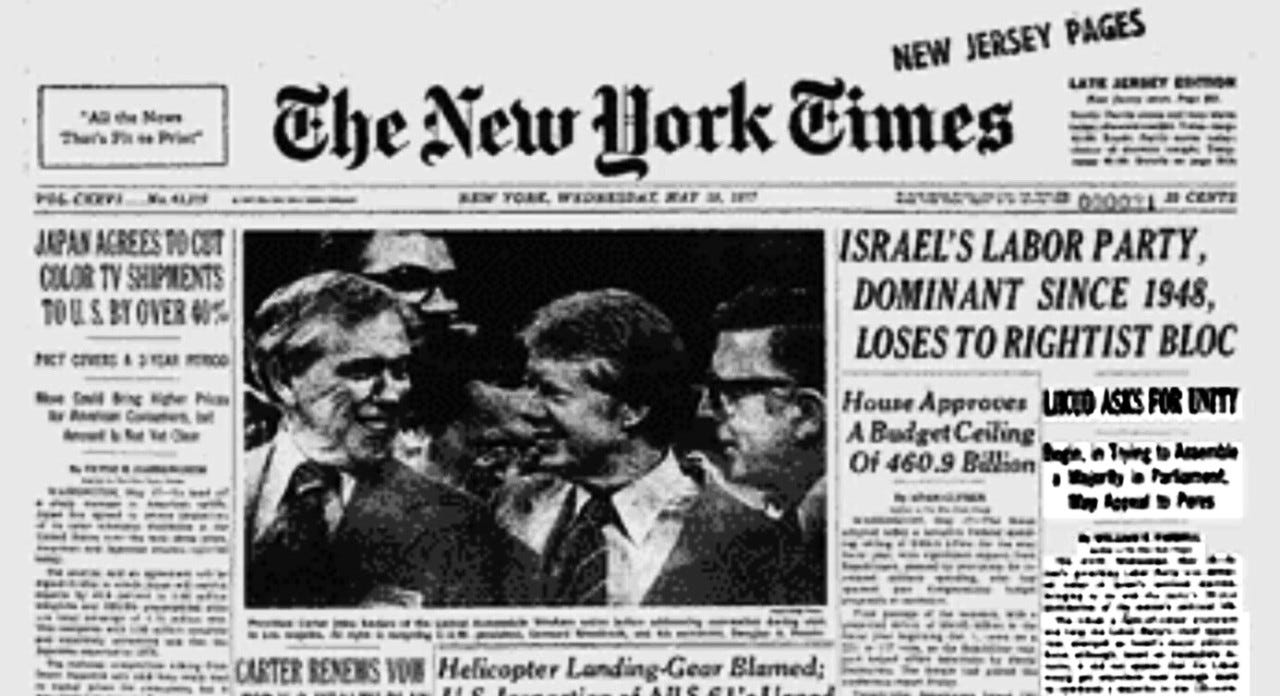
Then the answer changed. Likud’s political earthquake in 1977 broke the Labor Party’s longstanding monopoly on power. Emergency stabilization in 1985 proved reform was possible. And beginning in 2003, Benjamin Netanyahu set out to complete the transformation: to replace envy with admiration — cheerleading the success of others — in law, policy, and culture.
What followed — the rise of what has been called “the Start-Up Nation” because despite having only 9.5 million people it produces more start-ups than Japan, China, India, Korea, Canada, or the UK — is not a mystery. Rather, it is the predictable fruit of freeing human capital.
From Labor to Likud
The founding generation had reasons for what they built. In many cases they were refugees, they were pioneers in a desert, and they were completely surrounded by enemies. The kibbutz was both a farm and a fortress; central planning looked like discipline and unity. The Histadrut grew into a state within the state, running factories, clinics, ports, banks, and schools. The government owned the “commanding heights,” as Lenin put it, fixing prices and rationing goods, but subsisting on a sea of foreign aid. It was egalitarian on paper and suffocating in practice.
By the mid-1970s the bill came due. Inflation spiraled into triple digits. Government and Histadrut conglomerates hoarded credit and stifled competitors. A young coder or physicist found fewer paths forward than in Boston or Silicon Valley, where many in fact went, including (for a time) IDF special forces hero Benjamin Netanyahu.
In 1977 the public said enough. Menachem Begin’s Likud, speaking for the “second Israel” — Mizrahim, religious Zionists, working-class voters long talked down to by the Socialist elite — broke Mapai’s lock on power. Begin was not yet a Thatcherite, but his victory shattered the presumption that Labor’s model was the only option.
Crisis forced a second shift. In 1985, with inflation nearing 400%, a national-unity government froze wages, cut subsidies, pegged the shekel, and reined in spending. Likud’s Stabilization Plan worked. Price stability returned.
But stabilization is not liberalization. Israel had cooled the fever without curing the disease. The state still owned too much. The banks still owned the pensions. The incentive structure still punished work and capital formation. Israel needed an architect who would rebuild the system from the foundations up, not just patch the roof.
How Netanyahu Achieved His Vision
Before he ever touched the Finance Ministry, Netanyahu had a plan. He had lived the American experience — MIT, consulting, Wall Street — and he had seen what free capital and open competition could do. He talked openly about turning Israel into a “mini-America”: a place where enterprise was celebrated, where capital markets funneled savings into risk, and where the state served citizens rather than smothering them. His speeches from the late 1990s read like a blueprint: cut marginal tax rates, privatize state assets, break monopolies, open the capital account, and treat entrepreneurs as national assets rather than necessary evils.

He took office as Finance Minister in 2003 in the teeth of the Second Intifada’s economic wreckage: collapsing tourism, fleeing investment, skyrocketing unemployment, deficits blown out. Lesser politicians reached for subsidies and slogans. Netanyahu reached for a wrench.
First, taxes. Marginal income brackets were flattened and lowered; the corporate rate fell; capital gains were rationalized. The point was not to favor the rich but to favor growth — to make the next factory, the next VC fund, the next hiring decision easier, not harder.
Second, welfare to work. The system of child allowances and transfer payments had been intended with compassion, and as in other countries, ended as a trap. For many households, rational calculation meant staying home paid better than working. Netanyahu cut allowances, tightened eligibility, and paired the change with job programs. As with Reagan in the early 1980s, the politics were brutal, but the economics worked. Employment rose, particularly among communities with historically low labor force participation.
Third, the Bachar capital-market reform. For decades, the big banks both collected household savings and lent those savings to themselves, locking retirement money into captive bank bonds. Competition was anemic. The stock market starved. Young companies went begging.
Netanyahu and his deputy, Haim Ramon, forced the banks to spin off their mutual and provident funds, birthing a modern asset-management industry. Suddenly, billions of shekels looked for returns in equities, corporate debt, and venture investments that financed a booming cohort of founders.

Fourth, privatization. El Al and Bezeq — symbols of statist pride and Socialist dysfunction — were sold. Service improved. Innovation resumed. And just as importantly, a signal went out to would-be founders: you will not have to compete with your own government.
Fifth, deregulation in the trenches: fewer permits, faster approvals, simpler import rules. Entrepreneurs began to experience the state not as a brick wall but as a set of rules they could understand and navigate.
The reaction was ferocious. The Histadrut called strikes. Editorial pages predicted social collapse. Demonstrators denounced “Bibi the butcher.” Even allies wondered whether the coalition could survive the pain. Netanyahu’s reply was clinical and consistent: “The medicine is harsh because the disease is fatal.” He promised not utopia, but a future in which work, savings, and risk would be honored and rewarded.
The results came quickly. Growth returned. Unemployment fell. Israel’s credit outlook brightened. But the deeper change was cultural. When the banks lost their grip on pensions, ordinary people became investors. When privatization ended the ministry’s role as national CEO, ministers stopped pretending they knew how to run airlines. When welfare tilted toward work, families recalculated their futures. The country’s posture shifted from defensive crouch to forward lean.
The Start-Up Nation
Netanyahu’s long prime-ministerial tenure entrenched his earlier reforms. It also translated abstract policy into felt experience. Ask an Israeli in 2011 what Capitalism looked like and he might not quote Milton Friedman — he would likely show you his phone bill. When Likud opened mobile telecom to real entry, prices collapsed and service improved. That was competition you could feel in your pocket every month.
The tech ecosystem thickened. First-time founders could hire seasoned executives who had already scaled a company or two. Military units that incubated elite technical skills spun out alumni who formed world-class cyber and data-science teams. Venture funds found abundant limited partners at home as well as abroad, because the Bachar reforms had created actual fund-management industries with mandates to seek returns. An Israeli founder no longer had to move to California to raise a Series A. He could do it in Herzliya or Tel Aviv.
Macro indicators mirrored the street-level story: inflation tame, unemployment at multi-decade lows, the shekel strong enough to annoy exporters, GDP per capita converging with and then passing G7 stalwarts.
But those numbers are only the shadows on the wall. The true substance was and is cultural. Builders came to be admired and imitated. Wealth was no longer seen as a sin but as a driver of opportunity. Envy was preached against not just from pulpits, but from paychecks.
And any who would live peacefully could share in the rising tide.
The Snags
The transformation is real, but there is still much to be done. A candid audit is part of any serious success story. Israel faces real growing pains, and real threats.
Aside from the war, housing is the loudest. Planning monopolies and glacial approvals throttled supply just as tech-sector wages rose, pushing prices out of reach for young families. Productivity outside tech and finance lag, in part because infrastructure has not kept pace with growth. Labor-force participation remains too low among some communities. Education and skills pipelines are uneven. And the venture cycle is unforgiving: easy money can cover structural sins for a while. Hard money can expose them in a quarter.
War shocks are real. They raise risk premia, drain budgets, and pause investment committees. Yet the striking fact of the last twenty years is resilience: the machine slows, it does not stall. After the initial shock of October 7th faded, funding resumed; when exports wobbled, the domestic market picked up the slack.
That is not luck. It is what happens when an economy is wired for adaptation, and when individuals have the freedom to get ahead and invest in their own futures.
Energy: Tamar, Leviathan, and the End of Isolation
Nothing dramatizes the link between markets and security like natural gas. For half a century, Israel’s enemies tried to starve it by boycott. The Tamar discovery in 2009 and Leviathan a few years later inverted that relationship. Israel would no longer be starved. It would supply.
The economic effects are straightforward: cheaper electricity, new industrial inputs, royalties that seed a sovereign wealth fund. The strategic effects are profound. Jordan and Egypt now buy Israeli gas because physics beats propaganda. Pipelines create constituencies for normal relations. European buyers, looking to diversify away from Russian coercion, treat East-Med molecules as not just energy but security.

Equally important is how that gas was developed: not by a bloated, nationalized oil company, but by private risk-takers under a contested but durable regulatory regime. The capital flowed because the rules were legible; the gas flowed because entrepreneurs believed contracts would be honored. Capitalism — not resource nationalism — turned geology into statecraft.
Energy has also begun to knit Israel’s periphery into its core. Ports, processing facilities, and skilled jobs sprout in places that were once afterthoughts in the central-coast success story. That diffusion matters. Spreading opportunity is better and more durable than prosperity piled into a single tech corridor.
The Duty to Admire, Not Envy
Here the moral and the practical merge. Israel’s security does not float above the economy: it stands on it. Iron Dome and Iron Beam batteries are made of atoms bought with tax receipts generated by growth. R&D for lasers, interceptors, and cyber defense comes from profits the state does not confiscate and talent it does not drive away. Joint development means America no longer subsidizes like a benefactor but invests as a partner and buys as a customer.

You can measure this, crudely, in budgets and exports. But there is a subtler ledger: the decision of a 23-year-old captain to stay in Israel, start a company with his unit buddies, and hire twenty compatriots — instead of taking a one-way flight to New York or California. The decision of a world-class chip designer to return from Nvidia or Apple because he believes he can do his life’s best work in Tel Aviv or Haifa.
Those choices are moral acts as much as economic ones. People vote with their feet for polities that celebrate achievement, eschew envy, and encourage opportunity.
This is why Gilder’s Israel Test is not just a slogan but a survival strategy. A country that cheers for winners makes it possible for everyone to win. A society that blesses wealth-creation multiplies its defenders and its inventions. A nation that punishes success eventually cannot afford its own shield. It becomes a basket case dependent on charity.
The Jewish state learned this the hard way. It chose a better path — and lived.
What Must Come Next
Picture an Israel that fixes its housing choke point with American-style “by-right” approvals where infrastructure exists, and fast-track corridors where it doesn’t. Young families buy near where they work. Commutes shrink. Wages buy more life.
Picture the periphery tied to the core by high-speed rail and reliable freight. A biotech lab in Beersheba partners with a foundry in Kiryat Gat and a seed-stage fund in Jerusalem — and none of them feel like they’re operating from the edge. Productivity rises not just because of code, but because trucks, data, and people move faster.
Picture education that is unafraid of excellence: rigorous math and science in every school, entrepreneurship tracks that start in tenth grade, and civics education that explains why markets are moral — because they reward service to others. Haredi and Arab students, without surrendering identity, plug into high-value work because pathways are clear and incentives aligned. School choice becomes the norm.
Picture capital markets deepened again: pension funds with larger domestic mandates for growth equity; a second wave of Israeli limited partners who want to own more of Israeli scaling companies, not sell them prematurely for lack of capital at home.
Picture the natural gas story maturing into a full energy strategy: expanded production, resilient contracts with neighbors, and a credible framework for the next wave of technologies, all built by Israeli firms that already live at the frontier of power electronics, photonics, and control software, and all tying former enemies together as suppliers, customers, and friends.
Perhaps most of all, picture Israel’s neighbors learning the lessons that Israel has pioneered. Damascus and Beirut could become wealthy and peaceful. Gaza could become an Arabic Tel Aviv or Riviera.

The only thing standing in the way is envy, the centerpiece of Socialism and the engine of all hate. It is not without reason that the Lord our God has told us, “Thou shalt not covet.”
A New Day of Freedom
Israel chose admiration over envy and was reborn. It turned ration books into cap tables, state monopolies into competitive markets, kibbutz romance into a different kind of heroism — the builder who hires hundreds and exports resilience to the free world.
Netanyahu’s reforms were the hinge. But the door that swung open was cultural: dignity over dependency; responsibility over grievance; the pride of serving others well enough that they gladly pay you for it.
The work is not finished. No free economy’s work ever is. The temptations are familiar: to sandbag the winners, to regulate the vitality out of new industries, to smother the next Tamar or Mobileye in committees, to retreat to the false comfort of the state. We must all resist them. Keep admiration not envy at the center of both policy and pedagogy, and Israel’s future will be larger than its already astonishing present.
There is a final reason to keep faith with the capitalist transformation. The world is darker than it ought to be. It needs positive examples. A small nation that was poor, besieged, and socialist became rich, resilient, and free by blessing excellence and clearing the way for it. That example is not merely good for Israelis. It is good for everyone who hopes for a civilization where genius is thanked, not shackled; where wealth comes from service, not plunder; and where security is purchased not by tribute to tyrants, but by the prosperity of a free people.
Israel has crossed over from its Socialist nightmare into its bright new day of freedom. Its neighbors can do likewise, if they can but summon the courage to try. Will they?
The secret is simple: Admire your builders. Bless your wealth-creators. Cheer one another’s success. Reward those who take the risks that lift everyone else. Never succumb to resentment or envy.
Make that your policy, not just your opinion. If it worked in tiny, impoverished Israel, surrounded by enemies, it can work absolutely anywhere.


Netanyahu and IDF Clash Over Iran
Also, Israel’s four cities.
Oct. 26 2026
(Snip)
Israel is essentially four very, very different, densely populated electoral districts stuffed into a tiny speck in the Middle East. Ultra-Orthodox, Arabs, Likud supporters and secular voters. Or, in short, four different cities.
Let’s start with the secular public, what’s known as the center-left: Tel Aviv. In the last election in 2022, voters from the “Change Bloc,” who would soon rally against the judicial overhaul, turned out at nearly the same rate as in the previous election, with a slight decline of about 1 percent. That means their turnout can and will increase, but it’s not yet clear whether it can rise significantly.
In general, across the five previous elections, the most stable factor in Israel is the secular vote. A percentage point here, a percentage point there. It certainly hasn’t declined, but it’s doubtful it will rise significantly. That said, of course, every vote counts.
Let’s head east to Jerusalem to meet the Likud voters. Last time around, their turnout rose about 5 percent over the previous election, which pushed Likud from 30 seats to 32. But Netanyahu didn’t win on his own voters alone. The electoral threshold did some of the work. Meretz on the left fell just below it, as did Balad and Jewish Home, and 420,000 votes, or almost 9 percent of those cast, were thrown away. Likud’s own votes were worth only about 28 seats. Thanks to the votes lost below the threshold, the bloc as a whole rose from 60 to 64.
Will Likud manage to keep that turnout high out of fear of the other camp’s rise, or will voters stay home out of apathy and disappointment? That’s the question keeping Bibi up at the moment.
Now let’s return to the center of the country and visit the ultra-Orthodox in Bnei Brak—the people who, as the joke goes, always turn out at 110 percent. Last time, in 2022, they brought even more voters to the polls, an impressive 8 percent increase over 2021. That surge caught every pollster off guard and delivered 18 seats, defying all the early predictions. This time may be different. There is apathy, there is anger at the current political establishment and a bevy of new small parties offering alternatives. Turnout will likely drop. The big question is by how much.
And now for the biggest unknown of all: the Arab public. Their turnout also rose last time, by about 7 percent, but that didn’t change their seat count, because Balad’s roughly 140,000 votes went straight into the bin. Do they have room left to grow? Absolutely. It could be worth up to 16 seats, and I’m careful not to say 17. If that happened, it would be an almost unprecedented case anywhere in the world: a relatively poor community turning out almost as heavily as the wealthiest ones.
Put it all together and, according to pollster Mano Geva, turnout in the last election was even between coalition and opposition voters. Now, according to the latest poll, the gap stands at 2 percent in the coalition’s favor, a less comfortable picture than before for the bloc led by former IDF Chief of Staff Gadi Eisenkot.
Four streets, four tribes and one intersection at the end of them all. Turn left for Eisenkot, right for Netanyahu, or, as most polls suggest, drive straight into a “No Entry” sign.
Great story. While I agree that ENVY plays a big part in the old system, I think that the same globalism that Donald Trump is battling is also very much opposed to Nentayhu’s Israel. The globalists fight sovereign, successful nations at every turn.